
Ask any builder what the single biggest quality-of-life upgrade on a classic is and most of us land on the same answer: cold air. A '68 fastback can have a rebuilt suspension, big brakes, and 500 horsepower under the hood, but if the cabin is 105 degrees on the drive to Cars and Coffee, nobody wants to sit in it twice. Factory air on most classics, when it existed at all, was an anemic add-on choking on a dashboard already tight for space. Adding real, modern classic car air conditioning is one of the first boxes I check on a build, and it is one of the easiest ways to turn a weekend show car into something you actually drive.
Car Features
7 min read
Adding Air Conditioning to a Classic
Modern A/C is the quality-of-life upgrade that gets a classic driven. Kits, retrofit vs factory, hiding it, and the electrical load that catches people out.
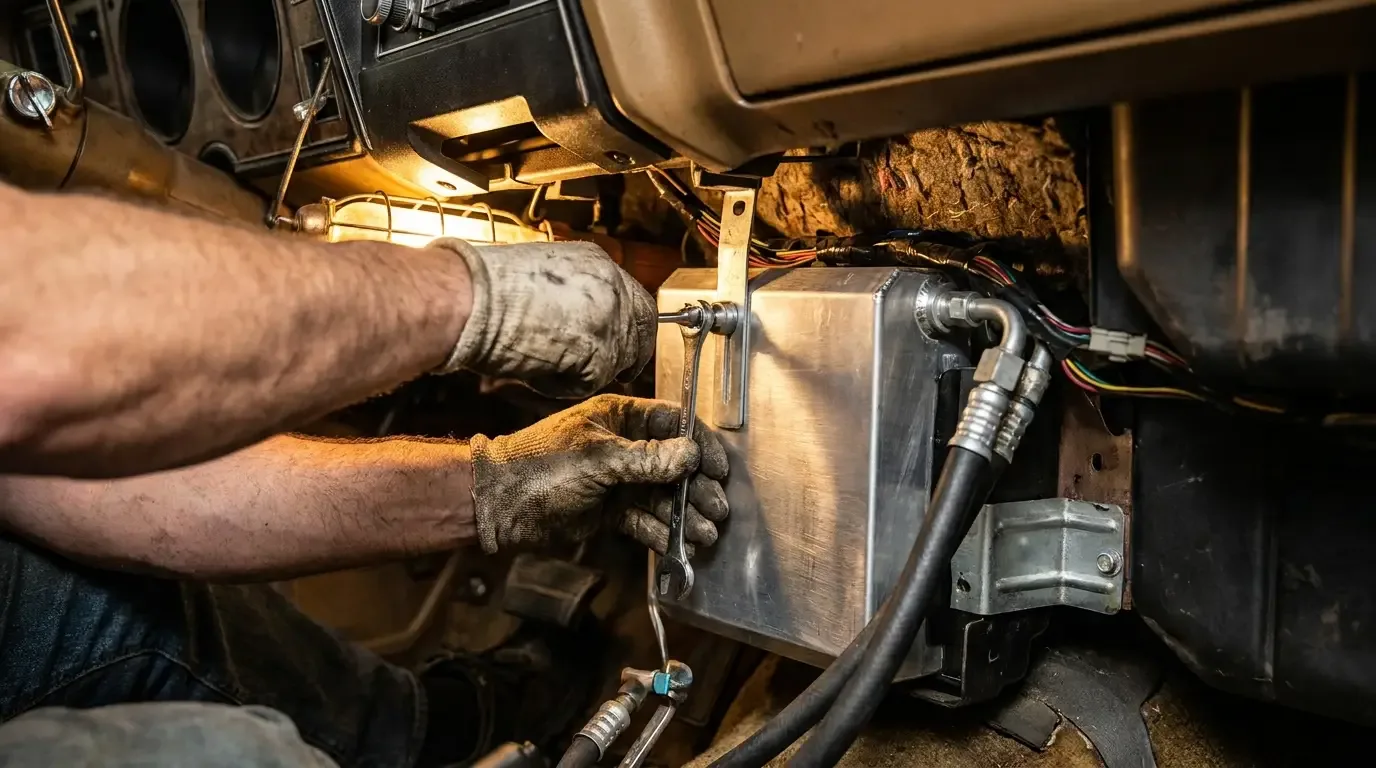
This is comfort work, not glamour work, which is exactly why it gets skipped. But a good system disappears into the car and only announces itself when you flip the fan on. Done right, it is a core part of the restomod interior and the difference between a car that lives under a cover and one that racks up miles.
Aftermarket kits versus keeping it factory
The first fork in the road is whether you restore the original factory air or throw it out and start over. On a numbers-matching restoration you keep the factory system, warts and all, because originality is the whole point. On a restomod, I almost always pull it. Original R-12 systems ran a different refrigerant, used undersized components, and leaked at every crimped fitting. The compressors were heavy cast-iron York and Tecumseh units that robbed power and shook the whole front of the engine.
A modern aftermarket kit solves all of that in one box. Companies like Vintage Air, along with Old Air Products and Classic Auto Air, build complete systems designed to drop into specific classic platforms. You get a compact rotary compressor, an aluminum parallel-flow condenser, a modern evaporator, and an electronic servo-controlled unit that fits behind the dash. These run R-134a (some newer kits are ready for R-1234yf) and put out air cold enough to fog your sunglasses. The whole thing weighs a fraction of the original hardware.
Choosing and sizing the system
Kits come in two broad flavors. A complete under-dash system uses a self-contained unit that hangs below the original dashboard, which is the simplest install and the choice when you want reversibility. The cleaner option is an in-dash system that replaces the factory heater box entirely and routes air through the original dash vents, so from the driver's seat the car looks bone stock. That second route is more work but it is the one I push customers toward on any serious build.
Match the system to the car and the climate. A big-block muscle car in Arizona needs more condenser and evaporator capacity than a small European coupe in a mild coastal climate. Buy the platform-specific kit if one exists for your car, because the brackets, hose routing, and evaporator dimensions are already worked out. A universal kit saves money up front and costs you a weekend of fabrication later.
| System type | Install effort | Dash appearance | Best for |
|---|---|---|---|
| Under-dash hang-on | Low | Visible box below dash | Reversible builds, budget jobs |
| In-dash (replaces heater box) | High | Stock vents, hidden | Clean restomod interiors |
| Restored factory R-12 | Medium | Original | Numbers-matching restorations |
Hiding the hardware and keeping the dash clean
The tell of a lazy A/C install is a bundle of hoses zip-tied across the firewall and a control panel screwed onto the bottom of the dash at an angle. Clean work hides everything. Route the hard lines along the frame rail and through existing firewall grommets, use the correct beadlock or O-ring fittings instead of parts-store barb clamps, and mount the drier where it is serviceable but out of sight.
Inside, this is where I spend the extra hours. The best kits offer a control panel that mimics the factory knobs, or you can integrate the controls into a modern climate display. Blend that thinking with the rest of the cabin electronics and it becomes part of the same conversation as Restomod Audio and Digital Gauges, where the goal is always the same: modern function behind a vintage face.
"I judge an A/C install by what you can't see. Pop the hood and if I spot rubber hose flopping around and hose clamps on the refrigerant lines, I already know how the rest of the car was built. The cold air is the easy part. Making it look like it was always there is the craft."
Jim Vasquez
Electrical load and the charging system
Here is the part people forget until the engine stalls at a stoplight. Air conditioning is an electrical and mechanical load, and a lot of classics were built with a generator or a 35 to 45 amp alternator that was barely keeping up with points ignition and headlights. Add an A/C compressor clutch, a high-draw condenser fan, and a blower motor on high, and a weak charging system falls on its face.
Before you charge the system, upgrade the alternator to a modern one-wire unit in the 90 to 130 amp range and run properly sized charging wire to match. Electric puller fans on the condenser and radiator draw serious current at idle, exactly when the engine is spinning slowest and the alternator is producing least. Wire the compressor and fans through relays, not through the original dash switches, so you are not pushing that current through 55-year-old copper.
What it costs and whether it is worth it
A quality platform-specific in-dash kit runs roughly 1,200 to 2,000 dollars for the hardware, and a universal under-dash system can be had for well under a thousand. Add professional install labor and evacuation and charging, and a turnkey job typically lands somewhere around 2,500 to 4,000 dollars depending on how much fabrication the car needs and whether you are also upgrading the charging system. Prices move, so treat those as rough 2026 ballparks rather than quotes.
Is it worth it? On a car meant to be driven, without question. A/C is one of the few upgrades that changes how often you actually use the car, and that usage is the entire premise behind the story of the restomod: a classic you can live with every day. Cold air will not win you a trophy at a concours, but it will get the car out of the garage and onto the road, which is where it belongs.
Sources and notes
- Aftermarket A/C system manufacturer catalogs and install manuals (Vintage Air, Old Air Products, Classic Auto Air).
- Period factory options literature and dealer accessory records for original air-conditioning take rates.
- Refrigerant transition references (R-12, R-134a, R-1234yf) from industry service data.
- Builder and restoration-shop interviews on install practice, charging-system loads, and hidden hardware routing.
Related Reading
Have a
Classic Car
for Sale?
Reach thousands of serious classic car collectors across the US.
Sell It Here →
Are You a Classic Car Dealer?
List your full inventory and connect with targeted classic car buyers.
Join as a Dealer →

About the author
Jim Vasquez
Southern California hot rod and custom car builder with roots in the traditional kustom kulture scene.



Comments
Be the first to comment on this article.