
I have handed people the keys to a big-block muscle car with a fresh paint job and watched their face fall about ten minutes into the drive. The thing looked perfect in the driveway. Then the cabin hit 110 degrees, the AM radio hissed, the seats had no support, and you could not hear the person next to you over the exhaust drone at 70 mph. A car can be beautiful and still be miserable to actually live with. That gap, between how a classic looks and how it drives, is the whole reason the comfort side of the restomod exists.
Car Features
10 min read
Restomod Comfort and Technology
The modern comforts that make a restomod livable: air conditioning, sound insulation, audio, digital gauges, and tech done so it still reads classic.
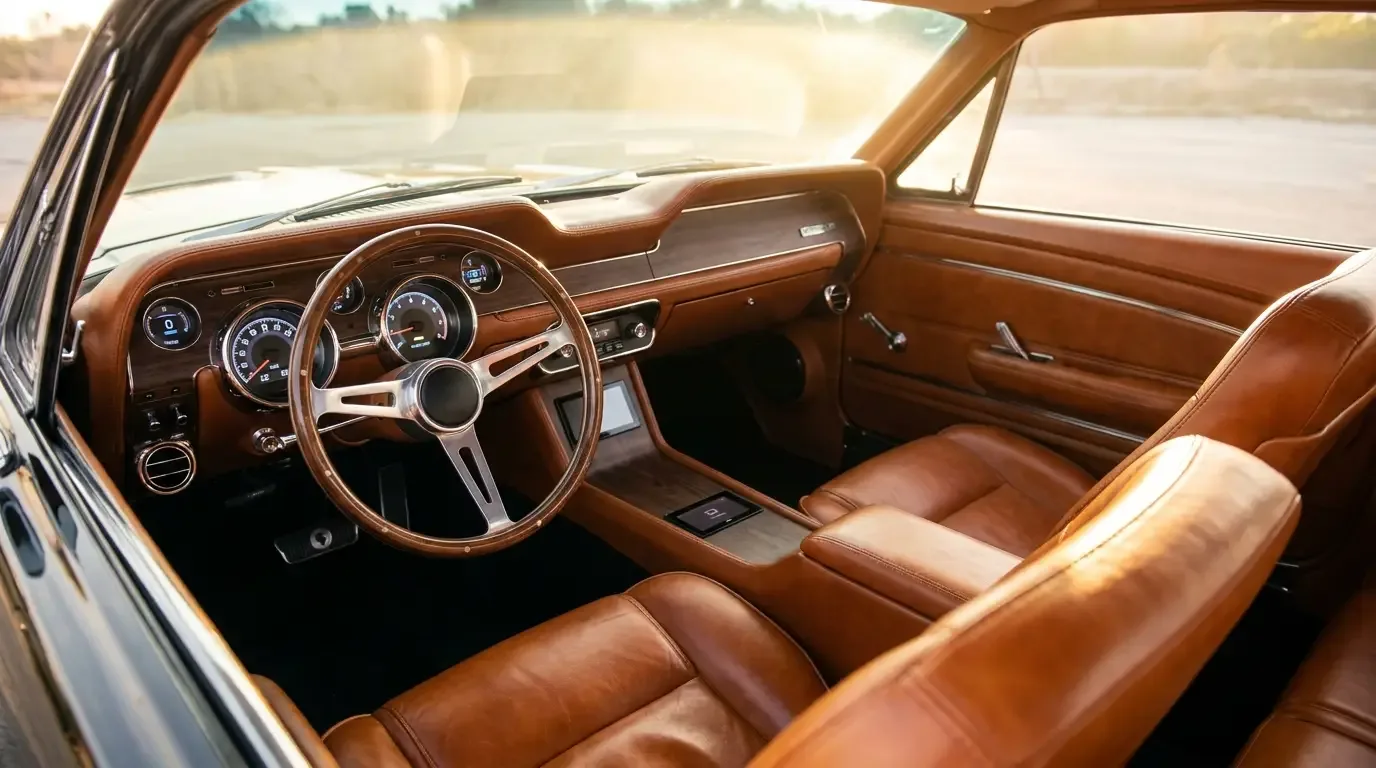
People fixate on the engine swap and the suspension, and those matter. But the parts that decide whether a restomod gets driven or gets parked are the quiet ones: the air conditioning, the sound deadening, the stereo you can hear, the gauges you can read at night, the seat that does not wreck your back on a three-hour cruise. Get those right and the car becomes a thing you reach for on a Saturday instead of a thing you admire and leave alone.
Why comfort is the point, not an afterthought
The restomod movement grew out of a simple frustration. Owners loved the shape of a 1967 Camaro or a 1955 Chevy, but hated everything about the ownership experience: the vapor lock in traffic, the drum brakes that faded, the vague steering, the sauna cabin. If you want the background on how restomods began, the short version is that people stopped accepting that a classic had to punish you to be authentic.
Here is the thing I tell every client. The mechanical upgrades get you a car that goes and stops like something modern. The comfort upgrades get you a car you want to spend time in. Those are different problems. A car with an LS3 and coilovers and Wilwood brakes is still a chore to drive across a state if the cabin is loud, hot, and the seat is a flat bench from 1969. Comfort is not the soft option. It is what converts a finished build into a car with miles on it.
Air conditioning that actually works
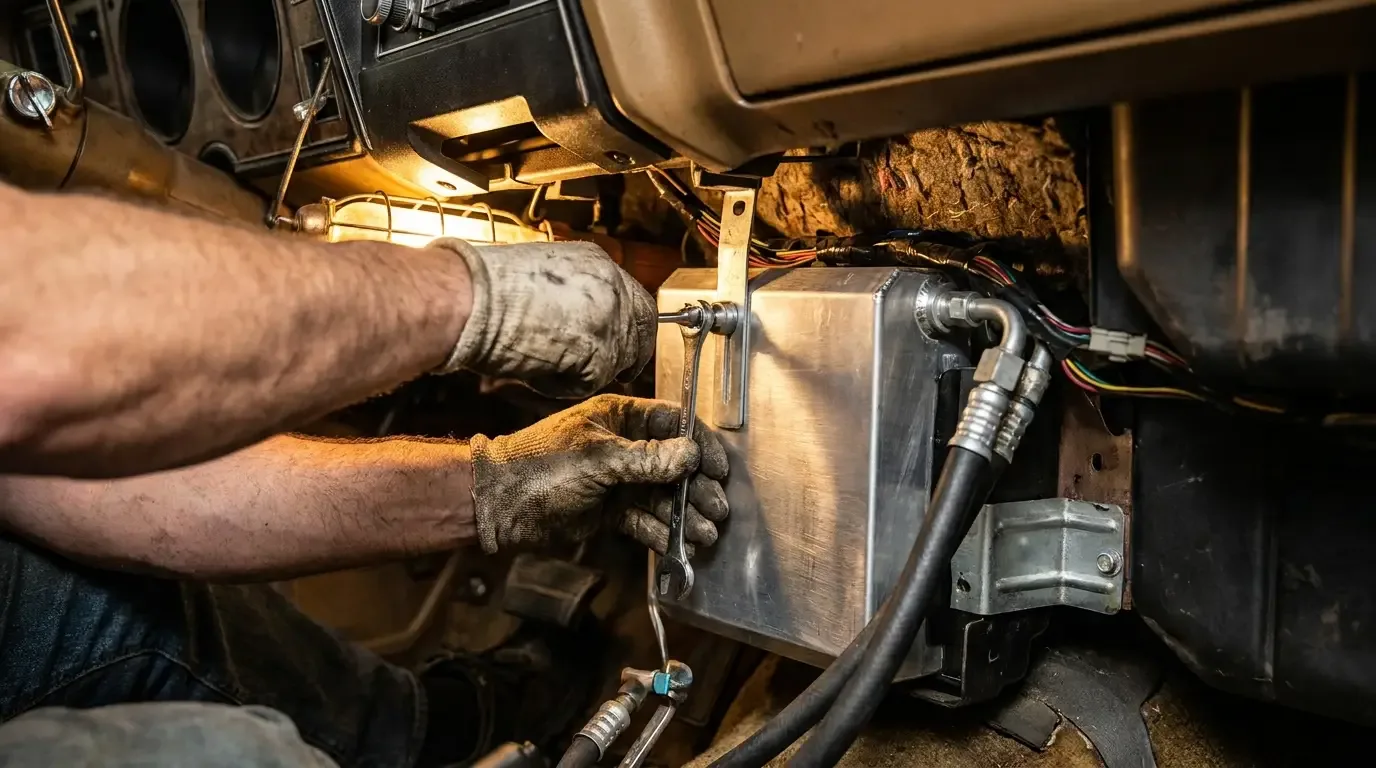
Air conditioning is the single upgrade that changes ownership the most, and it is the one people underestimate. Factory air in an old car, if it even had it, was weak and it leaked refrigerant. Modern aftermarket systems from companies like Vintage Air or Classic Auto Air use a rotary or scroll compressor, a proper condenser, and an evaporator unit that mounts under the dash. The good ones blend heat, cool, and defrost through one control panel and move real volumes of cold air.
The install is more involved than people expect. You are routing hard lines, mounting a condenser in front of the radiator without cooking the engine, and finding room for an evaporator box behind a dash that was never designed to hold one. In a tight interior you sometimes lose glovebox space. That is the trade. But a car that stays 68 degrees inside on a July afternoon is a car you will actually take out in July.
Killing the noise and the heat soak
Old cars are loud in a way that wears you down. Some of it is exhaust, some is wind, but a huge amount is bare metal transmitting road and heat straight into the cabin. The fix is layered. First a sound-deadening mat, the butyl-and-foil kind from Dynamat, Kilmat, or similar, bonded to the floor, firewall, doors, and trunk. Then a thermal and acoustic barrier layer on top, usually a closed-cell foam or a jute-backed material.
Two things happen when you do this properly. The cabin gets dramatically quieter, so the stereo works and you can hold a conversation. And the heat soak from the transmission tunnel and firewall drops, so the A/C does not fight a losing battle against a glowing floorpan. I treat sound deadening as a prerequisite for every other comfort upgrade. There is no point in a good stereo if you cannot hear it over the drone.
- Floor and transmission tunnel: the biggest source of heat and drivetrain noise.
- Firewall: blocks engine heat and induction noise from entering the cabin.
- Doors: kills the tinny slam and improves speaker bass response.
- Roof and trunk: cuts wind roar and rain drumming on long drives.
Audio you can actually hear
A factory single-speaker AM setup in a classic is a novelty, not a sound system. The modern approach hides the technology so the dash still reads period-correct. You can run a head unit with Bluetooth and a hidden phone connection behind a restored faceplate, or delete the visible radio entirely and control everything from your phone through a concealed amplifier. Kick panels, door pods, and a small subwoofer under a seat or in the trunk do the rest.
The tasteful move is restraint. I am not building a car that rattles its own trim at a stoplight. I want clean, full sound at cruising volume that disappears into the car. Component speakers in the kick panels, a modest four-channel amp, and good sound deadening beat a giant subwoofer every time in a car like this. The goal is a stereo that suits a Sunday drive, not a parking-lot competition.
"I judge a comfort build by one test. Would I drive this car three hours to a show and three hours back, in August, and enjoy both legs? If the answer is no, the interior is not finished, no matter how good the paint looks."
Jim Vasquez
Digital gauges, keyless, and the modern tech that hides
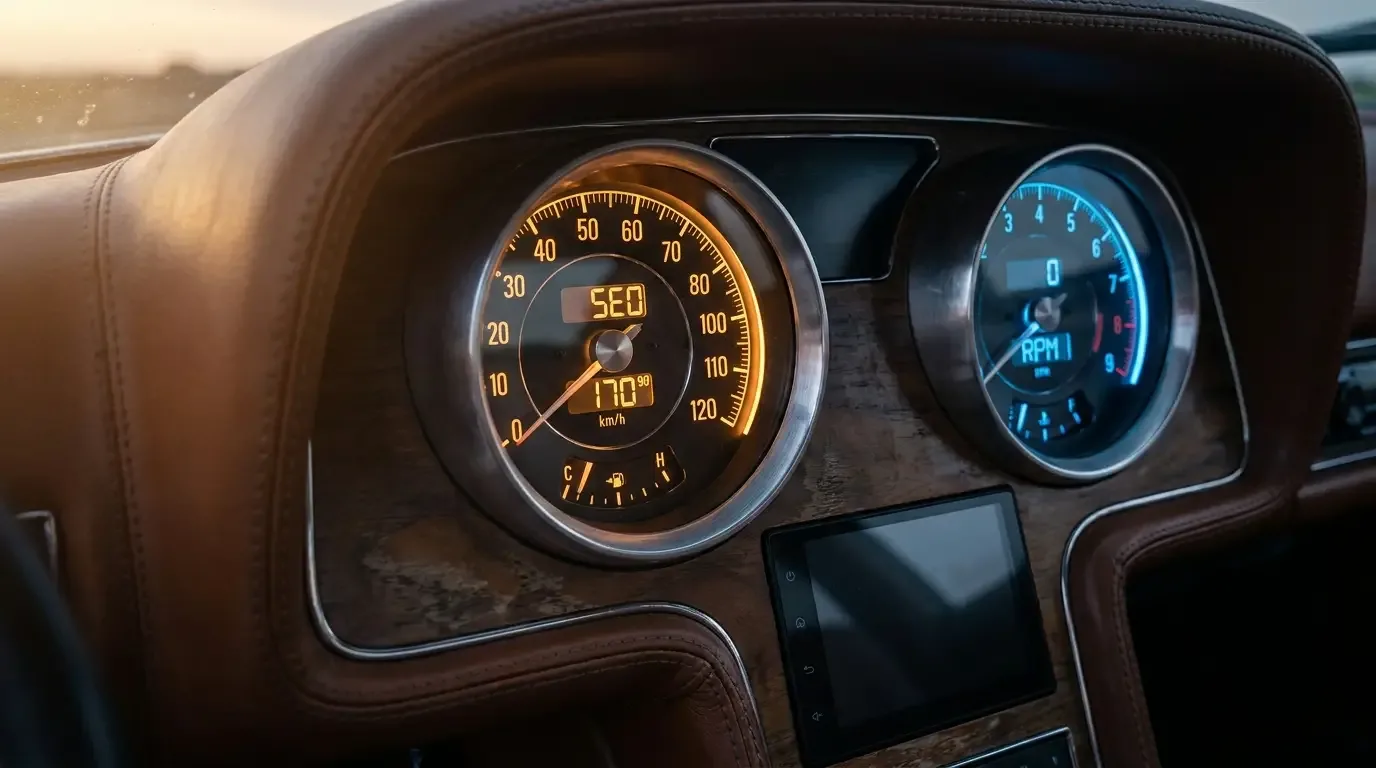
Gauges are where taste really shows. You have two honest paths. One is a digital dash from Dakota Digital or Holley that fits the original bezel and gives you accurate readings, trip data, and clean nighttime lighting while still looking like it belongs. The other is keeping restored analog gauges on the surface and running modern sensors behind them so the needles are actually correct. Both work. What does not work is a glowing tablet bolted where a chrome bezel used to be. That breaks the whole illusion.
The rest of the tech should be invisible until you need it. Keyless entry and push-button start, a hidden USB charger in the glovebox, power windows with the original crank handles converted to switches, cruise control wired into a modern throttle, a discreet backup camera feeding a mirror display. Every one of these makes the car easier to live with, and every one should be hidden well enough that a purist walking by never notices. Doing this tastefully is a real skill, and it feeds directly into restomod value, because a clean, well-integrated interior is what separates a serious build from a butchered one.
Wheels, tires, seats, and a budget cheat sheet
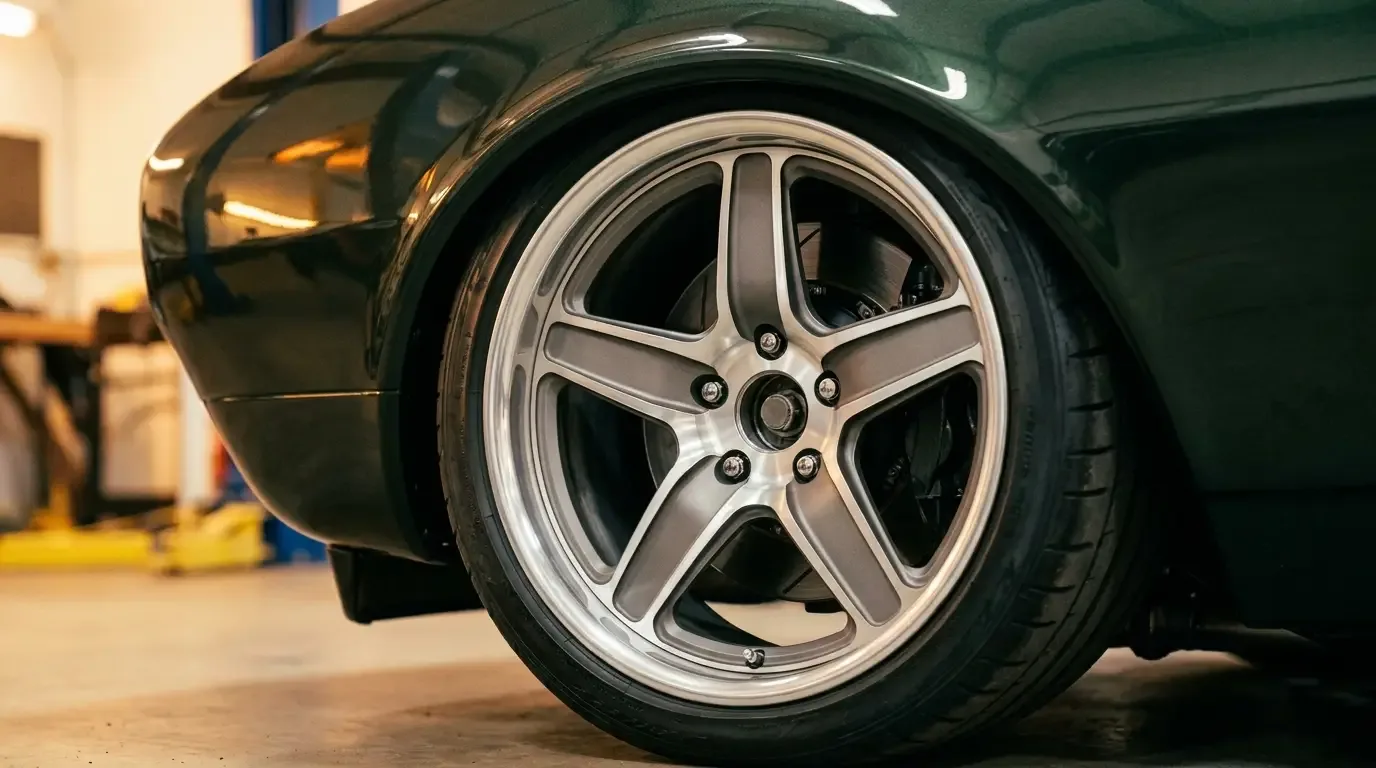
Wheels and tires are half comfort and half stance, and they are easy to get wrong. A modern radial tire on a correctly sized wheel transforms ride quality and grip over the old bias-ply or narrow radials these cars wore. The trick is picking a wheel design that reads period-appropriate. A five-spoke or a smoothie steelie with the right offset looks like it could have come from the era, while a huge modern multi-spoke on a 1960s body screams aftermarket. I usually go a size up from stock for the handling and brake clearance, not three sizes up for the look.
And then the seats, which nobody photographs and everybody feels. A reupholstered original bench can be rebuilt with modern foam and a hidden lumbar layer so it looks stock and supports you like a modern seat. Or you fit a modern bucket retrimmed in period-correct material. Either way, the seat and the tire are the two contact points between you and the car for the entire drive. Skimp on them and the whole comfort budget is wasted.
Here is roughly how I prioritize a comfort and technology budget when a client wants a car that gets driven. The costs are ballpark figures for parts plus typical shop labor and vary a lot by car and region, so treat them as a starting frame, not a quote.
| Upgrade | What it fixes | Rough cost range | Priority |
|---|---|---|---|
| Modern A/C system | Cabin heat, weak factory cooling | Around $1,500 to $4,000 | High |
| Sound deadening | Road noise, heat soak, rattles | Around $500 to $1,500 | High |
| Seats and upholstery | Back fatigue, poor support | Around $1,500 to $6,000 | High |
| Hidden audio system | Unusable factory radio | Around $800 to $3,500 | Medium |
| Digital or updated gauges | Inaccurate, dim instruments | Around $500 to $1,800 | Medium |
| Modern wheels and radials | Harsh ride, poor grip | Around $1,200 to $4,000 | Medium |
| Keyless and convenience tech | Daily-use friction | Around $300 to $1,500 | Low |
Notice the pattern. The high-priority items are the ones that determine whether the car is bearable to sit in for an hour. If you are shopping finished builds instead of building your own, this is exactly what to scrutinize. Plenty of used restomods for sale have a gorgeous engine bay and a cabin that was clearly an afterthought, and that gap tells you how the whole car was built.
Doing it so it still reads classic
The line I hold on every comfort build is that the technology serves the car, not the other way around. The moment a modern part announces itself, a screen where a clock should be, a subwoofer eating the trunk, a wheel that belongs on a different decade, the illusion cracks and you have a nice classic body wrapped around an obvious modern retrofit. That is the poseur version of this hobby, and it usually shows up when someone spent the money on visible flash instead of hidden function.
Done right, a comfort restomod fools people. The dash looks factory. The seats look original. The stereo is silent until you want it. But the A/C is cold, the cabin is quiet, the gauges are accurate, and you can drive the thing 300 miles without a second thought. That is the entire promise of a restomod, a car that looks like it rolled out of the past and drives like it was built yesterday. The comfort work is where that promise is either kept or broken.
Sources and notes
- Aftermarket climate-control and gauge manufacturer product documentation and installation guides.
- Period press and marque references for original interior and equipment specifications.
- Builder and restoration-shop interviews on interior integration practices.
- Enthusiast club and forum records on sound-deadening and audio approaches.
- Refrigerant and environmental regulation references (Montreal Protocol phase-out of R-12).
Related Reading
Have a
Classic Car
for Sale?
Reach thousands of serious classic car collectors across the US.
Sell It Here →
Are You a Classic Car Dealer?
List your full inventory and connect with targeted classic car buyers.
Join as a Dealer →
#restomod comfort
#restomod interior
#classic car air conditioning
#digital gauges
#sound deadening
#classic car audio

About the author
Jim Vasquez
Southern California hot rod and custom car builder with roots in the traditional kustom kulture scene.




Comments
Be the first to comment on this article.