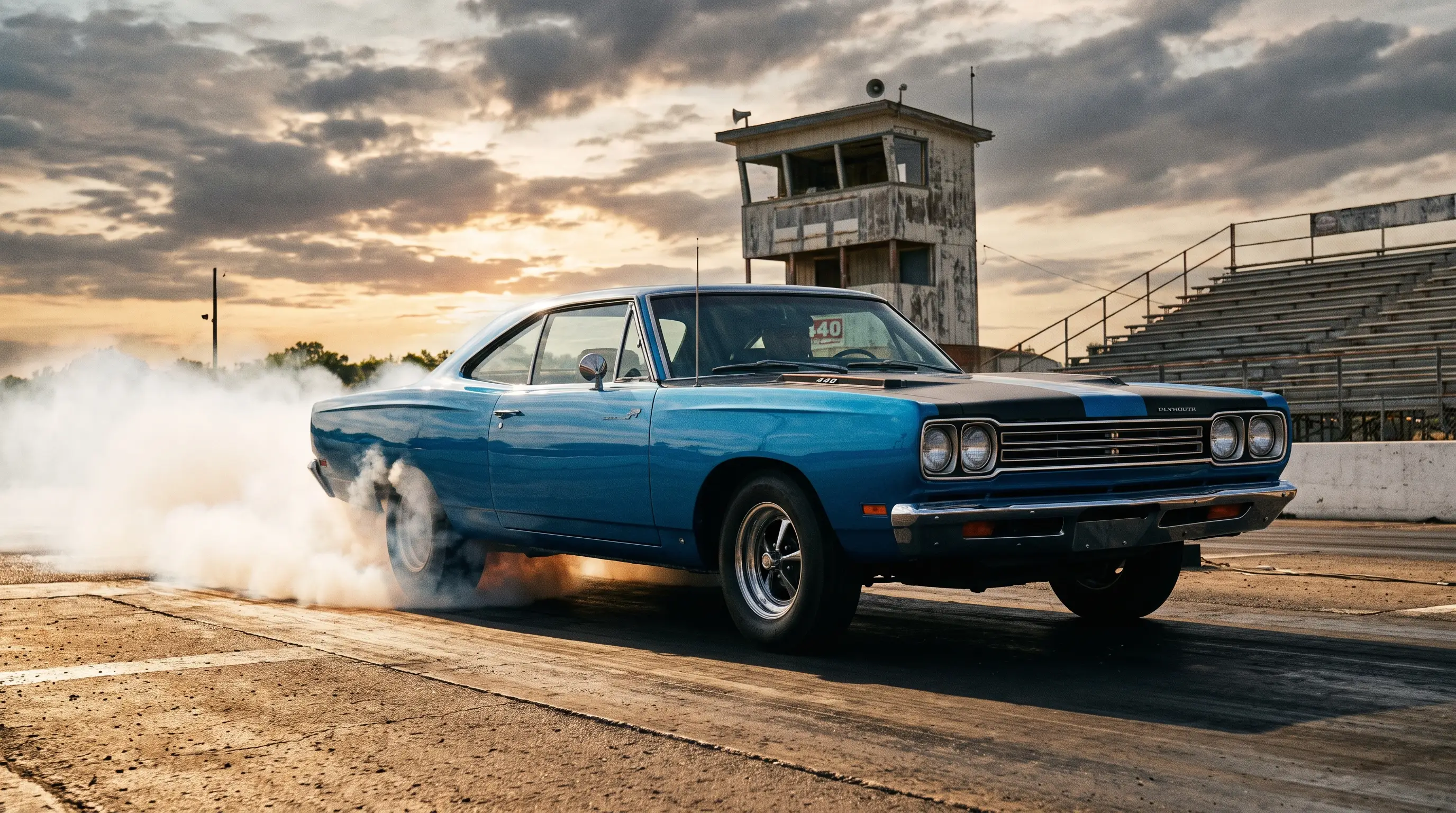
Ask any old-timer at a regional car club meeting how the Road Runner earned its reputation, and half of them will not start with the showroom. They will start with a Sunday afternoon at a local strip, some cousin or neighbor or shop foreman lining up against a car that cost twice as much, and winning anyway. That is the story that actually built the legend, told and retold at swap meets and club dinners for more than fifty years now, long before anyone thought to write it down properly. Road Runner drag racing was never just a marketing bullet point. It was the proving ground where the car's reputation got settled by people with stopwatches and bragging rights on the line, not by an ad agency.
The bar story that started it all
Every regional club has a version of this same tale, and the details change but the shape never does. A guy walks into a Road Runner dealership in 1968 wanting the cheapest car with the biggest engine option available, gets laughed at by the salesman, buys it anyway, and spends the next several years humbling cars that cost considerably more at the local strip. Whether any single version of that story is entirely accurate is beside the point. What matters is that Plymouth's stripped-down formula, minimal trim, maximum engine, actually worked exactly the way the sales pitch promised, and that consistency is what turned individual bragging-rights stories into a shared community mythology that clubs still trade today.
Where the factory met the strip
Plymouth did not leave the car's performance reputation entirely to chance or word of mouth. The factory built genuine race-oriented variants specifically for organized drag competition, cars stripped further than even the standard Road Runner, with lightweight body panels and factory-installed race equipment aimed squarely at NHRA and other sanctioning body classes. Those factory-backed cars gave weekend racers something concrete to chase, a benchmark performance that ordinary street cars could be measured against. Regional racers who could not afford the full factory race package still benefited from the trickle-down knowledge those programs generated, since parts and tuning wisdom developed for factory teams eventually filtered down through dealer service departments and local speed shops.
Club racing kept the legend alive
What kept the drag strip reputation alive long after the factory stopped building new Road Runners was the club scene itself. Regional Mopar clubs organized their own bracket racing events specifically to keep that competitive spirit going, and those events doubled as informal history-keeping sessions where older members would tell newer ones about the cars and drivers who built the model's reputation in period. That oral history is not always precise, dates shift, elapsed times get rounded favorably in the retelling, but it carries something a spec sheet cannot: the actual texture of what it felt like to be at those events, to hear a big-block Road Runner launch off the line against a car that should have won on paper and didn't. Anyone curious about the broader story behind the badge that made all of this possible can find the full story of the licensing deal and marketing decisions that shaped the car from the very beginning.
"Every club has that one member who still has the time slip from a race in 1971, laminated, in his wallet, thirty years after the car itself got sold. That's not nostalgia. That's proof, and proof is the only currency that matters when two old racers start arguing about whose car was faster."
- Wayne Coburn
Documentation as the real trophy
Ask a serious club member what actually settles these decades-old arguments and the answer is rarely memory alone. It is paperwork. Old time slips, dealer invoices, period magazine articles, and photographs from actual race weekends carry more weight in a club meeting than anyone's recollection, however confidently delivered. That respect for documentation has shaped how the entire Road Runner drag racing community preserves its own history, with clubs actively archiving old race records and encouraging members to hold onto anything that proves a car's competition history rather than letting it get thrown out with old receipts. The result is a surprisingly well-documented grassroots racing history for a model that was never treated as precious or exclusive when new.
The rivalries that never really ended
No club history of the Road Runner at the strip is complete without the rivalries, and those rivalries rarely stayed confined to a single race weekend. Two shops in the same town, one running a Road Runner and the other a Chevelle or a GTO, could keep an argument going for years, each new race just another chapter in a feud that outlasted the cars themselves in some cases. Those rivalries produced some of the best stories still told at club events today, the kind where the details get a little more colorful with each retelling but the core facts, who won, by how much, on what night, stay remarkably consistent because too many people were there to let the story drift too far from what actually happened.
What is easy to forget, decades removed from those Sunday afternoon grudge matches, is how local and personal this racing culture actually was. These were not televised events with national audiences. They were regional strips, sometimes barely more than a converted airstrip or a stretch of closed public road, where the crowd knew both drivers by name and the stakes were pride and maybe a few dollars rather than a championship trophy. That intimacy is part of why the stories survived so well through oral history and club culture rather than formal record-keeping alone. Everyone who was there had a personal stake in remembering it correctly, and that collective memory has proven more durable than a lot of official documentation from the same era.
Why the strip still matters to the story
The drag strip chapter of the Road Runner's story matters because it is where the car's reputation got tested honestly, away from advertising copy and dealer showroom pitches. Every claim Plymouth made about affordable performance either held up against a stopwatch or it didn't, and enough of it held up that the legend outlasted the production run by decades. That track record, kept alive through club culture, laminated time slips, and stories passed down at dinners and swap meets, is a large part of why the model still commands respect among people who take performance seriously rather than just aesthetics. Anyone drawn to that same combination of honest speed and documented history can look at a classic Runner for sale and start building their own chapter of the story, one more entry in a competitive record that regional clubs have been keeping honest for more than half a century.