
The Hemi GTX is a case study in an engineering decision made without a full accounting of the tradeoffs it created for the buyer who checked that option box. Plymouth offered the 426 Hemi in the GTX for the same reason it offered it across most of its performance lineup: to give the car a genuine top-tier engine option beyond the already strong standard 440. What that decision produced was a car with two distinct personalities depending on which engine sat under the hood, and the differences between them are worth examining honestly rather than treating the Hemi as simply "the better one."
Car Features
7 min read
The Hemi GTX
The Hemi GTX made more power than the standard 440 car, but the engineering tradeoffs behind that extra output explain why so few buyers actually ordered it.
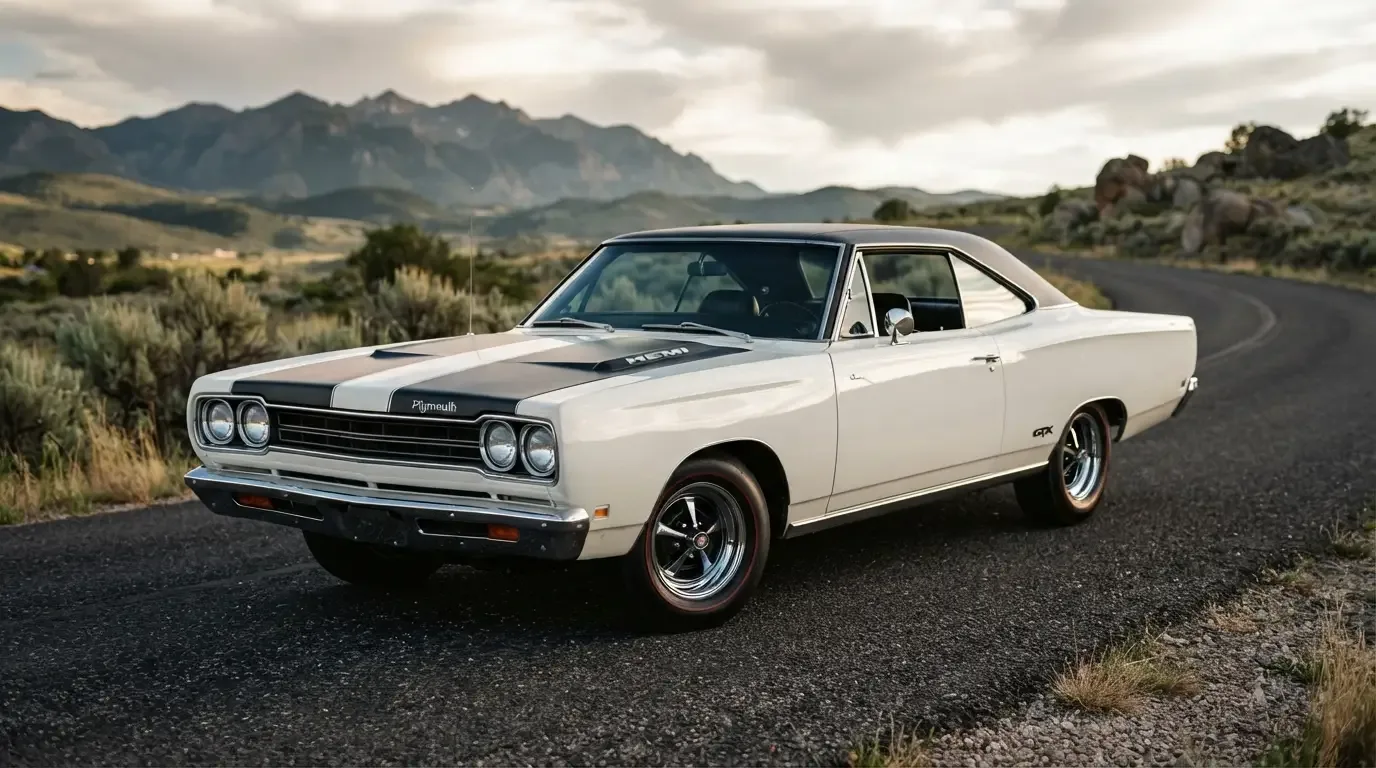
What the Hemi actually changed mechanically
The 426 Hemi's hemispherical combustion chamber design, the feature that gives the engine its name, allowed larger valves and more efficient airflow than the wedge-head 440's more conventional chamber shape. Rated output for the Hemi came in at 425 horsepower, unchanged across the GTX's model years it was offered, against the 440's 375, a meaningful gap on paper. But that extra output came with real engineering costs: a taller, heavier engine block, a more complex dual four-barrel induction system, and a valvetrain that required more frequent, more specialized maintenance than the comparatively simple 440.
Cooling demands were higher too. The Hemi ran hotter under sustained load and needed a more robust radiator and fan setup than the standard GTX cooling system was built around, which meant ordering the Hemi option effectively required ordering a package of supporting upgrades most buyers didn't fully appreciate until they were already living with the car.
The engineering tradeoff nobody put in the brochure
Weight distribution shifted forward with the Hemi installed, changing the GTX's handling balance relative to the 440 car in ways period road tests noted but rarely quantified precisely. Mopar engine specialists generally put the Hemi block and heads somewhere on the order of 100 to 150 pounds heavier than the 440's, with the gap coming from the Hemi's extra cast iron in the heads, its double rocker shafts, and its cast iron exhaust manifolds. The heavier front end meant more understeer at the limit and required stiffer front suspension components to manage properly, another cost buried inside the option rather than broken out separately for the buyer to weigh.
Fuel economy, never a strength of any big-block muscle car, dropped further with the Hemi, and the engine's stricter tuning tolerances meant a Hemi that fell out of proper adjustment ran noticeably worse than a 440 in the same condition. This wasn't a flaw exactly. It was the honest cost of a more sophisticated design being asked to do double duty as a daily-driven street engine rather than staying in its more natural habitat on a drag strip.
"The Hemi is a better engine in the ways an engineer measures better. Whether it made the GTX a better car to actually own depended entirely on what the owner wanted from it."
- Emily Chen
Why so few buyers actually chose it
The Hemi option carried a significant price premium over the standard 440, and that cost, combined with the maintenance and daily-driving tradeoffs outlined above, meant the overwhelming majority of GTX buyers stuck with the standard engine. Production numbers for Hemi GTX examples across the model's run are low enough that documented, verified cars are treated as genuinely significant finds by collectors and researchers alike: commonly cited figures put Hemi GTX output at roughly 733 for 1967, 446 for 1968, around 208 for 1969, 72 for 1970, and just 30 for 1971, the option's final year.
That scarcity, born directly from the practical tradeoffs discussed above rather than from any marketing decision, is exactly why the Hemi GTX commands such a premium in today's market. Buyers in 1967 through the GTX's later years were making a rational choice weighing performance against livability, and most of them landed on the 440. The buyers who chose the Hemi anyway, knowing the tradeoffs, are the reason those specific cars are worth so much more today.
Evaluating a Hemi GTX today
Anyone considering a documented Hemi GTX should go in understanding that a correctly sorted example, with cooling, suspension, and induction all properly maintained to the specification the engine actually needs, is a genuinely rewarding car to own. A neglected one, with tuning left to drift and cooling components not kept to spec, will disappoint an owner who expected it to simply be a faster 440 car with no other differences. The engineering tradeoffs built into the Hemi option in period are the same tradeoffs a buyer inherits today, just with fifty additional years of wear to account for on top of them.
For the full model history that puts this engine option in context, more on the plymouth gtx covers the GTX's complete run, and readers wanting the broader Road Runner family story can find it at where this started. If you're evaluating the market for a documented example, current classic Runners on the market listings are worth reviewing with a specialist before committing.
Rebuilding a Hemi correctly versus rebuilding a 440
A ground-up rebuild on a 426 Hemi is a fundamentally different job than the same work on a 440, and the difference is worth understanding in engineering terms rather than just cost terms. The Hemi's hemispherical chamber design requires a more complex valvetrain geometry, with rocker shafts and pushrod angles that differ from a conventional wedge-head engine, and machine shops need specific experience with this configuration to set clearances correctly. Get it wrong and the engine will run, but it will not make anywhere near its rated output, and it will wear unevenly in ways that show up as expensive problems years later rather than immediately.
The dual four-barrel induction system most Hemi GTX examples carried also demands careful synchronization between the two carburetors, a tuning step that has no real equivalent on the single four-barrel 440. A shop unfamiliar with this specific setup will often default to treating it like two independent carburetors instead of a matched pair, and the engine's driveability suffers accordingly. None of this is exotic knowledge, but it is specialized knowledge, and the pool of mechanics who hold it is smaller than the pool who can competently rebuild a 440.
What this means for long-term ownership costs
Factor these engineering realities into any decision to buy a Hemi GTX rather than treating the purchase price as the whole cost of ownership. A correctly maintained Hemi, serviced by someone who actually understands the architecture, is not dramatically more expensive to keep running year to year than a 440. An incorrectly maintained one becomes an expensive, underperforming problem that can take years to properly diagnose and fix, because symptoms of poor Hemi-specific tuning often get misattributed to more generic causes by mechanics working outside their depth.
The honest verdict on the Hemi option
The Hemi GTX was never simply a faster version of the standard car. It was a different engineering proposition with real costs attached, and the small number of period buyers who accepted those costs created the scarcity that defines this car's value today. Approached with clear eyes about what the engine actually demands, including who is qualified to service it correctly, it remains one of the most significant engine options Plymouth ever offered in this platform.
Sources and notes
Related Reading

About the author
Emily Chen
Bay Area engineer with a deep focus on vintage Japanese and European performance cars. Approaches classic car research and restoration with an analytical eye.
Related Listings - Plymouth Road Runner


Comments
Be the first to comment on this article.