
I still remember an old-timer at a Mopar swap meet, coffee in one hand and a fender tag in the other, telling a young guy who'd just bought a Pontiac, "You bought the one everybody copied, kid, not the one that beat it." That's road runner vs gto in a nutshell as our club has argued it for years, half serious and half nostalgic, over folding tables full of parts nobody else wanted.
Car Features
7 min read
How the Road Runner Outsold the Pontiac GTO
The GTO had a four-year head start and a bigger marketing budget. In 1968 the cheaper, stripped-down Road Runner still outsold it, and club members still argue about why.
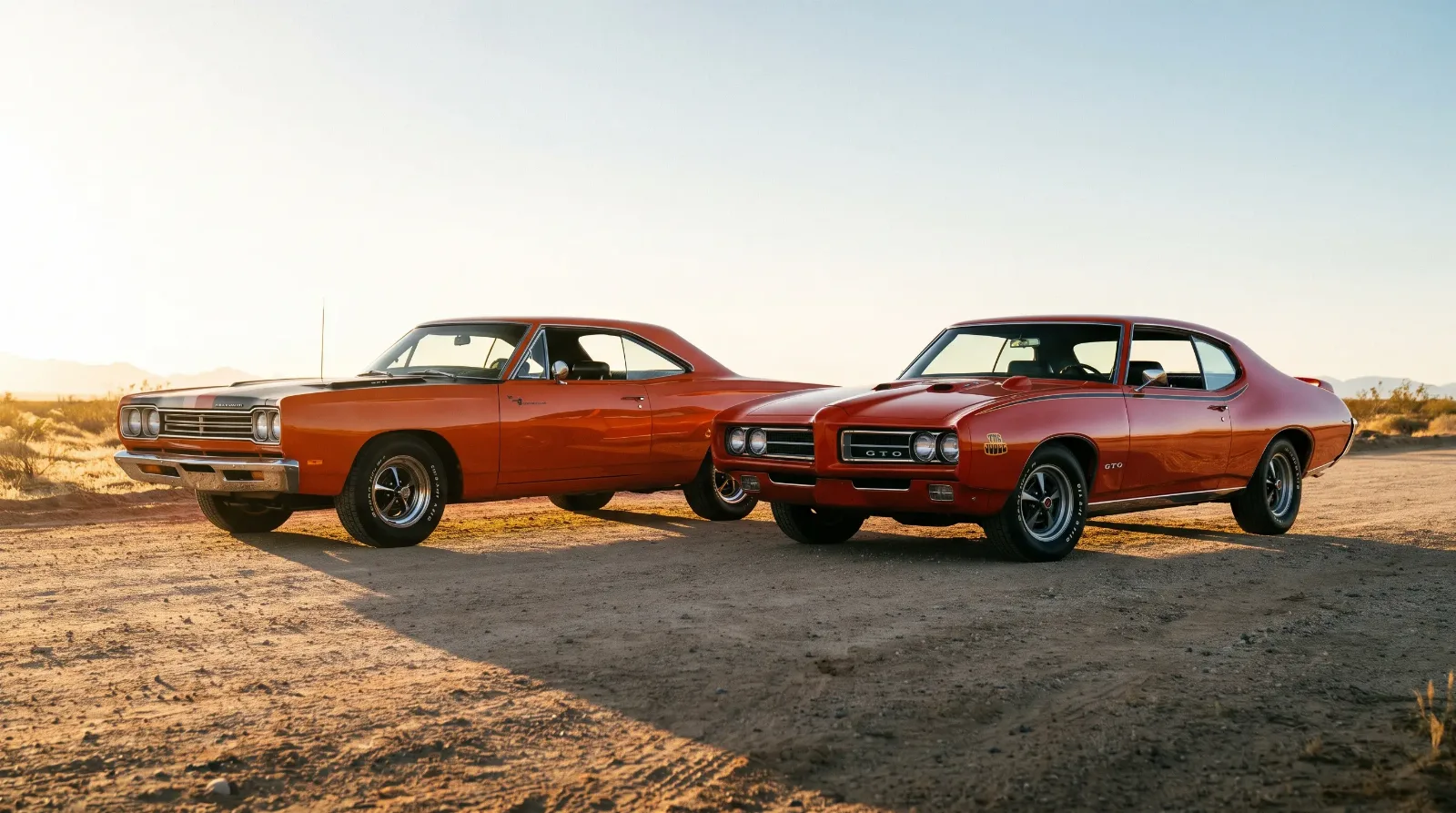
Pontiac's GTO gets credit as the car that started the muscle car era, and that credit is fair. But by 1969, a Plymouth priced thousands less than a comparably equipped GTO outsold it, and that story doesn't get told nearly as often as it should at the shows where GTO owners still like to remind everybody who came first.
The GTO's head start, and why it mattered less than people think
Pontiac launched the GTO in 1964, years ahead of the Road Runner, and spent that head start building a genuine performance reputation along with a marketing machine that leaned hard into the car's image as the smart man's muscle car. By the time Plymouth entered the fight with the Road Runner, GTO already had loyal owners, magazine credibility, and dealer relationships built over four full model years.
What Pontiac didn't have was a cheap answer to buyers who wanted the performance without the price. The GTO's options and trim packages had crept upward year over year, the same way every successful muscle car's sticker price tends to climb once a manufacturer realizes buyers will pay for the image. Plymouth looked at that gap and built the Road Runner to live directly inside it.
The sales numbers our club argues about every year
Plymouth's Road Runner production hit roughly 44,599 units in its 1968 debut year, a strong number, but the GTO still outsold it that first year, with Pontiac moving closer to 87,000 units in 1968. The real turnaround came the very next year. By 1969, Road Runner production climbed to 84,420 units while GTO sales slipped to roughly 72,287, the first time the segment's original leader got passed. Chrysler took notice internally and leaned further into the low-price performance formula in the years that followed.
The reason isn't complicated once you sit with it the way our club has over a few hundred cups of gas station coffee at meets. A GTO buyer in 1968 was paying real money for badge prestige, options, and a longer performance pedigree. A Road Runner buyer was paying a lot less for a comparably quick car and accepting a bare-bones interior in exchange. When gas station bragging rights and drag strip trophies matter more than a padded dash, plenty of buyers took the cheaper, faster option every time.
"Every club has that one guy who insists the GTO was always the better car. He's usually the same guy whose Road Runner buddy beat him to the finish line and never let him forget it."
- Wayne Coburn
The magazine comparison tests everybody quotes
Period road tests from 1968 and 1969 pitted the two cars against each other with a regularity our club still cites at meetings decades later. Writers at the time generally credited the GTO with a more refined ride and a more sophisticated overall package, while giving the Road Runner the nod on straight-line value and outright drag strip performance for the money spent. Neither magazine ever declared a clean winner, which is probably why the argument has survived as long as it has among owners of both cars.
What those old road tests rarely captured was how differently the two cars felt to actually live with day to day. A GTO owner got a quieter cabin and a more finished feel. A Road Runner owner got a louder, buzzier car that reminded you constantly it was built to go fast and not much else, which some of our members will tell you was exactly the point.
What our members actually remember from period
Ask around at any Mopar club meeting and you'll hear the same stories passed down from original owners or their kids. A Road Runner bought new for less than a loaded Chevelle, driven hard through high school and college, sold cheap a decade later because nobody thought a stripped-down muscle car with cartoon decals would ever be worth collecting. Compare that to the GTO stories, which lean more toward careful ownership and pride of badge from day one, and you get a sense of how differently these two cars lived their early lives even while competing for the same buyer.
That difference in how the cars were treated in period is a big part of why surviving, well-documented examples of both nameplates carry real weight today. The GTO earned its reputation through consistency and marketing. The Road Runner earned its numbers by simply being the harder deal to walk away from on a showroom floor.
How the rivalry played out at the drag strip
Our club's older members love telling stories from local strips where a Road Runner and a GTO lined up next to each other more often than any factory marketing department could have planned. Both cars pulled a similar crowd of young buyers chasing quarter-mile bragging rights, and the informal match-ups at small tracks around the country did more to shape the rivalry's reputation than any magazine comparison test ever could.
What those strip stories usually come back to is how close the two cars actually ran once similarly optioned examples squared off. A well-tuned 383 Road Runner could hang with a GTO's standard engine more often than GTO loyalists like to admit, and that competitiveness on the track, not just on the price sheet, is part of why the rivalry still gets argued about decades after both cars stopped being new.
Why the rivalry still matters to collectors
For anyone digging into the whole picture of how the Road Runner launched and why it undercut the rest of the muscle car field on price, the GTO comparison is the fastest way to understand what made Plymouth's approach so disruptive. It wasn't a better engine or a flashier design that won the sales fight by 1969. It was a fundamentally different pitch to the same buyer Pontiac had spent four years cultivating.
Our club still debates which car we would have bought new if we'd had the choice back then, and the answer usually depends on whether the guy talking cared more about badge prestige or bank account balance. Both are legitimate reasons to buy a car, then and now, and that's probably why this argument has never actually been settled at a single one of our meetings.
If the sales history has you leaning toward the underdog that actually won the numbers game, you can find a classic Runner and see for yourself what made this car outsell a nameplate with a four year head start and a much bigger marketing budget behind it.
Sources and notes
Related Reading
Have a
Plymouth Road Runner
for Sale?
Reach thousands of serious classic car collectors across the US.
Sell It Here →
Are You a Classic Car Dealer?
List your full inventory and connect with targeted classic car buyers.
Join as a Dealer →
#muscle car rivalry
#Pontiac GTO
#Plymouth Road Runner
#1968 muscle cars
#Mopar vs GM
#classic car sales history

About the author
Wayne Coburn
Longtime Corvette owner, judge and club figure who knows the cars, the records and the people behind them.
Related Listings - Plymouth Road Runner




Comments
Be the first to comment on this article.