
Two small plates tell you most of what the factory knew about a 1970 to 1981 Camaro, and a second gen Camaro VIN decoder is the first tool anyone should pick up before money changes hands. The VIN plate on the dash identifies the car to the government. The cowl tag, often called the trim tag, records what Fisher Body put into the shell. Read together, they confirm the year, the plant, the series, often the engine, and the paint and interior the car left with. Read carelessly, they get credited with things they never said. Anyone planning on restoring a classic Camaro from this era should know both plates cold, and should know where each one goes quiet.
Car Features
7 min read
Decoding a Second-Gen Camaro VIN and Trim Tag
A second gen Camaro VIN decoder for 1970 to 1981: the 13-digit VIN, the engine letter from 1972, the cowl tag codes and what neither plate can prove.
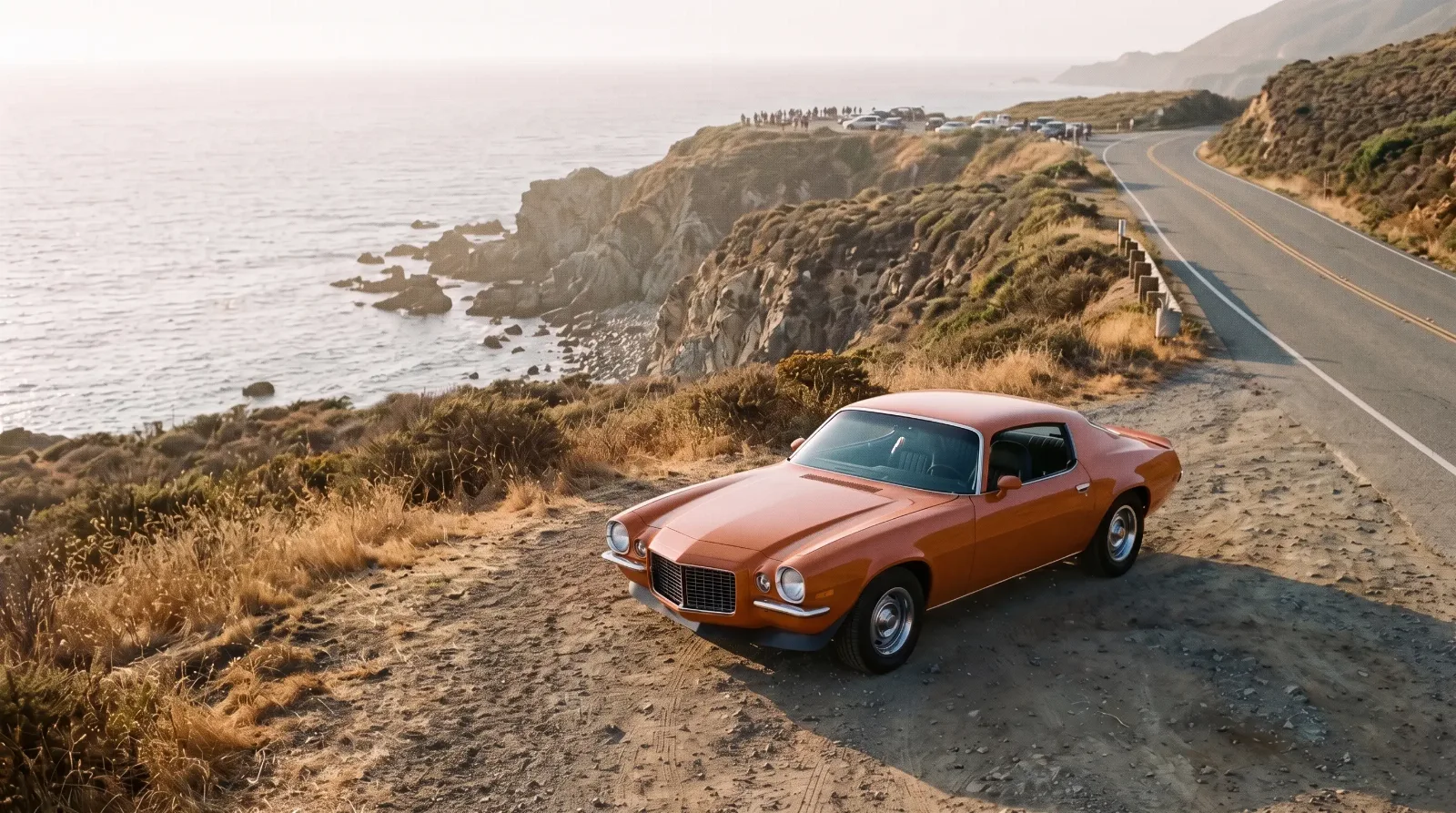
Where the numbers live on a 1970 to 1981 Camaro
The public VIN sits on a steel plate on the driver's side of the dash, readable through the windshield. Chevrolet moved it there from the door jamb for 1968, so every second-gen car carries it in the same spot. Factory plates were held by "Rosette" rivets, which show a star pattern when you look up from under the dash. Round rivets are not proof of a swapped plate, but they are a reason to slow down and look harder.
The cowl tag is on the cowl next to the windshield, facing up toward the hood. On a 1973 car it is at the upper right corner of the cowl under the hood. That is a change from the first generation, whose tags sat on the firewall. Most years the tag was riveted. The 1973 and 1974 tags were fixed with sheet-metal screws, so screws on those two years are correct and screws on a 1977 deserve a question.
Second gen Camaro VIN decoder: 1970 and 1971
The 1970 and 1971 VIN has 13 characters, and its structure is short enough to memorize. Take a dealer's decode of a real car, 124870N510539:
- 1 is Chevrolet.
- 2 is Camaro.
- 4 means a V8 (a 3 here means a six-cylinder).
- 87 is the coupe body, the only body the second generation was built in.
- 0 is the model year, 1970.
- N is the plant, Norwood, Ohio (L is Van Nuys, California).
- 510539 is the sequence number.
Notice what is missing. On a 1970 or 1971 car the VIN says nothing about the engine beyond the cylinder count. A 1970 Z/28 VIN reads exactly like the VIN of any V8 coupe. For the early cars that story lives elsewhere, and this piece covers the model years themselves if you need the background on what each year offered.
1972 to 1980: the engine letter arrives
Starting in 1972, GM separated the engine code from the series code, and the VIN became much more useful. From 1972 to 1980 the 13 positions read like this: 1 is Chevrolet; position 2 is the series; 3 and 4 are the body (87); 5 is the engine letter; 6 is the model-year digit; 7 is the plant; and 8 through 13 are the sequence, which starts at 100001.
The series letter is Q for a Camaro from 1972 to 1979, P for a 1980 Camaro, and S for a Type LT (1973 to 1978) or a Berlinetta (1979 and 1980). Real 1980 cars bear that out: a 1980 Z28 offered for sale with VIN 1P87LAL569566 carries the P, and its sixth character, the model year, is the letter A rather than a digit. A 1980 VIN that starts 1Q87 deserves a second look.
A sample 1973 VIN shows the system at work: 1S87T3N182396. That is Chevrolet, Type LT, coupe, T engine (the Z28 350), 1973, Norwood, sequence 182396. The engine letter is the part buyers care about, and it changed by year:
| VIN position 5 | 1972 | 1973 |
|---|---|---|
| D | 250 six | 250 six, 110 hp |
| F | 307 V8 | 307 V8, 115 hp |
| H | 350 V8 | 350 V8, 145 hp |
| K | 350 SS | 350 V8, 175 hp |
| L | Z28 350 | not used |
| T | not used | Z28 350, 245 hp |
| U | 396 | not used |
The 1973 ratings are SAE net. The Z28 kept the T code for 1974 as well. Full tables for 1974 to 1980 were not confirmed for this article, so do not assume a letter means the same thing two years apart. K is the clean example: a 350 SS in 1972, a 175 hp 350 in 1973.
The plant letter is N for Norwood or L for Van Nuys. In 1972, the year of the long strike at Norwood, the sources disagree on whether Van Nuys built any Camaros at all; every 1972 VIN we checked carries an N. An L on a 1972 car is a reason to dig into the paperwork, not proof of anything by itself.
Reading the cowl tag line by line
The cowl tag is a Fisher Body document, not a Chevrolet one, and it speaks in Fisher's codes. A 1973 example shows the layout. Line one reads 73-1FQ87-N-158854: the year, Chevrolet, Camaro, Q for the Sport Coupe (S would be the Type LT), the 87 body, N for Norwood, and then the Fisher Body number.
Line two on the same 1973 tag reads 777-A51-97-97. That is the interior trim code (777 is green vinyl), A51 for bucket seats, and then the lower and upper paint codes, here 97 for Medium Orange on both. A vinyl top shows up as a letter in the paint section; the 1973 list uses A, B, D, F, G, H and T.
The tag also carries a build date written as a month number plus a week letter, so 05B means the second week of May. Registry researchers point out, for the first-gen cars, that this date is when Fisher started the body, not when Chevrolet finished the car, and the same Fisher logic applies to the later tags.
On a 1973 tag the option line can show Z28 along with a stripe code: ZR8 for white stripes, YF8 for black. That is one of the few places a second-gen body plate names the Z28 directly. Treat the 1973 decode as a pattern rather than a template; line-by-line layouts for 1970 to 1972 and 1974 to 1981 were not confirmed here, and trim and paint codes change every year.
"The tags are honest about what they recorded and silent about everything else. Most of the arguments I hear at shows come from asking a plate a question it was never built to answer."
Tom Ramirez
What the plates cannot prove, and the 1981 exception
The most common myth is that the VIN proves a Z28. It does not on a 1970 or 1971 car, where the only engine clue is the V8 digit. Even on the 1972 to 1974 cars, the engine letter shows what the VIN was assigned, not what is between the fenders today. The Camaro Research Group makes the same point about the first-gen cars: the VIN does not tell you whether a car is a Z28, an SS or an RS, and first-gen owners lean on the stamped engine pad and the paperwork instead. The second generation adds clues in some years, but the principle holds. Paperwork such as a Protect-O-Plate, which Chevrolet was still issuing in 1972, carries more weight than any single stamping.
The last second-gen year breaks the pattern entirely. The 1981 Camaro uses the 17-character VIN, with B as the year code. It also brought Computer Command Control and the check-engine light. A 1981 decode belongs with the later 17-character system, and the 13-digit rules above do not apply to it. Chevrolet built 126,139 Camaros that year, so this is not a rare case, just a different one.
Once the plates check out, the next inspection is the metal they are attached to. The cowl, the floors and the lower quarters tell their own story, and our guide to second-gen rust zones covers where to look. A car with honest plates and rotten floors is still an honest car. It is just an expensive one.
Sources and notes
- Classic Industries: Camaro VIN decoder, 1970 to 1980 layout and series letters
- Chevy Hardcore: decoding a 1973 Camaro VIN and cowl tag
- Classic Industries: Camaro trim tag decoder
- Camaro Research Group: VIN, cowl tag and numbers on the 1967 to 1969 cars
- 1980 Camaro Z28 listing showing VIN 1P87LAL569566
- Wikipedia: Chevrolet Camaro (second generation), 1981 changes and production
Related Reading
Have a
Chevrolet Camaro
for Sale?
Reach thousands of serious classic car collectors across the US.
Sell It Here →
Are You a Classic Car Dealer?
List your full inventory and connect with targeted classic car buyers.
Join as a Dealer →
#Z28
#chevrolet camaro
#camaro VIN
#camaro restoration
#trim tag
#cowl tag
#second generation Camaro

About the author
Tom Ramirez
Corvette researcher and historian based in Bowling Green, Kentucky. Two decades documenting Corvette production history from original factory records.
Related Listings - Chevrolet Camaro
Comments
Be the first to comment on this article.