
On March 3, 2018, a small team stood on a property in rural North Texas looking at a car many people in the Shelby world never expected to see again. It was led by Craig Jackson, the chairman of Barrett-Jackson, and the restorer Jason Billups, who had followed a paper trail built around one original Ford VIN, and it had led them here. The car in front of them was the Shelby Little Red prototype, a 1967 GT500 notchback that had been unaccounted for since its working life ended. Kevin Marti, the Ford production records specialist, helped confirm what they had found.
Car Features
7 min read
Little Red and the Green Hornet: Shelby's Lost Prototypes
The Shelby Little Red prototype and the Green Hornet: two notchback test cars, how they shaped the California Special and how both came back.
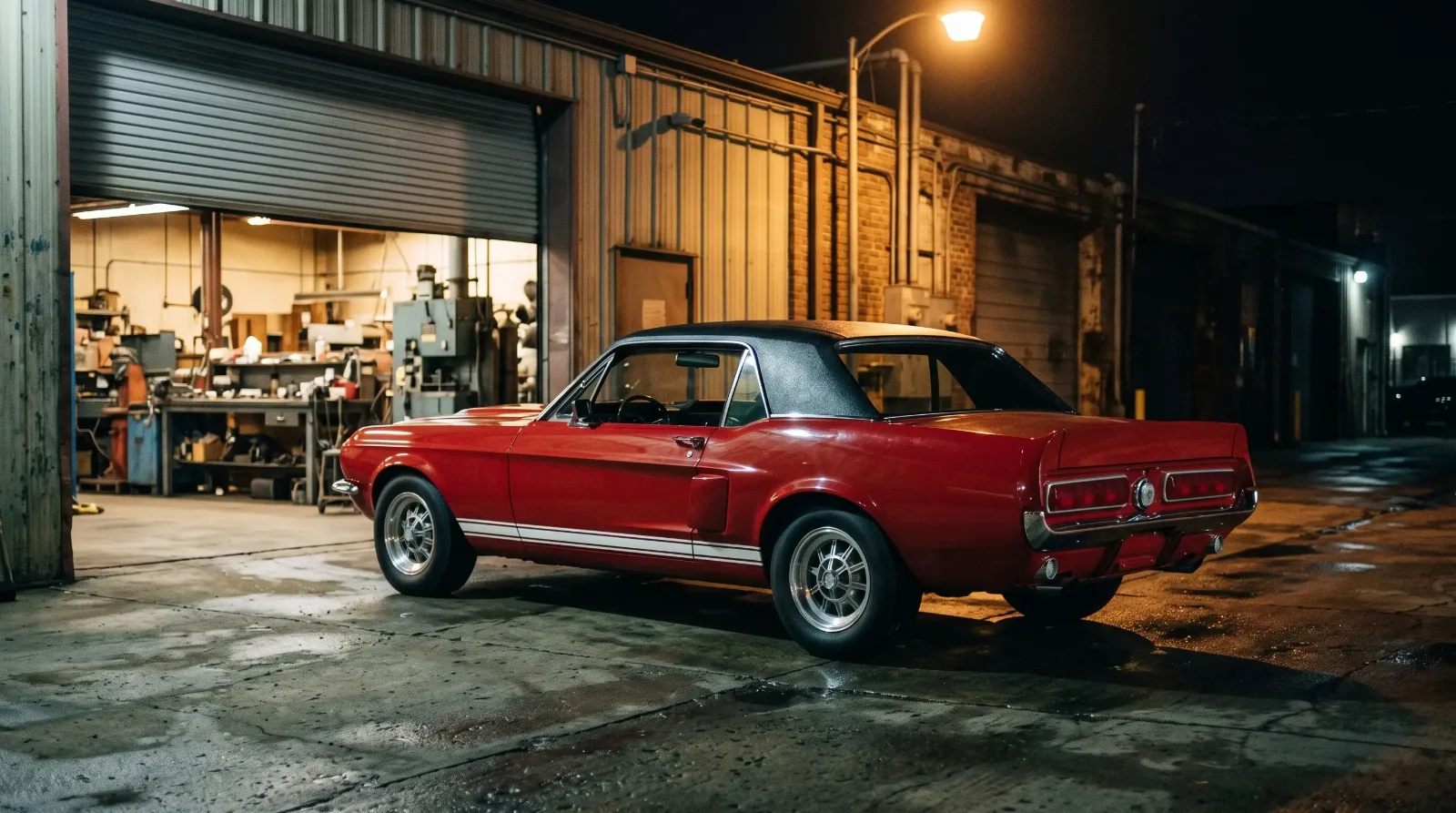
Little Red has a sibling, a 1968 hardtop the Shelby crowd calls the Green Hornet. Between them, these two cars are the strangest chapter in the Shelby Mustang story: coupes in a lineup of fastbacks and convertibles, built to test ideas rather than to be sold. For the production cars, the GT350s and GT500s that people actually bought, the overview has the details. This piece is about the two that got away.
What the Shelby Little Red prototype was
In the Shelby records Little Red is the 1967 Shelby GT500 EXP, car number 0131. It was a notchback, the formal-roof hardtop body that was never part of Shelby's showroom lineup. Shelby's engineers used it as a development car for testing performance parts. Among the things it carried at one point was a Paxton-supercharged 428 big-block.
The production 1967 GT500 used the 428 Police Interceptor with two 600-cfm Holley four-barrels, rated at 355 hp at 5,400 rpm and 420 lb-ft at 3,200. For the longer story of that car and how it sold, the GT500 history covers it in full. Little Red was the place where the engineers pushed past it.
Its most lasting job was not mechanical. Little Red was a model for the 1968 California Special, the regional Mustang that Lee Iacocca backed. That connection is the reason a forgotten Shelby prototype matters to people who have never owned a Shelby at all.
From prototype to the California Special
The 1968 GT/CS, the California Special, was conceived by Lee Grey, Ford's Southern California district sales manager, and pushed through with Iacocca's support. It looked like a Shelby coupe because, in a real sense, it was built from the Shelby coupe idea. Shelby Automotive designed the parts. A.O. Smith in Ionia, Michigan made the fiberglass pieces: the decklid with its spoiler, the end caps, the taillight panel and the side scoops. The car wore 1965 Thunderbird taillights, a blacked-out grille with fog lamps and a pop-off gas cap.
Production began on February 17, 1968, at San Jose only, and the run came to 4,118 cars, including 251 rebadged as High Country Specials for the Denver district. Ford had aimed for 5,000. A notchback Shelby that the public was never allowed to buy ended up shaping a Mustang that thousands of California buyers drove home. That is a good outcome for a prototype, and it is the clearest line from Little Red to the showroom. For more on how the shape fits the wider Ford styling picture, see the Mustang design story.
The Green Hornet: a 1968 test bed
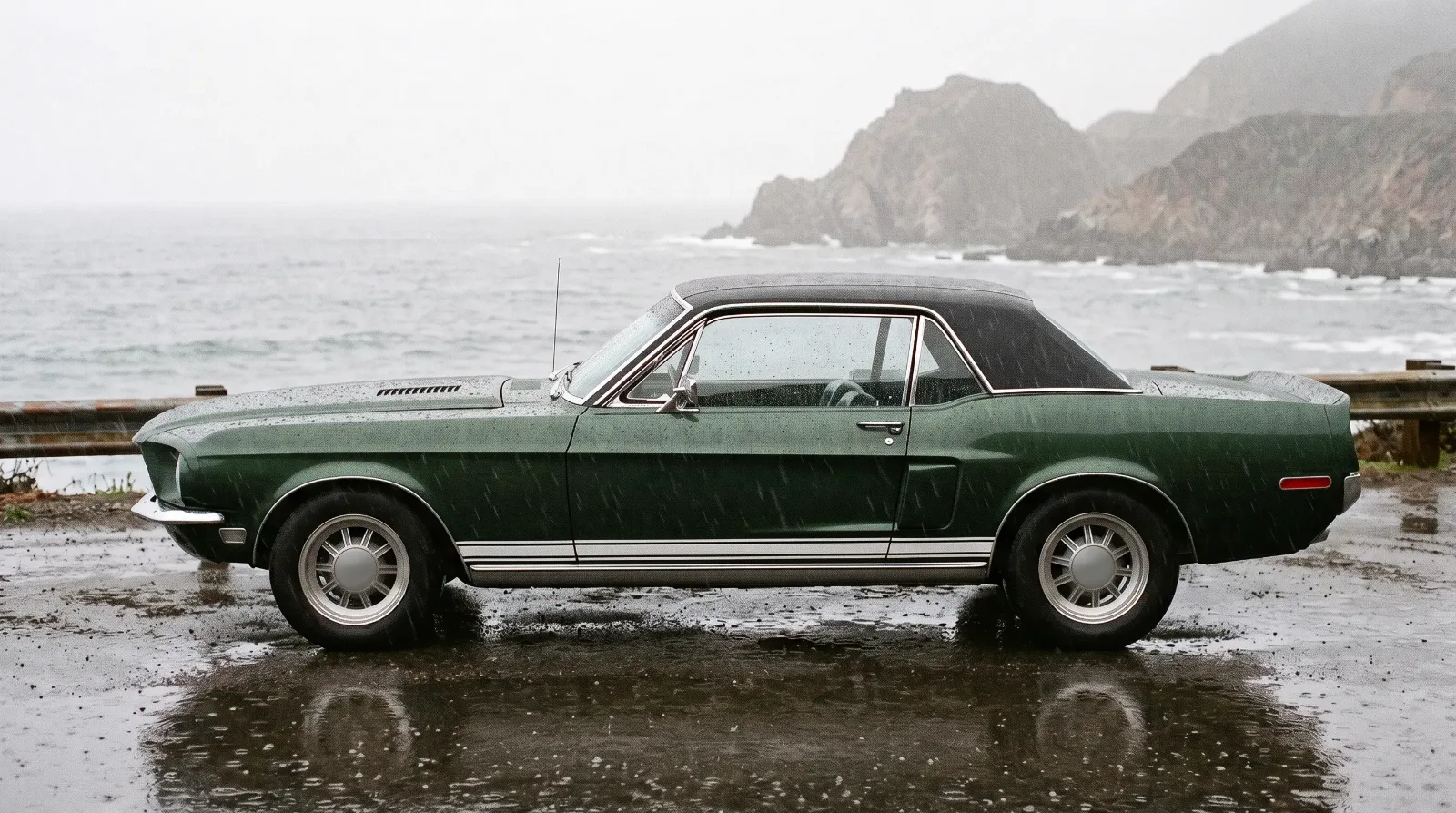
The second car was built a year later and for a different purpose. The Green Hornet is the 1968 Shelby EXP 500, built from an S-code 1968 hardtop with the VIN 8F01S104288. It was first used to try equipment for a proposed GT/Super Coupe, and when that plan was shelved it stayed on as a test mule. One account ties it to the Cobra Jet engine program. Either way, the engineers loaded it with hardware that no production Mustang offered.
The Green Hornet was assembled at Ionia by a four-man crew: Fred Goodell, Walt Nelson, George Merwin and Ray Geddes. By then Shelby production had left California. Ford sent the remaining cars and a small engineering staff to A.O. Smith in August 1967, partly to fix fiberglass quality problems and partly to take tighter control of the program. That is the background of the move to Michigan, and the Green Hornet is one of its most interesting products.
What went into it reads like a wish list. It had experimental electronic fuel injection on a 428, an independent rear suspension and Kelsey-Hayes disc brakes at all four wheels. Published accounts give a 0 to 60 mph time of about 5.7 seconds and a top speed of 157 mph, recorded at the Ford proving grounds. One of those accounts names two different suppliers for the injection, Bendix in its text and Conelec in its spec table, which is a reminder of how thin the paperwork is on a car like this.
| Little Red | Green Hornet | |
|---|---|---|
| Official name | 1967 Shelby GT500 EXP | 1968 Shelby EXP 500 |
| Identity | Shelby car 0131 | Ford VIN 8F01S104288 (S-code hardtop) |
| Body | Notchback coupe | Notchback hardtop |
| Main purpose | Development car; model for the 1968 California Special | Test car for a proposed GT/Super Coupe, then a general test mule |
| Notable hardware | Paxton-supercharged big-block | Experimental fuel injection on a 428, independent rear suspension, four-wheel discs |
| Rediscovery | Found March 3, 2018, rural North Texas | Identified by Randy Darrow in the 1980s |
Lost, found and put back together
Prototypes have a way of disappearing. Their work is done, the experimental parts come off, and the car is sold as a used Mustang with nothing on the outside to say where it came from. The Green Hornet followed that path. The fuel injection and the independent rear suspension were removed before the car was sold to the public.
It was Randy Darrow who identified it in the 1980s. In 1988 he approached Fred Goodell, one of the four men who had built it, to help correct the car back to its 1968 specification. The restoration was finished in April 1993 by Classic & Muscle Mustang Restorations of Midland, Michigan. The car later passed to Craig Jackson, the same collector who would go looking for Little Red.
"These two cars were never meant to be kept. The fact that both survived, and that both ended up in the same hands, is luck on a scale the hobby rarely sees."
Patrick Walsh
Little Red took longer. It stayed missing until the 2018 discovery, and it surfaced only because someone kept chasing the VIN. That is the part of the story worth remembering: in both cases, the cars came back because people trusted the paper over the rumor.
Why the two coupes still matter
It is tempting to call Little Red and the Green Hornet the only Shelby notchbacks, and some sources do. The safer description is that they were the only street prototype notchbacks. Shelby also built a batch of 1967 K-code coupes for FIA Group 2 racing, which complicates any claim that these were the only Shelby coupes ever made.
What they show is how Shelby and Ford actually worked in 1967 and 1968. Ideas were tried on one-off cars, the good ones moved toward production, and the rest came off before the car went out the door. Little Red pointed the way to the California Special. The Green Hornet tested hardware that would not show up in a regular Mustang for years. Neither was ever offered for sale as built, and both survived anyway.
Sources and notes
- Old Cars Weekly: 1967 Ford Shelby GT500 EXP prototype "Little Red" found
- Carscoops: Little Red restored to its former glory (2020)
- Petrolicious: restored Little Red prototype debuts at auction
- Supercars.net: 1968 Shelby EXP500 hardtop
- Jalopnik: the Green Hornet's independent rear suspension and fuel injection
- Wikipedia: California Special Mustang
Have a
Ford Mustang
for Sale?
Reach thousands of serious classic car collectors across the US.
Sell It Here →
Selling a classic? Here's how: sell my classic car
Are You a Classic Car Dealer?
List your full inventory and connect with targeted classic car buyers.
Join as a Dealer →
#Ford Mustang
#shelby mustang
#shelby gt500
#Little Red
#Green Hornet
#Shelby prototypes
#1968 California Special

About the author
Patrick Walsh
Automotive journalist covering classic car shows, events, and the enthusiast community across North America.
Related Listings - Ford Mustang




Comments
Be the first to comment on this article.