
The 1955 Ford Thunderbird is a strange object to study, because it is simultaneously a brand-new nameplate and a car built almost entirely from parts Ford already had on the shelf. That combination, a genuinely fresh idea wrapped around proven mechanical hardware, is what let Ford bring the car to market in barely a year and what gives the first model year its particular character among collectors today.
Car Features
7 min read
The 1955 Thunderbird: The First Year of the Personal Car
The 1955 Ford Thunderbird arrived as a brand-new idea built from proven parts, and the compressed schedule shows up in the details.
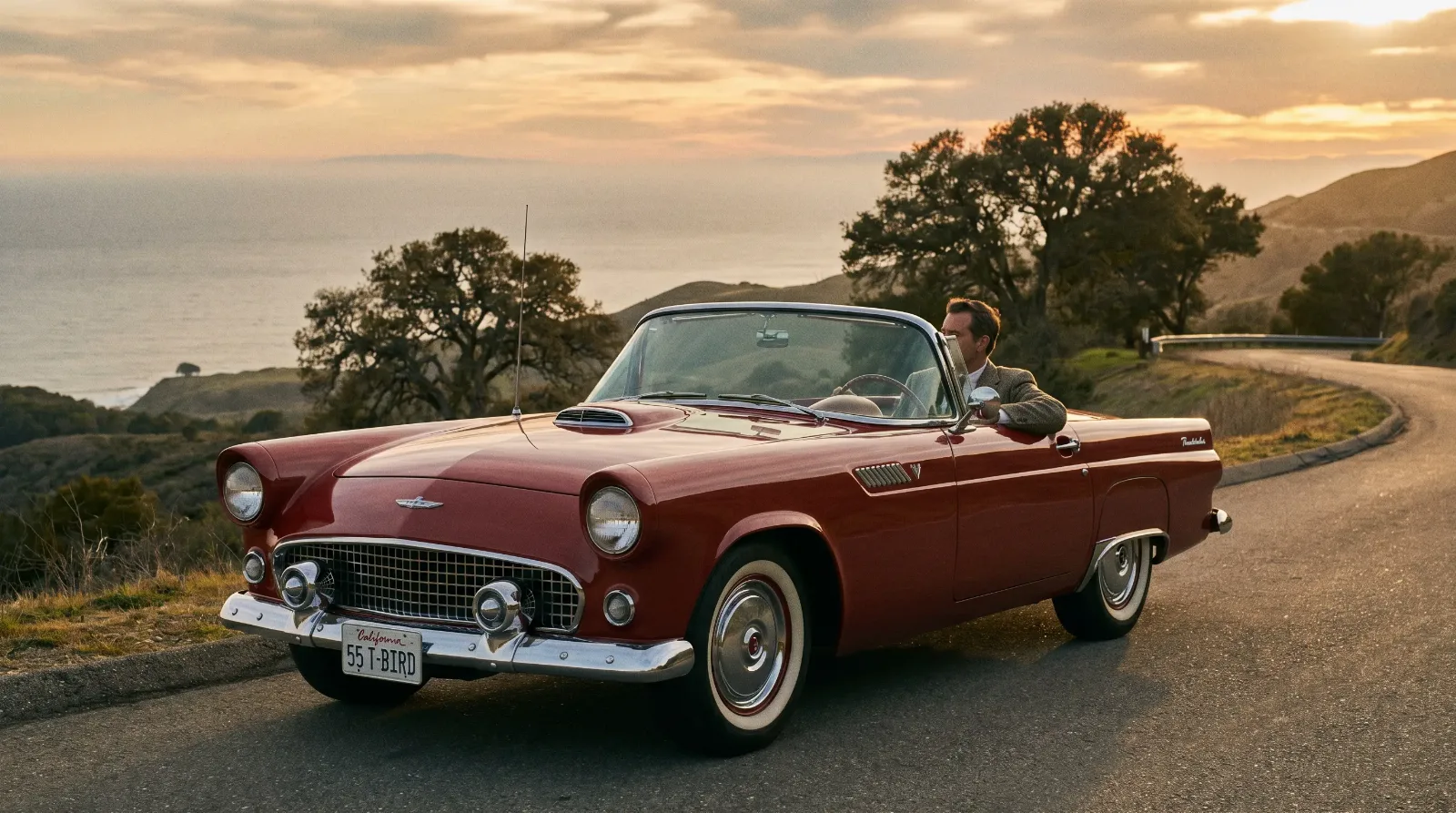
What went on sale in October 1954
Ford introduced the 1955 Thunderbird to the public on October 22, 1954, at dealerships across the country, with production having begun a few weeks earlier at the Dearborn assembly plant. It arrived as a two-seat convertible with a removable hardtop as a factory option, powered by a 292 cubic inch Y-block V8 rated at 193 horsepower with the standard three-speed manual, or 198 horsepower with the optional Ford-O-Matic automatic transmission. Those figures place the car well ahead of the contemporary Corvette in output, a detail Ford's engineering staff was not shy about pointing out to the automotive press at the time.
Base price for the 1955 model landed at $2,944, a figure that undersold the Corvette by a meaningful margin while offering a longer options list. Buyers could add power steering, power brakes, a Master Guide power seat, and a Motorola signal-seeking radio, none of which existed on the Corvette's 1955 order sheet. First-year Thunderbird production reached 16,155 units, a number that dwarfed the Corvette's contemporaneous sales and settled, almost immediately, which car the market actually wanted.
| Spec | 1955 Thunderbird |
|---|---|
| Engine | 292 cubic inch Y-block V8 |
| Horsepower | 193 hp (manual) / 198 hp (automatic) |
| Base price | $2,944 |
| Production | 16,155 units |
| Body style | Two-seat convertible, removable hardtop optional |
Reading the 1955 as an artifact, not just a car
Examine an original, unrestored 1955 Thunderbird closely and the compressed development schedule becomes visible in the details. The frame is a shortened version of Ford's standard passenger car chassis. The instrument cluster borrows heavily from Ford's full-size line, dressed up rather than redesigned from scratch. None of this reads as a shortcut when you sit in the car; it reads as confidence, the product of a design team that knew exactly which parts bin items would disappear under a genuinely new body and which ones needed real attention.
That body is where the actual investment shows. The 1955 Thunderbird's proportions, a long hood, short deck, and low beltline, were unlike anything else in Ford's lineup and unlike most of what competitors offered at any price. Collectors and appraisers who handle first-year cars today consistently point to the body's surfacing, particularly the way the front fenders taper into the hood line, as evidence of how much attention the design staff paid to a car that mechanically owed so much to existing Ford engineering.
Color, trim, and what survives in period documentation
Ford offered the 1955 Thunderbird in a run of colors that reads like a study in mid-century American taste: Raven Black, Snowshoe White, Torch Red, Thunderbird Blue, Goldenrod Yellow, Torch Red and Colonial White two-tone, and Coral Sand among them. Interior trim followed suit, offered in combinations that coordinated rather than contrasted, a period convention that appraisers use today to help authenticate original paint-to-interior pairings when a car's history is incomplete.
Ford's own factory records and dealer invoices from the 1955 model year, where they survive, remain the gold standard for verifying originality on a given car. Serial number placement, engine block casting numbers, and body tag stampings all follow conventions specific to the 1955 run, distinct enough from the 1956 and 1957 cars that a researcher familiar with the differences can usually date an unmarked component within a single model year just from its casting details. For readers who want the full three-year arc rather than just the debut season, our complete history traces how the car changed from 1955 through the final two-seat model in 1957.
"A 1955 Thunderbird tells you exactly what Ford believed it could get away with borrowing, and exactly what it refused to compromise on. Read the parts list against the body panels and you are reading a company's priorities in real time."
- Sarah Whitfield
How the automotive press received it
Contemporary road tests treated the 1955 Thunderbird as something genuinely new rather than a Corvette answer, which tells you how Ford's positioning landed with the people whose job was to be skeptical of it. Writers at the time focused less on lap times and more on how comfortable the car felt to drive daily, praising the ride quality and the ease of the standard power steering option compared to the effort required in a contemporary Corvette. That reception mattered to Ford's marketing department, which had bet the whole project on convincing buyers that comfort and style did not have to come at the expense of looking sporting in a driveway.
Period magazine coverage also spent real space on the car's fit and finish, a subject that would have seemed unremarkable for a mainstream Ford sedan but read as noteworthy for a low-volume specialty model built on a compressed schedule. Reviewers who handled early production cars noted panel gaps and paint quality on par with, or better than, Ford's standard passenger line, evidence that the assembly process at Dearborn had been dialed in carefully despite the short runway between design approval and the start of production.
Why the debut year still commands attention
Among the three two-seat model years, 1955 cars occupy a specific place in the market and in collector conversation. They are the purest expression of the original concept, built before Ford began adding the trim revisions and detail changes that mark the 1956 and 1957 cars. That purity matters to researchers and restorers who prize originality above running changes, and it shows up in how carefully documentation is scrutinized when a 1955 example comes up for sale or judging.
For anyone assembling a period-correct collection or simply looking to own the car that started the personal-car category, current listings are worth watching closely, since first-year cars in original or correctly restored condition do not sit on the market long. You can find a classic Thunderbird currently available and compare how a documented 1955 example is priced against the later two-seat model years discussed elsewhere in this history.
What makes the 1955 car worth the extra scrutiny, whether you are buying, judging, or simply cataloging one for research, is that it never got a second chance to be a debut. Every running change Ford made to the Thunderbird after this first season, from the porthole hardtop to the larger engines that followed, was a response to what the 1955 car proved and where it fell short. Studying the original release in isolation, rather than folding it into the broader three-year story, is the only way to see Ford's first instincts clearly before the market started talking back.
Sources and notes
Related Reading
Have a
Ford Thunderbird
for Sale?
Reach thousands of serious classic car collectors across the US.
Sell It Here →
Are You a Classic Car Dealer?
List your full inventory and connect with targeted classic car buyers.
Join as a Dealer →
#collector cars
#Ford history
#classic ford
#ford thunderbird
#1955 Thunderbird
#two-seat thunderbird

About the author
Sarah Whitfield
Third-generation classic car collector specializing in pre-war American and European coachbuilt automobiles. Researcher and concours enthusiast.
Related Listings - Ford Thunderbird
Comments
Be the first to comment on this article.