
The 1956 Ford Thunderbird gets treated in a lot of casual writing as a minor refresh between the debut year and the more heavily revised 1957 model, and that framing undersells what actually changed. Two visual signatures that would define the Thunderbird in popular memory, the exterior spare tire and the porthole hardtop, both trace to this single model year, and both were direct engineering responses to a problem Ford's own customers had identified in the first year of sales.
Car Features
6 min read
The 1956 Thunderbird: Continental Kit and the Porthole Roof
The 1956 Ford Thunderbird solved a real trunk-space complaint with its continental kit and made the porthole hardtop a standard, catalog feature.
The trunk problem Ford had to solve
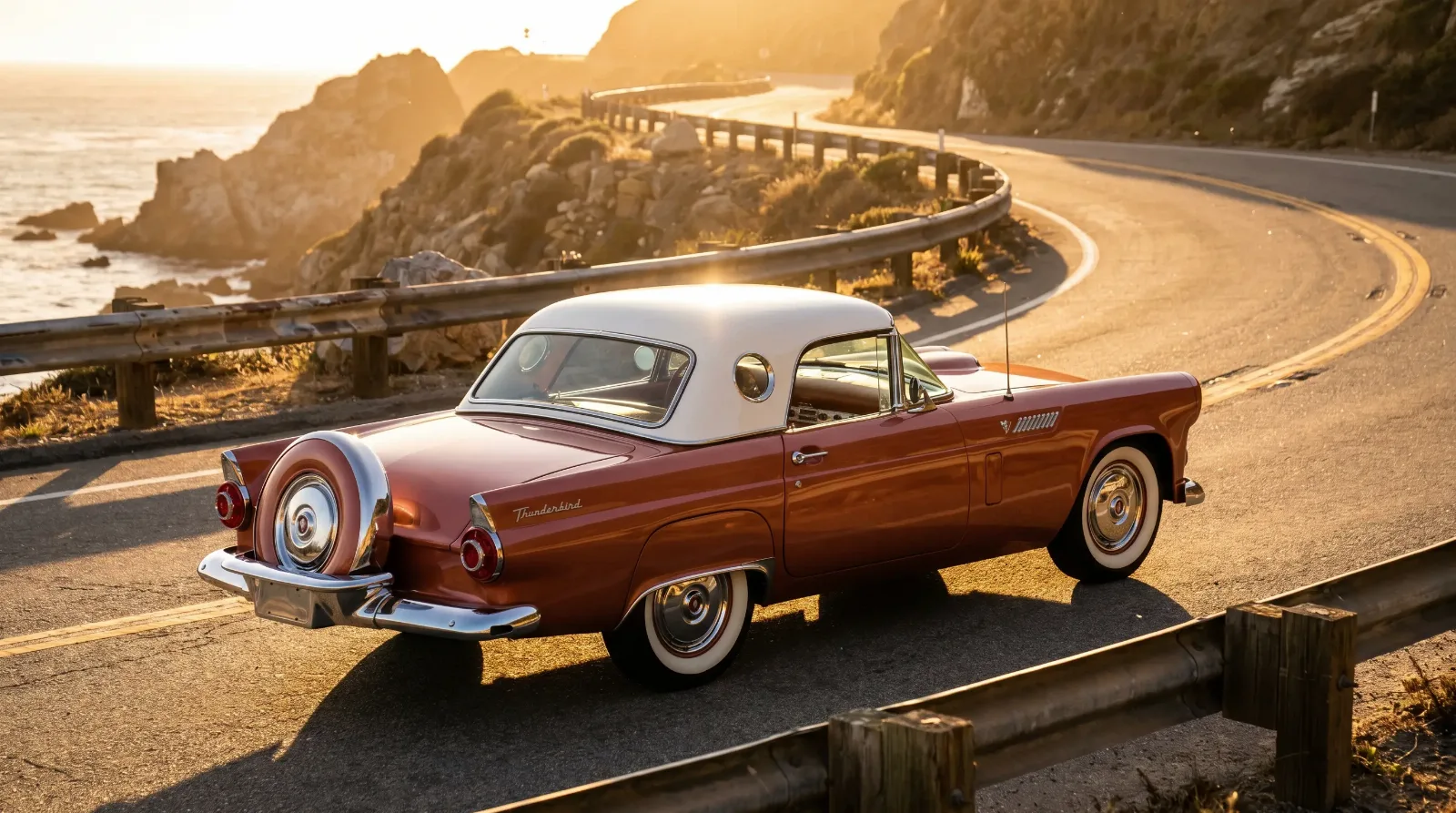
Owners of the 1955 Thunderbird complained, consistently enough to reach Dearborn, that the trunk had almost no usable capacity once the spare tire sat inside it. The car's short rear deck, one of the defining proportions of the original design, left little room for luggage alongside a full-size spare. Ford's solution for 1956 was to relocate the spare tire to a continental-style kit mounted outside the body, cantilevered off the rear bumper. Factory records describe the assembly as the "continental kit," and it became standard equipment for the 1956 model year rather than an aftermarket add-on, a detail that surprises people who assume the look was a dealer accessory.
The change worked, functionally, but it came with a real tradeoff that period road testers noted immediately: relocating weight to the rear bumper shifted the car's handling balance and made reverse parking noticeably harder, since the tire mount extended the effective length of the car. Ford addressed the rear visibility complaint that followed by revising the taillight and bumper assembly around the tire mount for better sightlines, but the fundamental tradeoff between trunk space and handling balance remained a known characteristic of the 1956 model specifically, corrected only when Ford lengthened the rear deck for the redesigned 1957 car.
The porthole hardtop arrives
The removable hardtop on the 1955 Thunderbird had no porthole; the circular window in the fiberglass roof was new for 1956, added to cut down the rear-quarter blind spot that early owners had complained about. This is worth stating precisely because enthusiast writing sometimes collapses the timeline and implies the feature existed on the debut car. Ford's own documentation places the porthole's introduction at the start of the 1956 model year, offered as a no-cost option alongside a plain hardtop rather than as a running mid-1955 change.
Under the hood: more displacement, more output
Ford also revised the powertrain lineup for 1956. The standard engine grew from the 1955 car's 292 cubic inch V8 to a Y-block rated at 202 horsepower with the manual transmission, while a new optional 312 cubic inch V8 became available, producing 215 horsepower with the three-speed overdrive manual transmission or 225 horsepower when paired with Ford-O-Matic and a four-barrel carburetor. The larger engine option gave the 1956 Thunderbird a genuine performance edge over the debut year car, one that mattered to buyers cross-shopping against an increasingly capable Corvette during the same period.
| Spec | 1956 Thunderbird |
|---|---|
| Standard engine | 292 cubic inch V8, 202 hp |
| Optional engine | 312 cubic inch V8, up to 225 hp |
| Signature changes | Continental spare tire kit, standard porthole hardtop |
| Production | 15,631 units |
Reading production numbers and casting codes
Ford built 15,631 Thunderbirds for the 1956 model year, a modest decline from the debut year's 16,155 units. That drop is frequently misread as evidence the car was losing momentum, but factory sales data from the period suggests the more likely explanation is a shorter model year selling season combined with buyers anticipating the more substantial redesign already rumored for 1957. Engine block casting numbers and body tag codes specific to 1956 production allow researchers to date components precisely, which matters because the continental kit and the standard porthole hardtop are exactly the kind of desirable, easily faked details that turn up on cars they were never originally fitted to. Cross-referencing casting dates against a car's documented build sheet remains the most reliable way to confirm originality on a 1956 example. For the full arc connecting this model year to the two-seat cars before and after it, read the background on how the Thunderbird evolved across all three two-seat years.
"The continental kit gets talked about as a styling flourish, but the factory paperwork tells a plainer story. It was a fix for a customer complaint, dated, documented, and standardized within a single model year. That is how Ford actually worked."
- Tom Ramirez
Trim, color, and dealer options worth knowing
Ford also expanded the color palette and interior trim choices for 1956, adding shades not offered on the debut car alongside carryover colors from 1955. Two-tone paint combinations became more common on dealer order sheets, and Ford paired specific interior trim packages with certain exterior colors as factory-recommended combinations, though buyers could deviate from those pairings through special order. Researchers verifying originality on a 1956 car typically cross-check paint codes stamped on the body tag against factory color charts from the period, since aftermarket resprays using close but not exact period colors are common enough on cars that have passed through several owners.
Interior upholstery for 1956 continued Ford's practice of offering vinyl and cloth-vinyl combinations, with leather available as a premium option on higher-trim cars. Steering wheel color, dash trim, and even the specific pattern stitched into the seats varied by build sequence within the model year, which is part of why body tag decoding remains essential rather than optional when authenticating a car's original specification. A 1956 Thunderbird presented for judging without matching documentation between its casting numbers, body tag, and visible trim is treated with appropriate skepticism by anyone who has spent time with the factory records.
Where 1956 fits in the two-seat story
The 1956 Thunderbird occupies an awkward but important place in the three-year two-seat run. It corrected a real functional flaw from the debut year, standardized a design element that would become permanently associated with the nameplate, and offered buyers meaningfully more power, all without the wholesale sheet metal redesign that arrived for 1957. Collectors who focus specifically on 1956 cars often point to this combination, the last year of the original body with the continental kit and larger engine already in place, as the most complete expression of the first-generation formula before Ford moved on to a longer, lower, more heavily revised car. The 1957 model, which addressed the continental kit's handling tradeoff directly, is worth a look too for anyone comparing how Ford closed out the two-seat era.
If you are researching or shopping for a documented 1956 example, expect casting numbers, body tags, and continental kit hardware to draw the most scrutiny from serious buyers and judges alike. You can shop classic Thunderbird listings to see how current examples from this model year are priced and documented against the broader two-seat market.
Sources and notes
Related Reading
Have a
Ford Thunderbird
for Sale?
Reach thousands of serious classic car collectors across the US.
Sell It Here →
Are You a Classic Car Dealer?
List your full inventory and connect with targeted classic car buyers.
Join as a Dealer →

About the author
Tom Ramirez
Corvette researcher and historian based in Bowling Green, Kentucky. Two decades documenting Corvette production history from original factory records.
Related Listings - Ford Thunderbird
Comments
Be the first to comment on this article.