
Every shop has that one part that gets more phone calls than it deserves, and on the Ford Thunderbird it is the taillight panel. Ask any parts counter guy what people call about most on a mid sixties Thunderbird and taillights are near the top of the list, right behind the transmission. The reason is simple. Thunderbird sequential taillights are not just a light, they are a piece of choreography, and when one bulb in that chain goes dark the whole show looks wrong.
Car Features
7 min read
The 1965 Sequential Turn Signals: A Thunderbird First
In 1965 the Thunderbird introduced a taillight that swept in sequence instead of just blinking, and it turned a turn signal into a signature.
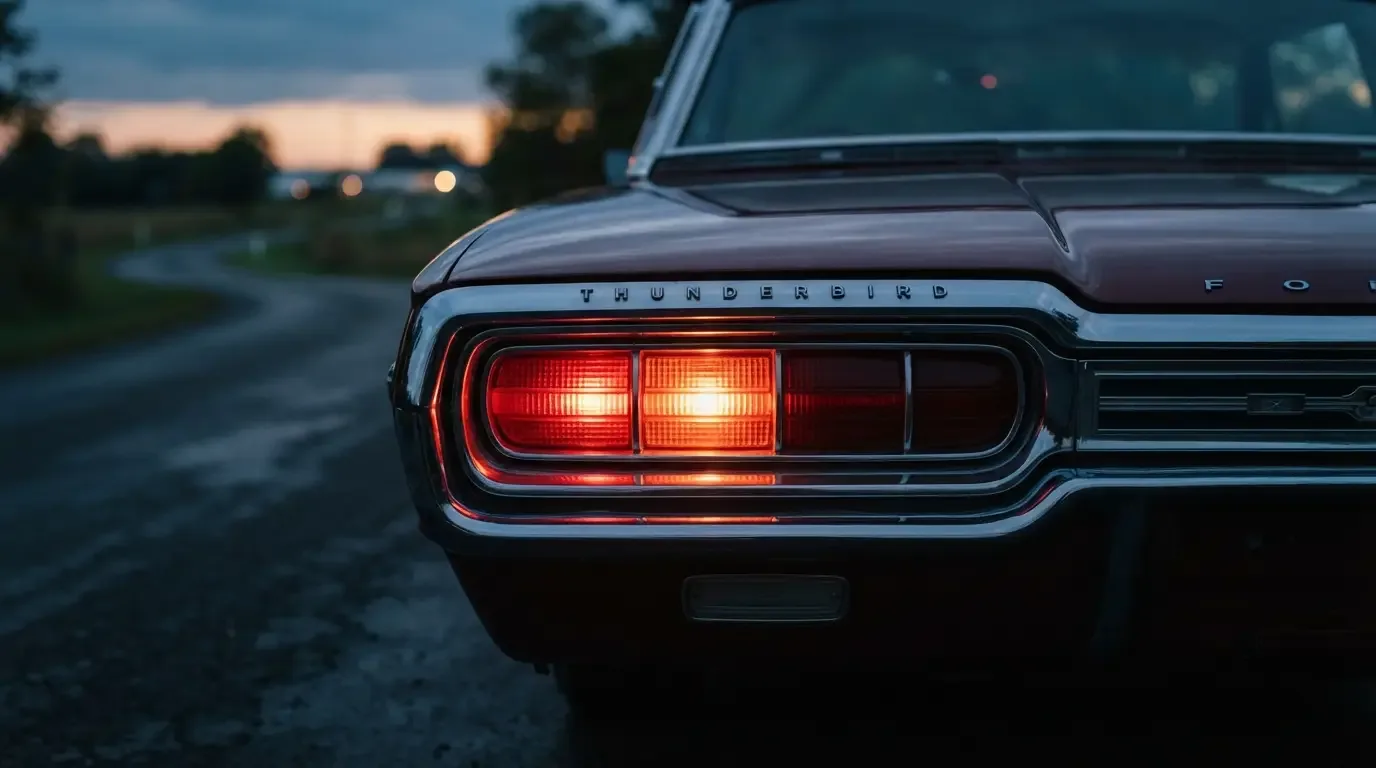
A taillight that told a story
Before 1965, turn signals on American cars did one thing. They blinked. On or off, left or right, that was the whole vocabulary. Ford changed the conversation with the 1965 Thunderbird by making the rear signal sweep across three segments in sequence, inner to outer, so the light appeared to travel toward the direction of the turn. It sounds like a small trick. In person it is not small at all. Cars lined up at a stoplight with a Thunderbird in the mix, and people noticed.
I have had customers bring in a running, driving, otherwise unremarkable 66 Thunderbird and the only thing they wanted to talk about was getting all six segments flashing correctly again. That tells you something about how much this feature mattered to the people who bought these cars new, and it still matters to the people restoring them now.
How the sequence actually works
The system uses a chrome trim panel across the rear of the car, split into three lit segments per side. Behind that panel sits a mechanical sequencer, essentially a small motor driven switch that fires each segment in order with a controlled delay, then resets. It is not electronic in the way we would build it today. It is a cam and a set of contacts doing a job that a modern control module would do with a chip. That is part of the charm and part of the headache. When the motor slows down with age or the contacts get dirty, the sequence gets sloppy instead of failing outright, which is honestly worse because it is harder to diagnose at a glance.
The sequencer itself was a small electric motor fitted with three cams, one per bulb in each side's taillight panel, each cam independently triggering its own switch. As the cams rotated, the three bulbs on a side lit in order, then the whole set turned off and the cycle repeated for as long as the turn signal stayed on.
The good news for anyone chasing one of these systems is that the basic idea did not change much through the decade. Ford kept refining the mechanism, but the core layout of three segments per side, firing inner to outer, stayed the format that people expect when they picture a Thunderbird from this era.
1965: the year it showed up
The 1965 model year is the starting point for this feature, and it landed on a car that was already trying to look different from everything else on the road. The Thunderbird of that era had a long hood, a formal roofline, and a rear end designed to be looked at, which made it the right car to carry something as theatrical as a moving light. Ford was not shy about promoting it either. Dealers used it as a talking point, and buyers who cared about being noticed at a stoplight had a real reason to pick a Thunderbird over a competitor with a plain flashing bulb.
If you want more on how the Thunderbird got to this point in its design language, read the background on the years just before this, when the car was settling into the look that made a feature like sequential lighting make sense in the first place.
By 1966 the format carried forward largely unchanged, and that car is worth a look too if you are comparing which model year fits what you want out of a Thunderbird.
Living with the system today
From a shop perspective, the sequencer is the part owners underestimate. It is not glamorous, it does not show up in a spec sheet next to horsepower, but it is one of the more complicated mechanical assemblies on the car relative to its size. Replacement units exist in the reproduction market now, which is a relief, because sourcing a good original core got harder every year. Anyone shopping a Thunderbird from this generation should ask specifically whether the sequential function works, not just whether the lights come on. A seller who says "the taillights work" without confirming the sequence is either not aware of the difference or hoping you will not ask twice.
Wiring corrosion, a tired sequencer motor, and cracked lenses are the three things I see most often on cars that have sat for a while. None of them are deal breakers on their own. They are, however, a fair reason to negotiate, since a proper sequencer rebuild or replacement is not a five minute fix.
"People ask me what makes a mid sixties Thunderbird feel special compared to anything else from that decade, and honestly, half the time I just point at the back bumper and wait for the light to sweep. That usually settles the argument."
- Mike Sullivan
Why it still matters
Sequential taillights eventually spread to other cars and other decades, but the Thunderbird got there first and got there in a way that still reads as confident rather than gimmicky. That first impression carries weight with collectors today. A Thunderbird with a correctly functioning sequential system feels complete in a way that one with a dead or disconnected sequencer does not, even if every other part of the car is sorted.
If you are in the market and want to see what is actually out there right now, you can shop classic Thunderbird listings and start comparing cars with that detail in mind. It is a small thing to check, and it tells you a lot about how a car was maintained.
What to look for at a car show
Walk any decent sized car show with a mid sixties Thunderbird in the lineup and watch what happens at dusk when someone hits the turn signal stalk. That is the real test of a correctly sorted car, not the paint, not the chrome. A crowd will gather around a taillight panel doing its job the way it did the day it left the assembly line, and the owner knows it. That reaction is not new either. Dealers in 1965 used the same trick on the showroom floor, running the sequence for customers standing at the back bumper before they ever opened a door or looked at the interior.
Owners who show these cars regularly tend to develop a habit of testing the sequence before every event, the same way they check tire pressure or top off the washer fluid. It takes thirty seconds and it avoids the awkward moment of a segment sticking mid sweep in front of a judge or a crowd. That kind of routine maintenance, small and unglamorous, is really what keeps a fifty plus year old mechanical sequencer working as intended decade after decade.
There is also a quieter side to this story worth mentioning. Not every owner cares about the sequence the way collectors do. Plenty of Thunderbirds from this era were bought and driven as regular family cars, and their owners never thought twice about the taillights beyond whether they worked. It is only in hindsight, once the feature became rare enough to be notable, that it turned into a selling point people specifically hunt for. That shift in perception, from ordinary equipment to signature detail, is part of what gives these cars their standing today.
Sources and notes
Related Reading
#collector cars
#ford thunderbird
#thunderbird history
#sequential taillights
#1965 Thunderbird
#classic Ford lighting

About the author
Mike Sullivan
Detroit-area muscle car enthusiast and restoration specialist with three decades of hands-on experience working on American iron.
Related Listings - Ford Thunderbird
Comments
Be the first to comment on this article.