Ford's advertising department treated the Thunderbird as a special case from the very first press kit in the fall of 1954, and the surviving material bears that out. This is thunderbird advertising history worth reading closely, because Ford's own copywriters reveal, generation by generation, exactly who they thought was buying the car and what they thought that buyer wanted to hear. The tone shifted considerably across twenty five years of production, tracking the car's own evolution from two-seat sports car to full-size personal luxury coupe, and reading the ad copy in sequence tells the Thunderbird's story almost as clearly as the cars themselves do.
1955 to 1957: selling exclusivity in small print
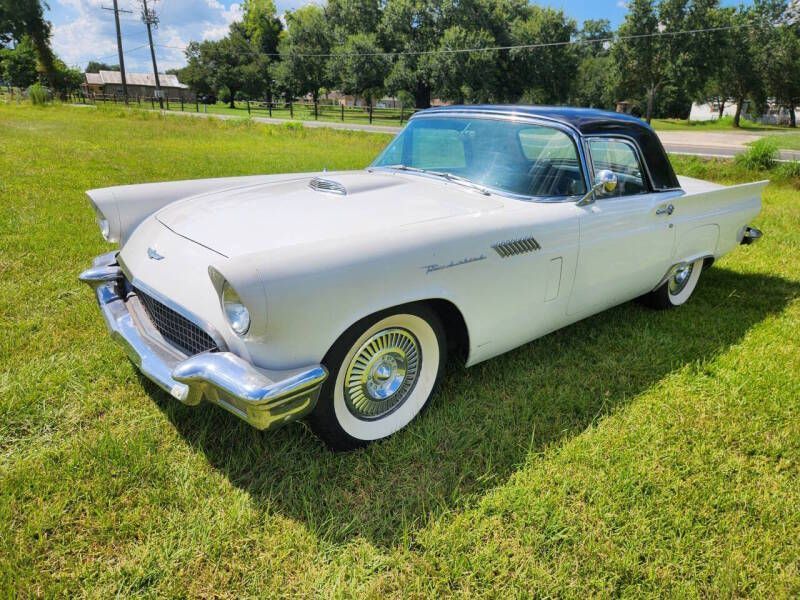
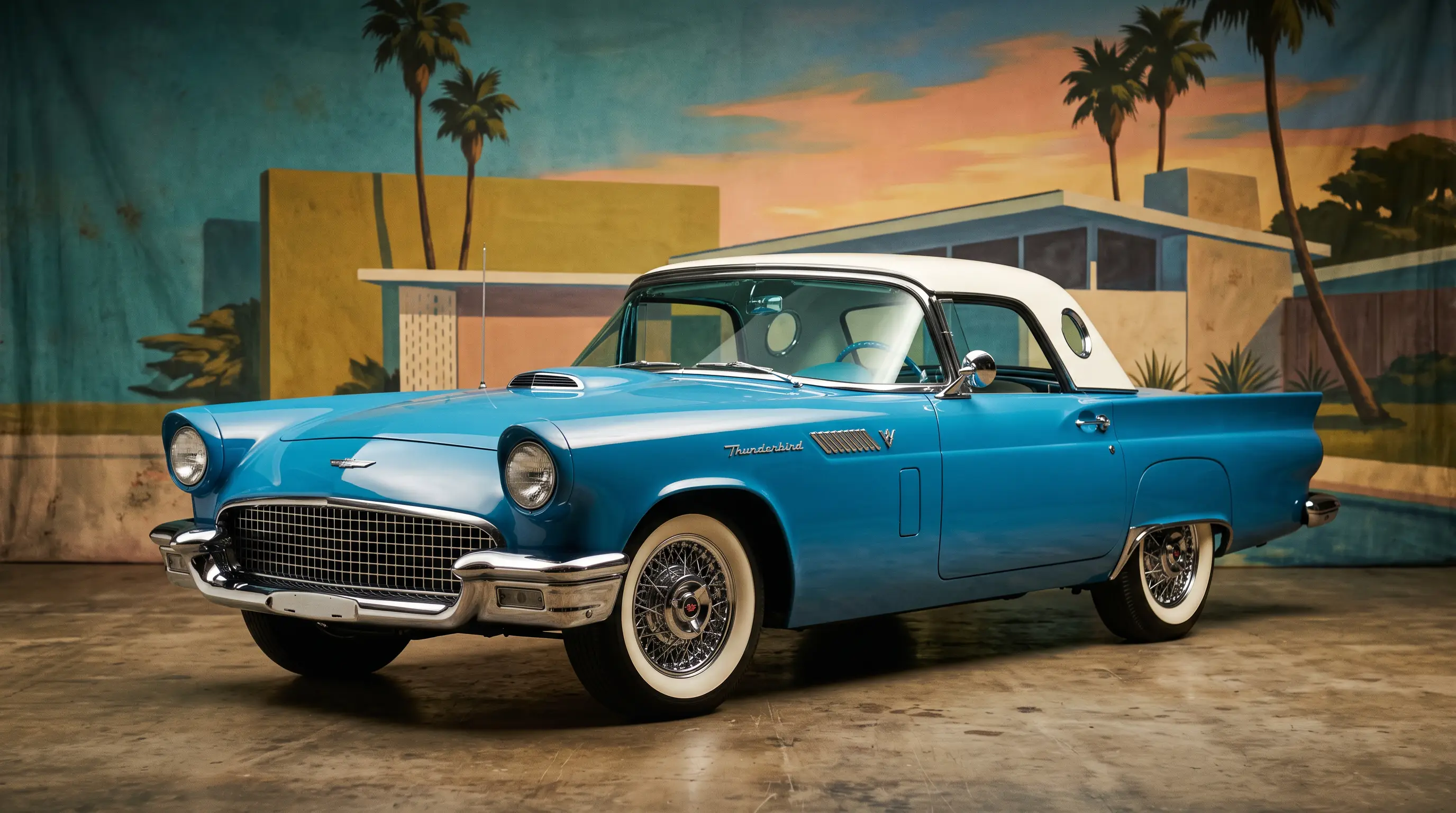
The earliest Thunderbird advertising leaned hard on the word "personal," a term Ford's marketing team used deliberately to separate the car from ordinary Detroit output. Print ads from this period rarely mention price prominently and instead describe the car in terms of individual pleasure, referencing its removable hardtop, its compact proportions, and its status as something built for one driver's enjoyment rather than a family's transportation needs. Ford was careful never to call it a sports car outright in most official materials, preferring "personal car" language that let the Thunderbird sit apart from both economy compacts and Corvette-style performance machines. Production for these three model years totaled just over 53,000 units combined (16,155 in 1955, 15,631 in 1956, and 21,380 in 1957) and the advertising's exclusivity angle was not exaggeration so much as an accurate reflection of genuinely limited output.
Regional dealership advertising from this period is a useful supplement to Ford's national campaigns, since local ads often reveal how individual dealers interpreted the corporate messaging for their specific markets. Newspaper tear sheets held in several regional archives show dealers in different parts of the country adjusting the personal luxury pitch to fit local tastes, some leaning harder on performance language in areas with strong hot rod culture, others emphasizing craftsmanship and finish for markets closer to the traditional luxury segment. The core national messaging held steady, but the local execution varied more than most collectors realize until they start comparing period tear sheets directly.
1958 to 1960: the four-seat pivot and a wider net
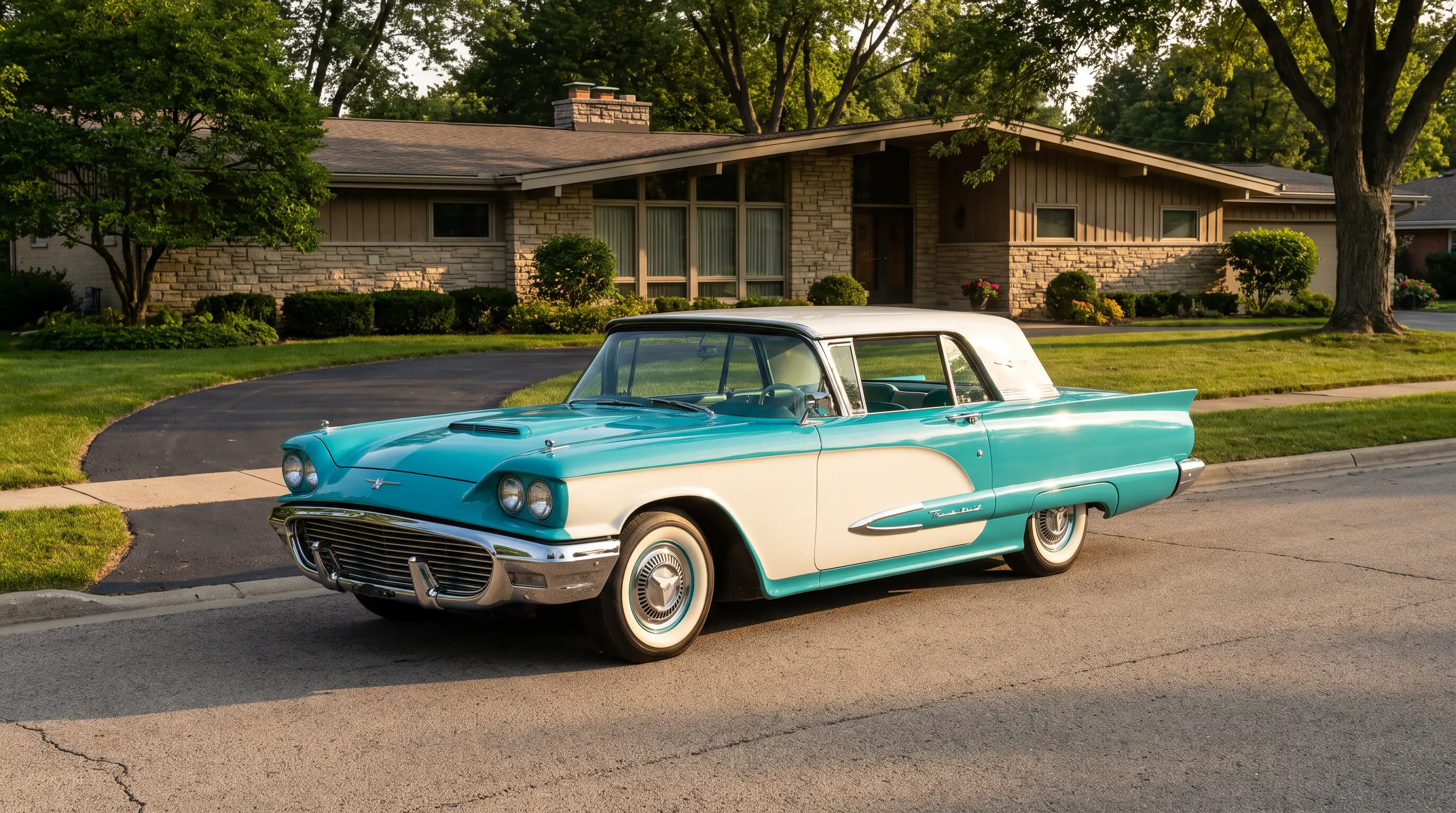
When Ford enlarged the Thunderbird to four seats for the 1958 model year, the advertising language shifted to match. Copy from this period introduces family-adjacent phrasing for the first time, describing the "Thunderbird look" and marketing the unibody Squarebird as roomy enough for real trips while still carrying forward the personal luxury vocabulary from the two-seat years. This was a deliberate hedge. Ford wanted the sales volume that came with a broader buyer base, four-seat Thunderbird production topped 198,000 units across those three years, well above the entire two-seat run, but did not want to abandon the exclusivity positioning that had made the nameplate valuable in the first place. The resulting ad copy tries to have it both ways, and largely succeeds, framing the Squarebird as a car spacious enough for a family yet special enough that not every family should have one.
1961 to 1966: the space-age Bullet Bird sells the future
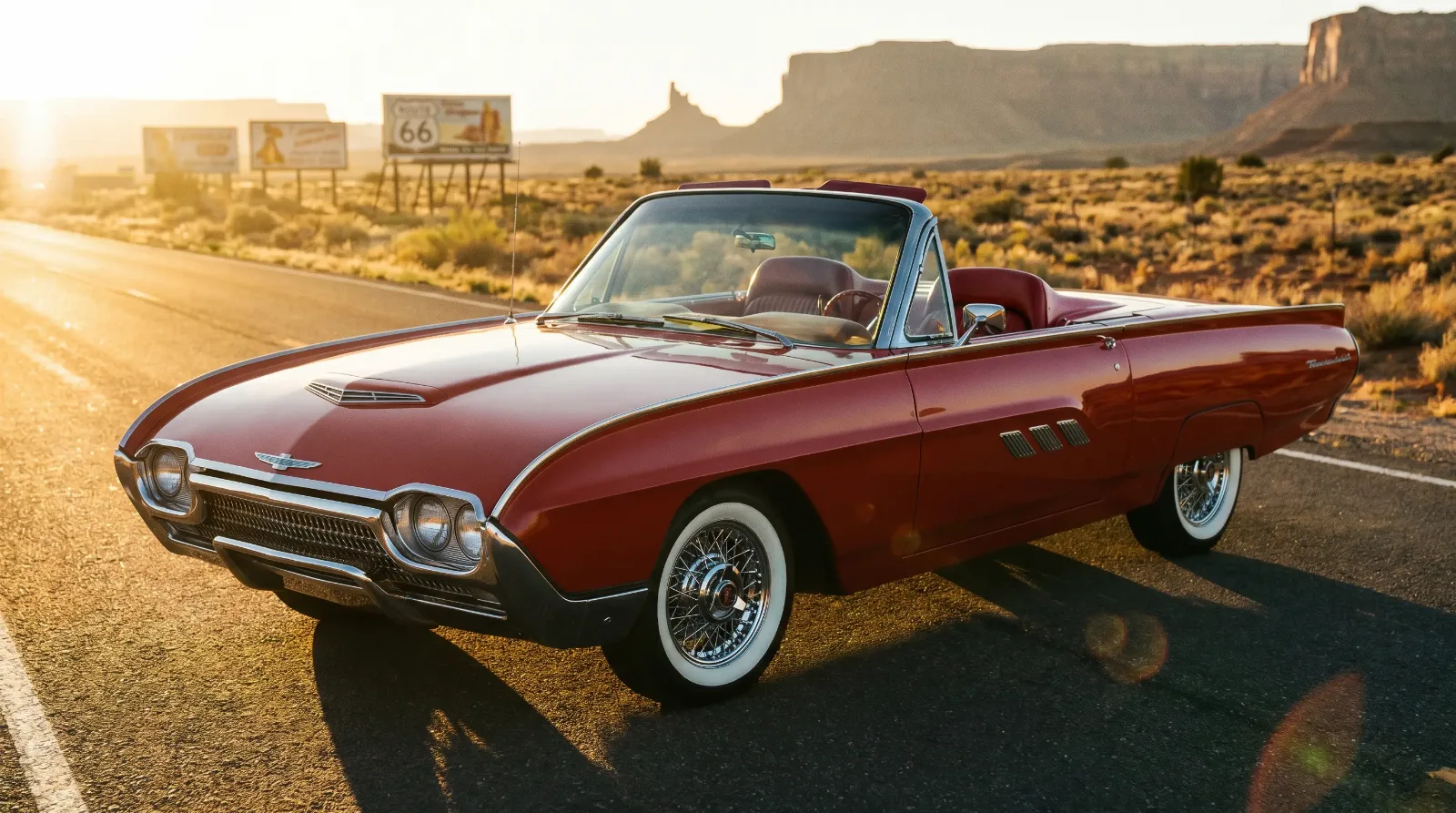
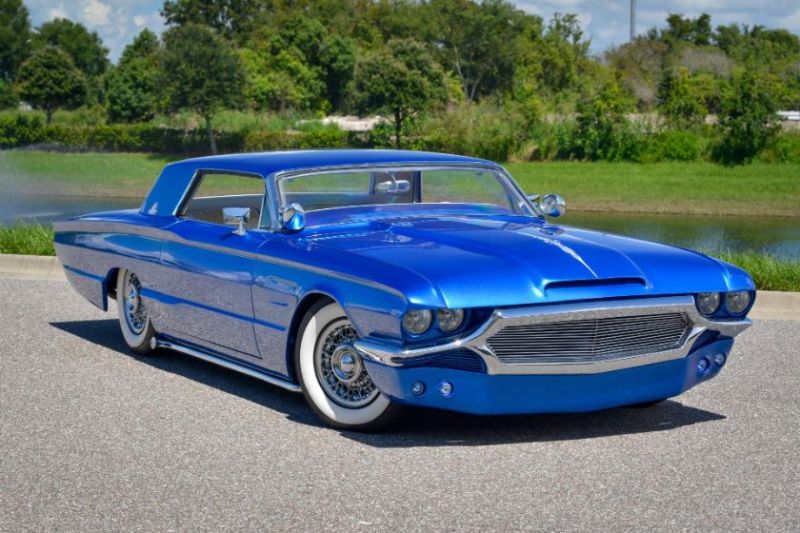
The Bullet Bird generation coincided with America's early space program, and Ford's advertising for these model years borrowed liberally from that cultural moment. Copy referencing swiveling bucket seats, unusual dashboard layouts, and the car's rocket-inspired styling appeared regularly, positioning the Thunderbird as forward-looking transportation for a country that had just watched its first orbital flights. This is one of the periods where misconceptions have crept into later retellings; some accounts describe official Ford materials as directly referencing NASA or specific astronauts, which the primary documents from this period do not support. Ford's copywriters were happy to evoke the space race in general terms, futuristic language, rocket imagery, forward-thrust styling cues, without making direct claims that would have required cooperation from the space program itself.
Sales brochures from these model years also introduced more technical language than earlier Thunderbird materials had used, describing suspension changes, unibody construction, and interior features in language pitched toward a buyer assumed to be reasonably informed about engineering rather than purely swayed by image alone. This shift reflects a broader change across the industry during the early sixties, when manufacturers generally began assuming a more technically literate customer base, but Ford applied it to the Thunderbird earlier and more thoroughly than most competitors applied it to their own personal luxury offerings.
"Read enough original Thunderbird sales literature and you start noticing what the copywriters were careful not to say as much as what they did say. The space age styling references are everywhere. Direct claims about NASA involvement are nowhere in the documents I have reviewed."
- Tom Ramirez
1967 to 1976: selling size and formality
As the Thunderbird grew into a genuinely large coupe through the late sixties and seventies, competing head-on with Cadillac and Lincoln for personal luxury buyers, the advertising language grew more formal as well. Copy from this period emphasizes hidden headlights, vinyl roof treatments, and interior appointments in terms borrowed from the language traditionally used to sell full-size luxury sedans. This shift tracks closely with the car's broader cultural repositioning during those years, a subject covered in more depth in the whole picture of how the Thunderbird moved through different identities across its production history. Sales during this stretch remained strong by Ford's own figures, though the advertising's emphasis on prestige over performance reflected a genuine shift in what the car was actually built to deliver by that point.
Reading the ads today
Model-year brochures also make excellent primary sources for dating an unrestored car, since specific option callouts, color chip references, and even the typography Ford used shifted noticeably from year to year within a single generation. A researcher trying to confirm whether a particular feature was factory-correct for a specific production month often gets further by comparing brochure language against a build sheet than by relying on general reputation or secondhand club lore, useful as that lore usually is for the softer questions brochures cannot answer.
What stands out most across two and a half decades of Thunderbird advertising is how consistently Ford's copywriters returned to the same core promise, individuality within reach, even as the product itself changed dramatically in size, mechanical layout, and price point. The two-seat 1955 model and the full-size 1976 coupe share almost nothing mechanically, yet the advertising for both makes essentially the same pitch about what owning one says about the buyer. For collectors and researchers working with original brochures and magazine tear sheets today, that consistency is a useful dating tool in its own right, since specific phrases and design emphases map fairly reliably to particular production years. Anyone building out a collection of period materials, or simply hunting for a car to go with them, can shop classic Thunderbird listings and compare what is currently for sale against the promises Ford's ad department made decades ago.
Sources and notes
- Ford Thunderbird (second generation) - Wikipedia
- 1960 Ford Thunderbird Production Numbers - Squarebirds.org
- Little Bird: The 1955-1957 Ford Thunderbird - Ate Up With Motor
- Hip to be Square: The 1958-1960 Ford Thunderbird - Old Cars Weekly
- The Ford Thunderbird - Ford Motor Company
- Classic Thunderbird Club International