
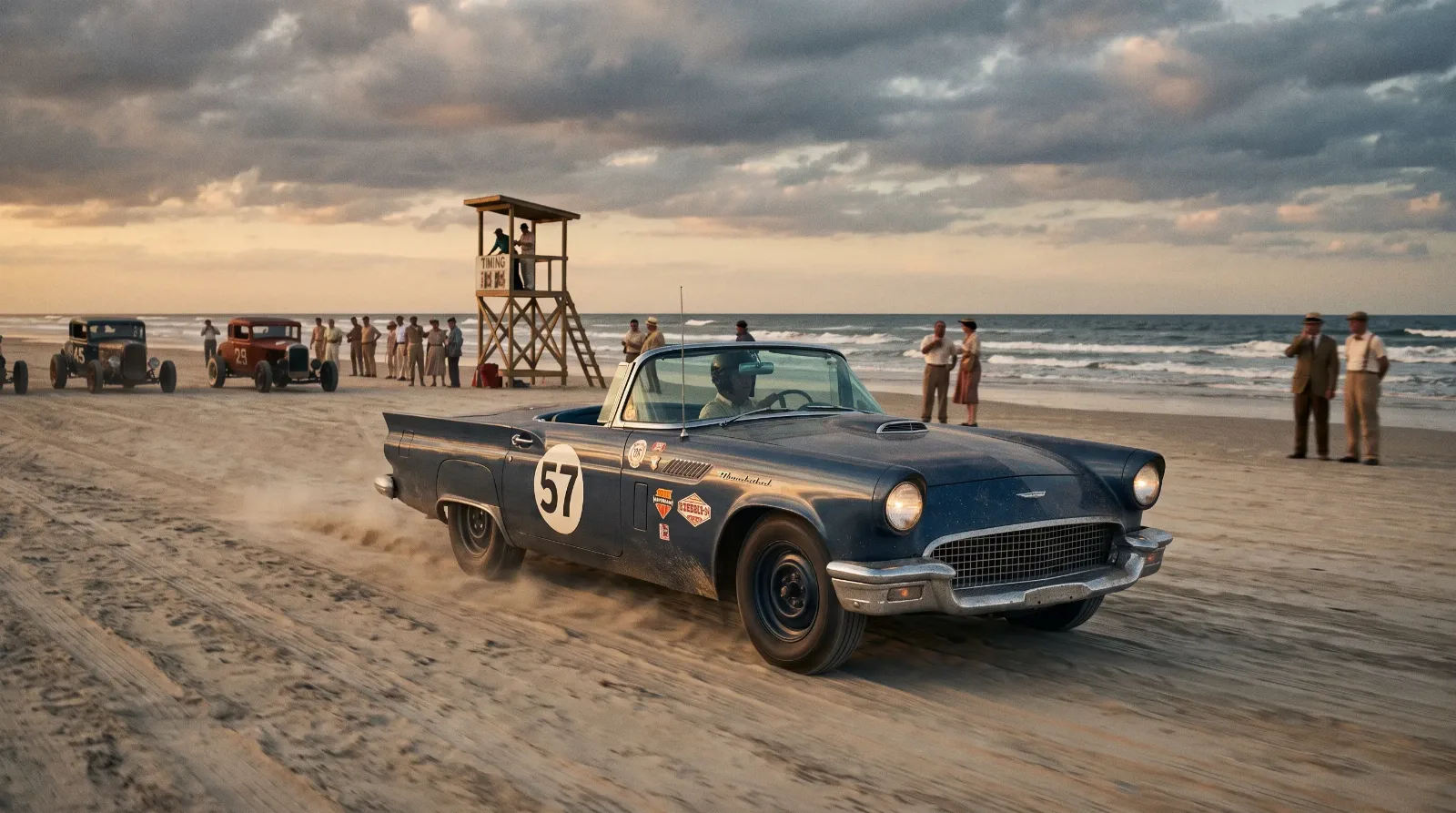
Daytona Beach in February 1957 was still a stretch of hard packed sand and paved highway, not the banked speedway that would open two years later, and it was there that the Ford Thunderbird made its most public case as a genuine performance car rather than a personal luxury runabout. Speed Weeks brought factory-adjacent teams from across Detroit to run flying mile trials on the beach course, and the Thunderbird, in its final two-seat model year, showed up ready to be timed against the fuel-injected Corvette it had been built to answer.
Car Features
7 min read
Thunderbird at Daytona Speed Weeks 1957
In February 1957 the two-seat Thunderbird ran the flying mile at Daytona Speed Weeks, a compressed and well-documented chapter that closed just months before the racing program itself ended.
What Speed Weeks actually measured
The Daytona Beach and Road Course event combined a measured mile on the sand with a road course layout using a section of Highway A1A, and cars were timed over a flying mile in both directions to cancel out wind effects. This was not a race in the conventional sense so much as a public, verifiable speed contest, the kind of event where a manufacturer could point to a stopwatch and say, credibly, that its car had done something specific and repeatable. For Ford, arriving with supercharged F-code and dual quad E-code Thunderbirds, Daytona in 1957 was a chance to put a number on the record that dealers could repeat to customers all year.
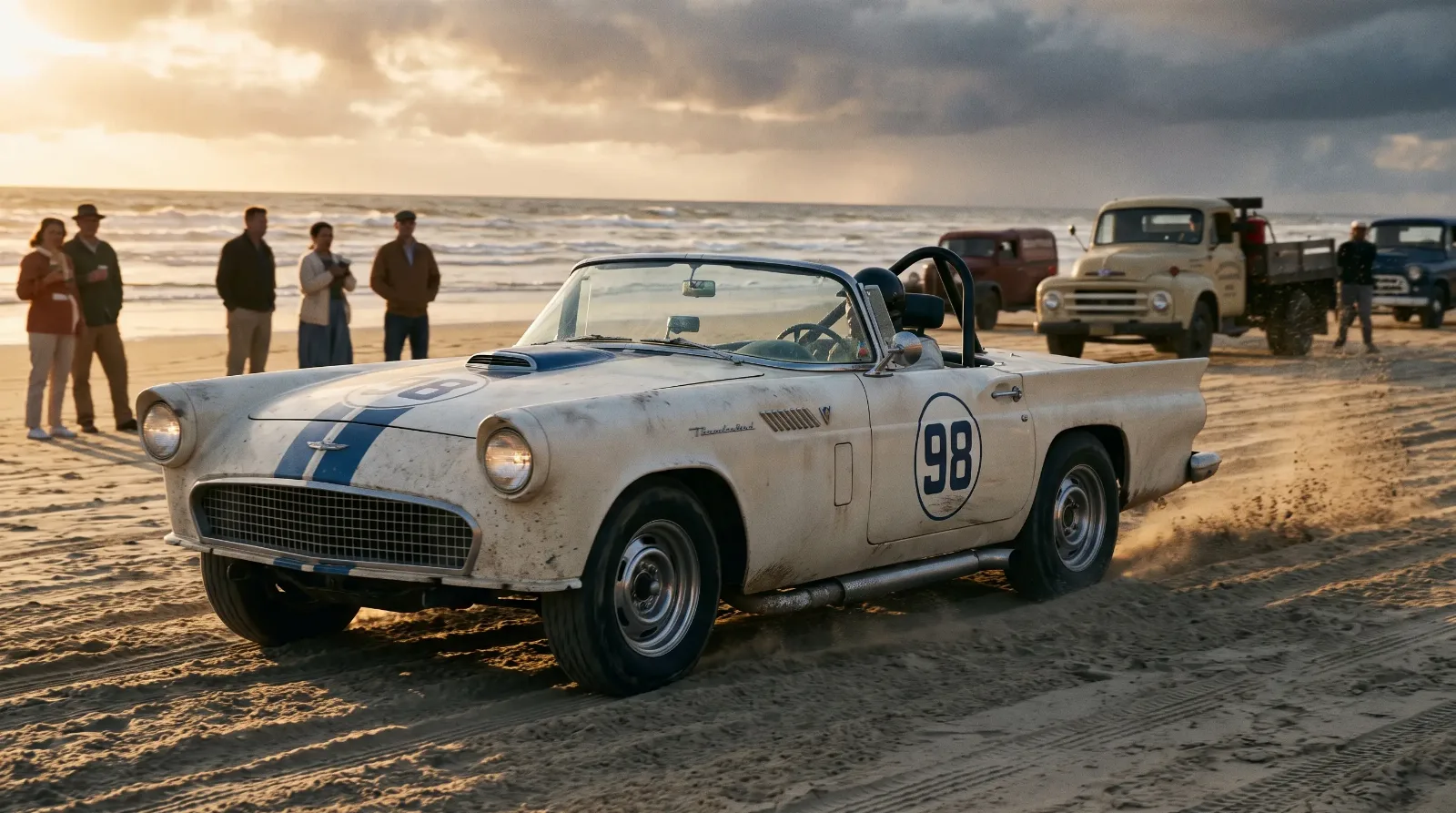
The Thunderbird's showing at Daytona in 1957 was strong enough to matter in period advertising. A supercharged Thunderbird driven by Harold Mauck ran 138.755 mph for the two-way flying mile, a new record for an American sports car at the beach, roughly 6 mph better than the mark the Corvette had set there the year before. Beyond that specific run, the exact top figures recorded for other individual entries vary by source and by which specific car and driver combination is being cited, so a single number attached to any other Thunderbird's run deserves caution before it gets repeated as gospel.
The cars and the people behind them
Ford's presence at Daytona in 1957 ran through the same Pete DePaolo Engineering operation that built the factory's quiet racing program that year, keeping Dearborn's name off the entry list while its engineering and parts underpinned the effort. Drivers with real competition credentials, rather than dealership staff or amateur enthusiasts, were behind the wheel, and the cars themselves carried the supercharged and dual carburetor engine options Ford had developed specifically to compete with Chevrolet.
The atmosphere at Speed Weeks in the 1950s was informal by later standards, closer to a gathering of serious enthusiasts and factory representatives than the highly organized, sponsor-driven motorsport spectacle Daytona would become once the speedway opened. Cars ran on public sand next to spectators who could walk right up to the machines between runs, a level of access that simply does not exist at a modern racing event.
Documenting a beach event decades later
Researching a mid century beach racing event presents its own challenges that a purpose-built race track does not. There was no permanent grandstand recording every entrant with a modern timing transponder. Results came from a mix of official American Automobile Association timing officials, period newspaper coverage out of the Daytona Beach area, and manufacturer press materials that were not always consistent with each other on the exact figures. A careful researcher working with 1957 Speed Weeks results has to cross-reference multiple period sources rather than trust any single account, and even then some gaps in the record remain.
What survives clearly enough to state with confidence is the format, the presence of factory-adjacent Ford entries running supercharged and dual carburetor Thunderbirds, and the general competitive standing of those cars against the Corvette entries that same week. What survives less clearly, and what deserves caution before repeating as fact, are the precise top speed figures attributed to specific individual cars and drivers, since period reporting on exact numbers was not always uniform between publications covering the same event.
Weather and tide were as much a part of the event's logistics as any car's specification sheet. Timing runs on the sand depended on a hard, flat surface, which meant organizers worked around the tide schedule and monitored beach conditions closely in the days leading up to competition. A soft or rutted stretch of sand could ruin a run regardless of how well prepared the car or driver were, and period accounts of Speed Weeks frequently mention delays and rescheduled sessions tied directly to conditions on the beach itself rather than anything mechanical.
Why 1957 was the last chance for this kind of running
The Automobile Manufacturers Association's June 1957 ban on factory-backed racing closed the door on the kind of quiet manufacturer support that had brought the Thunderbird to Daytona that February. Speed Weeks continued as an event, but the direct factory involvement that had defined the Ford effort at the beach in 1957 could not continue in the same form. Combined with the two-seat Thunderbird's own retirement after the 1957 model year, the Daytona showing became a closing chapter rather than the start of an ongoing program.
That compressed timeline is part of what makes the 1957 Daytona story significant to Thunderbird history specifically. The car's most public performance credential arrived in the same handful of months that both the racing program and the two-seat body style were coming to an end, which gives the whole episode a defined beginning and end that is unusual in automotive history, where most stories sprawl across a decade or more.
"Provenance from a single documented season is still provenance. The 1957 Daytona record for the Thunderbird is precise enough, and short enough, that a serious researcher can actually trace it end to end."
- Sarah Whitfield
What this means for the car's standing today
A Thunderbird with genuine, documented ties to the 1957 Daytona Speed Weeks entries carries a different kind of significance than a car that simply shares the model year. Verifiable competition history from a specific, well-documented event tends to hold its value better than vague claims of period racing involvement, precisely because researchers can check public records, period photographs, and entry lists against a specific car's chassis and engine numbers.
For the broader context on how the two-seat Thunderbird reached this moment, our complete history traces the model from its 1955 introduction through the 1957 model year changes that made the Daytona cars possible. And for those who want to see what is currently available from this generation, browse classic Thunderbird listings to compare documented cars against ones offered with looser claims about their history. As with any car tied to a specific historical event, the documentation is the real product being sold, and it is worth paying for accordingly. A stopwatch reading from 1957 cannot be reissued. Whatever paperwork survives to back it up is the only thing standing between a real record and a good story, and the two are not always the same thing at a car show.
Sources and notes
Related Reading
Have a
Ford Thunderbird
for Sale?
Reach thousands of serious classic car collectors across the US.
Sell It Here →
Are You a Classic Car Dealer?
List your full inventory and connect with targeted classic car buyers.
Join as a Dealer →
#ford thunderbird
#Daytona Speed Weeks
#two-seat thunderbird
#1957 thunderbird
#Daytona Beach racing
#vintage motorsport

About the author
Sarah Whitfield
Third-generation classic car collector specializing in pre-war American and European coachbuilt automobiles. Researcher and concours enthusiast.
Related Listings - Ford Thunderbird




Comments
Be the first to comment on this article.