
Every second-generation Camaro built for 1970 left the plant as a 1970 model, yet collectors have called it the 1970 1/2 Camaro for more than fifty years. The half is not a factory designation. It is shorthand for a calendar problem: the new car reached the public on 26 February 1970, about five months behind schedule, and the reason for that delay is still told wrong about as often as it is told right.
Car Features
7 min read
The 1970½ Camaro: Why the Second Generation Arrived Late
The 1970 1/2 Camaro arrived on 26 February 1970, five months late. The records blame failed quarter-panel dies at Fisher Body, not a strike.
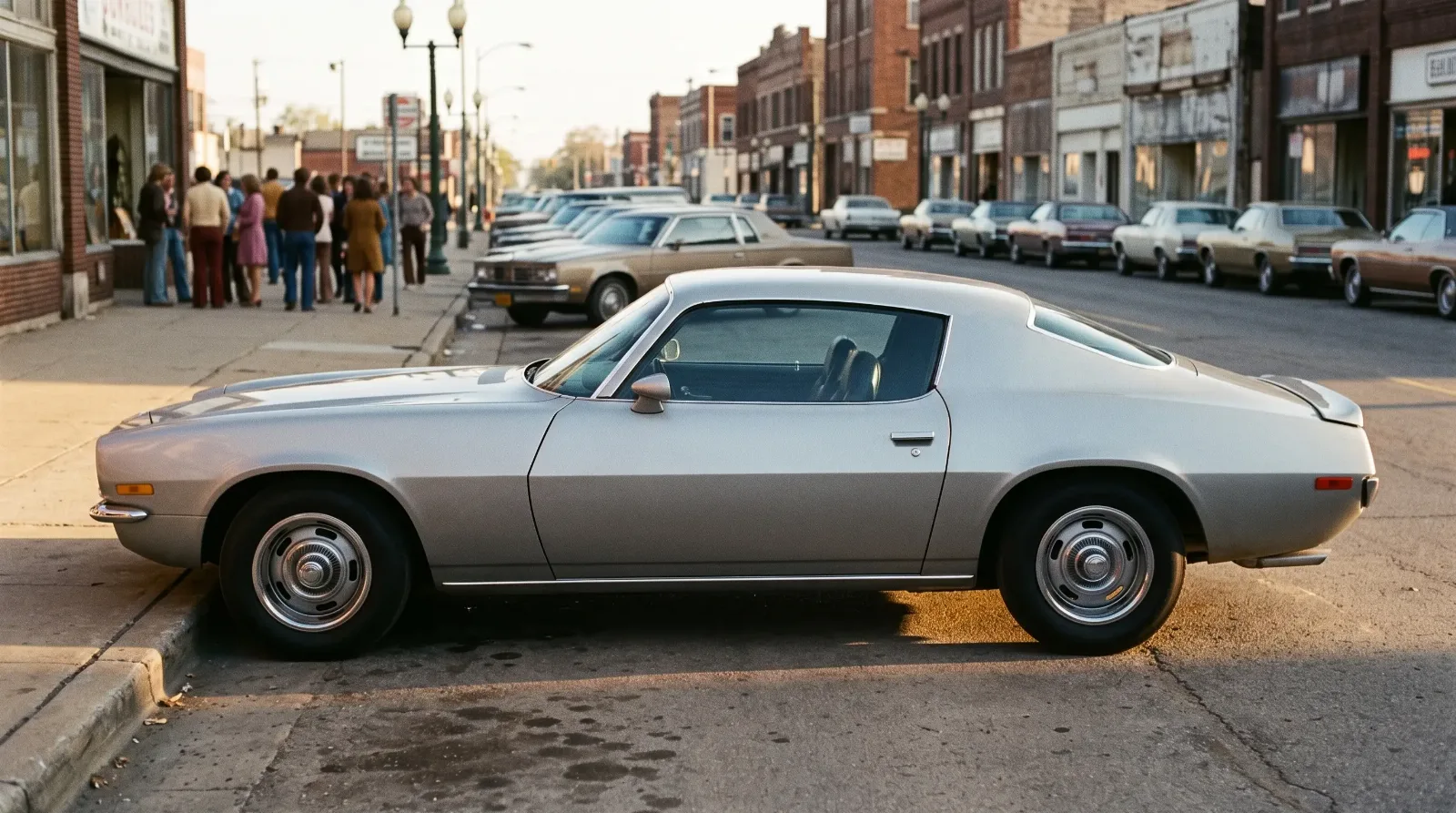
The records point to a tooling failure, not a labor dispute. What follows is the sequence as the production and registry sources lay it out, along with what the late start meant for the cars themselves. The full run from 1970 to 1981 is covered in the second-generation Camaro story; this account stays with the months on either side of the launch.
Dies, not strikes: what held up the 1970 1/2 Camaro
The new body existed on paper and in clay well before the model year began. The trouble was in the press shop. According to the Camaro Research Group's account, the complex rear quarter-panel dies failed during final tryout at Fisher Body and had to be rebuilt. A quarter panel is not a part that can be improvised. Without dies that drew the sheet metal cleanly, there was no rear body, and without a rear body there was no car.
A different explanation appears in some magazine histories, which say the car was "delayed by labor unrest." The confusion is understandable. The second generation did have real labor trouble: a 67-day corporate-wide GM strike in the fall of 1970, and a far longer UAW strike at Norwood in 1972. Neither fits the 1970 launch, which was already months late before either one began. Two other accounts lean the same way as the registry. One says simply that the 1970 tooling was not ready; another blames Fisher Body parts delays and the plant changeover. Read together, the sources describe one problem seen from different desks.
It is worth noting which panel failed. The stylists had drawn a long-hood coupe with deep, curved rear quarters, and those quarters carried most of the new shape. How that look came together is the European styling story. For this account, the point is narrower: the hardest panel to stamp was the one that defined the car.
The longest 1969 model year
While the dies were rebuilt, Chevrolet kept building the old car. The Camaro Research Group says the end of the 1969 model year moved from July to November 1969, four months longer than normal, and that the extension had nothing to do with labor problems. From August to November all of that output came from Norwood, Ohio. A registry member's forum account has Norwood shutting in mid-July for a changeover that never came, then restarting 1969 production on 11 August 1969, while Van Nuys, California, stopped building 1969s at the end of June 1969 and did not resume. A separate source has the last 1969s built in early December.
The extension explains several things that confuse buyers today. Model-year 1969 production reached 243,085 cars, 211,922 from Norwood and 31,163 from Van Nuys, the highest total of the first generation. Some late 1969 cars were titled as 1970s in certain states, which is one reason a title alone never settles what a car is. And one writer who drove GM's 1970 lineup at the Milford Proving Ground in June 1969 recalls that the only Camaros and Firebirds there were carryover 1969s, because nothing else was ready to show.
For the dealer network, the arrangement had an odd effect. The showroom car in October 1969 was a 1969, still selling against competitors that had already launched their new models. The Camaro sat out the fall introduction season entirely.
February 26, 1970, and a quiet arrival
Build information for the new car was released to the plants in February 1970. Chevrolet's launch advertising, run under its "Super Hugger" theme, announced the new Camaro for February 26th. The Z/28 arrived on the same day with the LT-1 350, rated 360 hp gross and 380 lb-ft, as a $572.95 option. Base prices started at $2,749 for the six-cylinder coupe, with the V8 adding $90. One account has the press driving the new cars at Ontario Motor Speedway in California while the track itself was still under construction; the speedway did not open to the public until August 1970.
The public response was muted. Car and Driver's May 1970 issue reported that the new car "generally went unnoticed," even in Los Angeles. The magazine was not dismissing the Camaro; its own Z/28 test car drew a comparison to an American Ferrari challenger. The problem was timing. Buyers who wanted a sporty 1970 car had been shopping since the fall, and Dodge had introduced a new pony car of its own in the autumn of 1969, and how the new Challenger measured up against the late Camaro is a story of its own.
Reading the record: what the short year produced
The production figures are the clearest measure of the delay. They are summarized below, with 1969 included for scale.
| 1970 Camaro item | Figure |
|---|---|
| Public introduction | 26 February 1970 |
| Base price, six-cylinder coupe | $2,749 (V8 add $90) |
| Z/28 option price | $572.95 |
| Total model-year production | 124,901 |
| Cars with the 250 six | 12,578 |
| Z/28 production | 8,733 |
| 1969 production, for comparison | 243,085 |
The 124,901 total is the figure four sources agree on; a lower count of 117,604 appears in one profile and is the outlier. Against 1969, the second generation sold barely half as many cars in its first year. That is roughly what a selling season of about seven months should produce, and it says more about the calendar than about the car.
A few details belong to the 1970 cars alone. It is the only year with the "Camaro by Chevrolet" decklid emblem, and its side marker lamps do not flash with the turn signals. Both are easy to lose in a restoration that borrows later parts, and both are worth checking on any car offered as an original 1970.
That limitation matters when comparing 1970 Camaros for sale. Because every car is a 1970 on its title and the VIN cannot confirm an engine or package, the build documents and the details above carry more weight than any 1970½ badge in an advertisement.
What the late start cost Chevrolet
The short year had consequences beyond the sales chart. The 1971 models were introduced in late September 1970, during the 67-day GM strike, so the first model year of the second generation lasted only about seven months in showrooms. Chevrolet lost a fall launch, a full season of buyers, and the first-impression press coverage that a new body usually earns.
"The 1970½ label is a fair nickname and a poor history lesson. Every one of these cars is a 1970 on paper, and the half came from a set of quarter-panel dies, not a picket line."
Tom Ramirez
The longer record is kinder to the car. Second-generation production stayed above 100,000 in every year except the strike-hit 1972 and 1973, and it peaked at 282,571 in 1979, the highest of any Camaro model year. The body that arrived late lasted twelve model years. Seen against how the Camaro evolved over the following decades, the delay is a footnote. For the people building and selling Camaros in 1969, it was the whole year.
Sources and notes
- Camaro Research Group: general information, 1969 model-year extension and production by plant
- Camaro Research Group forum: Norwood and Van Nuys 1969 production in summer 1969
- Car Guy Chronicles: the 1970 Camaro, coming late to the party
- Silodrome: Chevrolet Camaro Z27 SS and the quarter-panel die story
- Hagerty: the lasting design influence of the second-gen Camaro
- Wikipedia: Dodge Challenger (1970), introduced autumn 1969
Related Reading
Have a
Chevrolet Camaro
for Sale?
Reach thousands of serious classic car collectors across the US.
Sell It Here →
Are You a Classic Car Dealer?
List your full inventory and connect with targeted classic car buyers.
Join as a Dealer →
#camaro history
#camaro production
#fisher body
#1970 1/2 Camaro
#second generation Camaro
#1970 Camaro
#Norwood

About the author
Tom Ramirez
Corvette researcher and historian based in Bowling Green, Kentucky. Two decades documenting Corvette production history from original factory records.
Related Listings - Chevrolet Camaro
Comments
Be the first to comment on this article.