
Park a gasser next to any other old car and you know it in a half second. The nose points at the sky, the front tires are skinny, and the whole thing looks like it is about to launch off the trailer on its own. People call it aggressive. I call it honest. Every ugly, wonderful thing about a gasser came straight out of a rulebook, and once you understand that, the style stops looking like a costume and starts looking like a solution.
Car Features
14 min read
The Gasser Story
The gasser is one style where the look and the engineering are the same conversation. Here is what it is, where the stance came from, and how to build one.
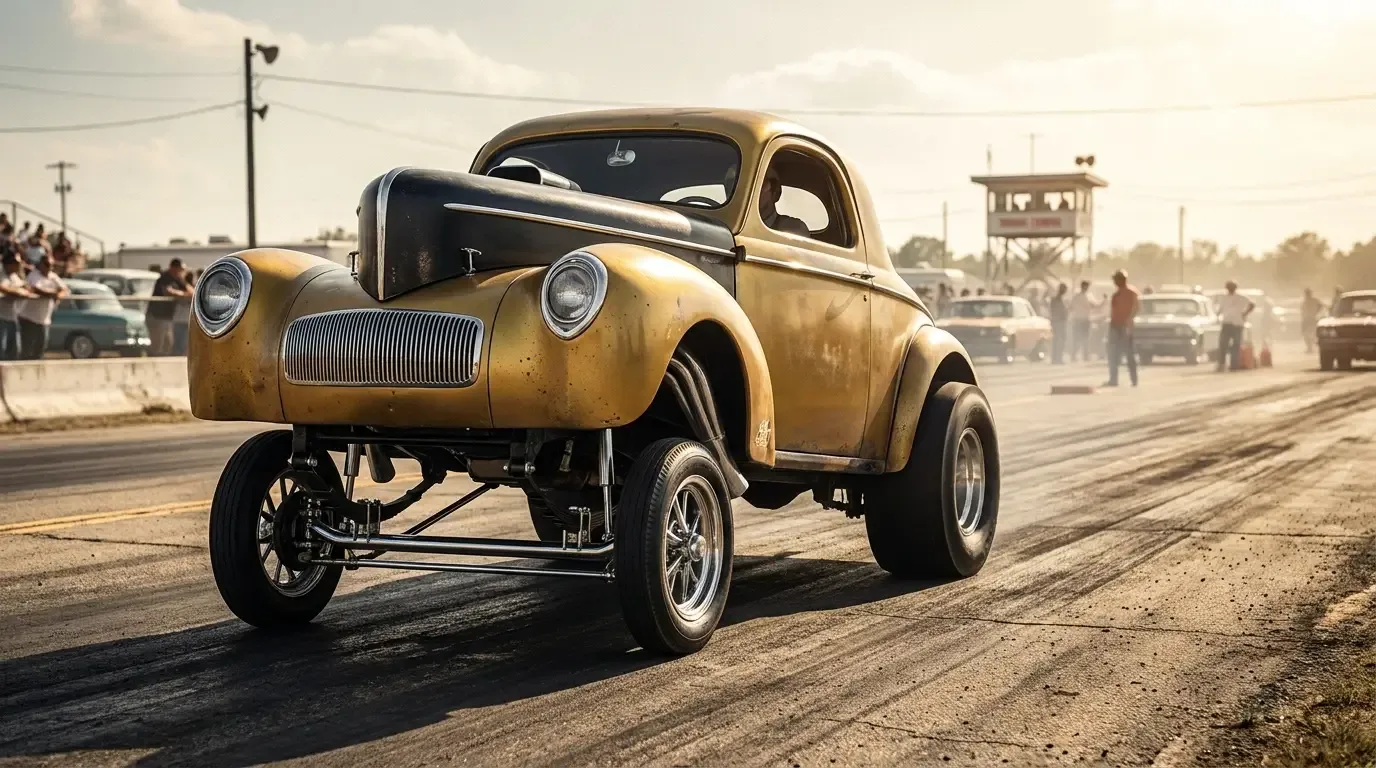
I have built a few of these, driven more, and argued about all of them. The gasser is one of the few American car styles where the look and the engineering are the same conversation. You cannot fake the stance without changing how the car works, and you cannot change how the car works without changing the stance. That is why a real one reads different from a lowered coupe with a paint job. This is the whole story: what a gasser actually is, where the look came from, and what it takes to build one that holds up.
What a gasser actually is
A gasser is a drag car built for the gas classes that ran in NHRA and AHRA competition through the late 1950s and 1960s. The name is literal. These cars burned pump gasoline, not nitro or alcohol, and they competed in classes defined by weight divided by engine displacement. Get the ratio right and you had a shot at a class win. That single number, pounds per cubic inch, drove almost every decision a builder made.
The recipe was simple to describe and hard to master. Start with a light, small body. Strip everything you legally could. Stuff in the biggest, most worked-over engine the class allowed. Then get the weight forward and up so the car would plant its rear tires and leave hard on a sticky launch. The nose-high stance was not a fashion choice at first. It was weight transfer and clearance, and it happened to look mean, so it stuck.
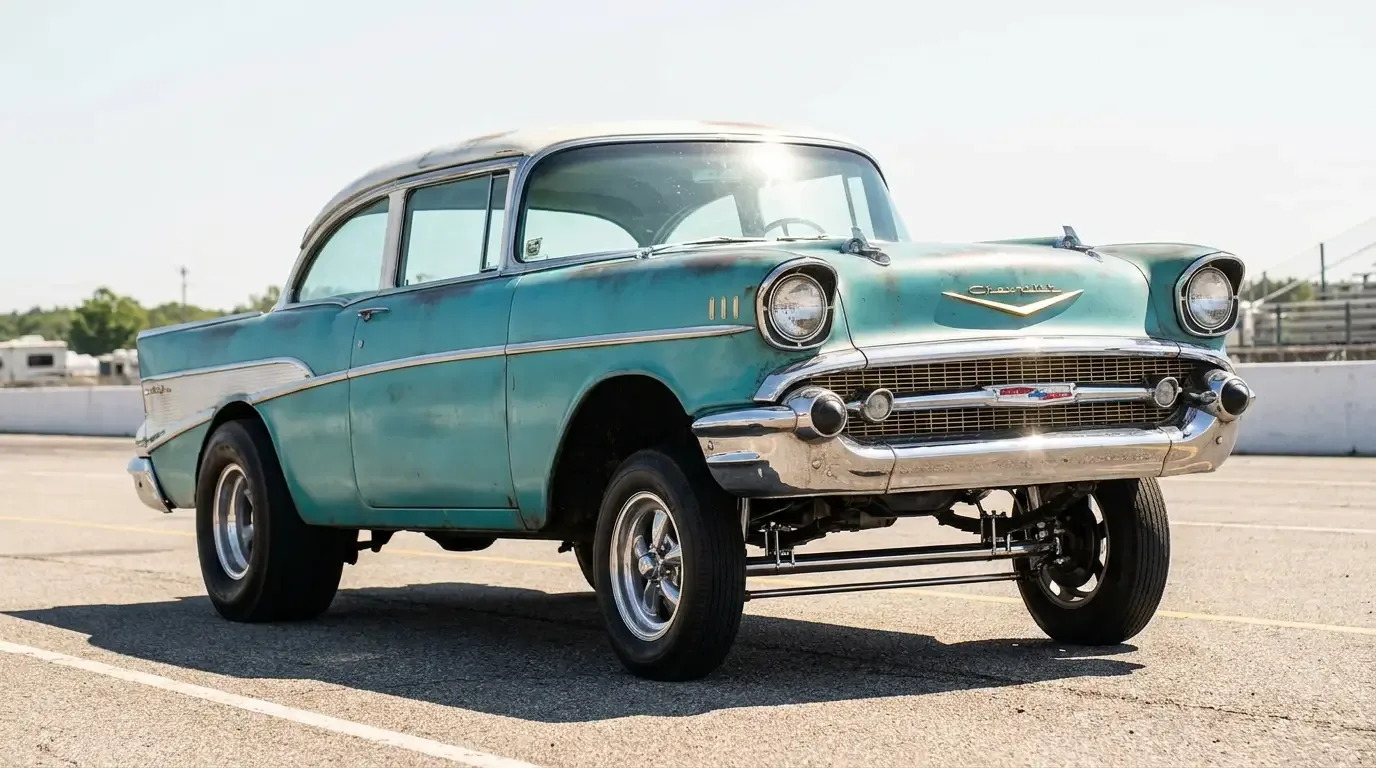
The classic gasser silhouette usually sat on a solid front axle instead of independent suspension. That axle is the thing your eye locks onto. It sets the front end high, shows off the chassis, and tells anyone watching that this car was set up to race, not to cruise. The bodies that became famous were the light ones: the Willys coupe, the tiny Austin and English Ford Anglia, and the tri-five Chevrolet, which was cheap, plentiful, and easy to make fast.
Where the straight-axle look came from
Here is the part people get wrong. The famous nose-high, straight-axle gasser look did not exist at the very start. Early gas-class cars often kept their stock or near-stock front suspension and sat fairly level. The dramatic stance came later, and it came from racers chasing traction.
To get more bite off the line, builders wanted weight shifting rearward under acceleration and the front end lifting. Swapping the independent or stock front suspension for a solid tube or leaf-sprung straight axle did several things at once. It moved weight, it raised the front, it was light, and it was dead simple to build and repair. Once a few winning cars showed up wearing that look, everybody copied it, because in drag racing you copy whatever just beat you.
There is a practical side too. A stock front suspension on these old cars was never designed for repeated hard launches and hard braking at the strip. A solid axle with a simple spring setup was easy to inspect, easy to swap, and easy to adjust between runs. When something bent, you straightened it or replaced it in the pits. Racers value parts they can fix with the tools in the trailer, and the straight axle fit that life perfectly.
So the straight axle became the signature not because someone decided it looked cool, but because it worked and it was cheap. The style is a fingerprint of the rules and the physics. That is the thing I keep coming back to with new builders who ask me why gassers look the way they do. The look is a side effect. Chase the function and the look shows up on its own.
"People think the stance is the point. The stance is the receipt. It is proof the car was built to leave hard, and if you jack a car up without doing the rest of the work, everybody at the show can tell in about two seconds."
Ray Delgado
The stance, and why it is not just ride height
A gasser stance is a whole geometry, not a single measurement. Get one piece wrong and the car looks off even if you cannot say why. The front sits high on that straight axle. The rear sits lower, usually on leaf springs, sometimes with traction bars hanging under it. The car rakes forward from back to front, and the wheels and tires exaggerate the whole thing: narrow and tall up front, fat and short out back.
That skinny front tire is doing real work. Up front you want the least rolling resistance and the least weight you can get away with, so builders ran narrow bias-ply fronts that look almost comically thin by modern standards. Out back you want a big contact patch to put the power down, which is where the wide rear slicks or cheater slicks came in. The visual tension between those two ends is a huge part of why a gasser looks right.
- High front ride height on a solid axle, forward rake into a lower rear.
- Narrow, tall front tires; wide, short rear tires for traction.
- Minimal front weight, weight bias set up to transfer rearward on launch.
- Chassis and axle left visible instead of hidden behind bodywork.
When I evaluate somebody's build, I look at the relationship between all of those, not one number. A car can be tall and still look wrong if the rake, the tire sizes, and the wheel offsets are fighting each other. A car can be more subtle and look absolutely correct because every element agrees with every other element.
"I would rather see a gasser that sits an inch too low with everything in proportion than one jacked to the moon with mismatched tires. Proportion is the whole game. The rake, the rubber, and the wheels have to be telling the same story."
Ray Delgado
The drag-racing history and the gas classes
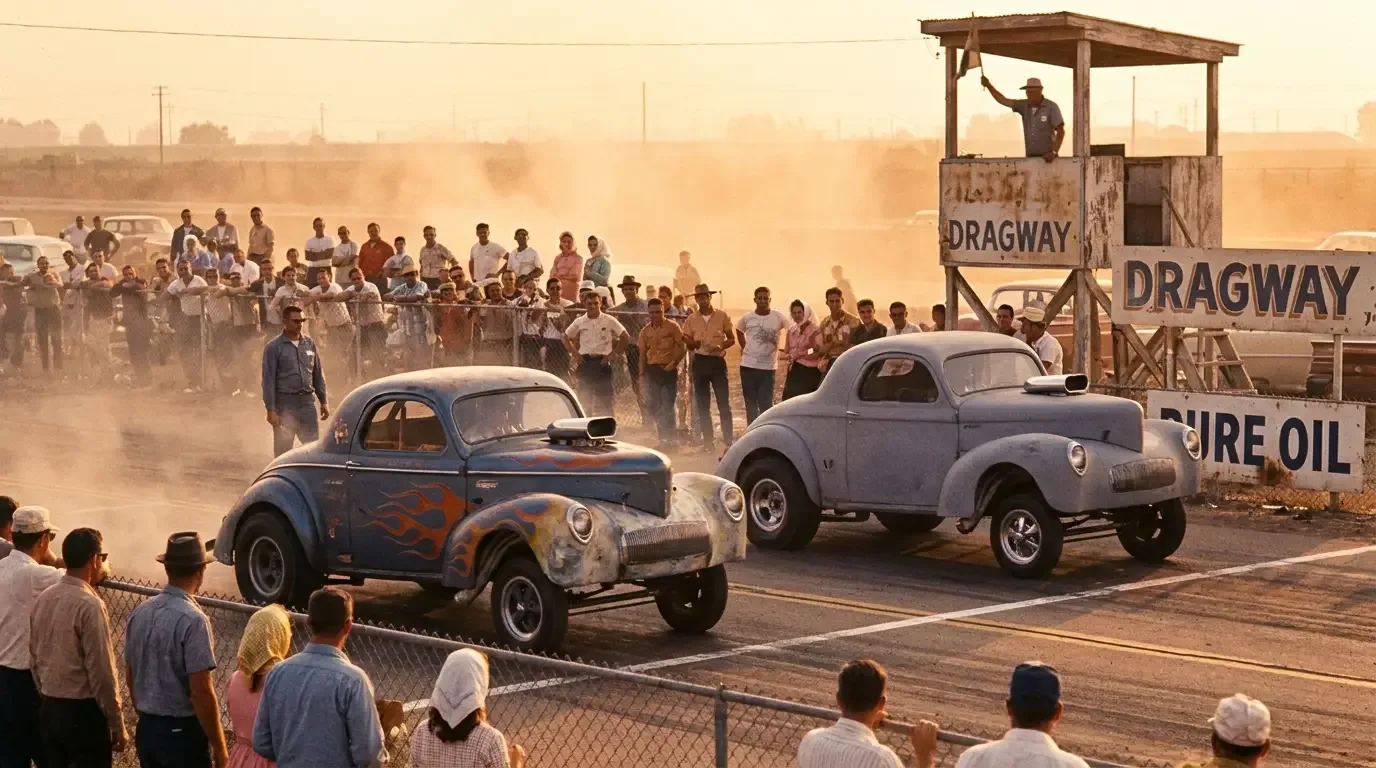
To understand gassers you have to understand the sanctioning bodies that made them. The NHRA and the AHRA ran organized drag racing with defined classes, and the gas classes sat in a specific spot in that structure. They were for hopped-up, gasoline-burning cars that were closer to something you could imagine on the street than the wild fuel dragsters, but far past anything stock.
The class letter, A through C and beyond, was tied to weight-to-displacement. Racers wanted to sit at the light end of a class with the biggest engine that bracket allowed. That pushed two obsessions at once: cut weight everywhere and build the engine to the edge of the rules. Fiberglass front ends, gutted interiors, plexiglass windows, aluminum where you could get it, all of it chased a better ratio.
Through the 1960s the arms race got wilder. Builders moved engines and even started messing with wheelbase to shift weight, which eventually spun off into the altered-wheelbase cars that helped give birth to Funny Cars. But the core gasser era, the one people picture, is that stretch when solid-axle gas-class coupes were the fastest thing a regular racer could realistically build and run.
The competition itself was raw. Tracks were often converted airfields or purpose-built strips, timing gear was primitive by modern standards, and safety equipment lagged well behind the speeds people were reaching. A gas-class racer typically towed the car to the strip, ran all day, fixed what broke in the pits, and towed it home. That do-it-yourself economy is baked into the style. Nothing on an original gasser was there for show. If a part cost weight and did not earn its keep on the clock, it came off.
It also matters that gassers were the bridge between the street and the far end of the sport. A young racer could not build a top-fuel dragster, but a gas-class coupe was within reach. You could drive a mild one on the street, race it on the weekend, and dream your way up the class ladder as your budget and your engine grew. That accessibility is a big reason the style spread so far and lodged so deep in American car culture. It belonged to regular people.
What matters for a builder today is that the class rules are the design brief. When you see an old gasser, you are looking at a set of answers to questions like "how do I make weight," "how do I make power on pump gas," and "how do I hook up." The car is a solved equation. Copy the answer without knowing the question and you get a car that looks the part but does not hang together.
The engines that made them run
Gasoline was the whole point, so the engine work went into making naturally aspirated and, later, supercharged gas engines make real power without exotic fuel. Small-block and big-block Chevrolet V8s were everywhere because they were cheap, tough, and responded to hop-up parts. Ford and Chrysler power showed up too, including the early Hemi, which was a favorite when a builder wanted big power and had the budget for it.
The tricks were the tricks of the era: multiple carburetors on a high-rise intake, aggressive camshafts, ported heads, higher compression, and lightweight rotating parts. As the classes evolved, superchargers and mechanical fuel injection entered the picture on the wilder cars, though a blower changed which class you ran in. Every power adder had a rules cost, so builders were always trading engine choices against weight and class placement.
| Element | Typical gasser choice | Why |
|---|---|---|
| Front suspension | Solid straight axle, leaf or coil | Light, simple, raises nose, aids weight transfer |
| Body | Willys, Anglia, Austin, tri-five Chevy | Light and small for a better weight ratio |
| Engine | Hopped-up gas V8, Chevy small/big block, early Hemi | Cheap power on pump gas; responds to tuning |
| Induction | Multi-carb, later blower or injection | More air and fuel within the class rules |
| Front tires | Narrow, tall bias-ply | Low weight and rolling resistance up front |
| Rear tires | Wide slicks or cheater slicks | Traction to hook the power on launch |
| Transmission | Manual, often 4-speed, or early automatic | Driver control off the line |
Traction was the other half of the engine problem, and it is the part beginners forget. Making power is only useful if the car can put it down. That is why the whole rear of a gasser was built around hooking up: leaf springs tuned to plant the tires, traction bars to control axle wrap, and wide rear rubber to hold the launch. A gasser that spins the tires off the line is slower than a milder car that leaves clean, and the old racers knew it. The engine and the chassis had to be tuned as one package, not as separate projects.
The exact figures varied wildly build to build, and I am not going to hand you a horsepower number that pretends every gasser made the same power. A worked small-block might make a couple hundred horsepower over stock; a big blown engine made a great deal more. The honest answer is that power depended entirely on the class the builder was chasing and the money in the account.
Building one today
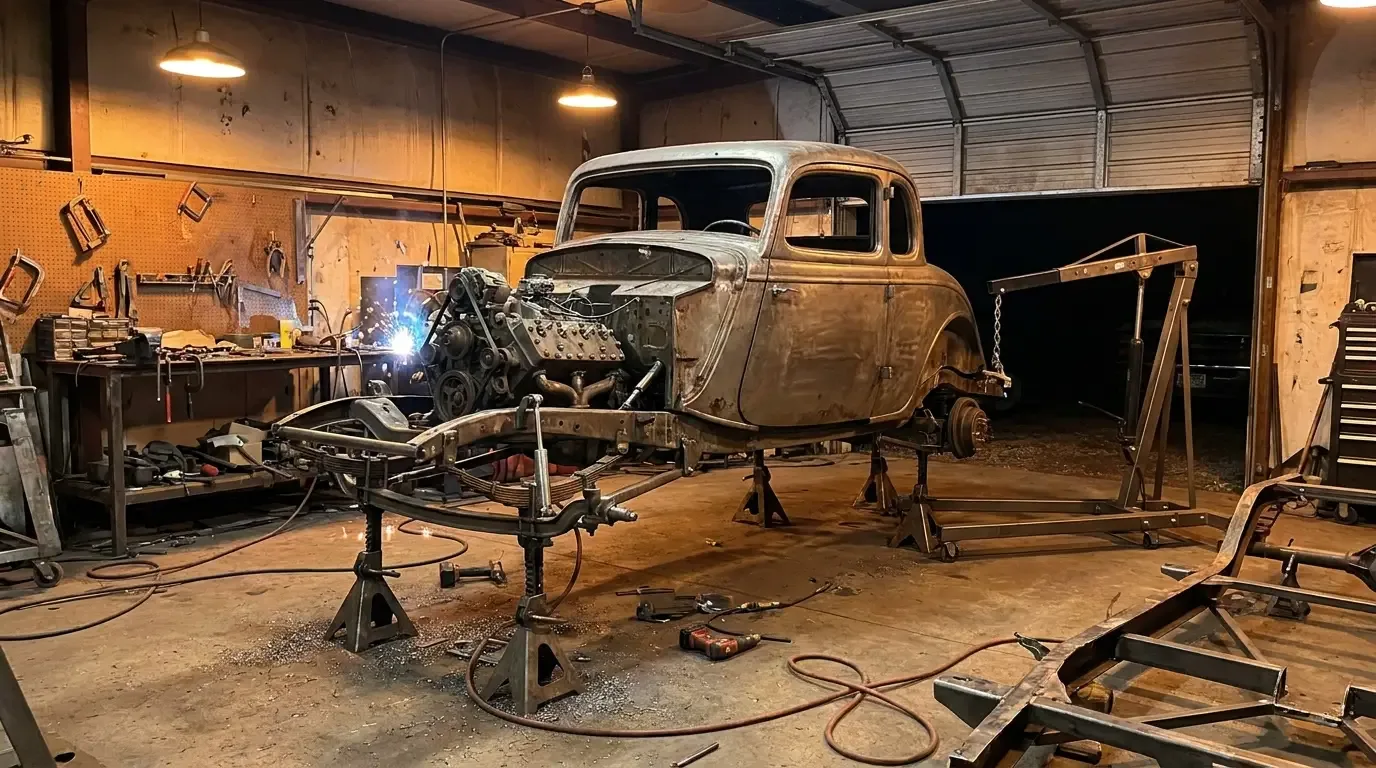
If you want to build a gasser now, the good news is that the parts world has caught up. You can buy straight-axle kits, reproduction fiberglass, correct-style wheels, and period-look tires without hunting swap meets for a decade. The bad news is that easy parts make it easy to build a car that looks like it is wearing a gasser costume instead of being one. The details separate the two.
Start with the body. A light, small, period-correct body gives you the right bones. Tri-five Chevys are the friendly entry point because parts are everywhere and the community is huge. Willys and Anglia bodies are the icons but cost more and are harder to find in good shape, so many people run fiberglass reproductions. Get the body sorted before you touch the stance, because ride height only looks right in relation to the body it lifts.
🔧 Inspection Priorities
- Front axle and mounts. On a swapped car, check axle geometry, spring mounts, and steering angles. Bad geometry means bump steer and a car that darts. Fixing a botched axle swap can run into real money and fabrication time.
- Chassis and floor rust. These are old, light bodies. Rot in the floors, frame rails, and mounting points undoes everything above it. Budget for metalwork if you find it.
- Brakes for the stance. A tall front end and skinny tires change how the car stops. Confirm the brake system matches the weight, tire, and speed you actually plan to run.
- Engine and trans mounting. Verify motor mounts, setback, and driveline angles are done right, not hacked. Vibration and U-joint wear here point to a rushed build.
Then chase proportion. Set the front height, pick front and rear tire sizes that talk to each other, and get the wheels and offsets right before you fuss with paint. A gasser earns its look through geometry, and geometry is cheaper to fix in mockup than after the car is painted and assembled.
When a build is done right, the reward is a car that is unmistakable from a block away and, more important, one that actually behaves like what it looks like. If you are shopping instead of building, it is worth studying a spread of finished cars to train your eye on proportion, and browsing classic gassers for sale is a fast way to see what good ones and bad ones look like side by side before you spend a dollar.
Why the gasser still matters
Plenty of old race styles came and went. The gasser stuck around because it sits at a rare intersection: it is a genuine piece of drag-racing history, it is buildable by a regular person, and it looks like nothing else on the road. It is one of the last styles where the aggression is earned. The stance means something. The skinny tires mean something. The visible axle means something.
That is also why fakes stand out so badly. When the whole style is a set of answers to real engineering questions, a car that skips the questions looks hollow no matter how nice the paint is. The gasser rewards builders who respect where it came from and punishes the ones who treat it as a costume. Sixty years after the gas classes, that is still the test, and it is still the reason these cars are worth building right.
Sources and notes
- Period drag-racing press and NHRA and AHRA class-structure references from the gas-class era.
- Marque and body references for Willys, Anglia, Austin, and tri-five Chevrolet cars used in gas-class competition.
- Engine and induction references for period gasoline V8 builds, including small-block and big-block Chevrolet and early Hemi power.
- Club, registry, and vintage drag-racing historical accounts of notable gasser teams and rivalries.
- Builder interviews and shop experience on straight-axle setup, stance geometry, and gasser fabrication.
Related Reading
Have a
Classic Car
for Sale?
Reach thousands of serious classic car collectors across the US.
Sell It Here →
Are You a Classic Car Dealer?
List your full inventory and connect with targeted classic car buyers.
Join as a Dealer →

About the author
Ray Delgado
Metal fabricator and chassis builder who has spent 25 years turning flat sheet and mild steel into hot rods, gassers and restomod underpinnings.


Comments
Be the first to comment on this article.