
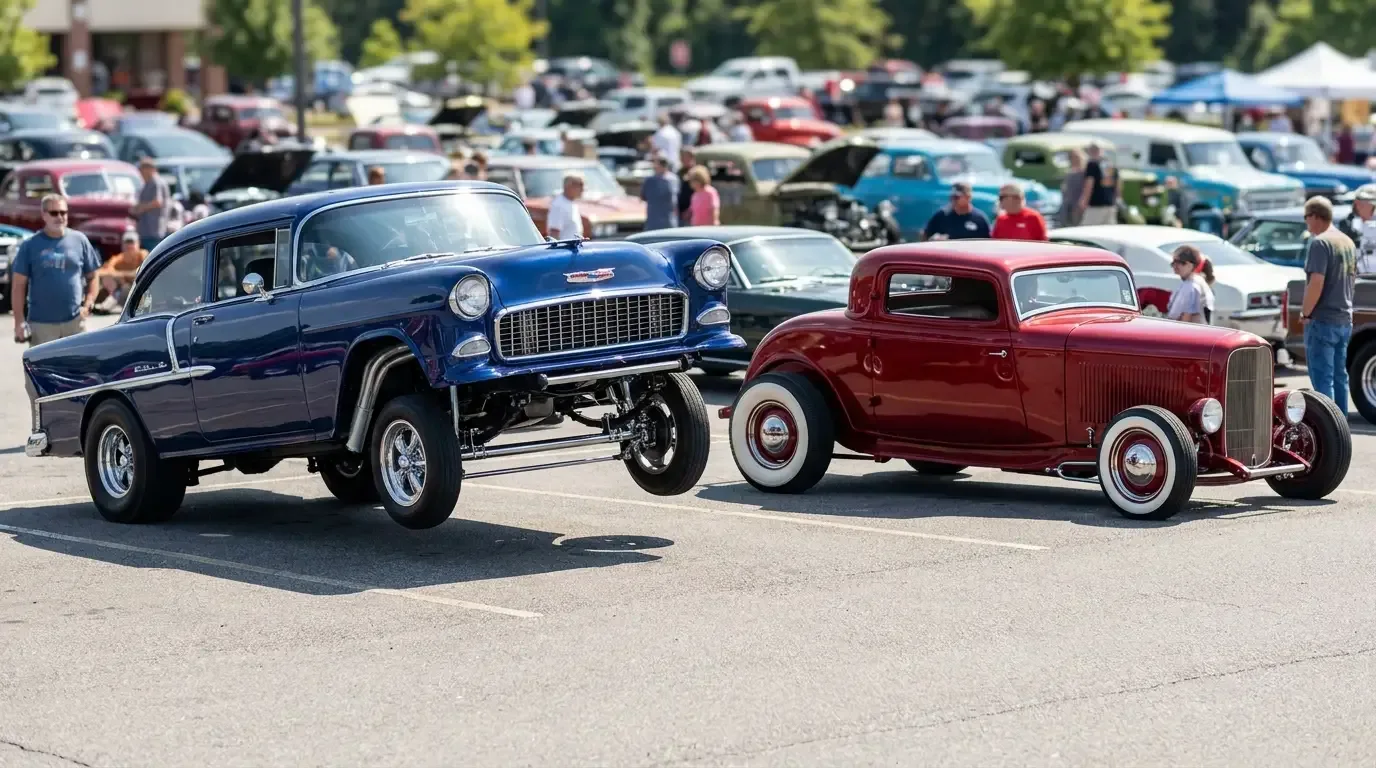
Ask ten people at a car show what a gasser is and half of them will point at anything with the front end jacked up in the air. That is close, but it misses the point. A gasser is not a look somebody dreamed up because it seemed cool. It is a race car built to a rulebook, and every strange proportion on it, the tall nose, the stripped interior, the skinny front tires, exists because the rules pushed builders in that direction. Understand the rules and the whole car suddenly makes sense.
Car Features
9 min read
What Is a Gasser? The Straight-Axle Drag Car Explained
The nose-high stance, the stripped interior, the towering engine. Every part of a gasser traces back to the NHRA Gas-class rulebook. Here is what defines one.
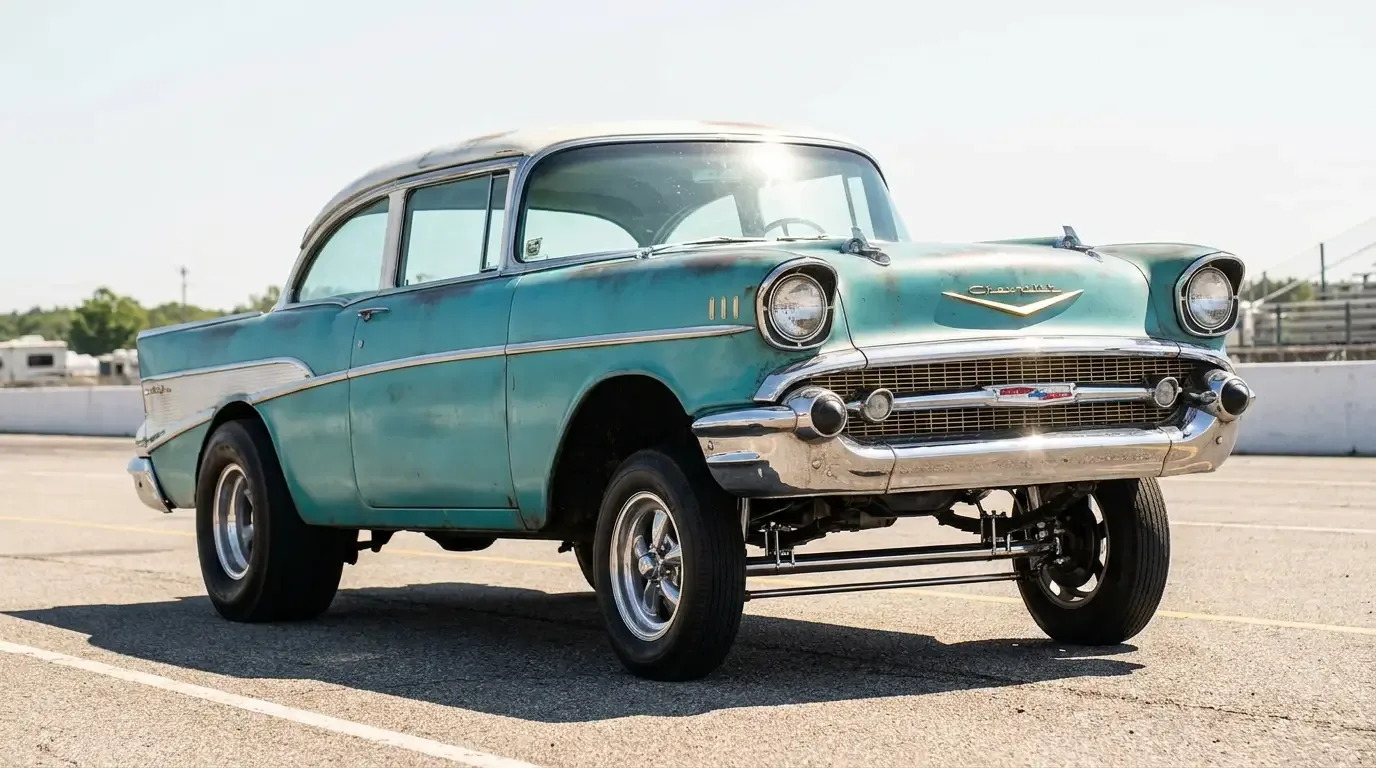
I have built a few of these over the years, and the thing I try to get across to people is that the gasser is honest. Nothing on a real one is there for decoration. If you want the full arc of how this style rose out of the strips and later became a collector obsession, read the gasser story. This piece is narrower. I want to answer one question: what actually defines a gasser, and why does it look the way it does.
The gas classes came first, the look came second
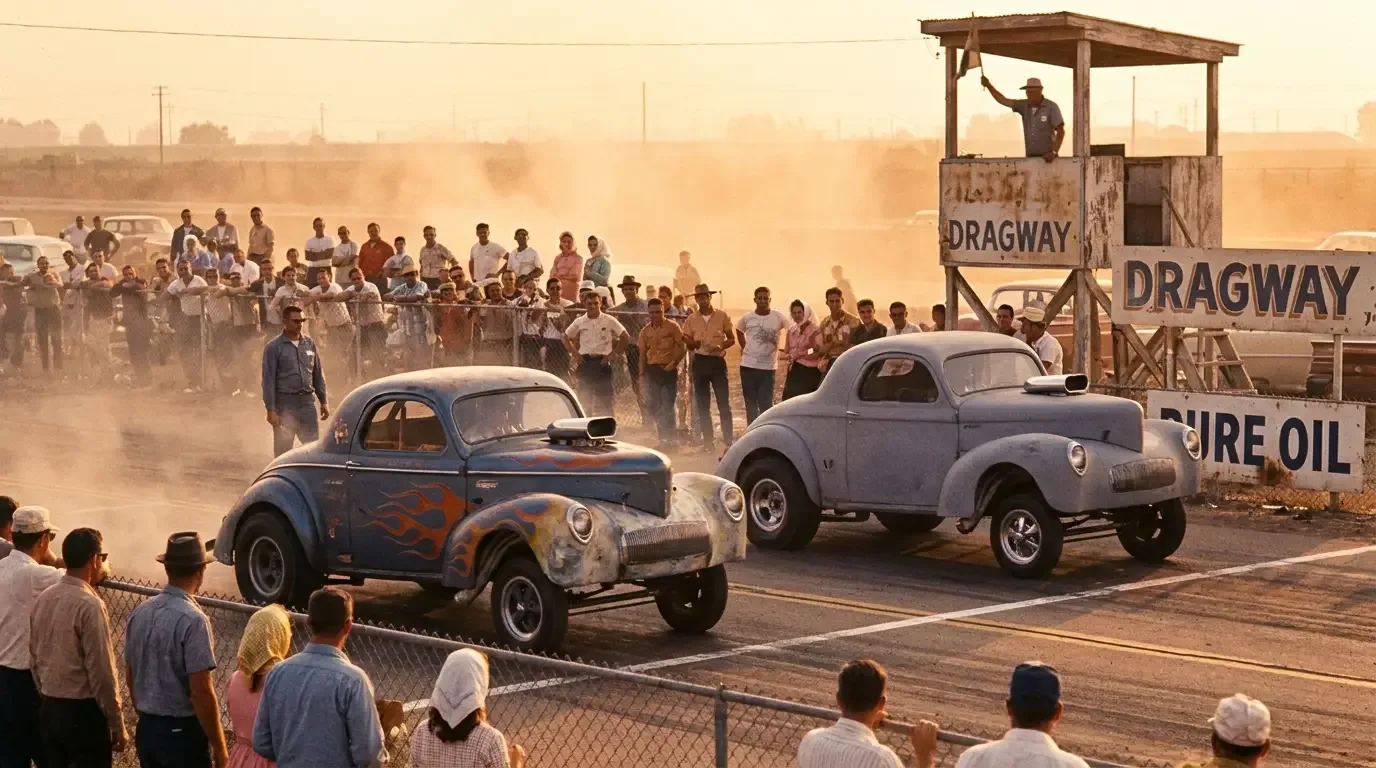
In the 1950s the NHRA and AHRA sorted drag cars into classes so that a Chevy sedan was not lined up against a purpose-built dragster. The Gas classes, labeled A/Gas, B/Gas, C/Gas and so on, were meant for closed-body production cars running on pump gasoline rather than nitromethane or alcohol. That fuel rule is where the whole family gets its name. These were street-legal-ish coupes and sedans, not slingshot rails.
The class you landed in came down to a weight-to-cubic-inch ratio. Lighter car with a bigger engine moved you up toward A/Gas. Add weight or shrink the motor and you slid down the ladder. That single math problem drove almost every decision a builder made, and it is the reason two gassers can look completely different yet chase the exact same goal. Everything below, the axle, the missing weight, the engine choice, traces back to gaming that ratio.
The straight axle and the nose-high stance
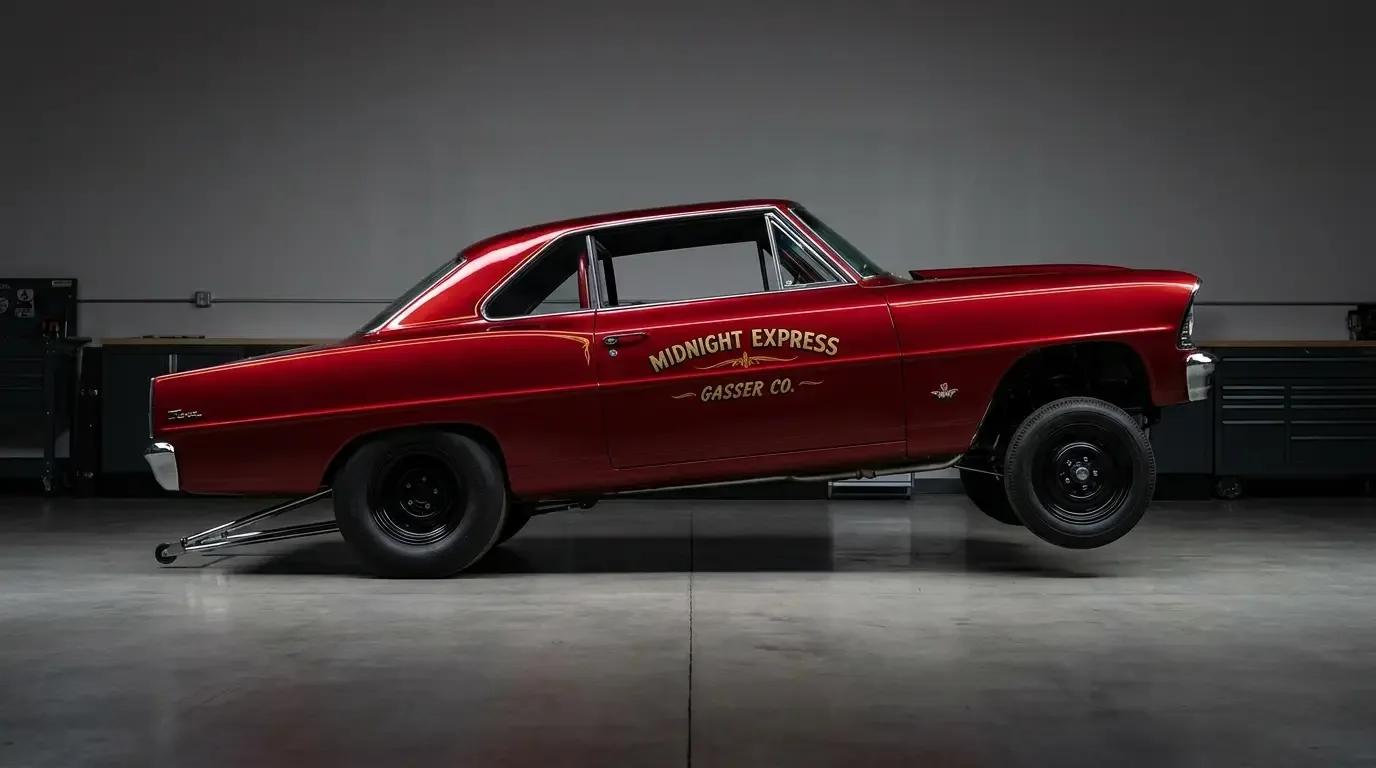
The single feature people recognize is the front end pitched toward the sky, and it sits on a solid, straight front axle instead of independent suspension. There were two reasons this took over. First, weight transfer. When a gasser launched, you wanted the mass to shift rearward and plant the driven rear tires. A tall front end and a high center of gravity up front helped throw weight back on the hit.
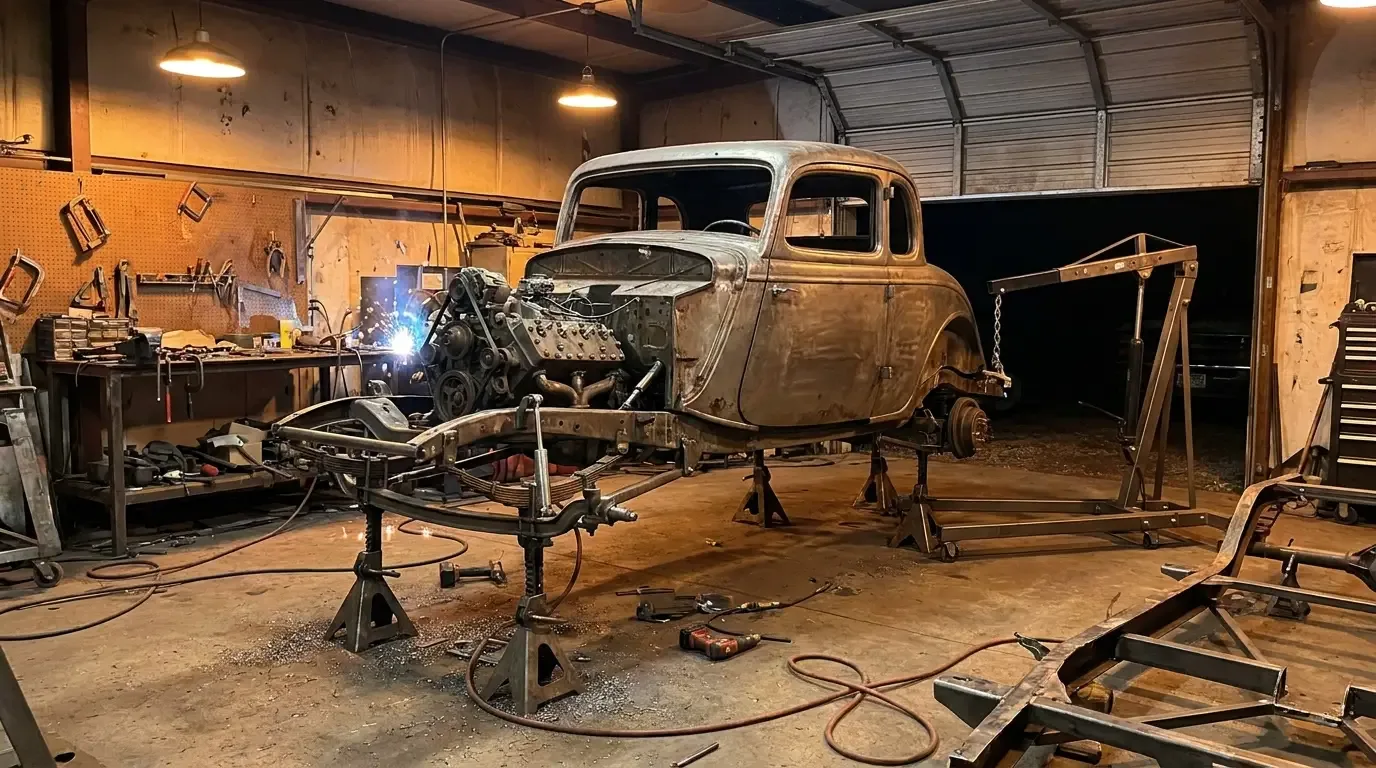
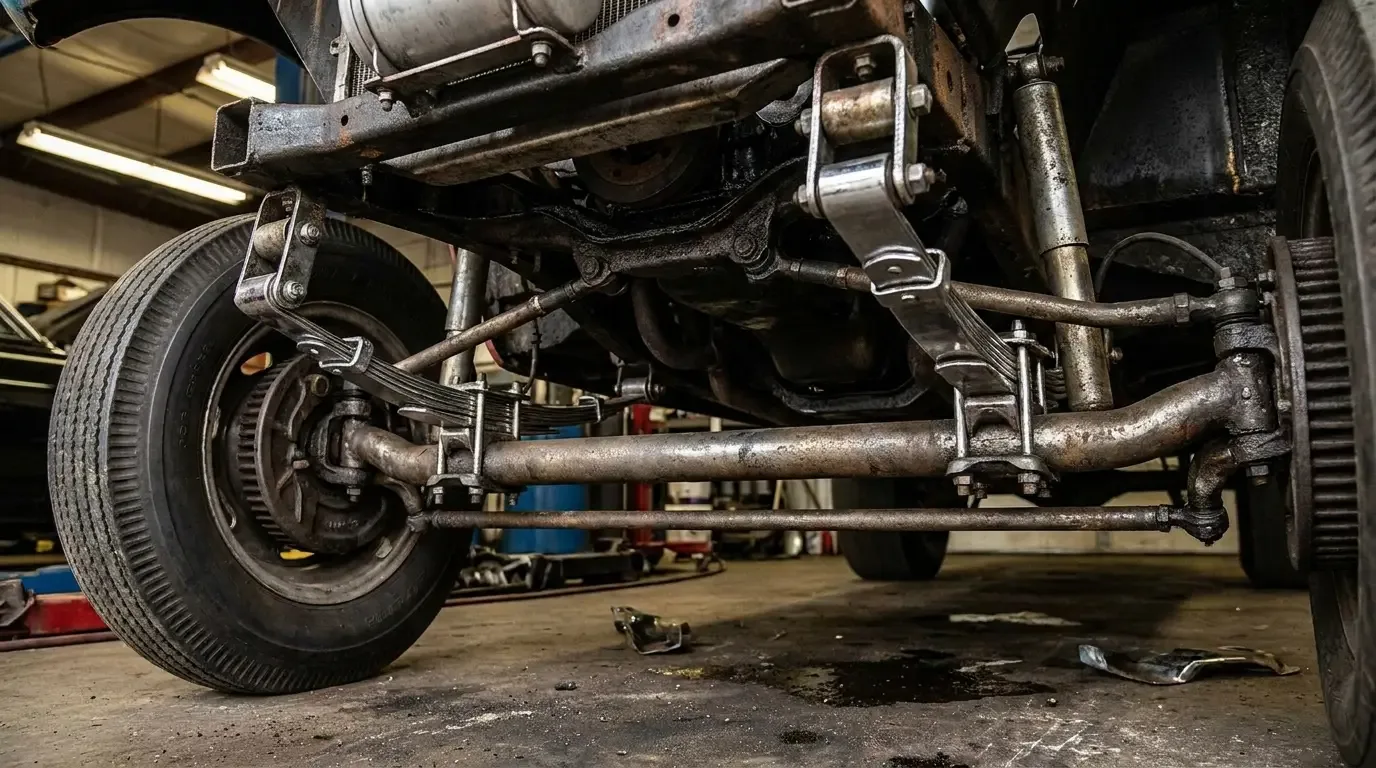
Second, and this is the part people forget, the straight axle was simply lighter, tougher and easier to lift than the factory independent front suspension it replaced. Builders would yank the stock front clip and bolt in a tube or I-beam axle, often from a truck, mounted on leaf springs. Raising the car in front was a side effect of clearing a bigger engine and getting the geometry they wanted, and racers leaned into it once they saw it worked.
| Trait | What it looks like | Why the rules or physics demanded it |
|---|---|---|
| Straight front axle | Solid beam on leaf springs, nose lifted | Lighter than stock IFS, aids rearward weight transfer |
| Stripped interior | Bare floor, single lightweight seat, no trim | Weight is the enemy in a weight-to-cubes class |
| Skinny front tires | Narrow bias-ply "pizza cutters" | Less rotating weight and rolling resistance up front |
| Big rear slicks | Fat, soft-compound rear tires | Put the hopped-up power to the ground on launch |
| Hopped-up engine | Overbored, high-compression V8, often blown | Maximize cubic inches to move up the Gas ladder |
Weight is the enemy, so it all comes off
Once you understand the weight-to-cubic-inch ratio, the stripped-out interior stops looking like neglect and starts looking like strategy. Every pound you pull is a pound that helps your ratio or lets you run a smaller, more reliable engine in the same class. So out came the back seat, the sound deadening, the heater, the carpet, sometimes the door glass in favor of Plexiglas, and the bumpers when the class allowed it.
Serious cars went further. Fiberglass front ends, tilt noses, aluminum panels and drilled brackets all showed up as builders hunted grams. This is the discipline that separates a real gasser from a car that just has the stance. On an honest build the diet is everywhere you look, not just under the hood.
There was a limit to how far you could go, and that limit was the class rulebook. Some classes required you to retain certain factory parts or a minimum weight, so builders could not simply strip a car into a skeleton. The art was cutting weight right up to the line the class allowed, then using the ratio math to decide whether to run a bigger engine and bump up a class or stay put and stay competitive. A well-sorted gasser is the answer to that trade-off, frozen in steel and fiberglass.
- Interior gutted to a bare floor and a single bucket or bench.
- Steel body panels swapped for fiberglass where legal.
- Glass replaced with lighter Plexiglas in the doors and rear.
- Brackets and non-structural steel drilled to shed ounces.
The engine: cubic inches and, often, a blower
Because moving up the Gas ladder rewarded a bigger engine in a lighter car, gasser motors were built for displacement and compression. Small-block and big-block Chevy V8s were everywhere because they were cheap, plentiful and took modification well, but you saw Oldsmobile, Cadillac and Chrysler Hemi power too. Overbored blocks, high-compression pistons, big cams and multiple carburetors on a tall intake were the common recipe.
Superchargers, usually a GMC 4-71 or 6-71 blower poking up through the hood, became the signature of the wild A/Gas cars in the mid-1960s. Not every gasser was blown, and plenty of respected cars ran multiple carbs instead, but the supercharged look is what most people picture now. If you want to see how this engine arms race played out on the strip week to week, the fuller account lives in the gasser drag racing record.
Fuel is the quiet part of the story. Because these were Gas classes, the engines had to live on gasoline, which capped how much compression and timing you could throw at them compared to a nitro car. That constraint is exactly why builders leaned on displacement and boost instead. If you cannot change the fuel, you make the engine bigger or force more air into it. The blower was not just for show. It was the legal way to make more power within a class that told you what could go in the tank.
Why the whole thing looks the way it does
Put the pieces together and the gasser silhouette explains itself. The nose is high because the axle is up and the weight wants to move back. The front tires are skinny because there is no reason to carry rubber up there. The rear tires are fat because that is where the power lands. The interior is empty because weight loses races. The engine towers out of the hood because cubic inches move you up the class. It is a shape dictated entirely by function.
That is also why a modern car with airbags faking the stance rubs a lot of builders the wrong way. The look without the reasons behind it is costume, not a gasser. The real thing carries the evidence of the rulebook in every proportion. When people shop for classic gassers for sale, the ones that hold value are the cars where the straight axle, the diet and the engine all tell the same story instead of a lowered body wearing a tall-nose disguise.
"I can walk up to a car and tell in ten seconds whether somebody built it or bought a look. A real gasser is honest about being a race car. Nothing on it apologizes for the nose in the air, because the nose in the air is the whole point."
Ray Delgado
What a gasser is not
It helps to draw hard lines, because the word gets stretched. A gasser is not a street rod, which is about a smoothed, finished, often lowered hot rod meant for cruising. It is not a lowrider, which sits down on the ground and lives in a completely different culture. It is not a modern pro-mod, which is a tube-chassis, computer-managed door-slammer that happens to share the door-car outline.
The gasser is a specific period thing, roughly 1955 to the late 1960s, born out of the NHRA and AHRA Gas classes, defined by the straight axle, the diet and the pump-gas engine. When those rules changed and the classes evolved in the late 1960s, the true gasser era wound down. Everything since is revival and tribute, which is fine, but the definition stays anchored to that window and that rulebook.
Sources and notes
- Period drag-racing press and NHRA/AHRA class rule summaries of the 1950s and 1960s.
- Marque and engine references for the common V8, Willys, Anglia and tri-five platforms.
- Club, registry and auction records documenting surviving Gas-class cars.
- Builder interviews and shop notes on straight-axle conversions and weight reduction practice.
Related Reading

Have a
Classic Car
for Sale?
Reach thousands of serious classic car collectors across the US.
Sell It Here →
Are You a Classic Car Dealer?
List your full inventory and connect with targeted classic car buyers.
Join as a Dealer →

About the author
Ray Delgado
Metal fabricator and chassis builder who has spent 25 years turning flat sheet and mild steel into hot rods, gassers and restomod underpinnings.



Comments
Be the first to comment on this article.