
A 1965 Mustang fastback with the 271 hp K-code ran 0 to 60 mph in 5.2 seconds and the quarter mile in 14.0 seconds at 100 mph for Car and Driver. The engine gets the credit for that run. The test car also had a four-speed and a 4.11 rear axle, and without those two parts the same 289 would have posted a much slower card. This piece is about the hardware behind the engine: the Ford Toploader 4 speed Mustang gearbox and the Ford 9-inch rear end. Together they decided how much of the catalog horsepower actually reached the pavement.
Car Features
7 min read
Toploader and 9-Inch: The Drivetrain Behind Classic Mustang Muscle
The Toploader four-speed and Ford 9-inch axle: close vs wide ratios, spline counts, Drag Pack gears and why the rear axle beat the rating.
If you want the engines themselves, from the K-code to the Boss 429, start with our performance Mustang guide. Here we stay behind the bellhousing.
Where the Toploader came from
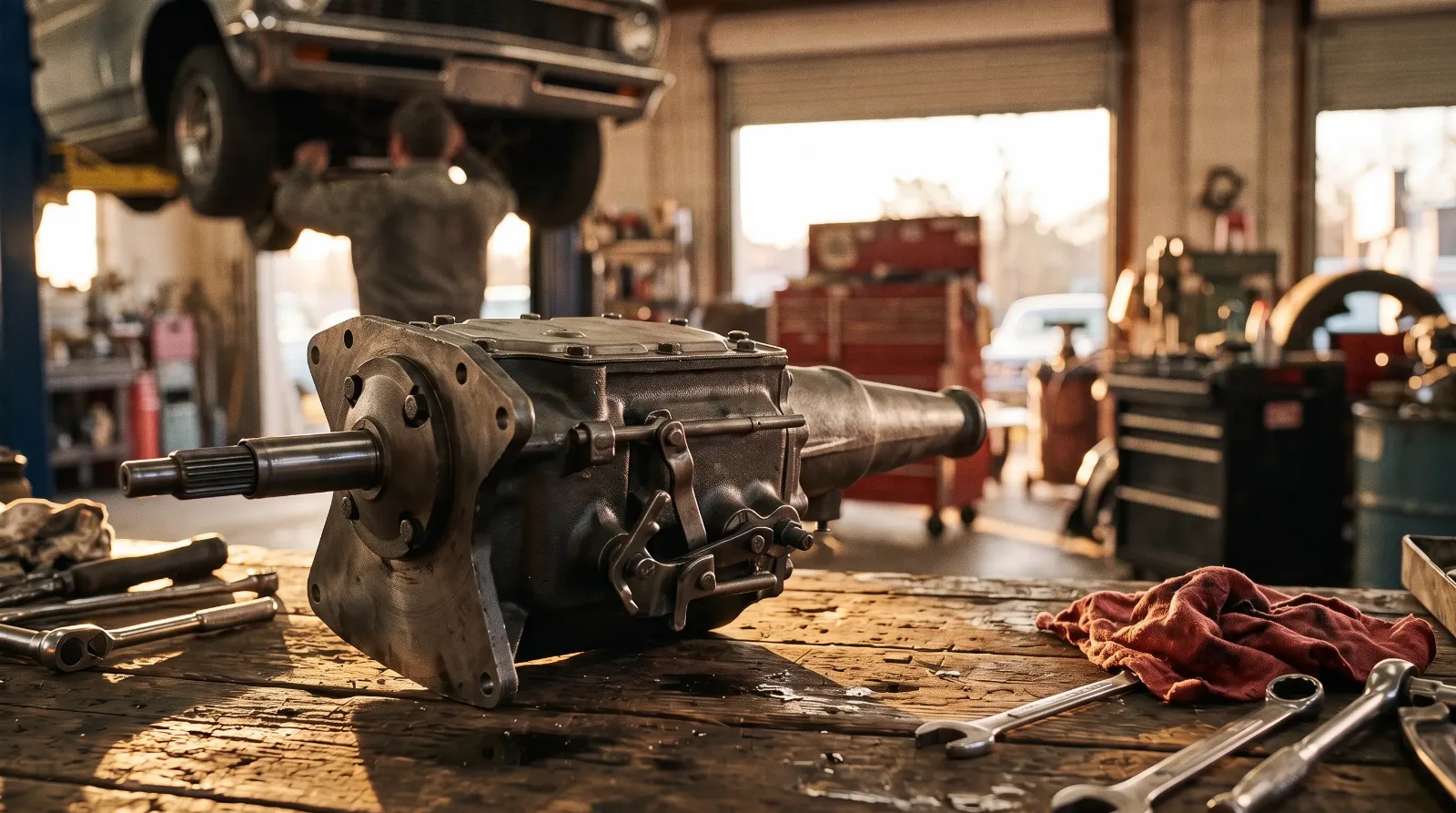
Ford introduced the Toploader in 1963 to replace the BorgWarner T-10, and production of the gearbox ran from 1964 to 1973. The name is literal. The inspection plate sits on top of the case, where other four-speeds of the period put it on the side. That is the whole story behind the nickname, and it is also the quickest way to identify one under a car.
The Toploader covered the full first-generation run. Mustangs from 1964 to 1973 with the 170 and 200 sixes and the 289 used a version with a 1 1/16 inch input shaft, 10 splines on the input and 28 on the output. From 1968, the big engines (the 427, the 428 and the Boss motors) got a heavier version with a 1 3/8 inch input shaft and 10/31 splines. Same family, same top plate, different strength.
Not every early performance Mustang had one, though. The 1965 Shelby GT350 used a BorgWarner T-10 four-speed instead, in an aluminum case on the 1965 street cars and on the R-model. For 1966 the T-10 stayed standard on the GT350, with a three-speed automatic as the option.
Close ratio vs wide ratio on the Ford Toploader 4 speed Mustang
The Toploader came in two gearsets, and the difference shows up in first and second gear. The close-ratio box started at 2.32:1. The wide-ratio box started at 2.78:1. Both finished at 1.00:1 in fourth. On the bench, the quickest way to tell them apart is the second-gear tooth count: 28 teeth on the close-ratio gear, 31 on the wide-ratio gear.
| Gear | Close ratio | Wide ratio |
|---|---|---|
| First | 2.32:1 | 2.78:1 |
| Second | 1.69:1 | 1.93:1 |
| Third | 1.29:1 | 1.36:1 |
| Fourth | 1.00:1 | 1.00:1 |
| Second-gear teeth | 28 | 31 |
Run the arithmetic and the trade-off is clear. Behind a 3.91 axle, the wide-ratio first gear gives about 10.9:1 overall multiplication. The close-ratio first gear gives about 9.1:1. That is roughly 20 percent more leverage off the line for the wide box. The price is a bigger step between gears: the drop from first to second is 1.44 to 1 on the wide box and 1.37 to 1 on the close box, so the engine falls further down its power curve on each shift.
Which one makes sense depends on torque. A big-block with a fat torque curve can pull a tall first gear and likes the tight spacing at the top. A smaller, high-revving engine wants the extra leverage to get moving. Ford's own choice for the 1971 Boss 351, a 330 hp solid-lifter 351 Cleveland, was the wide-ratio Toploader with a Hurst T-handle shifter and a 3.91 Traction-Lok 9-inch rear.
The Ford 9-inch: why the axle mattered
The 9-inch predates the Mustang. Ford introduced it for the 1957 model year. The name comes from the 9.00 inch ring gear, but the strength comes from two design choices. The pinion is straddle-mounted, supported by a bearing on each side of the gear instead of hanging off one end. And the whole third member drops out of the housing as a unit, so a gear change means unbolting one assembly rather than setting up gears inside a housing still under the car. Factory axle shafts came in 28-spline and 31-spline versions.
The drop-out center is why the 9-inch suited racing so well. A team could carry spare third members with different ratios and swap one between rounds. The factory drag racers of the 1960s lived on that kind of flexibility, and the same layout is why the 9-inch is still a common swap today.
The 9-inch was not under every first-generation Mustang. Most ordinary cars ran lighter Ford axles, and the 9-inch was the heavy-duty piece that went where the torque was. The 271 hp K-code came with a heavy-duty 9-inch, the 1969 and 1970 Shelby GT500 used a 9-inch with Traction-Lok optional, and the 1971 Boss 351 had a 3.91 Traction-Lok 9-inch as standard. Collector references disagree on the exact cut-off for some small-block and option combinations, so on any given car the axle tag and the data plate code settle it. The 9-inch served the Mustang from 1964½ through 1973. Ford kept building it for trucks and other models until 1986, and that same year an 8.8 inch rear axle arrived on V8 Mustangs.
Axle ratios, period tests and the real numbers
Here is where catalog horsepower and real performance part ways. Gross ratings tell you what the engine made on a stand. The axle ratio tells you how hard that power hit the tires. Look at four period tests side by side.
The 1965 K-code fastback that ran 14.0 seconds had a 4.11 axle. Car Life's 1967 390 fastback had a C6 automatic and a 3.25 limited-slip axle (3.00 was standard with the 390), and it ran 0 to 60 mph in 7.8 seconds and the quarter mile in 15.5 seconds at 91.4 mph. That is 101 more cubic inches than the K-code car and 1.5 seconds slower through the quarter mile. Part of that gap is weight and the automatic. A big part is gearing.
Then the big-blocks. Car Life's March 1969 428 Cobra Jet Mach 1, also a C6 automatic, ran 0 to 60 mph in 5.5 seconds and the quarter mile in 13.90 seconds at 103.32 mph. The spec panel listed a 3.50 axle, but the speeds in each gear suggest it actually had a 3.91. Car Life's July 1969 Boss 429, with a four-speed and a 3.91 limited-slip, ran 0 to 60 mph in 7.1 seconds and the quarter mile in 14.09 seconds at 102.85 mph. On paper the Boss 429 had 375 hp against the Cobra Jet's 335. At the strip, the automatic Cobra Jet was quicker.
"Gross horsepower sells the car. The axle tag decides the time slip. If I had to choose one number to see before a drag race, it would be the rear gear, not the rating on the air cleaner."
Dan Reeves
Ford knew this, which is why the strongest street engines were tied to gears. For 1969 and 1970, the Drag Pack meant a 3.91 or 4.30 axle, and ordering it turned a 428 Cobra Jet into a Super Cobra Jet with heavier rods and an oil cooler (standard from November 13, 1968 builds). For 1971, the Drag Pack offered 3.91 Traction-Lok or 4.11 Detroit Locker axles and did the same for the 429. On the Shelby side, the 1969 and 1970 GT500 came with a Toploader or a C6, a 3.00 axle if you ordered air conditioning and gears up to 4.30 if you did not.
The pattern holds across the period. The Toploader was strong enough to live behind everything from a 200 six to a Boss 429, and the wide-ratio box gave the most leverage off the line. The 9-inch let Ford, Shelby and racers fit the ratio the job needed. The engine set the ceiling. The gearbox and axle decided how close a given car got to it.
Toploader production ended in 1973, the same year the 9-inch left the Mustang. Later Mustangs moved on to five-speeds and different axles, but the 1960s pairing is still the reference point when people talk about a classic Mustang that hooks up and stays together.
Sources and notes
Related Reading
Have a
Ford Mustang
for Sale?
Reach thousands of serious classic car collectors across the US.
Sell It Here →
Selling a classic? Here's how: the best sites to sell a classic car
Are You a Classic Car Dealer?
List your full inventory and connect with targeted classic car buyers.
Join as a Dealer →
#Ford Mustang
#Boss 351
#Cobra Jet
#Ford 9-inch
#Drag Pack
#Toploader
#classic Mustang drivetrain
#Traction-Lok

About the author
Dan Reeves
Performance engine builder from North Carolina's motorsports corridor, focused on swaps, forced induction and making real, repeatable power.
Related Listings - Ford Mustang


Comments
Be the first to comment on this article.