
Ask a room full of old Ford people which open Model T to buy and you will get two answers, and both will be right for somebody. The model t touring is the family car: five seats, a long body and a big folding top. The runabout is the two-seater with a deck out back. Underneath, they are the same machine. Same engine, same planetary transmission, same chassis. What separates them is how many people you plan to carry and what you plan to haul.
Car Features
6 min read
Model T Touring vs Runabout
Five seats or two: how the Model T touring and runabout differed in price, sales and use, and which open T makes more sense to buy and restore today.
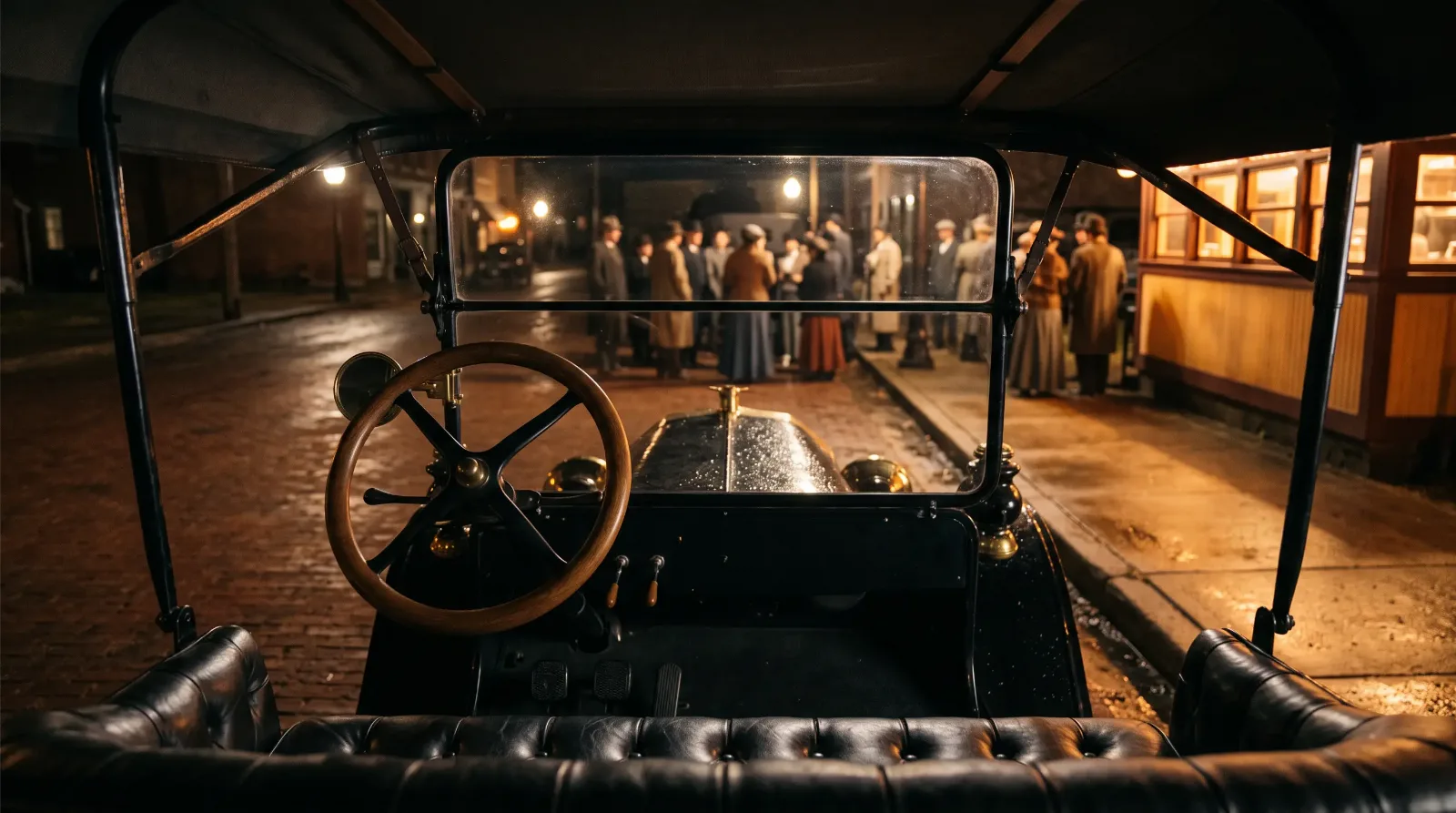
Ford sold a lot of bodies on the T, and the Model A that followed had even more, with a code for every one; that guide walks through the body styles years in detail. Here we stick to the two open cars that carried most of the T's early sales.
Model T touring vs runabout: what you actually got
The touring seated five. Two up front, three on a bench in back, all under one long top. The runabout seated two, on one bench, with the rear of the car given over to a deck or a small box. A 1923 price listing put it simply: touring five passengers, runabout two seats.
That difference in body is the whole story. The touring carried more wood, more sheet metal, more upholstery and a bigger top. The runabout was shorter behind the seat and lighter at the back. On a car rated at 20 horsepower, a heavier body plus three more passengers is something you feel on every hill.
Both were open cars with side curtains for weather. Neither one was warm in January. People who wanted a roof and glass bought one of the closed Model Ts, and paid a lot more for the privilege.
The price gap, year by year
The two cars were never far apart on price. The touring always cost a little more, and the gap stayed between $25 and $50 while Ford squeezed cost out of the whole line.
| Model year | Touring | Runabout | Gap |
|---|---|---|---|
| 1909 | $850 | $825 | $25 |
| 1915 | $490 | $440 | $50 |
| 1925 | $290 | $260 | $30 |
Prices are f.o.b. Detroit list for the base car. In 1925 the runabout hit $260, the lowest list price the runabout ever carried. Optional equipment changed the picture later. For 1926, a basic open car listed at $290 without a starter, generator or battery, while the fully equipped version with an electric starter and demountable wheels ran $375.
Why the touring outsold the runabout
Five to one is not close. The reason is plain arithmetic. For $50 more in 1915 a family got three more seats. A farmer with a wife and kids was not going to buy a two-seater to save fifty dollars and leave half the family on the porch.
The touring also did double duty. Take the back seat passengers out and you had room for feed sacks, cream cans or tools. Plenty of tourings spent their weekdays as light haulers and their Sundays as church cars.
The runabout made sense for a different buyer. A doctor making house calls, a salesman covering a territory, a young man on his own. One or two people, a case or a sample bag behind the seat, and a bit less weight for the engine to pull. It was the cheapest way into a new Ford, and for a lot of single buyers that settled it.
Ford itself treated the touring as the face of the car. When Henry and Edsel Ford drove the fifteen millionth Ford off the Highland Park line on May 26, 1927, it was a Model T touring. The naturalist John Burroughs, who got several Model Ts from Henry Ford, used a 1914 touring for field work until his death in 1921. Both cars are held by The Henry Ford today.
"The touring was the car. The runabout was the tool. Ford figured that out in 1925 and bolted a pickup box on the tool."
Robert Halloran
The runabout's second life as a pickup
The runabout's open back turned out to be its future. In April 1925 Ford introduced the Model T Runabout with Pickup Body at $281. It was a pickup bed mounted on the standard runabout chassis, and it was Ford's first factory pickup.
That matters to anyone shopping today. A lot of runabouts were converted to pickups in period, and a lot of pickups have been converted back to runabouts since. Neither is a crime, but you should know which one you are buying. Closed-cab Model T pickups deserve the most suspicion. Ford's factory pickup was the open runabout type, and club members report that many closed-cab Model T pickups seen today were converted from Tudors or coupes.
Buying one now: which open T makes sense
From the parts counter, the two are close to identical. Engine, transmission, rear end, front axle, brakes and wheels interchange. Where they part ways is the body, and the body is where restoration money goes.
Prices for Model Ts as a group are not high. One UK auction tracker lists 391 Model T sales, with a median of £10,169 for those since 2020. Body style, year and condition move that number around. A 1908 touring carrying serial number 2, believed to be the earliest surviving Model T, sold at Bonhams in March 2022 for $246,400. That is the outlier, not the guide.
For most people the practical choice comes down to use. If you drive alone and want a lighter, simpler car, the runabout is fine. If you want to share the ride, the touring is the better buy, and it is the body Ford built in far bigger numbers. Either way, the mechanical parts are out there, the books are out there, and the club people know both cars inside out.
Sources and notes
- 1915 Ford Model T: prices and production by body style (The Arsenale)
- 1923: the Model T Ford's biggest year (Mac's Motor City Garage)
- Ford Model T Runabout with Pickup Body, 1925 (The Henry Ford)
- John Burroughs' 1914 Ford Model T touring car (The Henry Ford via Google Arts and Culture)
- 1908 Ford Model T Touring, serial no. 2, Amelia Island 2022 (Bonhams)
- Ford Model T auction results (The Classic Valuer)
Related Reading
Have a
Ford Model T
for Sale?
Reach thousands of serious classic car collectors across the US.
Sell It Here →
Selling a classic? Here's how: where to sell your classic car online
Are You a Classic Car Dealer?
List your full inventory and connect with targeted classic car buyers.
Join as a Dealer →
#ford model t
#open cars
#Model T touring
#Model T runabout
#Model T buying guide
#Model T restoration

About the author
Robert Halloran
Texas-based classic truck enthusiast with decades of experience buying, restoring, and writing about American pickups from the 1940s through the 1980s.
Related Listings - Ford Model T

Comments
Be the first to comment on this article.