
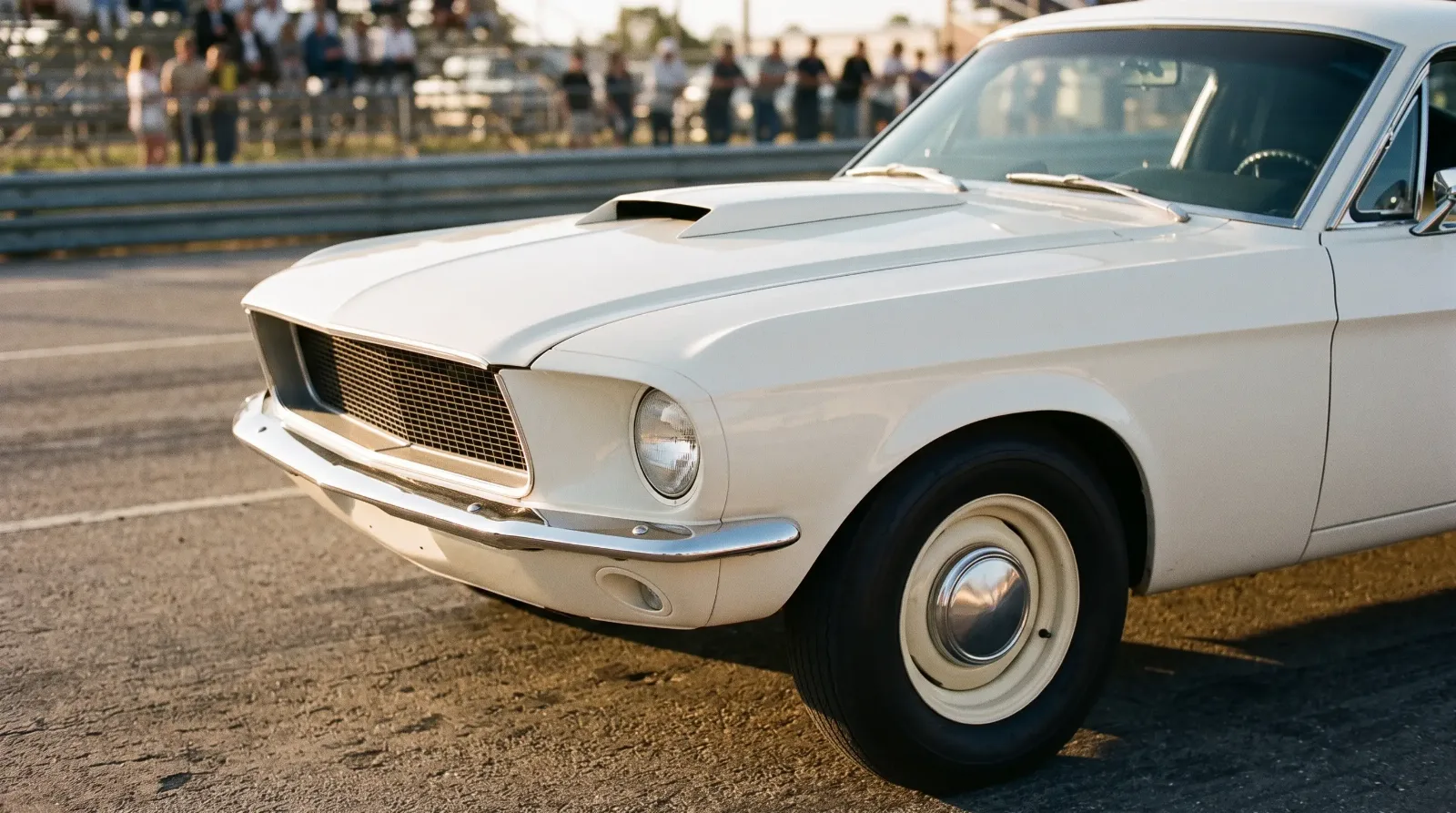
Pomona, February 1968. Two Mustangs roll to the line for the Super Stock E class final at the NHRA Winternationals, and both are wearing Ford's new 428 Cobra Jet. Al Joniec is in one, Hubert Platt in the other. Whoever wins, Ford wins. Joniec takes it, then wins the overall Super Stock Eliminator title too, and a car most buyers could not yet order had just beaten the best stockers in the country. That afternoon is the hinge of classic Mustang drag racing history, and it only makes sense if you go back three years, to a very different kind of factory Mustang.
Car Features
8 min read
A/FX to Cobra Jet: The Factory Drag-Racing Mustangs, 1965–1968
From Holman-Moody A/FX funny cars to the 428 Cobra Jet sweep at Pomona: how Ford put a drag-winning Mustang on the regular assembly line by 1968.
This piece sits under the wider look at Ford's performance Mustangs, so it stays on one thread: how Ford went from hand-built, barely legal A/FX cars in 1965 to a drag-ready engine on the regular assembly line in 1968.
1965: the A/FX Mustangs and the funny car
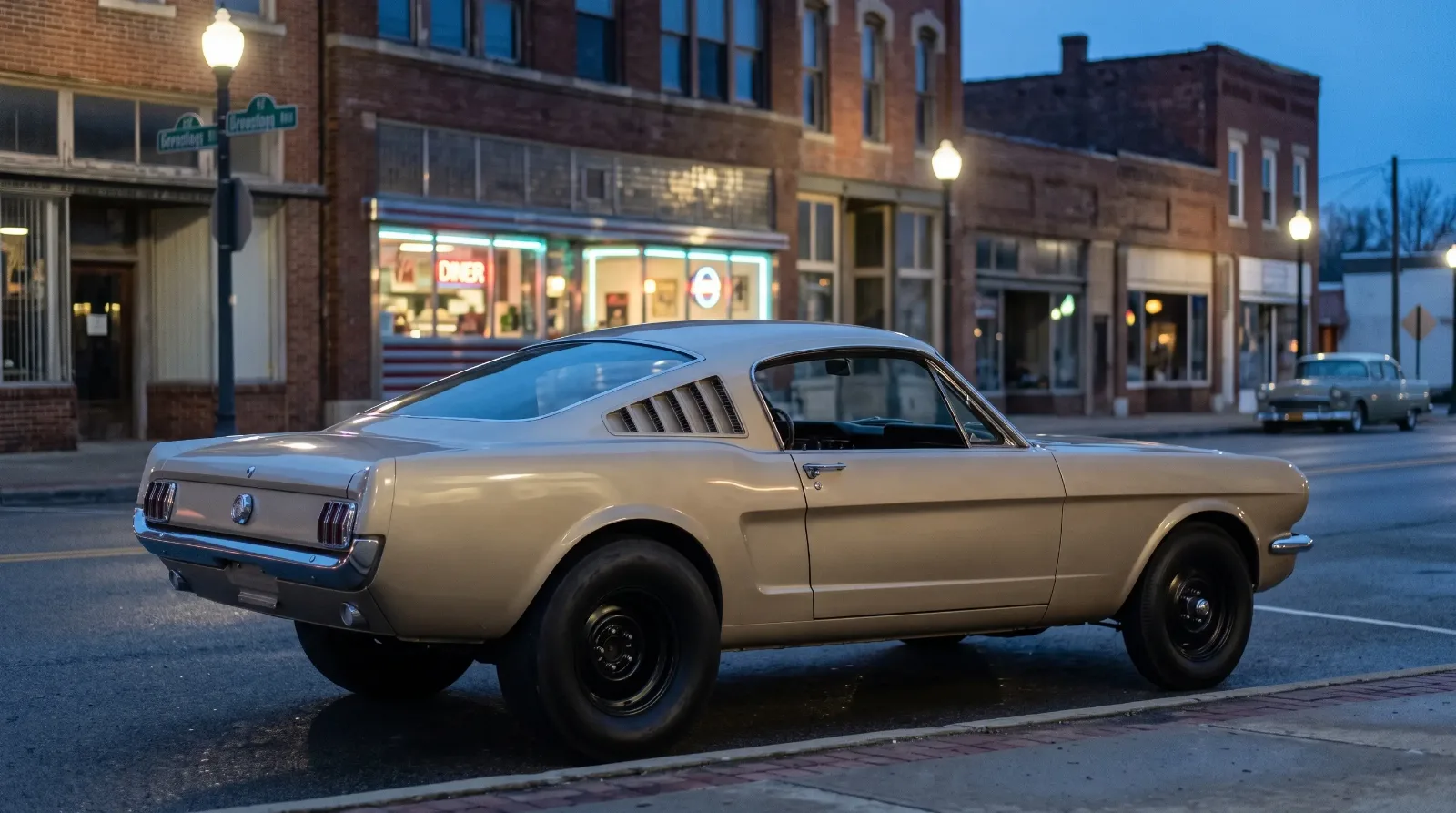
The first factory drag Mustangs looked like Mustangs the way a caricature looks like a person. Ford sent a batch of fastbacks to Holman-Moody in Charlotte, which fitted them with fiberglass fenders, hood and doors and handed them to a group of racers, Gas Ronda among them. Holman-Moody's own history counts ten competition cars, though accounts of how many bodies were delivered run from 11 to 13. Under the hood went Ford's 427. Only five of the cars got the new single overhead cam version, the engine racers called the Cammer, and the rest ran the wedge-head 427. The Cammer's output is quoted at 616 hp at 7,000 rpm with a single four-barrel and 657 hp at 7,500 with two. Holman-Moody describes the cars as altered-wheelbase, with the rear axle moved forward to throw weight onto the rear tires.
They ran in A/FX, the factory experimental class, and they were fast in a way that rewrote what a "stock" body could mean. Bill Lawton won the A/FX class at the 1965 Winternationals with a 10.88 at 129.84 mph. Ronda's car used a four-speed and set the NHRA A/FX record at 10.43 seconds and 134.73 mph. At the 1965 AHRA World Championship at Lions Drag Strip he reached the Mr. Stock final and lost to a Ford teammate, Dick Brannan, taking home $700 as runner-up. That detail says a lot about the period. The money was small. The point was the badge on the fender on Monday morning.
Those altered-wheelbase Mustangs are among the ancestors of the funny car, and that matters for how we remember them. They were not cars a dealer could sell you. They were rolling advertisements, built in tiny numbers, owned by a factory program and driven by people it paid. Ronda, Lawton and Les Ritchey are the names that turn up most, and Ritchey beat his teammate Ronda for the 1965 A/FX class title, but no two accounts give quite the same full roster.
The gap between the strip and the showroom
Here is the uncomfortable truth about those early cars. The Mustang you could actually buy in 1965 topped out with the K-code 289 Hi-Po, rated at 271 hp at 6,000 rpm. That was a lively street engine. It was not a Cammer, and nobody walking out of a showroom with one was going to run ten-second passes. The engine itself, and how the 289 later grew into the 302, belongs to the small-block story.
Shelby closed a little of the gap. Of the 562 GT350s built for the 1965 model year, four were drag cars. Four. That was a token presence, and it tells you Ford's drag effort still lived in special builds rather than in anything you could order off a sheet.
The 1967 redesign changed the physical problem. The bigger body made room for a big-block, and the S-code 390 arrived at 320 hp and 427 lb-ft. About 28,800 buyers chose it that year. The torque was real, but a 390 in street tune was built for the boulevard, not for winning a drag class. Ford still needed something it could build by the thousand that would also beat Chrysler and GM on a Saturday night.
| Engine | Years in this story | Factory rating (gross) | Who could buy it |
|---|---|---|---|
| 289 Hi-Po (K-code) | 1965 to 1967 | 271 hp @ 6,000; 312 lb-ft | Any showroom buyer |
| 427 SOHC "Cammer" | 1965 A/FX | 616 hp (one 4-bbl) / 657 hp (two 4-bbl) | Factory-supported racers only |
| 390 4V (S-code) | 1967 | 320 hp; 427 lb-ft | Any showroom buyer |
| 428 Cobra Jet | 1968½ | 335 hp @ 5,200; 440 lb-ft @ 3,400 | Any showroom buyer, from April 1968 |
The 428 Cobra Jet and classic Mustang drag racing history
The Cobra Jet was the answer, and its genius was that it was ordinary in the right places. It was a 428 FE V8 with a 735-cfm Holley, built on the regular production line and launched in April 1968. Ford rated it at 335 hp at 5,200 rpm and 440 lb-ft at 3,400. Road-test data suggest it made something closer to 275 hp SAE net, which is the kind of number that explains why rivals thought the gross rating was modest. The recipe is widely credited to Bob Tasca's Rhode Island Ford dealership, and NHRA's own retrospective describes the 428 as the engine Tasca first developed, in place of the 427 Ford had originally planned to use.
Now look at the calendar again. The Winternationals ran February 2 to 4, 1968. The Cobra Jet's showroom launch came in April. Ford brought the engine to Pomona before a buyer could walk in and order one, backing five drivers in six 428 CJ Mustangs. Four of those cars reached their class finals, and the SS/E final was a Cobra Jet against a Cobra Jet. Joniec then took the overall Super Stock Eliminator title when Dave Wren red-lighted his Plymouth in the final. As a product launch, it is hard to think of a louder one.
Those race cars came from a run of 50 lightweight Cobra Jet fastbacks, all Wimbledon White, built without radio, heater, sound deadener or undercoating, with production starting in December 1967. Joniec's best of the meeting was an 11.49 at a little over 120 mph, by NHRA's account. What is not in doubt is the result, and the shift it represented. In 1965 the fast Mustang was a Holman-Moody special you could only watch. By the spring of 1968, the engine that won at Pomona was an option a dealer could write up.
"The A/FX cars were the dream. The Cobra Jet was the dream with a window sticker on it, and that is the one that changed who showed up at the track."
Patrick Walsh
After Pomona: the Drag Pack and the street cars
Once the Cobra Jet was a production engine, Ford kept turning the screws through regular options rather than special builds. For 1969 the Drag Pack, a 3.91 or 4.30 rear axle, brought the Super Cobra Jet upgrades with it: heavier "Le Mans" connecting rods and an external balance weight. An oil cooler became standard from cars built on November 13, 1968, and a Drag Pack car could never be ordered with factory air conditioning. That last rule tells you exactly who Ford was building it for.
The street numbers followed. Car Life tested a 428 Cobra Jet Mach 1 with a C6 automatic in its March 1969 issue and recorded 0 to 60 mph in 5.5 seconds and a quarter mile of 13.90 seconds at 103.32 mph. That is a stock-appearing car, bought with a warranty, running times the 1965 showroom cars could not approach. The functional scoop that fed some of these engines is its own subject, and the Shaker is covered in this piece.
The arc from 1965 to 1968 is the arc of the Mustang growing up as a performance car. The A/FX cars proved Ford would spend money to win. The Cobra Jet proved it could sell the win. Everything that came after, from the Boss cars to the 429 Super Cobra Jet, built on that second lesson, and the broader chronology is laid out in the history of the Ford Mustang.
If you want to see where the story became something you could own, start with the cars that carried it into showrooms, and browse 1968 Mustangs for sale. A real 1968½ Cobra Jet car is the rare one. The car that made it possible is the one that sat on the line at Pomona before any of them were delivered.
Sources and notes
Related Reading
Have a
Ford Mustang
for Sale?
Reach thousands of serious classic car collectors across the US.
Sell It Here →
Selling a classic? Here's how: sell my classic car
Are You a Classic Car Dealer?
List your full inventory and connect with targeted classic car buyers.
Join as a Dealer →
#drag racing
#Ford Mustang
#first generation Mustang
#428 Cobra Jet
#afx
#427 SOHC
#NHRA Winternationals

About the author
Patrick Walsh
Automotive journalist covering classic car shows, events, and the enthusiast community across North America.
Related Listings - Ford Mustang

Comments
Be the first to comment on this article.