
Sit in a good original Trans Am and the first thing you notice is not the shifter or the gauges. It is the dash itself, that engine-turned aluminum look running across the instrument panel and down onto the console, catching the light in little concentric arcs every time the sun moves. A guy at a Pontiac show in Ohio once told me he bought his 1978 Trans Am on the strength of that dash alone. He had not even test driven it yet. He opened the door, saw the turned-metal finish, and started negotiating.
Car Features
7 min read
The Engine-Turned Dash and TA Interior
The trans am interior turned an aviation-inspired engine-turned dash into one of the fastest ways to spot a real Trans Am, and it still tells buyers a lot about a car's restoration quality.
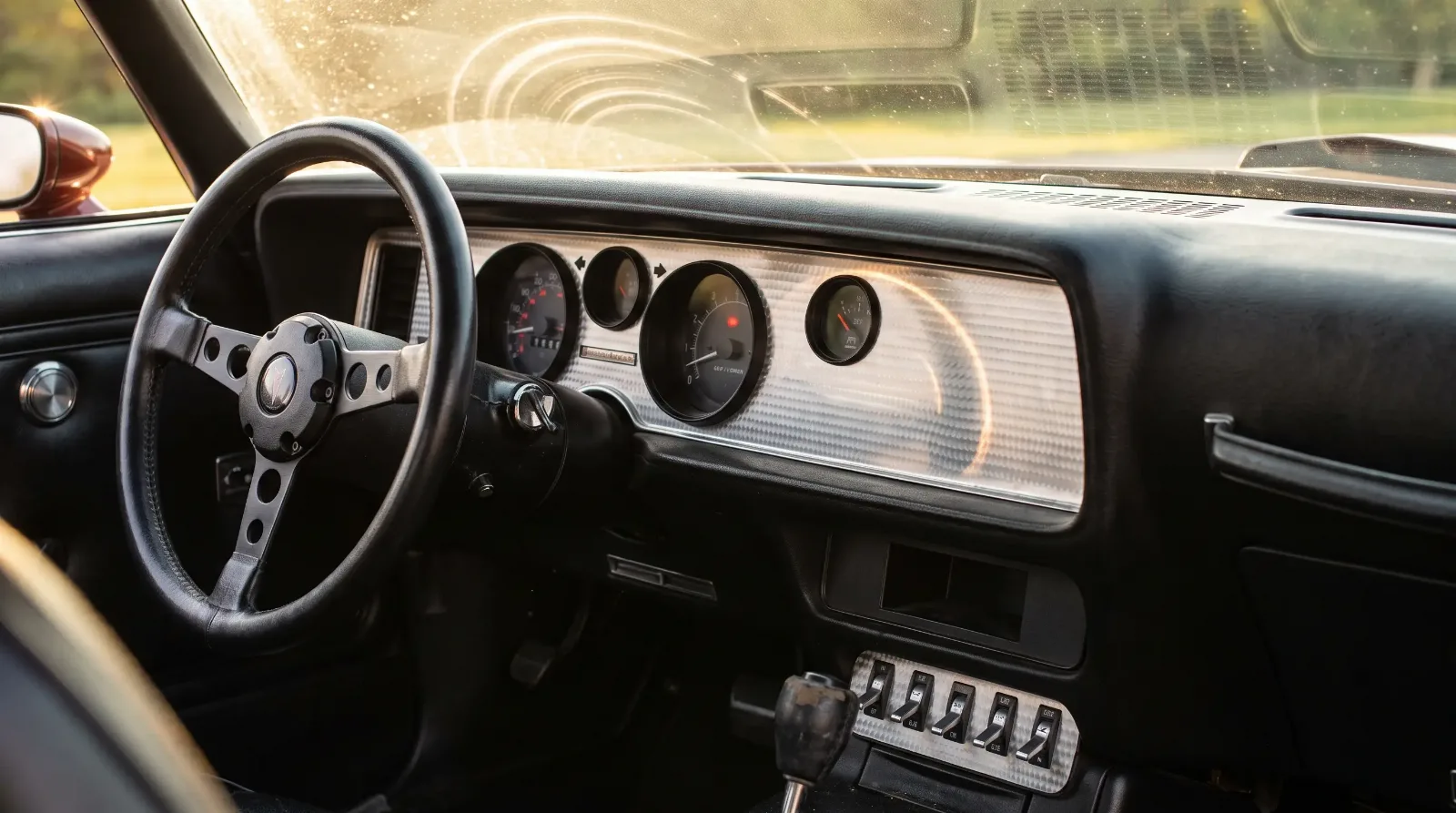
That reaction is not unusual. The trans am interior was built to feel like a cockpit, and Pontiac's stylists leaned hard into the idea that a Trans Am should look different from a base Firebird the moment you dropped into the driver's seat, not just from the outside with the screaming chicken hood decal.
Where the engine-turned look came from
The engine-turned or "damascened" metal treatment was borrowed straight from aviation instrument panels, where turned aluminum was used both to cut glare and to look purposeful. Pontiac's designers brought that same idea into the Trans Am cabin, applying the pattern to appliques across the dash face and center console rather than the woodgrain that dominated most American performance cars of the era. It was a deliberate break from the walnut-look plastic that Detroit leaned on through the 1960s and into the early 1970s, and the engine-turned dash bezel became a fixture of the Trans Am cabin starting with the second-generation car's 1970 debut, staying part of the package all the way through the 1981 model year.
Base Firebirds and even Formulas got a more conventional treatment in most years. The Trans Am's turned-aluminum dash became one of the fastest ways to spot a real TA from ten feet away, right alongside the shaker hood scoop and the wide C-pillar louvers on certain years.
Gauges, switches and the driver-focused layout
Pontiac's engineers angled the entire center stack toward the driver, a layout choice that felt unusual at a time when most domestic dashboards ran flat and symmetrical across the car. The full instrumentation package in higher trim Trans Ams included a tachometer, oil pressure, and temperature gauges rather than idiot lights alone, which was not universal across the Firebird lineup and definitely was not standard on cheaper pony cars from other manufacturers in the same years.
The switchgear had a heft to it too. Toggle-style switches for the rear defroster and some accessory functions gave the cabin a slightly aircraft-adjacent feel that matched the dash finish. None of it was expensive to produce. It was clever design working with modest budgets, which is really the story of the whole second and third generation Firebird program.
| Interior feature | What made it distinct |
|---|---|
| Engine-turned dash applique | Aviation-style turned aluminum look, unique to Trans Am trim in most years |
| Full gauge cluster | Tach, oil pressure, temperature standard on upper trims, not just warning lights |
| Console switchgear | Toggle-style switches gave a cockpit feel distinct from base Firebird |
| Formula steering wheel | Thick-rim wheel shared across performance trims, upgraded on later WS6 cars |
Seating and the road toward Recaro
Standard buckets through the mid to late 1970s were comfortable but fairly conventional, vinyl or cloth over foam with decent bolstering for a car of that era. The bigger shift came later in the model's life when Pontiac started offering more aggressively bolstered seating as buyers who actually drove these cars hard on back roads and autocross courses started asking for something that would hold a driver in place through a fast corner. That evolution is worth its own read, and a companion piece on where Trans Am values sit today gets into how those upgraded interior options shifted what collectors will pay for a well-optioned car versus a stripped one.
What stayed consistent across nearly every year of production was that Pontiac treated the interior as part of the performance story, not an afterthought bolted onto a fast car. Compare that to some competitors who kept selling a base bench seat and column shifter on their sportiest trims well into the 1970s, and you start to understand why Trans Am buyers were loyal in a way that went beyond horsepower numbers.
"I've sat in a lot of muscle car interiors from this era, and most of them feel like an afterthought, a sportier steering wheel bolted to an otherwise ordinary cabin. The Trans Am is one of the few where you can tell somebody in Pontiac's studio actually thought about what it would feel like to sit there for three hundred miles."
Patrick Walsh
Why it still matters to buyers now
Restoring an engine-turned dash correctly is not simple. The appliques were not painted, they were mechanically finished, and a lot of cars on the market today have appliques that were repainted or replaced with lower-quality reproduction pieces that do not catch the light the same way. Anyone shopping the Pontiac Trans Am today should look closely at the dash finish before anything else, because it tells you a lot about how the rest of the restoration was handled. A car with a correctly redone dash and matching console trim usually means the seller cared about details that do not show up in a five-minute walk-around.
The interior is not the reason people fell in love with the Trans Am in the first place. That was always the hood, the stance, the exhaust note. But it is the reason a lot of owners stayed in love with the car decades later, long after the initial thrill of the screaming chicken decal wore off. You live with a car from the inside, and Pontiac understood that better than most of Detroit did in the 1970s.
None of this is meant to turn a car search into an interrogation. It is meant to explain why serious buyers spend as much time with their hands on the dash as they do with their head under the hood. A Trans Am with the interior details right almost always means the rest of the car was treated with the same level of care, and that correlation holds up often enough that veteran buyers use it as a first filter before they even open the hood.
Sources and notes
Related Reading
Have a
Pontiac Firebird
for Sale?
Reach thousands of serious classic car collectors across the US.
Sell It Here →
Are You a Classic Car Dealer?
List your full inventory and connect with targeted classic car buyers.
Join as a Dealer →
#trans-am
#pontiac firebird
#engine-turned dash
#pontiac history
#Trans Am interior
#classic car interiors

About the author
Patrick Walsh
Automotive journalist covering classic car shows, events, and the enthusiast community across North America.
Related Listings - Pontiac Firebird




Comments
Be the first to comment on this article.