
He still remembers the exact sound, a low whistle building underneath the exhaust note like something breathing in before it speaks. His father had bought the car new in the spring of 1980, a dark blue Trans Am with a hood scoop and a small "TURBO" script tucked low on the front fender, and for a nine year old riding in the passenger seat, that whistle was the most interesting sound in the world. He didn't know yet that half the men on his street thought his father had been swindled by Pontiac's marketing department. He just knew the car sounded like nothing else in the neighborhood.
Car Features
6 min read
The Turbo Trans Am 1980-81
A short-lived, ambitious engine gamble that made the turbo Trans Am the pace car of the 1980 Indianapolis 500, and a reputation problem it didn't quite deserve.
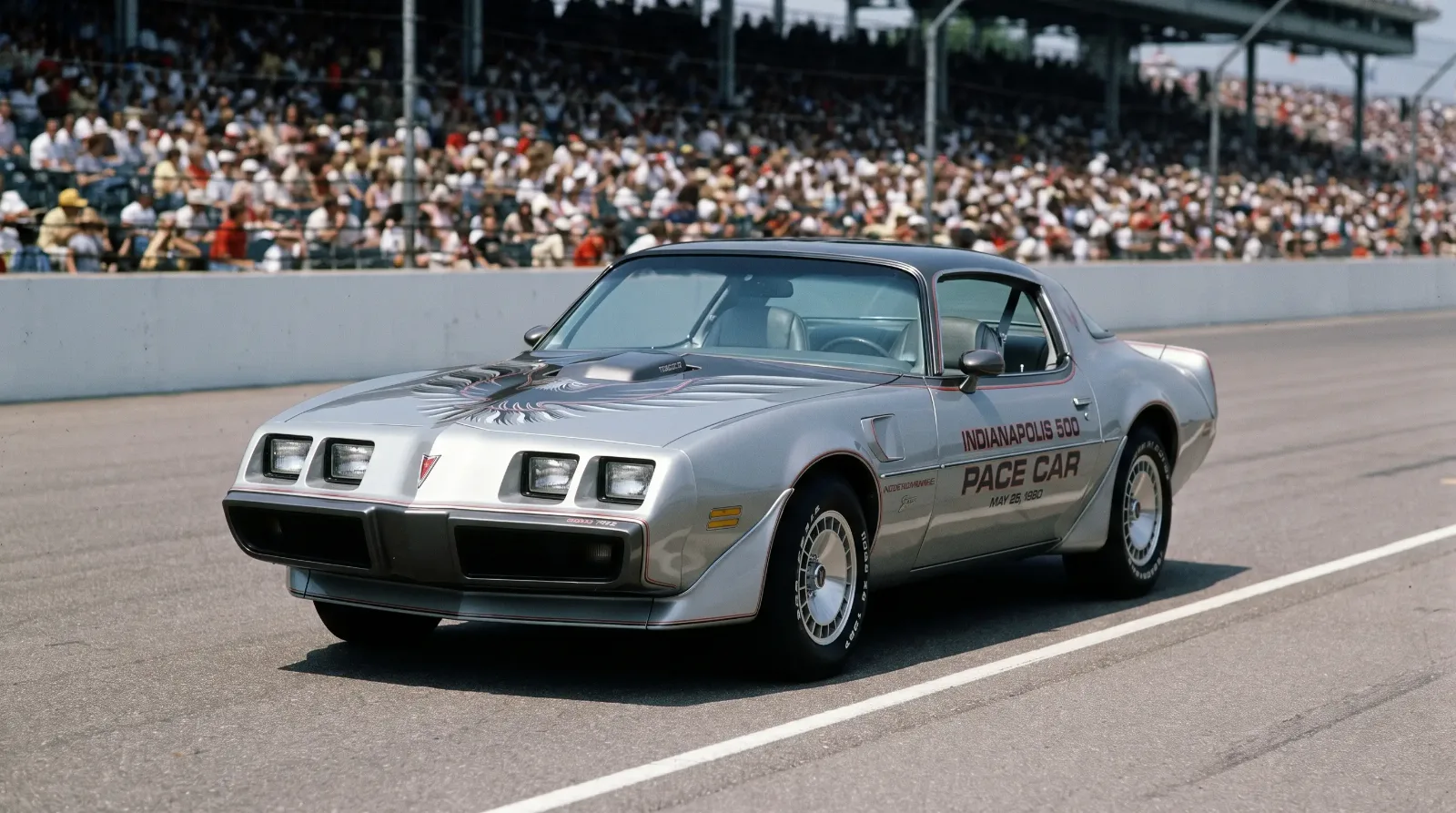
That's the emotional core of the turbo Trans Am story, a car that split opinion the moment it arrived and has spent the decades since slowly winning people back over. It showed up for 1980 and 1981, powered by a turbocharged version of Pontiac's 301 cubic inch V8, and it carried real weight for the brand. This was the engine meant to prove Pontiac could still build something quick in an era when emissions rules and fuel economy mandates had gutted the big-inch V8s that made the the Trans Am story what it was in the first place.
A small engine asked to do a big job
The 301 wasn't a big motor by Pontiac standards, and on its own it wouldn't have impressed anyone shopping a Trans Am in 1980. Bolt on a Garrett turbocharger, though, and the numbers climbed to a factory rating of 210 horsepower and 345 lb-ft of torque for 1980, enough to make it the most powerful engine Pontiac offered that year. The rating dropped slightly to 200 horsepower and 340 lb-ft for 1981, a small but real step back that mirrored the tightening emissions picture across the whole industry. On paper that made the turbo car a genuine flagship. In practice, it made it a car that demanded patience from its driver, since boost came in slowly and unevenly by modern standards, building over a beat or two rather than arriving the instant a foot touched the throttle. Drivers used to the immediate shove of a big-block V8 sometimes found that lag disorienting, and more than a few dealers spent time explaining to confused customers that no, nothing was wrong with the car, it just built power differently than what they were used to.
The turbo system also ran close to its limits under the electronic control available at the time. Pontiac engineers built in a boost gauge on the dash and a knock sensor to pull timing back before detonation could damage the engine, technology that felt genuinely advanced for a mainstream domestic car in 1980. It worked, mostly, but it worked at the edge of what the engineering of the era could reliably manage, and that edge is part of why these cars developed a reputation for finickiness that took years to shake.
The decision to reach for boost instead of bigger displacement wasn't stylistic, it was close to the only option left. Emissions rules and the fuel crises of the 1970s had already pushed Pontiac away from the big-inch engines that built the Trans Am's reputation, and a large-displacement answer wasn't realistic by 1980. A turbocharger let Pontiac chase a flagship horsepower number without growing the engine or blowing through fuel economy targets, an engineering answer to a regulatory problem as much as a performance one.
The year everything came together at Indianapolis
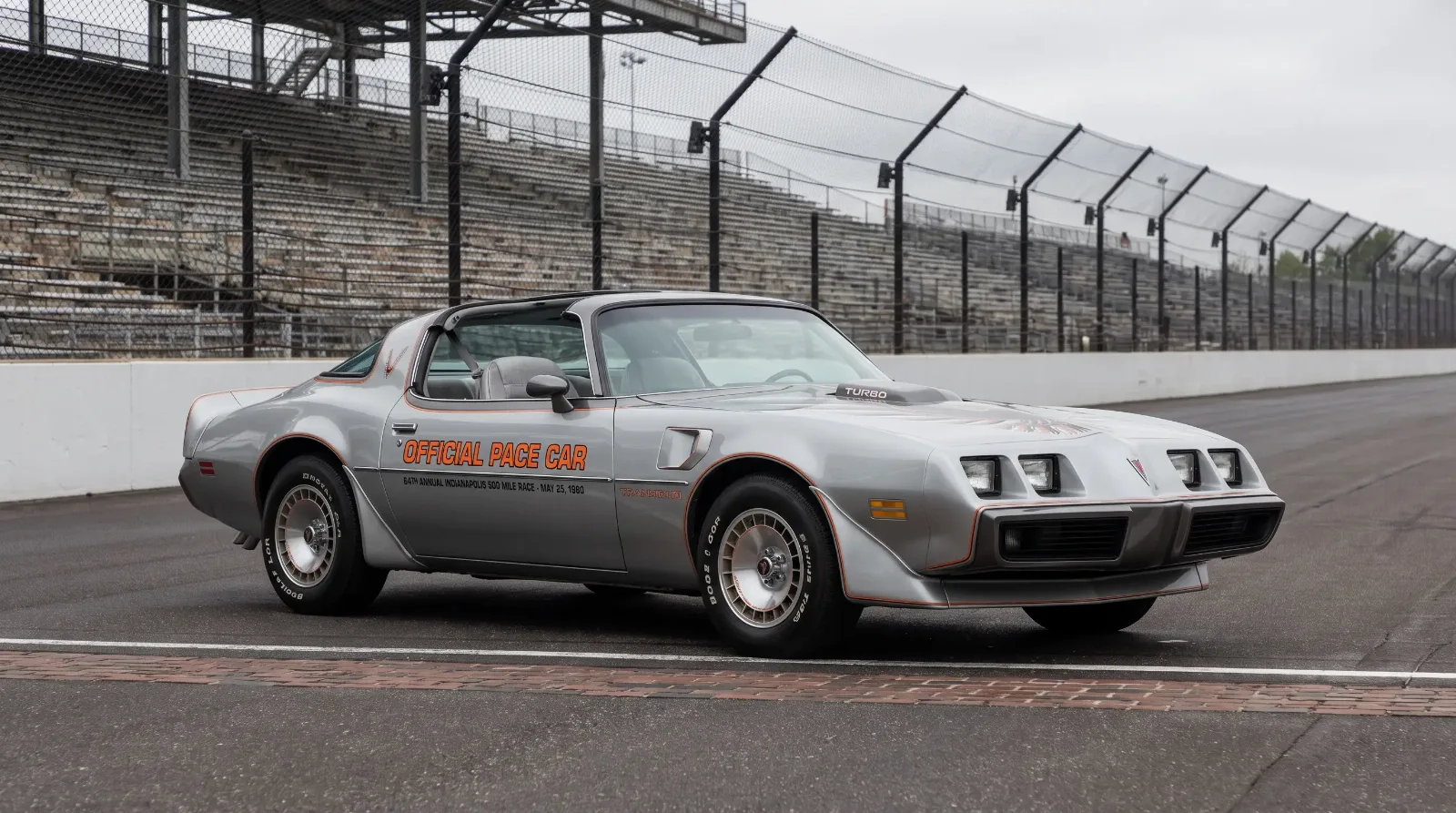
The turbo Trans Am's finest moment arrived in May of 1980, when it was chosen as the official pace car for the Indianapolis 500. Pontiac built a run of replica pace cars for sale to the public, finished in the same silver and gray scheme with the identifying graphics, and those replicas have become some of the most sought after examples of the model today. Standing at the start line of one of the biggest races in American motorsport gave the turbo car a spotlight moment that no amount of magazine advertising could have bought, and it's the image most people picture first when the words "turbo Trans Am" come up in conversation.
The assignment mattered beyond marketing. It put the turbocharged 301 in front of a national television audience at a moment when Pontiac badly needed a performance story in a hard decade for the whole muscle car idea, and the replica package kept that visibility alive in showrooms long after the race ended.
"I think about my father parking that car in our driveway the same week it turned up on television leading the pack at Indianapolis. He never said it, but I think that mattered to him more than the horsepower number ever did."
Nora Beckett
Why it disappeared after only two years
Pontiac dropped the turbo 301 after the 1981 model year, and the reasons were practical rather than dramatic. Reliability concerns around detonation and turbocharger longevity had followed the car since launch, warranty costs were adding up, and the third generation Firebird arriving for 1982 brought a fresh platform with its own new engine lineup, headlined eventually by a return to a 5.0 liter V8. The turbo experiment had done its job, proving Pontiac still had engineering ambition even in a difficult decade, but it wasn't the long-term answer the brand needed.
| Detail | Turbo Trans Am, 1980-81 |
|---|---|
| Engine | 301 cu in (4.9L) turbocharged Pontiac V8 |
| Horsepower | 210 hp (1980), 200 hp (1981) |
| Years produced | 1980-1981 only |
| Notable moment | Official pace car, 1980 Indianapolis 500 |
What owning one feels like today
Finding a well-preserved turbo Trans Am now means finding a car that survived a reputation problem it didn't entirely deserve. Enough owners walked away frustrated in period that plenty of these cars were sold off, neglected, or quietly swapped to a naturally aspirated engine over the years, which makes an original, unmolested example genuinely scarce. The ones that remain tend to belong to people who understand what the car actually was, a short, ambitious experiment born out of necessity, wearing a scoop and a whistle that a boy in a passenger seat never forgot.
Among collectors today, that scarcity has quietly turned a car once dismissed as a gimmick into one of the more interesting corners of the second-generation Trans Am market. A genuine 1980 or 1981 turbo car with its original drivetrain intact, especially one carrying the pace car trim, draws real attention at shows precisely because so few survived unmodified. The visual promise was always bigger than the 200 to 210 horsepower backing it up, and that gap now works in the car's favor, since buyers increasingly want the story and the rarity as much as raw output. If you want to keep reading the series, the pace car story picks up exactly where this one leaves off, tracing how Pontiac turned motorsport moments like Indianapolis into some of its most memorable special editions.
Sources and notes
Related Reading
Have a
Pontiac Firebird
for Sale?
Reach thousands of serious classic car collectors across the US.
Sell It Here →
Are You a Classic Car Dealer?
List your full inventory and connect with targeted classic car buyers.
Join as a Dealer →
#pontiac firebird
#pontiac history
#Turbo Trans Am
#1980 Indy 500 pace car
#301 turbo V8
#1980s performance cars

About the author
Nora Beckett
Automotive features writer and photographer who tells the human stories behind the cars, from show fields to cross-country road trips.
Related Listings - Pontiac Firebird




Comments
Be the first to comment on this article.