
Coachbuilding did not die from a single event. It died from a slow removal of the conditions that let it exist in the first place: money, labor, and a customer base willing to pay for both. By the end of the 1930s the math simply stopped working, and by the 1950s the practice was effectively finished as an industry rather than a novelty act.
Car Features
6 min read
Why Coachbuilding Disappeared
Coachbuilding did not vanish overnight. The Depression, steel bodies, and the war each removed a piece of the industry until nothing was left.
The Depression removed the customer base first
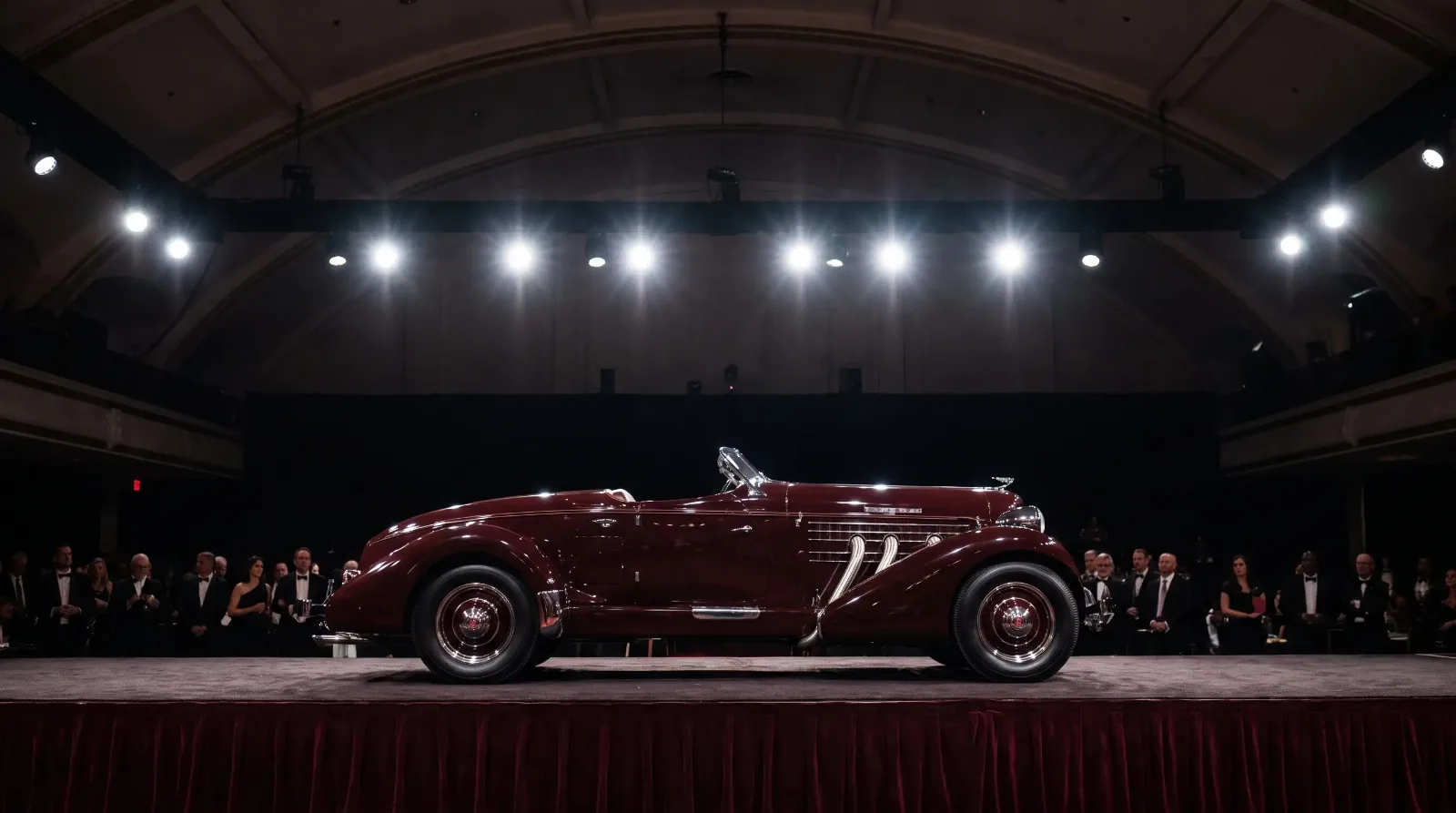
A bespoke body cost as much as, sometimes more than, the chassis it was built on. That kind of spending required a client with serious discretionary income, and the number of people who fit that description collapsed after 1929. Chassis makers who depended on coachbuilt orders, Duesenberg among them, saw demand for their most expensive models fall off sharply through the early 1930s. Some coachbuilders closed outright in this period. Murphy shut its doors in 1932. Others survived by cutting order volume drastically and leaning on a shrinking pool of loyal, wealthy repeat customers.
This is the part buyers often underweight when they look at cars from this stretch: a coachbuilt order placed in 1933 or 1934 represents a genuinely small surviving customer pool, which is one reason cars from the depth of the Depression can carry real rarity, whatever their condition today.
Steel unibody construction closed the technical gap
Through the mid-to-late 1930s, mainstream manufacturers improved their own body engineering to the point where a well-built factory steel body could match, and eventually beat, a hand-built wood-framed body on rigidity, weight, and cost. Once unibody and all-steel construction techniques matured, a factory body was no longer the compromise it had been a decade earlier. That eroded coachbuilding's core technical argument: if a customer could get a stiffer, quieter, cheaper body straight from the factory, the case for paying a premium for hand construction weakened considerably, even for buyers who still had money to spend.
World War II ended what was left
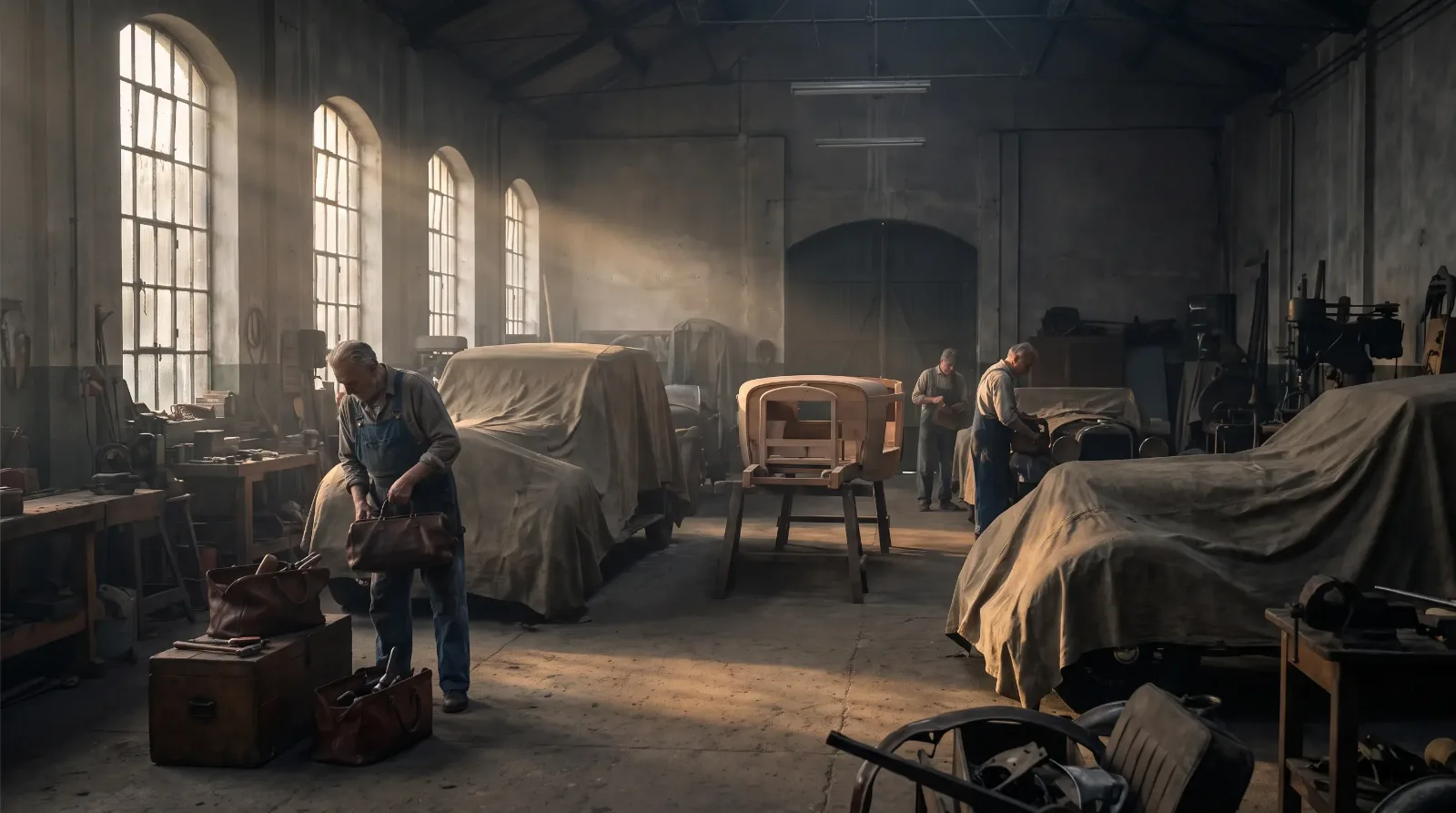
Whatever coachbuilding demand survived the 1930s ran into wartime production restrictions. Civilian automobile manufacturing largely stopped between 1942 and 1945 as factories converted to military output, and the skilled labor pool that coachbuilders depended on, metalworkers, trimmers, cabinet-grade woodworkers, scattered into war industries and the armed forces. When production resumed after the war, the surviving customer base had different priorities and the surviving coachbuilders had lost much of their trained workforce and their prewar client relationships in one stroke.
A handful of firms attempted a postwar revival, working in low volume for a shrinking set of wealthy clients, but the economics never recovered to prewar scale. By the 1950s, coachbuilding as a functioning industry, in the sense of an independent firm bodying someone else's chassis to custom order, had effectively ended in the United States.
Labor costs, specifically
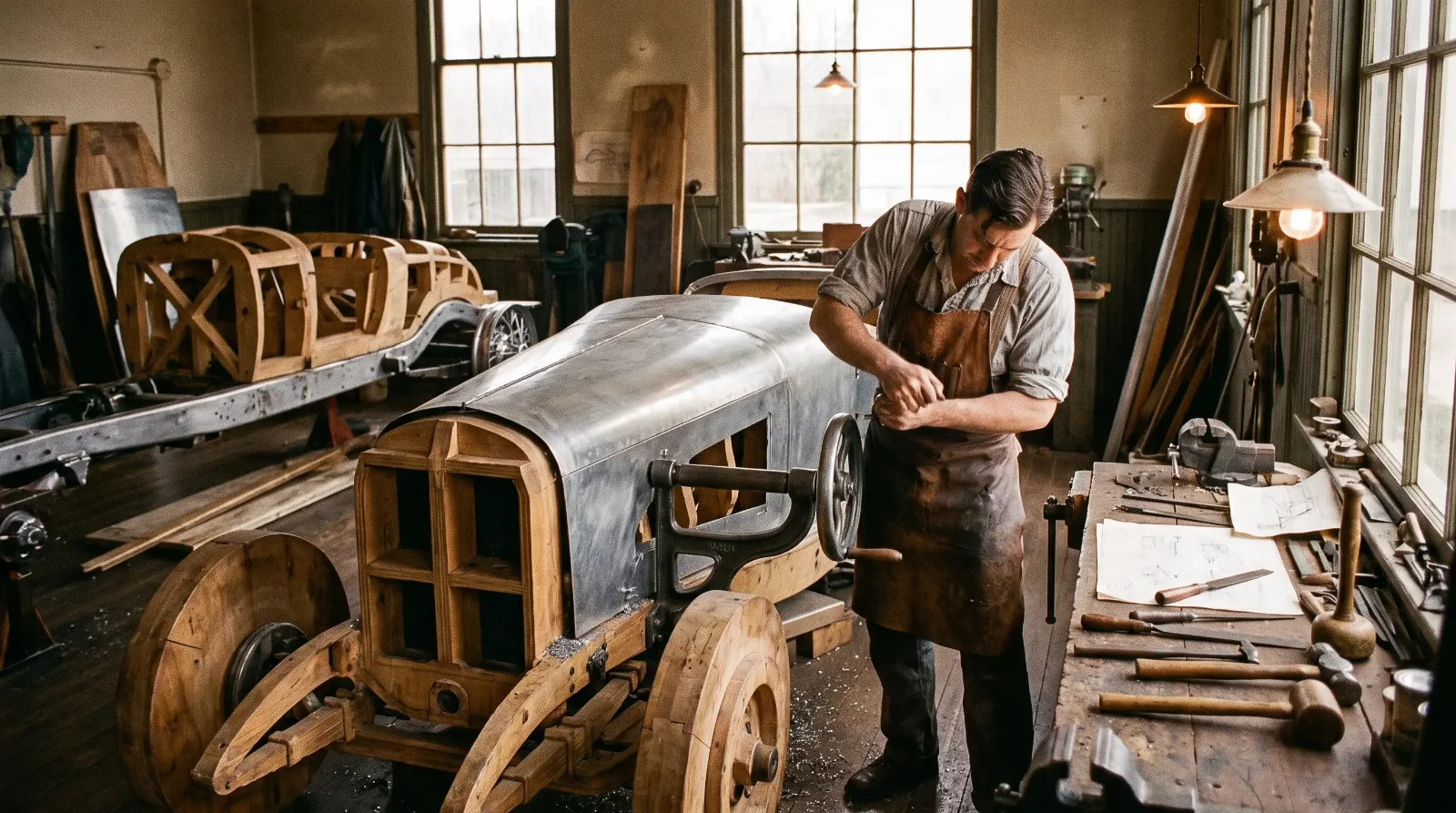
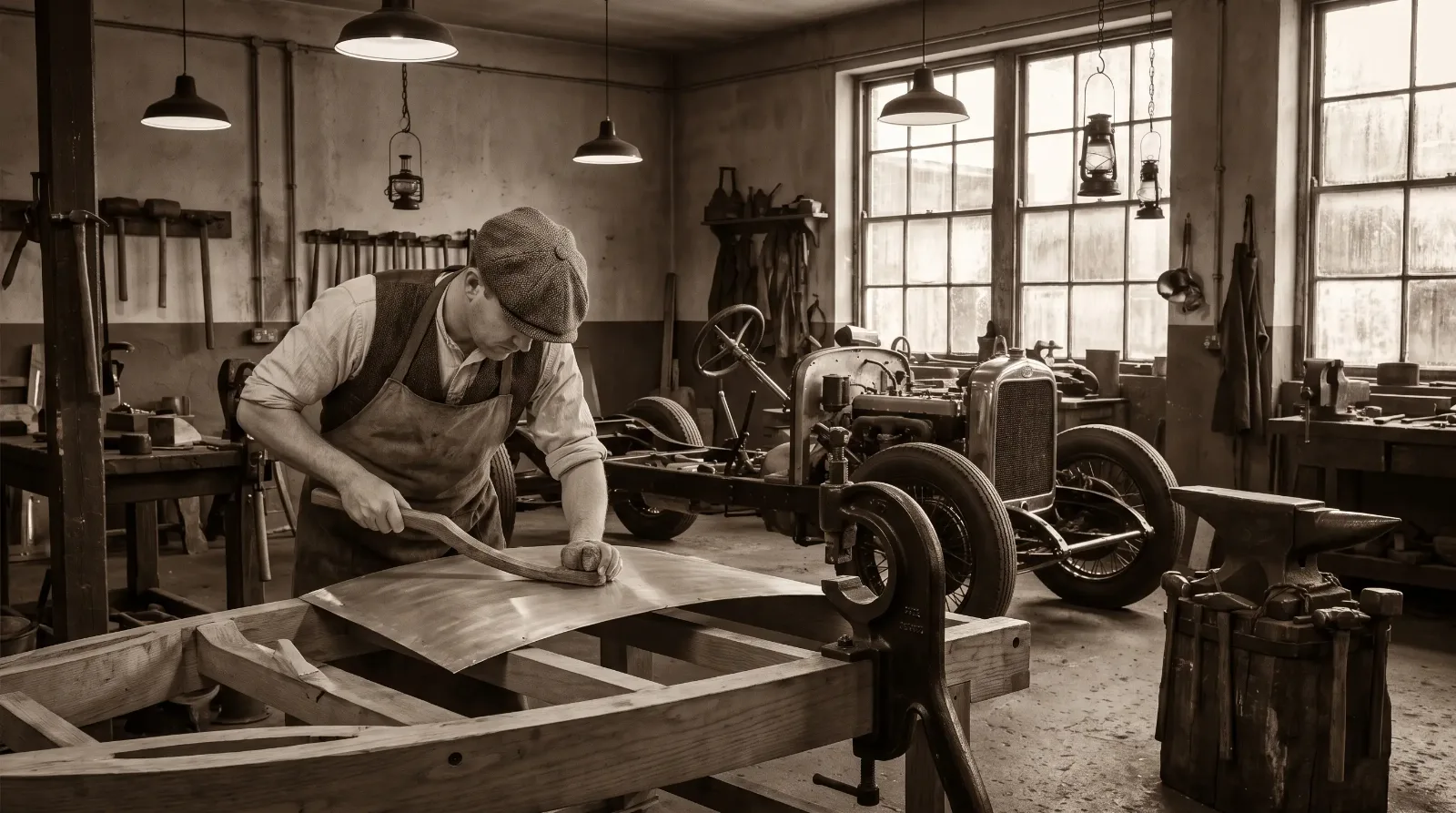
It is worth being precise about what actually made a coachbuilt body expensive, because "hand-built" alone does not fully explain it. A skilled panel beater, trimmer, or cabinetmaker in this trade commanded real wages, and a single body could consume hundreds of hours of that labor across several trades working in sequence rather than in parallel. Factory bodies, by contrast, spread labor costs across thousands of identical units stamped from the same die. That arithmetic never favored the coachbuilder once factory quality caught up, no matter how loyal a customer base a given house had built. Labor cost is usually the quiet variable people skip past when they explain this story through Depression demand alone, but it was working against coachbuilders even in years when demand held up reasonably well.
Changing taste played a role too
It would be a mistake to lay the entire collapse on economics and labor alone. Buyer taste shifted through the 1930s toward a more integrated, streamlined look, and factory design departments got genuinely good at producing that look without any coachbuilder involvement at all. General Motors' Art and Colour Section, established under Harley Earl in the late 1920s, proved that a factory could employ real design talent in-house and turn out bodies with strong visual identity on its own. Once that became standard practice across the industry, part of the coachbuilder's original appeal, access to design talent a factory simply didn't have, stopped being a unique selling point.
So by the time the war intervened, coachbuilding was already losing ground on taste as well as price. The war did not kill a healthy industry outright, it delivered a final blow to one that had been shrinking for close to a decade.
What this means for valuing surviving cars
| Period | Coachbuilding status | Effect on surviving car values today |
|---|---|---|
| Pre-1929 | Peak volume, broad customer base | More surviving examples, values vary widely by house and originality |
| 1930-1934 | Sharp demand collapse | Genuine scarcity, documentation carries outsized value |
| 1935-1941 | Steel bodies close the technical gap | Late coachbuilt orders often the rarest of all |
| 1942 onward | Wartime shutdown, no meaningful recovery | Essentially a closed chapter, values set by fixed remaining supply |
I say this to clients regularly: rarity is not the same as value, but it is the floor value gets built on. If you want the fuller picture of how these firms operated at their peak before this decline began, our deep dive on history of coachbuilding covers the industry from the other direction.
"Every collapsed industry has a moment where the smart buyers stop asking why and start asking what's actually left. With coachbuilding, what's left is finite, it is not being made again, and that is the entire basis for how I price these cars."
Marcus Feld
The end of coachbuilding also marks the point where the pre-war era's most expensive cars became fixed in number rather than growing, which is exactly the subject of the next story. For the broader arc of the period these cars came from, see our pre-war era guide.
Sources and notes
Related Reading
Have a
Classic Car
for Sale?
Reach thousands of serious classic car collectors across the US.
Sell It Here →
Are You a Classic Car Dealer?
List your full inventory and connect with targeted classic car buyers.
Join as a Dealer →
#pre-war classics
#coachbuilt cars
#depression era cars
#classic car values
#history of coachbuilding

About the author
Marcus Feld
Accredited collector-car appraiser who reads the market through hammer prices, condition tiers and risk.




Comments
Be the first to comment on this article.