
The 1974 Camaro Z28 was the best-selling second-generation Z28 Chevrolet had built, and it was cancelled anyway. That is the whole puzzle in one sentence. Chevrolet sold 13,802 of them for 1974, up from 11,574 the year before, and then left the Z28 out of the 1975 and 1976 lineups entirely. The official reason was emissions. The numbers show why that reason holds up, and they also show what Chevrolet gave away by taking it.
Car Features
8 min read
Why the Z28 Disappeared After 1974
The 1974 Camaro Z28 sold 13,802 cars, its best second-gen year, then vanished for 1975 and 1976. The emissions numbers explain why.
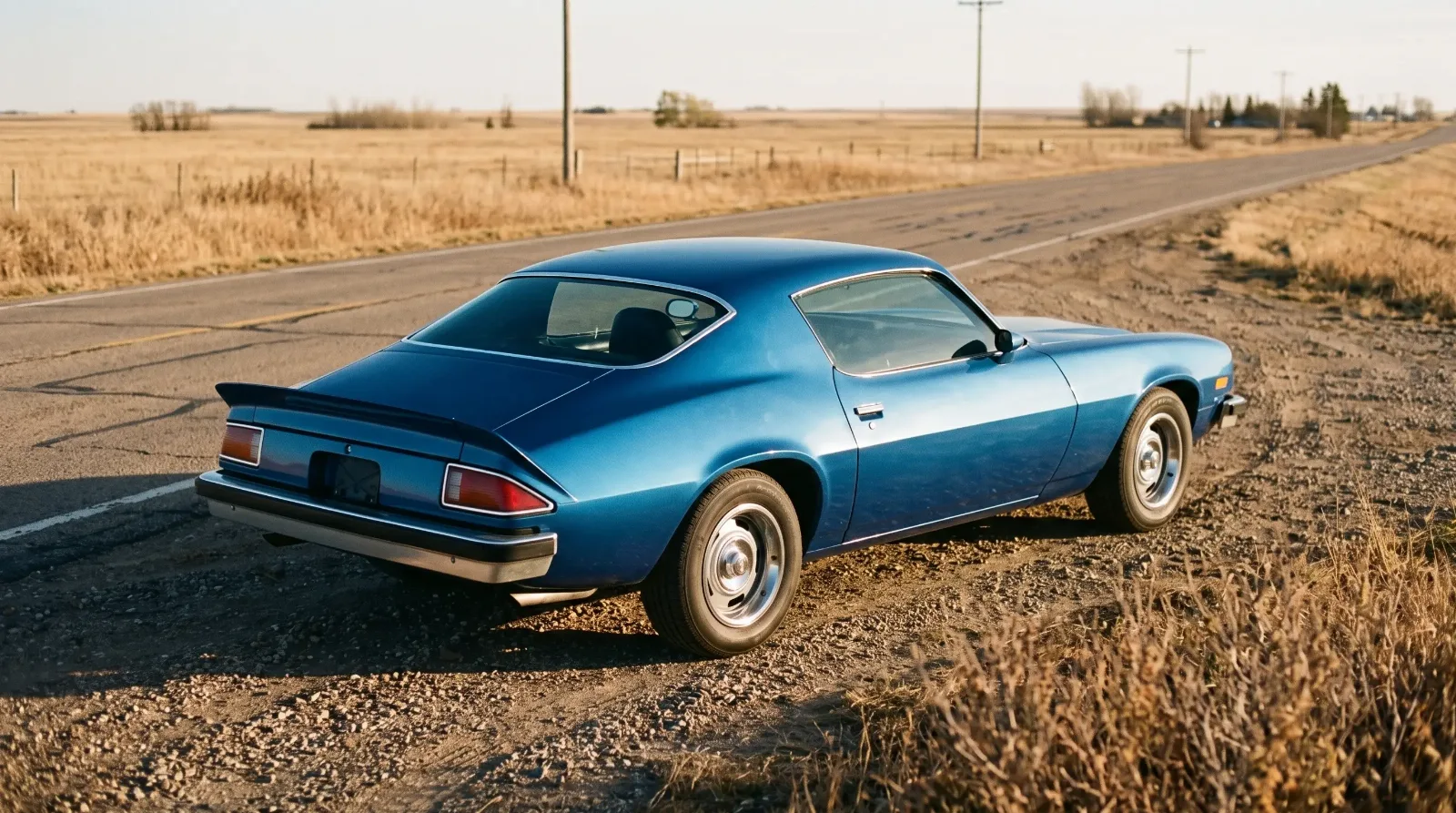
The wider arc of the second generation, from the late 1970½ launch to the last cars of 1981, is a longer story, and there is more on that here. This piece sticks to one question. Why did a car that was selling better every year vanish for two model years?
The 1974 Camaro Z28 by the numbers
Start with what the car actually was, because the 1974 gets lumped in with the smog cars that followed it and it does not belong there. The 1974 Z28 used the L82 350, rated at 245 hp net. That is the same 245 hp the 1973 Z28 carried, the year the engine switched to hydraulic lifters and the Z28 could be ordered with air conditioning for the first time.
The ratings tell you something else if you read them carefully. The 1971 Z28 was rated 330 hp gross, which works out to 275 hp net. The 1972 was 255 hp net. The 1973 and 1974 were 245 hp net. So the drop from 1971 to 1974 is 30 hp on the same net yardstick, not the 85 hp a careless comparison of gross and net figures would suggest. The industry switched from gross to net ratings for 1972, and a lot of the "power collapse" people talk about is that paperwork change, not the engine.
For 1974 the Z28 also picked up HEI ignition, and the whole Camaro line grew seven inches with new aluminum bumpers. Power steering became standard on V8 cars and the fuel tank went from 18 to 21 gallons. It was heavier and longer, but it was still a real 245 hp car, and the market liked it.
| Model year | Z28 engine | Rated output | Z28 production |
|---|---|---|---|
| 1971 | LT-1 350 | 330 hp gross (275 hp net) | 4,862 |
| 1972 | LT-1 350 | 255 hp net | 2,575 |
| 1973 | L82 350 | 245 hp net | 11,574 |
| 1974 | L82 350 | 245 hp net | 13,802 |
| 1975 | No Z28 (best Camaro V8: 350) | 155 hp net | 0 |
| 1976 | No Z28 (best Camaro V8: 350) | 165 hp net | 0 |
| 1977 | LM1-based 350 | 185 hp net | 14,349 |
Look at the production column. 2,575 cars in the strike year of 1972, then 11,574, then 13,802. That is a nameplate on the way up, not one on the way out.
The official reason: 1975 emissions rules
Chevrolet's stated reason was that the Z28 was dropped "due to tight emission regulations," and it said so despite more than 13,000 sales in the final year. The mechanical side of that is easy to see. For 1975 GM fitted a catalytic converter to all of its US passenger cars. A catalyst needs unleaded fuel and an engine tuned to run clean into it, and every Camaro V8 for 1975 was tuned that way.
Here is the result in one figure. The strongest V8 a buyer could order in a 1975 Camaro was a 350 rated at 155 hp net. The other 350 made 145 hp, and the 250 six made 105 hp. The best 1975 V8 was 90 hp down on the 1974 Z28. A car whose entire reason for existing was the engine could not be built on those terms without becoming a stripe kit.
That is the part I think gets lost. Chevrolet did not drop the Z28 because it stopped selling. It dropped it because the 1975 rules took away the one thing the Z28 had that the regular Camaro did not. A Z28 at 155 hp would have been a decal on a Sport Coupe, and anyone who knew what a 1970 Z/28 was would have said so.
"Read the production column before you read the press release. Nobody cancels a car that went from 2,575 to 13,802 in two years because it was failing. They cancel it because they cannot build it honestly next year."
Dan Reeves
Why the sales number did not save it
There is a fair objection here. If 13,802 people bought a 1974 Z28, why not sell them a detuned one in 1975 and keep the name warm? Plenty of makers did exactly that in the middle seventies.
The record does not include a full internal account of the decision, and I am not going to invent one. What it does give is the context. Chevrolet still built 145,770 Camaros for 1975 and 182,959 for 1976. The base car was doing fine without a performance flagship. On paper, a division looking at catalyst certification costs for one more engine combination, on a model that was already selling well, could talk itself out of the Z28 without much trouble.
The broader Chevrolet picture adds a strange twist. In 1974 Chevrolet had just replaced Porsche as the car supplier for the International Race of Champions. The first IROC Camaros were built from 1974 Camaros, and the first Camaro IROC race ran at Michigan in September 1974, won by Bobby Unser. So for 1975 and 1976 the Camaro was the car on television with the best drivers in the world in it, and there was no performance Camaro in the showroom to match. If you want to know how a company leaves money on the table, that is a clean example.
Two years without a Z28, and the Trans Am in the next aisle
The 1975 and 1976 Camaros were not bad cars. The 1975 got a wraparound rear window, HEI on every engine, and new options like power locks, cruise control and leather seats. The RS came back late in 1975 as a paint and trim package. The 1976 added a 305 V8 rated at 140 hp and a four-barrel 350 at 165 hp. The full picture of those two years, with every engine and option, lives in our look at the smog-era cars.
The problem was across the hall at Pontiac. Pontiac kept the Trans Am going through the same rules, and by 1976 roughly 47,000 of about 110,000 Firebirds sold were Trans Ams. That is close to half the Firebird line in the performance trim, on the same F-body the Camaro used. Chevrolet had walked away from a buyer that Pontiac was happy to take.
Separate the real power from the catalog claim here. The Trans Am of those years was not a 1970 car either. But it looked the part and it was for sale, and the Camaro had nothing to put next to it. That is a marketing hole, not an engineering one.
How the gap ended, and what it means for a 1974 today
Chevrolet saw the Trans Am numbers. Period accounts credit chief engineer Tom Zimmer with demanding the Z28's return after watching Trans Am sales, with engineer Jack Turner leading the revival. The Z28 came back in the spring of 1977 as the "1977½," shown at Daytona in February 1977. It used an LM1-based 350 rated at 185 hp, and it returned as a separate model rather than an option package, which is how it had been sold from 1967 to 1974. Chevrolet built 14,349 of them, more than the 1974 total in a partial year.
That figure settles the argument about demand. The buyers were there in 1974 and they were still there in 1977. The two missing years were a regulatory decision, not a market verdict. The comeback car is one of the Camaro performance legends partly because of that gap: it proved the name was worth more than the engine under it.
For anyone looking at a 1974 Camaro Z28 now, the takeaway is simple. It is the last Z28 with the L82 and the 245 hp rating, and the last one before the catalyst era. The 1973 and 1974 Z28 used the "T" engine code in the VIN, and that is the first thing to check, since the paperwork on a car with a story like this one matters more than the stripes.
Sources and notes
- Chevrolet Camaro (second generation), Wikipedia: 1974 Z28 output, 1975 catalysts and engines, the 1977½ return
- Hagerty: the Camaro Z28's return, with the 1974 L82, the IROC switch and 1976 Trans Am sales
- Hagerty: 1970 to 1981 Chevrolet Camaro buyer's guide, year-by-year changes
- Jalopnik: a brief history of the Camaro Z28, on the post-1974 cancellation
- Collector Car Market: 1970 to 1974 Chevrolet Camaro profile, Z28 ratings and production
- Motor Sport: the International Race of Champions and its first Camaro season
Related Reading

Have a
Chevrolet Camaro
for Sale?
Reach thousands of serious classic car collectors across the US.
Sell It Here →
Selling a classic? Here's how: compare the places to sell classic cars
Are You a Classic Car Dealer?
List your full inventory and connect with targeted classic car buyers.
Join as a Dealer →
#camaro z28
#chevrolet camaro
#1970s cars
#emissions era
#second generation Camaro
#1974 Camaro
#1977 Z28

About the author
Dan Reeves
Performance engine builder from North Carolina's motorsports corridor, focused on swaps, forced induction and making real, repeatable power.
Related Listings - Chevrolet Camaro




Comments
Be the first to comment on this article.