
By 1970, the big block Nova was effectively dead. Insurance surcharges on anything with a 427 badge had climbed to the point where the cars were becoming unsellable at the dealer level, and GM corporate was already tightening its own internal rules on which engines could go in which body. Don Yenko needed a new answer, and what he built instead was the Yenko Deuce, a 1970 Nova powered by the LT-1 350 small block rather than a big block at all. It is a stranger, more interesting car than its 427 predecessor precisely because it had to be.
Car Features
6 min read
The 1970 Yenko Deuce (LT1 350)
Why Don Yenko moved from the 427 big block to the LT-1 350 small block for 1970, and what separates a genuine Yenko Deuce from a well-built LT-1 Nova.
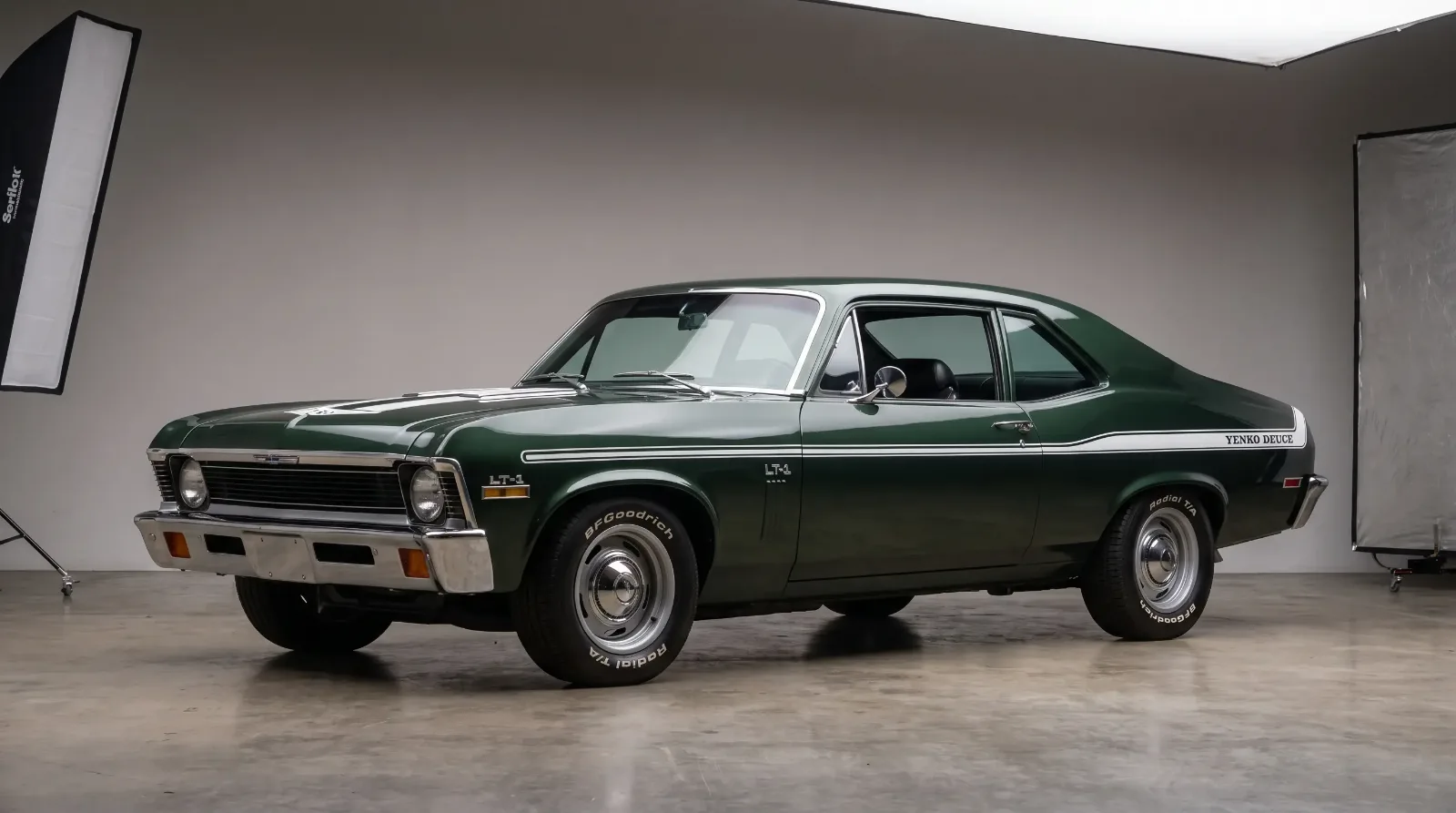
Why Yenko moved to a small block
The LT-1 350 was not a detuned engine looking for a home. Chevrolet built it as a genuine high-output small block, solid lifter cam, high compression, a big four-barrel carburetor, and a factory rating of 360 horsepower that made it competitive with far larger displacement engines on paper. The Corvette used the same basic architecture, and so did the Camaro Z/28, which tells you how seriously Chevrolet's own engineers took this platform even as insurance companies were making big blocks a liability nobody wanted to underwrite.
For Yenko, the small block solved two problems at once. It sidestepped the worst of the insurance penalty that big block muscle cars were absorbing, and it gave a Nova a genuinely high-revving character that a torque-heavy big block never had. The nickname "Deuce" reportedly traces back to how the car was marketed and discussed among Yenko's dealer network at the time, distinguishing this smaller, quicker-revving package from the earlier 427 cars covered in the 427 super Novas story.
There was also a practical business reason behind the switch. Insurance underwriters in 1970 were pricing big block compacts almost as aggressively as they were pricing full-blown muscle cars, which meant a Nova buyer paying for a 427 badge was also paying a premium that often made the car harder to finance and harder to insure for a young driver, exactly the demographic most likely to want one. A small block rated in the mid-300s on paper drew a friendlier insurance quote even when its real-world performance was close enough to a big block car that most owners never felt shortchanged on the street.
What made a Deuce different from a stock LT-1 Nova
A Nova with the LT-1 option was already a serious car straight from the factory order sheet. What Yenko added on top was dealer-level, similar in spirit to what his shop had done with the earlier 427 cars: specific graphics and badging, a stiffer suspension package tuned for the lighter front end of a small block car rather than a big block, and in some cases a different rear axle ratio aimed at street use rather than strip use. The core mechanical package, though, leaned heavily on what Chevrolet already offered in the LT-1, which is part of why documentation on genuine Yenko Deuce Novas is thinner than documentation on the earlier COPO big block cars. There was less unique factory paperwork generated, because less of the car required a special order code to build in the first place.
That thinner paper trail is exactly why this car gets misidentified more often than most muscle Novas. A well-optioned LT-1 Nova without genuine Yenko dealer work can look convincingly similar to the real thing at a glance, and only careful cross-referencing of dealer invoices and period photographs separates the two.
Suspension tuning is one area worth a closer look during any inspection. A Deuce built for street use through Yenko's shop often carried different spring rates and shock valving than a stock LT-1 Nova ordered without dealer involvement, reflecting the lighter nose weight of a small block car compared to the 427 cars that came before it. Original suspension components rarely survive fifty-plus years of use without replacement, so a buyer should not expect to find factory-original springs and shocks still in place. What matters more is whether the car's overall specification, gearing, brake package, and interior trim, lines up with what period Yenko literature and surviving invoices describe for this specific package.
Reading the market on a rare small block Yenko
Because production numbers on the Deuce were low, around 175 cars for the 1970 model year, and the surviving fleet is smaller still, comparable sales are infrequent enough that any single auction result gets outsized attention from collectors trying to establish where the market actually sits. What I watch for is whether a sale price reflects genuine Yenko documentation or whether it reflects an assumption that any well-built LT-1 Nova from 1970 deserves Deuce-level money. Those are not the same thing, and buyers who conflate them tend to overpay for cars that, however well built, cannot prove the dealer history that justifies the premium.
The honest read is that this remains a thin, illiquid corner of an already thin market. That is not a reason to avoid it. It is a reason to be patient and to insist on paperwork before writing a check.
"A genuine Yenko Deuce is worth chasing, but I want to see the invoice before I get excited about the badge. Plenty of good LT-1 Novas wear graphics that suggest more history than they can actually prove."
David Mercer
| Spec | 1970 Yenko Deuce Nova |
|---|---|
| Engine | 350 cu in LT-1 V8, solid lifter |
| Horsepower | 360 hp factory rating |
| Compared to | 1969 Yenko 427 (see prior chapter) |
| Key advantage | Lighter nose, higher redline, friendlier insurance rating |
| Documentation risk | Higher, since less unique factory paperwork was generated |
Where the Deuce fits in the bigger picture
The shift from big block to small block in a single model year says as much about the era as it does about any one car. Readers tracking how Chevrolet and its performance dealers adapted to insurance pressure and tightening corporate rules should look at the next story in this set, which walks through what actually survives from this entire chapter of Nova history. For a wider view of how the compact Nova evolved across its full production run, from economy car to muscle car and back again, the full Nova story puts this small block detour into context alongside everything that came before and after it.
Sources and notes
Related Reading
Have a
Chevrolet Nova
for Sale?
Reach thousands of serious classic car collectors across the US.
Sell It Here →
Are You a Classic Car Dealer?
List your full inventory and connect with targeted classic car buyers.
Join as a Dealer →

About the author
David Mercer
Classic car market analyst with two decades of experience tracking collector car valuations, auction results, and investment trends.
Related Listings - Chevrolet Nova




Comments
Be the first to comment on this article.