
Pull the spec sheet for a 1971 Chevelle SS 454 and set it next to a 1975 Chevelle 350. The difference is not subtle. It is not a matter of trim level or axle ratio either. Somewhere in those four years, the entire premise of what a Chevelle engine was built to do changed, and the paperwork tells the story better than any dyno pull could.
History & Heritage
7 min read
The Malaise-Era Horsepower Decline
Why Chevelle horsepower ratings dropped through the Colonnade years: net vs gross ratings, unleaded fuel, and emissions equipment explained.
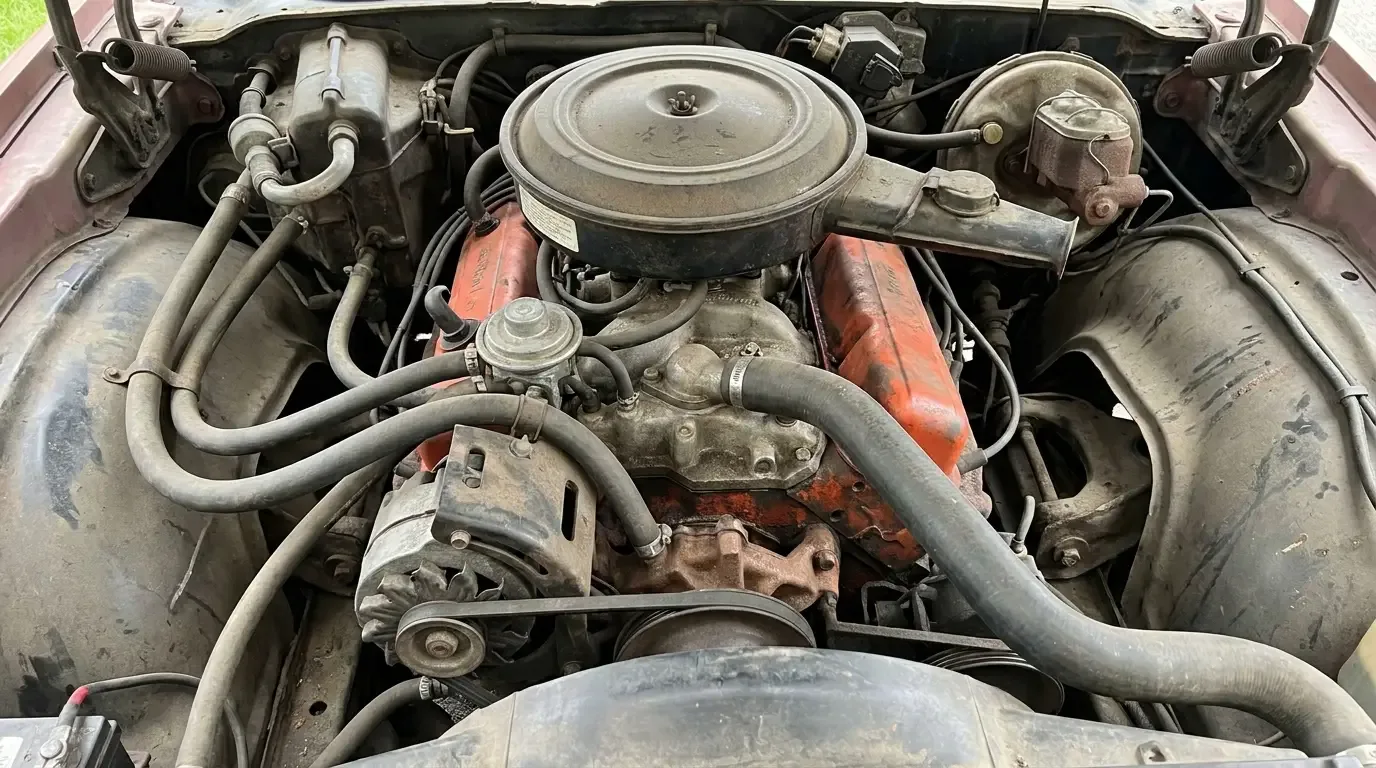
Chevrolet did not lose the ability to build powerful engines during the Colonnade years. What changed was the rulebook, and reading the factory documentation year over year shows exactly how fast the rulebook moved.
The net horsepower switch nobody explained well
The first thing to untangle is the rating system itself. Through 1971, Chevrolet published gross horsepower figures, measured on a test stand with the engine stripped of accessories, mufflers, and a proper air cleaner. Starting with the 1972 model year, the industry moved to SAE net ratings, measured with the engine dressed the way it actually sat in the car, alternator turning, fan spinning, full exhaust in place.
That single change made every engine look weaker on paper even before emissions equipment tightened further. A 1970 LS6 454 carried a gross rating of 450 hp. The same basic architecture, by 1972, wore a net rating of 270 hp for the LS5 variant, the top big-block Chevelle buyers could order that year. Buyers walking into a Chevrolet showroom in 1972 saw a smaller number and assumed the engine had been detuned. Some of it had. A lot of it was just honest math replacing optimistic math.
I've spent enough time with factory build sheets and RPO code documentation to know how often this gets flattened into "cars got weaker in the seventies" as if it were one simple story. It was two or three separate stories happening at once, and they deserve to be separated.
Compression ratios come down for unleaded fuel
The second thread is fuel. Leaded gasoline had let engineers run compression ratios in the 10.5:1 to 11:1 range on the big-block Chevelle engines through the late sixties. Tetraethyl lead was cheap, effective at preventing detonation, and it let Chevrolet chase higher compression year after year.
The health and environmental case against lead started closing that door in the early seventies. By the 1975 model year, catalytic converters arrived across most of the Chevrolet lineup, including the Colonnade Chevelle, and catalysts are poisoned by leaded fuel almost immediately. The industry response was a hard drop in compression, down into the 8.0:1 to 8.5:1 range on most Chevelle V8s (the base 1975 350 two-barrel, for example, ran an 8.5:1 ratio), specifically so the engines could run on the new unleaded fuel the catalyst required.
Lower compression means a less efficient burn and less usable power at the same displacement. That alone accounts for a meaningful chunk of the horsepower drop that showed up in the middle of the Colonnade run, on top of the net versus gross bookkeeping change that had already happened a few years earlier.
Emissions equipment adds another tax
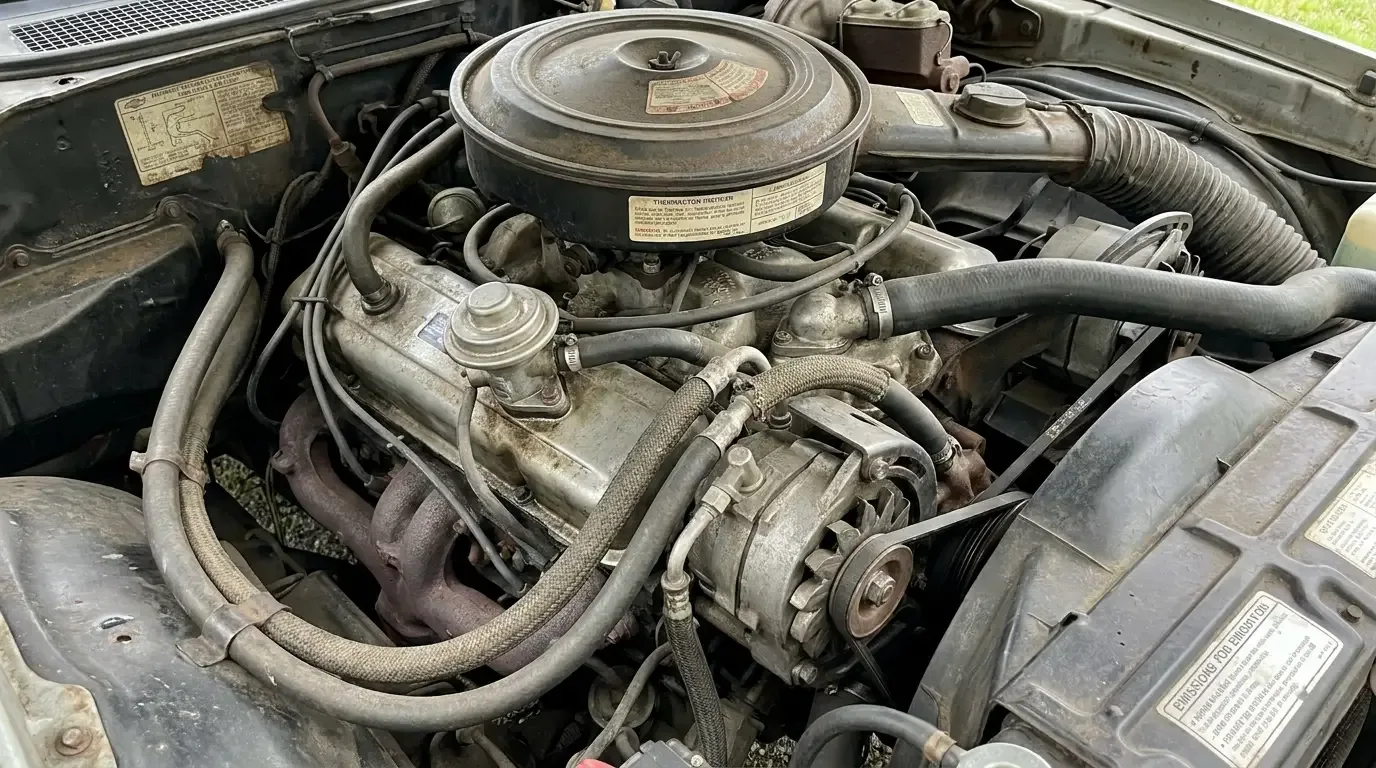
Then there is the hardware itself. EGR valves, recirculating a portion of exhaust gas back into the intake charge to lower combustion temperatures and cut oxides of nitrogen, became standard equipment across the board by the mid-seventies. Air injection systems, pumping fresh air into the exhaust manifold to burn off unburned hydrocarbons, added parasitic load and further leaned out the tune in ways that cost real power.
None of this was optional equipment a dealer could delete. It came from the factory as installed, calibrated to whatever the current emissions standard required for that model year, and every piece of it worked against peak output. Chevrolet's engineers were not trying to build weaker engines. They were trying to build engines that passed a moving target of federal and California requirements while still running acceptably on pump gas, and something had to give.
What the Chevelle SS454 lost, year by year
The clearest documented case is the SS454 option itself. In 1973, the LS4 454 in a Chevelle SS was rated at 245 net hp. By 1974, the same basic 454 slipped to 235 net hp. The engine displacement never moved. The bore and stroke stayed the same. What moved was the compression, the ignition timing calibration, and the exhaust restriction, all pulling in the same direction.
The 454 option was offered only through the first half of the 1975 model year, unchanged at 235 net hp, before Chevrolet dropped it from the Chevelle lineup entirely, a casualty of tightening standards and softening demand for big-block muscle in a market that had just lived through the 1973 oil embargo. Only 4,263 A-body Chevrolets, spread across Chevelle, Malibu, the wagon, El Camino, Monte Carlo, and Laguna, left the factory with that final-run LS4 454. What remained through the end of the Colonnade run in 1977 was a lineup topped out by 350 cubic inch V8s, four-barrel versions of which were making 165 net hp in 1976 and 170 net hp in 1977, numbers that would have been unthinkable for a mid-size Chevrolet performance car a decade earlier.
| Model year | Top Chevelle V8 option | Approx. net hp | Key change |
|---|---|---|---|
| 1971 | LS5 454 (LS6 dropped from Chevelle) | 365 (gross rating) | Last full year of gross ratings |
| 1973 | LS4 454 | 245 (net) | SS package still available |
| 1974 | LS4 454 | 235 (net) | Compression trimmed further |
| 1975 (first half only) | LS4 454 | 235 (net) | Catalytic converter, unleaded fuel required; dropped mid-year |
| 1976-77 | 350 four-barrel | 165-170 (net) | 454 discontinued in Chevelle |
Anyone weighing a Colonnade-era Chevelle against an earlier the Colonnade and Laguna years car needs to hold those two rating systems apart in their head, or the comparison stops meaning anything.
Reading a Colonnade Chevelle's numbers honestly today
None of this means the later Colonnade Chevelles are bad cars. It means they need to be evaluated on their own terms rather than measured against a 1970 LS6 and found wanting by a yardstick that never applied to them in the first place. A well-documented 1974 or 1975 Chevelle with matching build sheet and original RPO codes tells an honest story about where American performance stood at that exact moment, oil crisis, emissions mandates, and all.
The production numbers back up how quickly buyer appetite shifted too. Big-block take rates on the Chevelle dropped sharply after 1974, and by the time next: 1977 rolled around, the performance conversation inside Chevrolet had mostly moved on to the smaller-displacement, better-breathing engines that would carry the Malibu name into the eighties.
For collectors and buyers today, that means paperwork matters more than ever on a Colonnade-era car. The tank sticker and the factory build sheet tell you what compression, what carburetor, and what emissions package actually left the plant on your specific car, which is the only way to judge a Colonnade Chevelle fairly against the Chevelle's complete history rather than against a memory of a different decade.
"People want to blame one thing for what happened to horsepower in the seventies. It was never one thing. It was net ratings, then unleaded fuel, then a catalyst, stacked on top of each other in about three years. Read the build sheet before you judge the number."
Tom Ramirez
Sources and notes
- Chevrolet Chevelle: Wikipedia (1976-77 350 four-barrel ratings, SS package timeline)
- 454 In The Barn: 1973 Chevelle SS: Barn Finds (1973 LS4 rated 245 net hp)
- '72 454 horsepower: Team Chevelle forum (1972 LS5 confirmed at 270 net hp)
- 1975 Malibu with a factory 454: Team Chevelle forum (454 offered only first half of 1975, 4,263 built)
- 1975 Chevy 350 engine specs, myenginespecs.com (8.5:1 compression ratio, two-barrel)
Related Reading
Have a
Chevrolet Chevelle
for Sale?
Reach thousands of serious classic car collectors across the US.
Sell It Here →
Are You a Classic Car Dealer?
List your full inventory and connect with targeted classic car buyers.
Join as a Dealer →

About the author
Tom Ramirez
Corvette researcher and historian based in Bowling Green, Kentucky. Two decades documenting Corvette production history from original factory records.
Related Listings - Chevrolet Chevelle
More in History & Heritage
Comments
Be the first to comment on this article.