
Open the hood on a big-block Chevelle SS and the air cleaner tells you what you're looking at before you check a single casting number: "Turbo-Jet." No turbocharger anywhere on the engine. That's the part that trips people up every time, and it's worth settling before we go further, because the confusion has been baked into swap-meet conversation for fifty years.
History & Heritage
7 min read
SS and Turbo-Jet: The Marketing Lore
Chevelle SS Turbo-Jet badges never meant a turbocharger. Here is where Chevrolet's jet-age engine name actually came from and why it stuck.
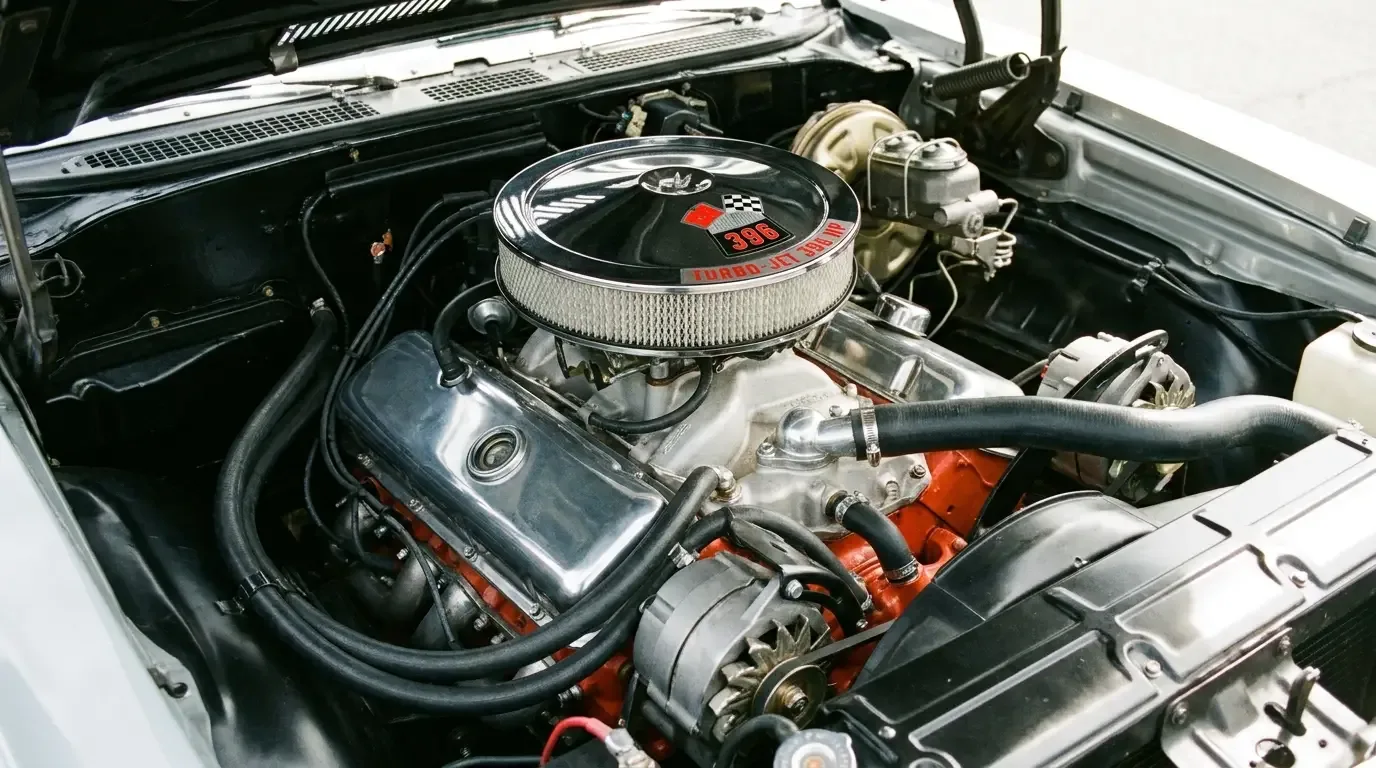
"Turbo-Jet" was Chevrolet's name for its big-block V8 family, full stop. It ran alongside "Turbo-Fire," the small-block designation, and neither name described forced induction of any kind. What it described was an era. Chevrolet's marketing department in the mid-1960s was leaning hard into jet-age and space-age language, and an engine family name that sounded like it belonged on an aircraft spec sheet did real work on a showroom floor. The SS396 badge, the fender callouts, the air cleaner decal: all of it traces back to a naming decision made well before the first 396 landed under a Chevelle hood.
Where the name actually came from
The Turbo-Jet name predates the Chevelle SS. Chevrolet applied it to its Mark IV big-block family starting with the 396 cubic inch engine's public debut in the Corvette and full-size cars around 1965, and the name carried forward as the family grew. By the time the Chevelle SS396 arrived for the 1966 model year, "Turbo-Jet 396" was already an established piece of factory vocabulary, not something invented for the Chevelle specifically. The Chevelle inherited the branding along with the engine.
What makes this a genuinely interesting bit of corporate history rather than a footnote is how deliberately non-technical the name was. Chevrolet's engineers had internal designations, the Mark IV block family among them, and RPO codes for every configuration a dealer could order. None of that language was going to sell a car to a nineteen year old standing in a showroom. "Turbo-Jet" did that job. It borrowed the credibility of jet propulsion, which in the mid-1960s still carried genuine cultural weight, NASA was flying real missions and the space race was front-page news, and it applied that credibility to a cast-iron pushrod V8 that owed nothing to turbine technology.
How the badge shows up on a Chevelle
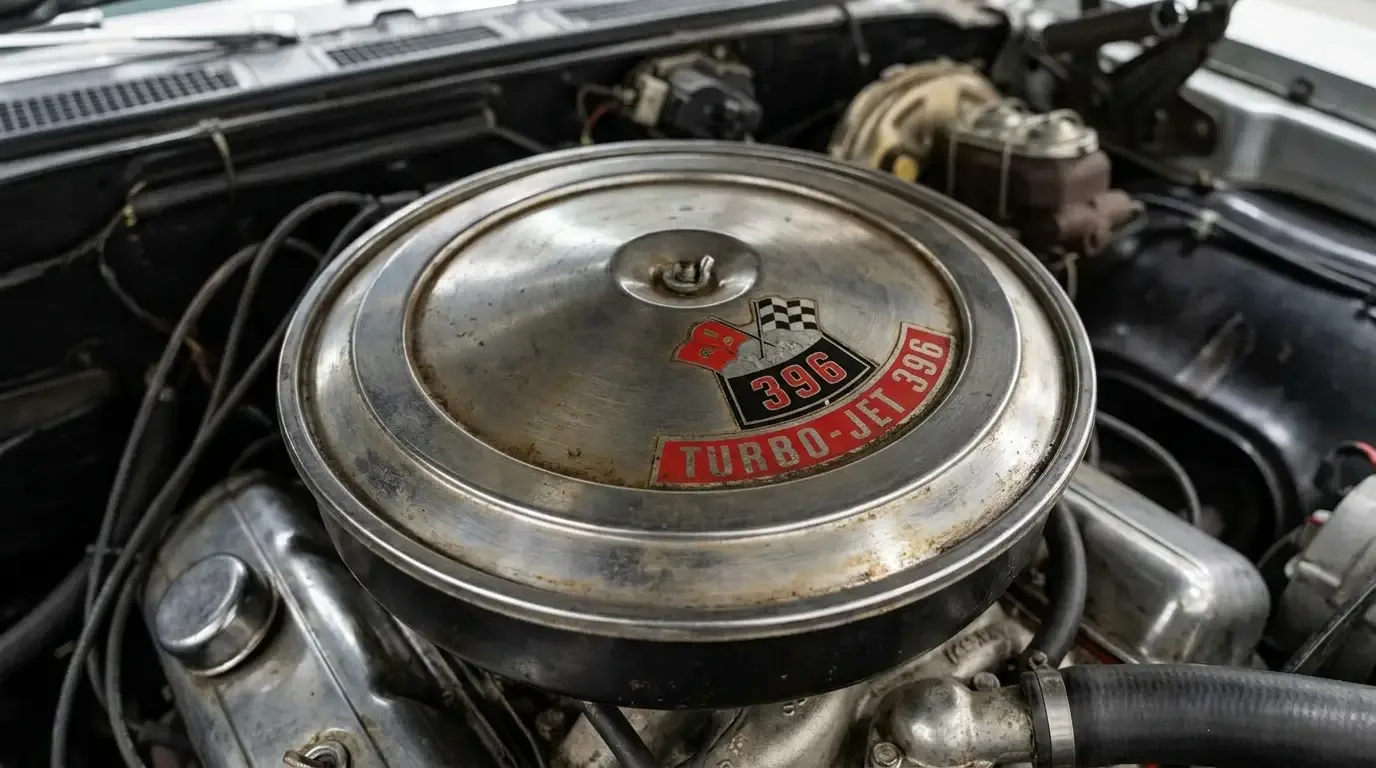
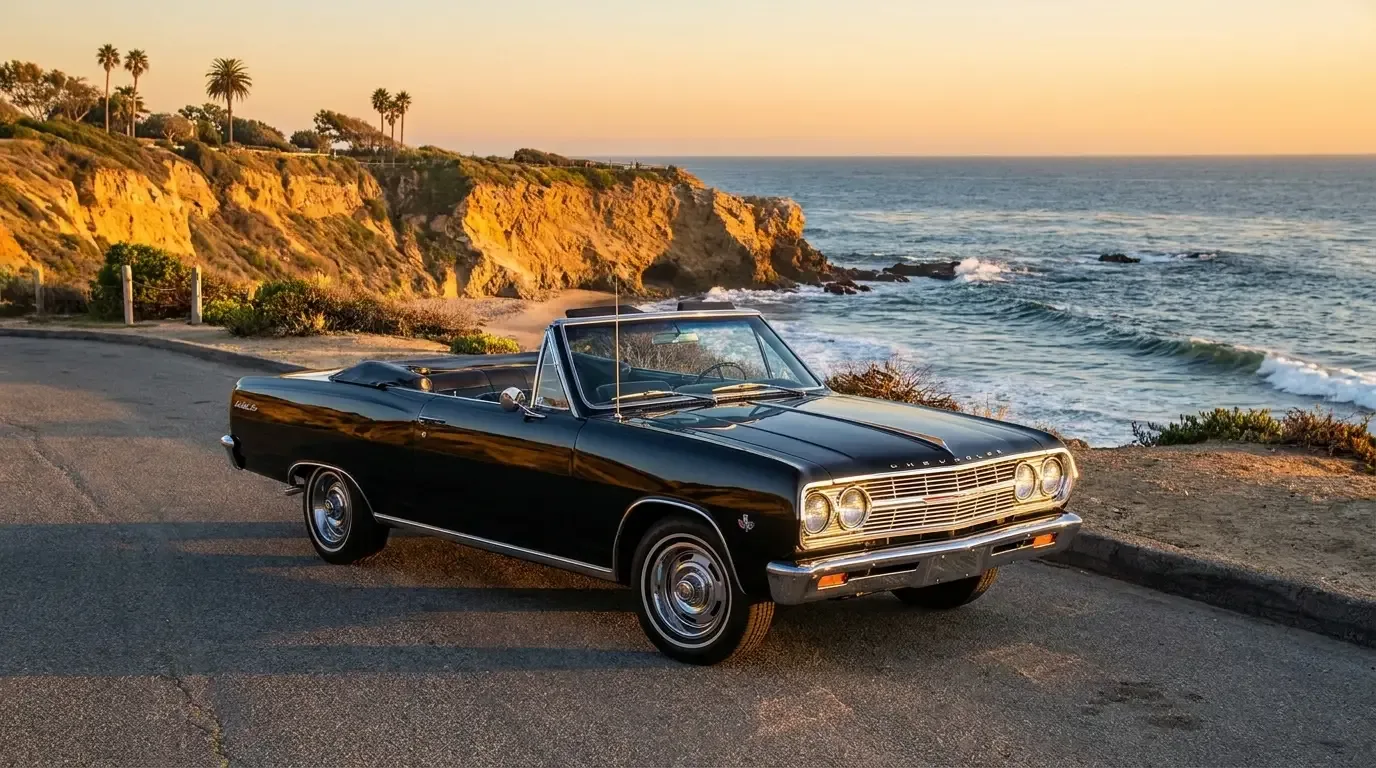
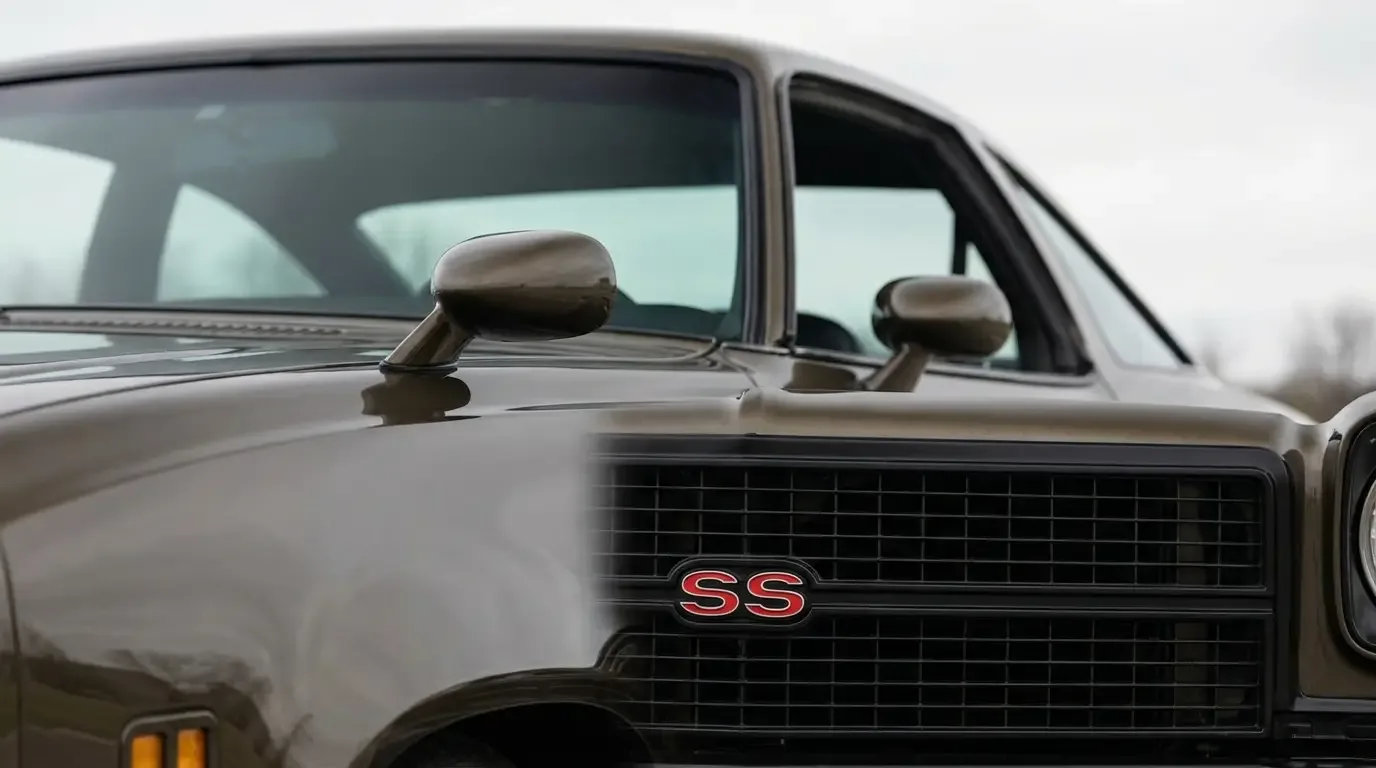
On a factory-correct SS396, the Turbo-Jet callout appears in a few specific places, and knowing where it belongs matters if you're checking a car against what left the factory. The air cleaner decal is the most visible, usually reading "Turbo-Jet 396" in a script that changed slightly from year to year. Fender emblems on early SS396 cars carried the same language, sometimes alongside the horsepower rating, sometimes without it depending on the model year and trim level. the Chevelle SS story covers how these badges evolved alongside the rest of the SS package, and it's worth reading if you want the full sequence rather than just the engine piece of it.
A detail that catches people out: the displacement badge didn't always match the actual cubic inches under the hood in later years. Sometime in late 1969, Chevrolet bored the 396 block out 0.030 inches over, taking actual displacement to 402 cubic inches, but kept the "396" badge and marketing name on most applications rather than rebadging the whole line as a 402. That's a marketing decision, not an engineering oversight, and it means a car wearing a Turbo-Jet 396 air cleaner in certain 1970 applications may actually be displacing slightly more than the badge claims. Anyone doing a numbers-matching restoration needs to check the actual casting and stamping, not just take the decal at face value.
| Badge era | Displacement referenced | Typical location |
|---|---|---|
| 1966-1969 SS396 | 396 cubic inches | Air cleaner, front fender |
| 1970 SS396 (actual displacement 402ci) | Badged 396, actually 402 | Air cleaner, fender, cowl tag reference |
| 1970-1971 SS454 | 454 cubic inches | Air cleaner, hood, fender |
The advertising push behind the name
Print ads from the period leaned on the Turbo-Jet name constantly, often pairing it with language about power and performance that had nothing to do with actual jet propulsion but everything to do with the feeling Chevrolet wanted a buyer to associate with the car. Dealer brochures listed engines by their Turbo-Jet designation ahead of, or instead of, their internal engineering codes. A customer ordering an SS396 in 1968 wasn't asking for RPO Z25 with the L34 engine option, most weren't fluent in option codes, they were asking for "the Turbo-Jet car," and the dealer knew exactly what that meant.
This is where the marketing lore gets genuinely useful for anyone trying to understand period documentation. Factory literature, window stickers, and dealer order guides from the era use Turbo-Jet nomenclature consistently, which means it shows up in the paperwork that actually matters for authentication today. If you're working from a copy of a broadcast sheet or a dealer invoice on a real car, the Turbo-Jet name is one more thread connecting the paperwork to what should physically be sitting under the hood.
"The name never described what the engine did. It described how Chevrolet wanted you to feel about what the engine did. That distinction matters when you're reading a fifty year old brochure and trying to figure out what a car actually came with versus what the ad copy wanted you to imagine."
Tom Ramirez
Why the lore outlived the marketing campaign
Most manufacturer marketing names from the 1960s faded once the styling language around them changed. Turbo-Jet didn't, not entirely. It survived on Chevrolet big-block engines well past the point where jet-age advertising was still culturally relevant, mostly because it had become functional shorthand inside the enthusiast community rather than purely a sales term. Ask someone at a swap meet about a "Turbo-Jet 454" and they know exactly what block family, what era, and roughly what output range you're talking about. The name did something marketing names rarely manage: it became technical vocabulary by accident, adopted by the same audience it was originally aimed at selling to.
That's part of why the confusion about actual turbocharging persists. New collectors encountering the term for the first time reasonably assume "Turbo" means what it means on a modern engine. It's a fair assumption and a wrong one, and it's worth correcting early, because it affects how people search for parts, verify build sheets, and describe cars to buyers who don't know the period vocabulary. For the fuller arc of how the SS package developed around these engines, the full Chevelle story lays out the model's complete run, badge changes included.
The Turbo-Jet name is a small piece of a much bigger period habit: naming engines for what they promised rather than what they contained. It worked. Half a century later, people are still using the name at cruise nights without a second thought about the aircraft imagery that put it there in the first place. Next, SS vs the Muscle Car Rivals looks at how the Chevelle stacked up against the competition that was fighting for the same buyer.
Sources and notes
Related Reading
Have a
Chevrolet Chevelle
for Sale?
Reach thousands of serious classic car collectors across the US.
Sell It Here →
Are You a Classic Car Dealer?
List your full inventory and connect with targeted classic car buyers.
Join as a Dealer →

About the author
Tom Ramirez
Corvette researcher and historian based in Bowling Green, Kentucky. Two decades documenting Corvette production history from original factory records.
Related Listings - Chevrolet Chevelle
More in History & Heritage
Comments
Be the first to comment on this article.