
Everybody who talks Chevelle history wants to talk big-block. Fair enough, that's where the legends live. But most Chevelles that rolled off the line in 1964 through 1967 didn't have a V8 under the hood at all. They had a six-cylinder, and that engine did more to keep Chevrolet's balance sheet healthy than any SS396 ever did. The six is the workhorse nobody name-checks, and it deserves a straight accounting.
History & Heritage
7 min read
The Six-Cylinder Chevelle Story
Most first-gen Chevelles left the factory with a six, not a V8. Here's why the 194 and 230 sixes mattered and what they're worth now.
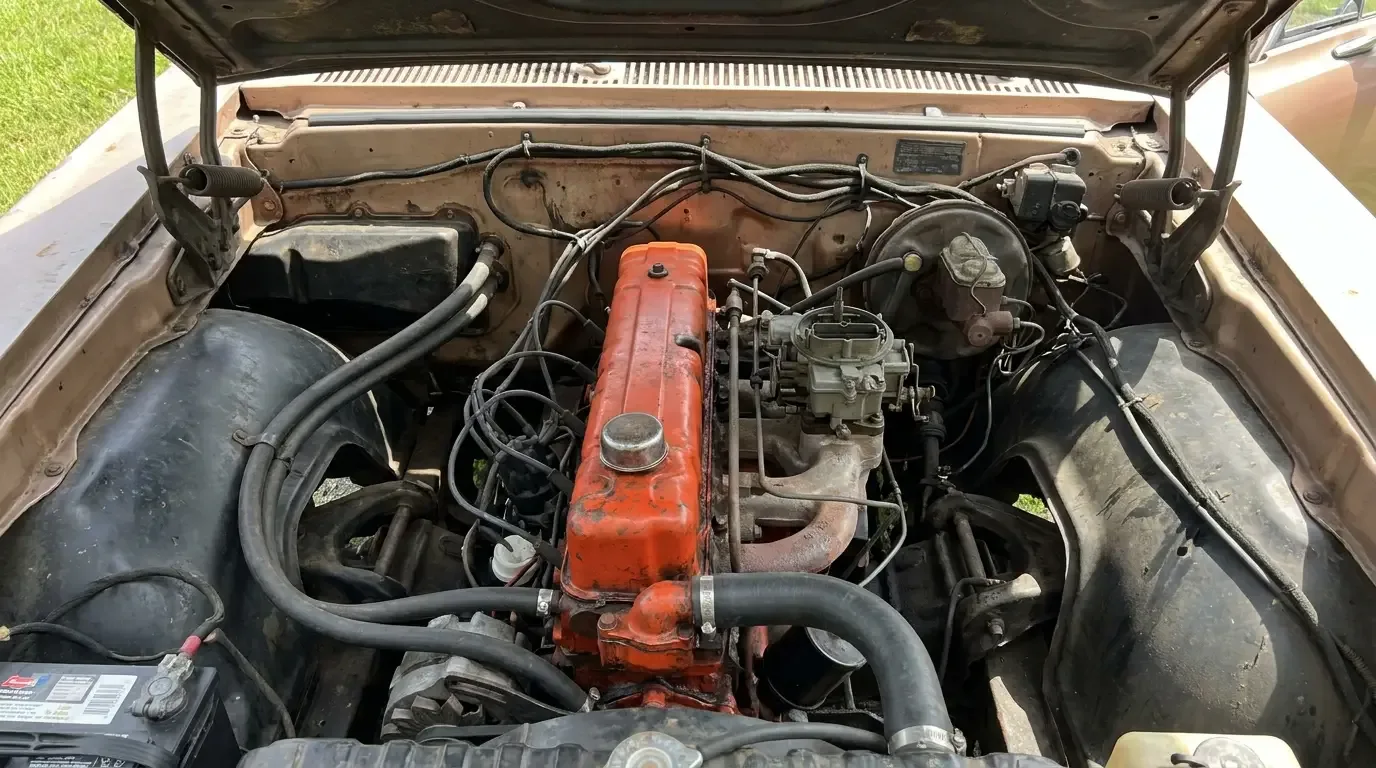
This isn't a nostalgia piece. It's a numbers piece, because the six-cylinder Chevelle only makes sense once you look at what it cost, what it made, and why Chevrolet needed it to exist. For the full context on how the whole car came together, the first-generation story lays out the platform basics. This is the engine that most first-gen Chevelles actually left the factory with.
The 194 that started it all
The base engine for the 1964 Chevelle was a 194 cubic inch inline six, rated at 120 horsepower at 4,400 rpm and 177 lb-ft of torque at 2,400 rpm. Nothing about that number is exciting, and it wasn't supposed to be. This was the engine for a fleet buyer, a company car, a family sedan bought by somebody who wanted four doors and decent gas mileage more than they wanted a stoplight win.
Compression was modest, the carburetor was a single-barrel unit, and torque came on low and stayed flat. That's the right recipe for a car that's going to spend its life doing errands and commuting, not the right recipe for anybody's build sheet today. But it's honest. The 194 did exactly what it was built to do, and it did it for a lot of miles.
What gets lost is how many Chevelles left the factory with this engine. In 1964, the base Chevelle 300 series alone accounted for roughly 45,000 six-cylinder cars against about 25,000 V8s, so the six was genuinely the dominant choice on the cheapest trim. Across the entire 1964 lineup the V8 still outsold the six overall, by a solid margin once Malibu buyers are counted in, but that doesn't erase how many six-cylinder Chevelles actually left the factory. It's a bigger number than most people assume when they picture this car as a de facto V8 platform from day one.
Stepping up to the 230
Above the 194 sat the optional 230 cubic inch six (RPO L61), rated at 140 horsepower at 4,400 rpm. That's a real step up, not a marketing bump. The 230 had more displacement to work with and a bit more breathing room, and it's the six you want if you're going to drive one of these cars regularly today.
Here's the part that matters if you're evaluating one of these engines in a car you're looking at buying: the 230 shares a lot of its architecture with the 194, but parts interchangeability isn't total. Get the block casting numbers confirmed before you assume anything bolts across. I've seen guys buy a six thinking it was a straight swap candidate and find out the motor mounts, the flywheel bolt pattern, or the accessory drive didn't line up the way they expected.
| Engine | Displacement | Approx. horsepower | Typical use |
|---|---|---|---|
| Base six | 194 cu in | 120 hp | Chevelle 300, fleet and base Malibu |
| Upgraded six | 230 cu in | 140 hp | Malibu, optional on 300 Deluxe |
| Entry V8 | 283 cu in | 195 hp (2-barrel) | All series, 300 included |
Why the six mattered to Chevrolet's math
Chevrolet built the Chevelle to compete in a segment that Ford was already working with the Fairlane, and the whole point of that segment was a car that cost less to build and less to buy than a full-size Impala or Bel Air. The six-cylinder wasn't an afterthought bolted in to check a box. It was central to hitting a price point that could pull buyers out of compact cars and into something with more room, without pushing them all the way up to full-size sticker prices.
Run the math the way a dealer would have in 1964. A six-cylinder 300 series two-door sedan started at a price meaningfully below a comparable V8 car, and the fuel economy difference mattered to a buyer paying their own gas money on a daily commute. Fleet buyers, in particular, cared about total cost of ownership more than they cared about a quarter-mile time. The six-cylinder Chevelle sold in volume because it was the rational choice for a huge slice of the market, and Chevrolet needed that volume to make the whole platform profitable.
There's also a simpler reason the six mattered: it kept the Chevelle within reach of buyers who'd been priced out of a full-size car but didn't need or want a performance machine. That buyer bought a six-cylinder Malibu two-door or a 300 sedan, drove it for years, and never once cross-shopped an SS396. Those cars are exactly what built Chevrolet's reputation for a product that fit whatever budget you brought to the lot.
Where these cars stand today
The collector market has almost entirely ignored the six-cylinder first-gen Chevelle, and that's created an odd situation. These cars are getting scarce, not because people are hoarding them, but because most got scrapped, converted to V8, or simply weren't worth saving to anybody chasing a numbers-matching big-block. A clean, unmolested six-cylinder Chevelle in original configuration is genuinely hard to find now, and it sells for a small fraction of what a documented SS396 brings, even in comparable condition.
That gap is real, and it's not likely to close. Buyers who want a driver-quality first-gen Chevelle without spending SS money have started looking at these cars specifically because the six-cylinder discount is so steep relative to how solid the platform is. You get the same body, the same suspension geometry, the same overall size and presence, for a fraction of the cost of entry. The trade-off is straightforward: less power, more affordability, and a car that's honest about what it is.
"Nobody restores a six-cylinder Chevelle to bring records to a show and expect a trophy. You restore one because you want to drive a real first-gen car without spending big-block money, and there's nothing wrong with that. The numbers on the dyno sheet don't lie, and a documented 230 in good tune will get you down the road just fine. It just won't get you there fast."
Dan Reeves
The six-cylinder Chevelle isn't a car you buy for bragging rights. It's a car you buy because the math works, the parts are cheap relative to a big-block build, and the platform underneath is the same one that made the SS396 famous. If you want the rest of the picture on how this whole generation fits together, the full Chevelle story covers the years around it. And for the real story behind the Chevelle's motorsport reputation, next: The Chevelle's Racing and Pace Car Legacy covers exactly that.
Sources and notes
- ChevelleStuff.net, 1964 Chevelle Engine Identification & Specifications
- Chevy Hardcore: Engine Options for the 1964 Chevelle
- ChevelleInfo.com, 1964 Chevelle Production Numbers by Series
- Hagerty: Your Handy 1964-67 Chevrolet Chevelle Buyer's Guide
- SS396.com, 1964 Chevelle Restoration Specifications
Updated October 6, 2026: Corrected the 230 six's rating to 140 hp and noted that the 283 V8 was available across the Chevelle lineup, including the 300.
Related Reading
Have a
Chevrolet Chevelle
for Sale?
Reach thousands of serious classic car collectors across the US.
Sell It Here →
Are You a Classic Car Dealer?
List your full inventory and connect with targeted classic car buyers.
Join as a Dealer →

About the author
Dan Reeves
Performance engine builder from North Carolina's motorsports corridor, focused on swaps, forced induction and making real, repeatable power.
Related Listings - Chevrolet Chevelle
More in History & Heritage
Comments
Be the first to comment on this article.