
Chevrolet called the 1967 redesign "Action Line," and if you spend enough time under these trucks, the name starts to make sense. It wasn't just a new grille stamped onto the old frame. The cab got wider, the glass got bigger, and the independent front suspension Chevy had first put under its half-tons back in 1960 got a thorough redesign, with new short-and-long-arm geometry replacing the outgoing torsion bars for a noticeably smoother ride. Buyers today lump all six years, 1967 through 1972, into one generation, and mechanically that's fair. Visually, though, each year left its own fingerprints, and knowing them is the difference between paying show-truck money for a truck with the wrong grille and knowing exactly what you're looking at before you crawl underneath it. If you want the whole arc from 1960 to 1987, the full C10 story covers it. This one is about telling the six Action Line years apart.
The Action Line Era: Spotting 1967–1972 C10 Model Years
A year-by-year field guide to the 1967-1972 Action Line C10, covering the grille, trim, and safety-mandate changes that tell each model year apart at a glance.
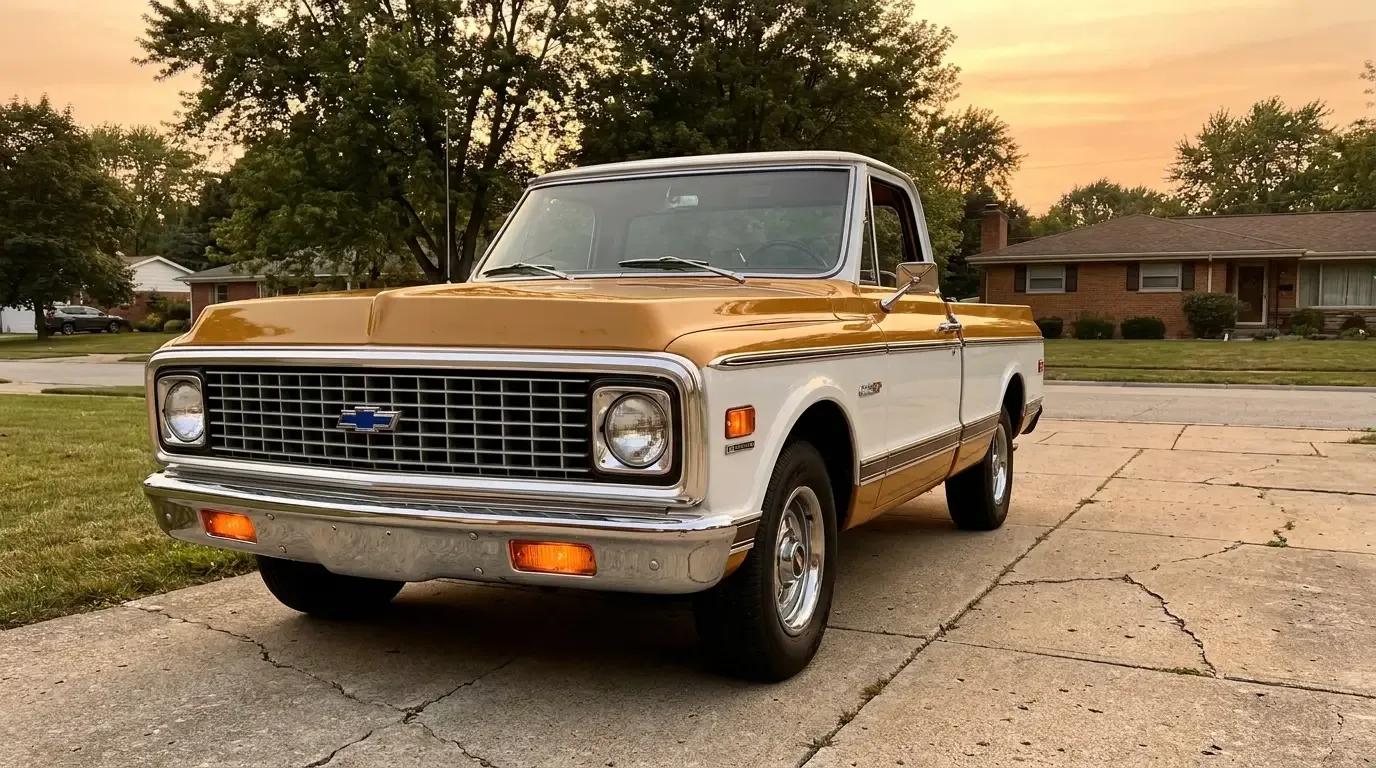
What Action Line actually changed
Before 1967, the C10 already rode on an independent front suspension, something Chevrolet had offered on its half-tons since 1960 and the competition still didn't match. Action Line changed the ride quality anyway, reworking that suspension with new coil-spring, short-and-long-arm geometry and marketing the result hard as a car-like ride. The cab grew wider inside, the windshield curved instead of sitting flat, and the doors got a lower beltline so you could actually see out of the thing. None of that shows up on a build sheet the way a paint code does, but it's the reason this generation gets talked about as the moment the pickup started becoming something people wanted to drive every day, not just something they needed on the ranch. If you're trying to place a truck in the wider timeline, every C10 generation is laid out side by side, which helps once you start comparing an Action Line grille to what came right before and right after it.
1967 and 1968, the trucks that started it
The 1967 model is the cleanest version of this design, and also the easiest to misdate if you don't know what to look for. Federal law required side marker lights on vehicles sold in the U.S. starting with the 1968 model year, so a 1967 truck has smooth, unbroken front fenders and rear quarters with no amber or red marker lenses. A 1968 truck has them. That single detail settles more arguments at a swap meet than any paint code will. Beyond the marker lights, 1968 also brought running changes to the grille trim and a heavier push toward the Custom Sport Truck package, which dressed up what had been a fairly plain work interior. Mechanically the two years are close cousins. Visually, the marker lights are your fastest tell, full stop.
1969 and 1970, the mid-cycle refresh
Chevrolet freshened the front end for 1969, and this is where a lot of casual buyers get years confused because the changes are more subtle than the marker-light jump. The grille insert changed to a simpler pattern, and the parking and turn signal lamps moved up into the grille corners instead of sitting low under the bumper the way they had in 1967 and 1968. The 1970 grille carried only a minor finish update, painted vertical bars in place of the earlier brightwork, rather than a new pattern, which is part of why the overall face reads similar enough at a glance that a lot of parts counters treat 69 and 70 trim as close to interchangeable, which occasionally leads to a truck wearing a mix of both. Worth checking a data plate and cross-referencing before you assume a grille is original to the truck in front of you.
1971 and 1972, closing out the generation
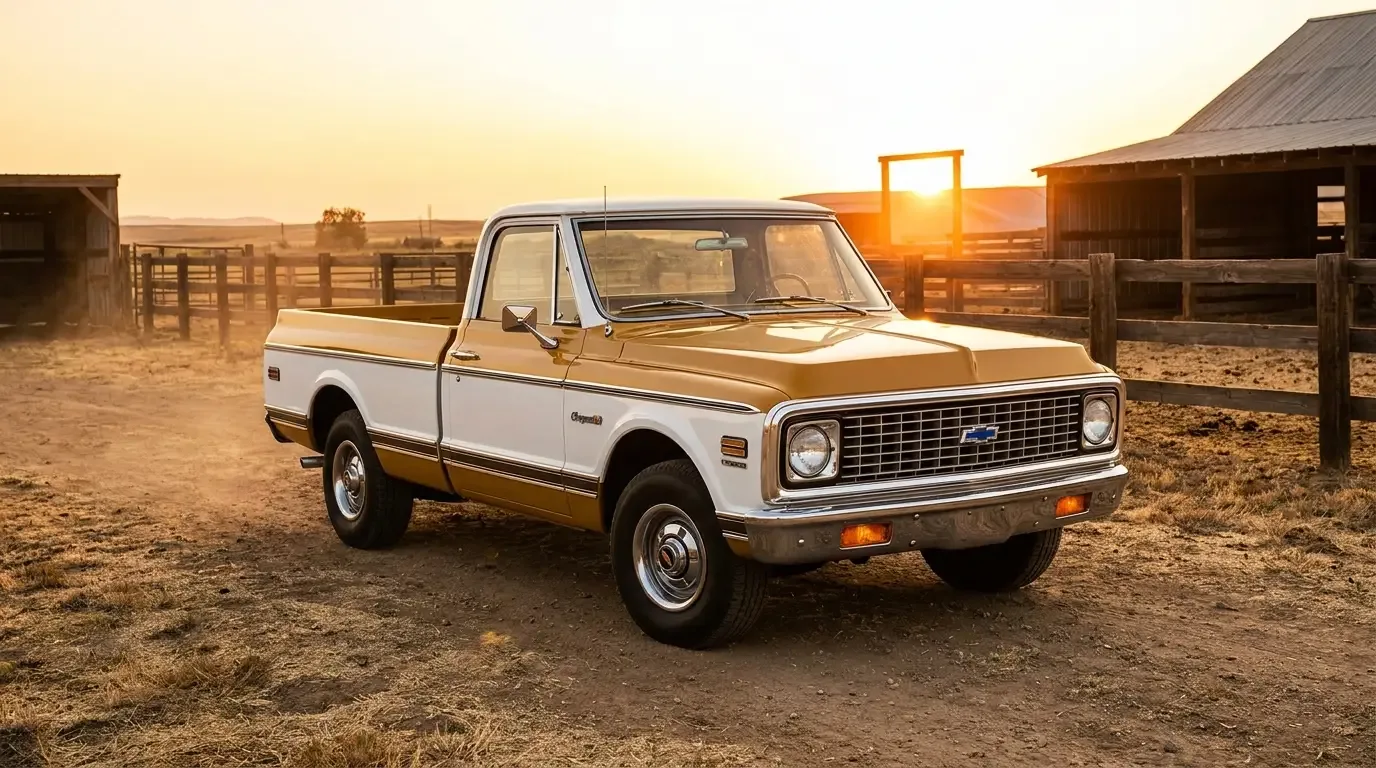
The last two years of Action Line brought the biggest jump in what you could actually order. The Cheyenne package arrived as a genuine top-tier trim, aimed straight at buyers who wanted carpet, better door panels, and gauges instead of idiot lights, on top of what the CST package had already offered. Power front disc brakes became standard equipment across the light-duty C/K line starting in 1971, which matters a lot more to a buyer planning to actually drive the truck than any trim detail does. Engine choices grew too, with the 396-cubic-inch big-block V8 (actually built at 402 cubic inches) moving further up the order sheet, rated at roughly 240 to 260 net horsepower once SAE net ratings took over in the early 1970s, down on paper from the low-300s gross figures the same basic engine carried a few years earlier even though the hardware barely changed. By 1972 the whole platform was close to played out. Chevrolet had a clean-sheet redesign coming, and it showed up for 1973 as what everybody now calls the Square Body, a truck with squarer lines, a bigger cab, and its own six-year run of its own details worth sorting out. That story, the Square Body years that came next, picks up right where this one leaves off.
Quick reference: telling the years apart at a glance
| Model year | Fastest visual tell | Notes |
|---|---|---|
| 1967 | No side marker lights | Cleanest fenders of the generation, low-mounted parking lamps |
| 1968 | Side marker lights added | Federal mandate, easiest year-over-year tell in the whole run |
| 1969 | New grille insert, signals moved up | Parking and turn signals relocated into grille corners |
| 1970 | Similar face to 1969 | Minor grille finish change (painted vertical bars), confirm against the data plate |
| 1971 | Cheyenne trim badge appears | Top-tier interior package, front disc brakes now standard equipment |
| 1972 | Final Action Line year | Broadest engine and trim spread of the generation, including the 402-cubic-inch big-block V8 |
"A truck from this era will tell you its year before the paperwork does, if you know which piece of trim to look at. I've had guys swear up and down a truck was a 68 because that's what the title said, and the fenders were smooth as a baby's cheek. No marker lights means no marker lights. The metal doesn't lie even when the title does."
Robert Halloran
None of this replaces pulling the data plate and checking the VIN against the actual specs, especially once money changes hands. But knowing the visual cues before you ever walk up to a truck for sale saves you from getting talked into a story that doesn't match the sheet metal in front of you. Action Line trucks earned their reputation the hard way, by being genuinely different from what came before, and each of these six years left just enough of a mark that a careful look tells you which one you're standing in front of.
Sources and notes
- Chevrolet C/K second generation overview, Wikipedia
- 1971 Chevrolet C-10 Pickup, GM Heritage Center
- Definitive Chevrolet pickup buyer's guide, Hagerty Media
- 1960-66 Chevrolet pickup trucks history, Curbside Classic
- 69/70 grille differences discussion, 67-72 Chevy Trucks forum
- 1967-1972 Chevy C10 history, Aldan American
Related Reading

Texas-based classic truck enthusiast with decades of experience buying, restoring, and writing about American pickups from the 1940s through the 1980s.
Related Listings - Chevrolet C10
More in History & Heritage
Comments
Be the first to comment on this article.