
Ask ten haulers what they charge and you will get ten answers, most of them quoted per mile and few of them measuring the same thing. That is the first problem with car hauling rates per mile: the number means one thing to the customer shipping a car and another to the carrier running the truck. Get the basis straight and the published data becomes useful. Mix the two and you will either underprice a classic haul or quote yourself out of the job.
Ownership & Lifestyle
7 min read
Car Hauling Rates per Mile: Pricing a Classic Car Haul
Car hauling rates per mile in 2026: open rates by distance, the enclosed premium, truck costs and what a classic car quote should spell out.
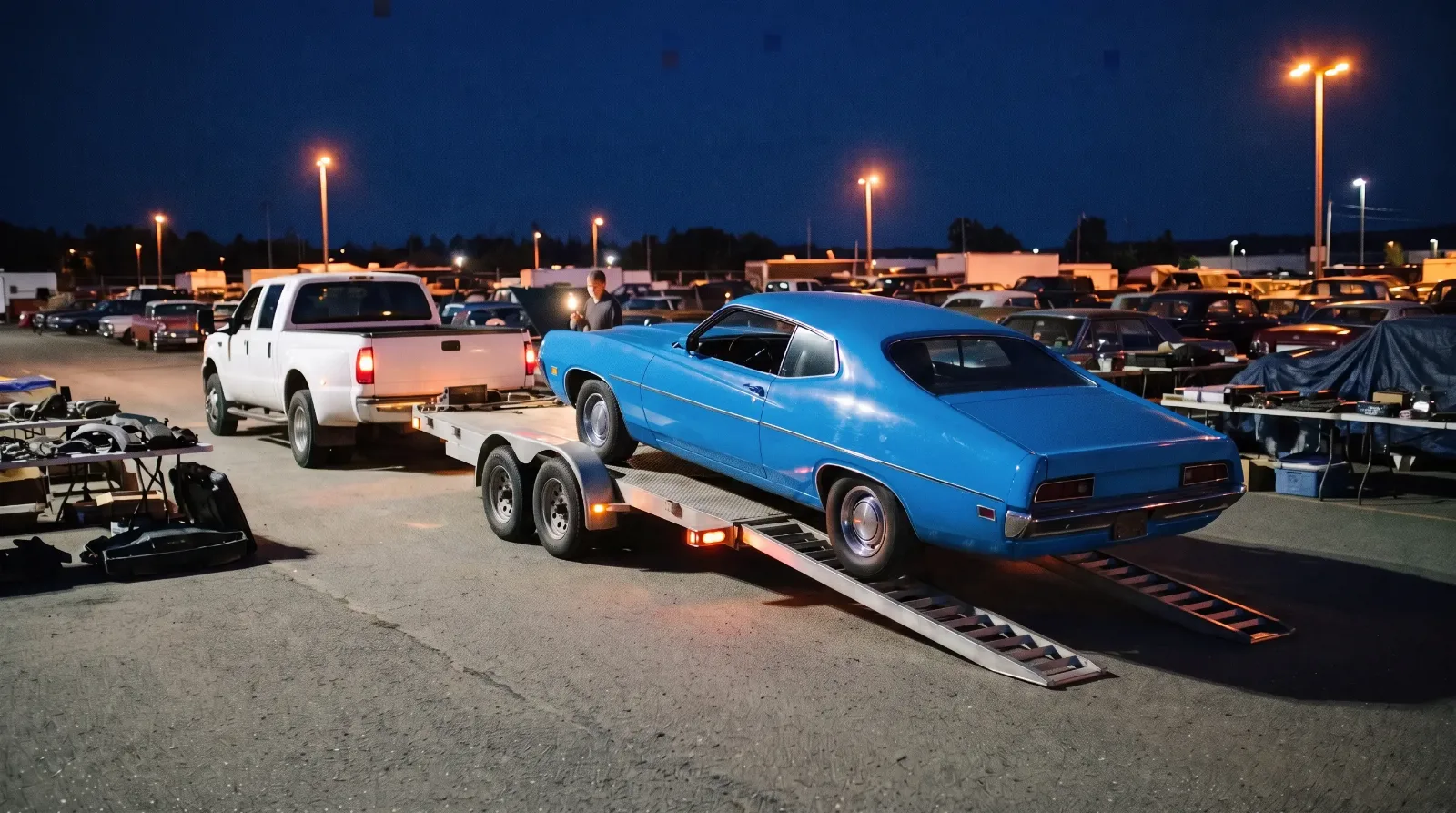
This article is about pricing only. Authority, insurance and equipment are covered in the full guide. Here the question is narrower: what a mile is worth, and what a classic car adds to it.
Two different numbers called "per mile"
The first is the customer price, per car, per mile. It is what a shipper pays to move one vehicle, and it is what consumer shipping sites publish. The second is carrier revenue per loaded truck mile: everything the truck earns on a trip, divided by the miles it drove loaded. A truck carrying several cars earns a much higher per-mile figure than any one customer pays.
Both are legitimate. They are not comparable. When you read a rate, find out which one it is before you use it. When you quote one, say which one it is.
For a classic car hauler, the customer price per car is the number that wins or loses the job. The truck-mile figure is the number that tells you whether the business works. You need both, but you build the quote from the first and check it against the second.
Car hauling rates per mile by distance
The clearest published figures are customer prices for an operable standard sedan on an open carrier. Two 2026 sources broadly agree, and both show the same shape: the per-mile rate falls as the distance rises.
| Distance | FreightWaves (2026-05-29), open, per mile | Ship A Car (updated 2026-09-05), open, per mile |
|---|---|---|
| Short haul | Under 500 mi: $1.25 to $2.00 | Under 300 mi: about $2.00; 300 to 600 mi: about $1.45 |
| Middle distance | 500 to 1,500 mi: $0.65 to $1.20 | About 1,000 mi: about $1.05 |
| Long haul | 1,500+ mi: $0.55 to $0.95 | 2,500+ mi: about $0.60 |
The reason is fixed cost. Loading, unloading, paperwork and the drive to the pickup cost about the same whether the trip is 200 miles or 2,000, so a short haul has to carry them over fewer miles. That is why a quote for a classic going 150 miles across the state can look high per mile and still be honest.
Both sources are shipper-side prices, one from a media site and one from a broker. They describe the market a customer sees, not the carrier's cost.
What enclosed transport adds to the rate
Most classic owners want an enclosed trailer, and the market charges for it. FreightWaves puts enclosed at 30% to 60% more than open. Ship A Car says about a third above open. Taken together, the fair summary is roughly a third to a half more than an open rate for the same run.
FreightWaves gives no enclosed per-mile rate, but it does give totals. Its 2026 examples for an operable sedan:
- 500 miles: open $600 to $700, enclosed $850 to $1,000
- 1,000 miles: open $650 to $800, enclosed $1,000 to $1,200
- 2,000 miles: open $1,200 to $1,400, enclosed $1,700 to $2,000
Divide by the distance and the 1,000-mile enclosed figure works out to about $1.00 to $1.20 a mile, per car, to the customer. FreightWaves also adds $150 to $300 for an inoperable vehicle and notes that spring and summer are typically the most expensive seasons.
Beyond the inoperable adder, we found no published figures for the surcharges classic haulers talk about: low ground clearance, winch loading, declared value above a set amount. Haulers price those case by case. If you add one, name it on the quote so the customer can see what it is for.
Checking your rate against what the truck costs to run
The customer price has to cover the truck. One owner-operator source, Trucking42 (dated 2025-09-17), gives the economics for car haulers by rig size:
- A single-car or two-car hotshot: about $1.50 to $2.50 per mile per car.
- A three- or four-car wedge: about $0.80 to $1.50 per car-mile. Counted on the truck instead, that is roughly $2.50 to $3.00 and up per loaded mile.
- Fuel at 25% to 40% of revenue, and insurance at about $10,000 to $30,000 a year per truck.
For a cost benchmark, the American Transportation Research Institute (ATRI) puts the average operating cost of a truck at $2.336 per mile in 2025, up from $2.260 in 2024, or $1.854 a mile with fuel taken out (as reported by FreightWaves on 2026-07-15). That figure is for trucking in general, mostly heavy freight fleets, not car hauling. Use it as a reference point to test against, not a cost to quote from.
Here is the practical check. Add up what a loaded trip earns from every car on the trailer, divide by the loaded miles, and compare that truck-mile figure with your own cost per mile, including the empty miles to the pickup. If the trip only works because the trailer is full, quote a lightly loaded run accordingly.
"A classic haul is priced on risk as much as distance. The customer is paying for the trailer, the cargo limit and the care at the ramp, and the miles are the easy part to count."
David Mercer
Insurance is the cost classic haulers feel most. Open carriers generally carry $100,000 to $250,000 of cargo cover per load, shared across every car on the trailer, while enclosed carriers carry roughly $250,000 to $1,000,000 or more. No federal rule sets cargo limits for a car hauler; they come from shippers, brokers and market practice. Limits, exclusions and premiums vary by carrier and by state, so confirm yours with your insurer before you quote a high-value car.
Pricing a classic car haul: what goes on the quote
A good quote for a classic does more than state a number. It shows the customer what the number buys.
Securement belongs in the conversation too. The federal rule for cars of 10,000 pounds or less requires at least two tiedowns restraining the vehicle at the front and rear, with wheel-engaging tiedowns going over or around the wheels. Classic owners often ask how their car will be held down. A hauler who can answer in those terms sounds like one who has done it before.
Pricing is only half of the job. The other half is volume, and that comes from finding shipping leads among the people who move classic cars: dealers, restoration shops, auction buyers. A fair, clearly stated per-mile rate is what turns those leads into repeat customers.
My view: classic car hauling is not a commodity, and it should not be priced like one. Start from the published open rates, add the enclosed premium the market supports, put your adders in writing, and check every quote against your own truck-mile cost. The haulers who get this wrong usually get it wrong on short runs and on half-empty trailers.
Sources and notes
- FreightWaves: cost to ship a car, open and enclosed rates (2026-05-29)
- Ship A Car: average cost to ship a car per mile (updated 2026-09-05)
- Trucking42: how much car haulers make, rates by rig size (2025-09-17)
- FreightWaves: ATRI operational costs of trucking, 2025 data (2026-07-15)
- Web Auto Transport: what carrier cargo insurance covers (read 2026-10-19)
- 49 CFR 393.128: securement of automobiles, light trucks and vans
Related Reading

Have a
Classic Car
for Sale?
Reach thousands of serious classic car collectors across the US.
Sell It Here →
Selling a classic? Here's how: the best sites to sell a classic car
Are You a Classic Car Dealer?
List your full inventory and connect with targeted classic car buyers.
Join as a Dealer →
#classic car shipping
#enclosed transport
#car transport business
#car hauling
#car hauling rates per mile
#pricing

About the author
David Mercer
Classic car market analyst with two decades of experience tracking collector car valuations, auction results, and investment trends.
More in Ownership & Lifestyle

Comments
Be the first to comment on this article.