
An enclosed car trailer keeps weather, road grit and curious eyes off a classic, but the box itself does nothing to hold the car still. That part is your job, and it is where most setups go wrong: tie-down points bolted where they were easy to reach instead of where the car needs them, a ramp too steep for a low front spoiler, a winch mounted off center so it drags the car sideways. Setting the trailer up properly is a short list of decisions made in the right order. Size the trailer to the car and the truck. Lay out the anchors. Secure the car the way the federal rule requires. Then fit out the inside so loading is slow, controlled and repeatable. This guide covers each step for a hauler starting out with classics.
Ownership & Lifestyle
8 min read
Setting Up an Enclosed Trailer for Classic Cars
How to set up an enclosed car trailer for classics: sizing, the federal tie-down rule, anchor layout, ramps, the winch and the fit-out inside the box.
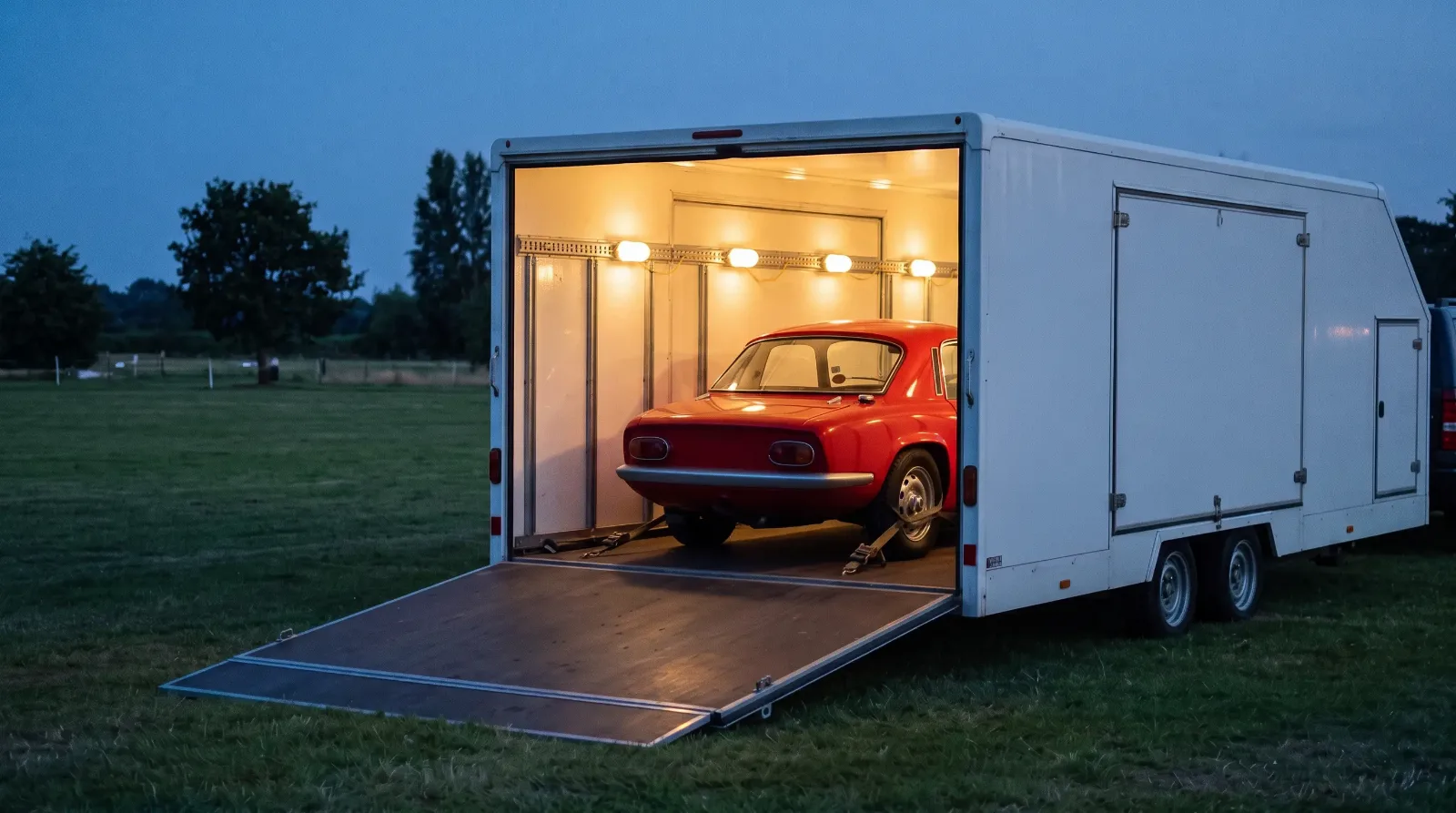
Size the enclosed car trailer to the car and the truck
Start with the car you will carry most often, then the widest and longest one you expect to carry. One trailer dealer's guidance is plain: the trailer must be wide and long enough for the widest and longest car, its weight capacity must cover the car, and the truck's towing capacity has to be factored in, because the trailer's weight decides how heavy a tow vehicle you need. The same dealer notes that classic cars and roadsters are almost always heavier than race cars, so a trailer specified for a race car may be marginal for a classic.
Two choices from that guidance carry straight into a classic setup. Electric brakes give more control than surge brakes with heavy loads. Aluminum resists rust, which counts on a trailer that will sit outside between jobs. The dealer gives no figure for the weight difference, so check the actual car's curb weight and the trailer's payload and gross vehicle weight rating (GVWR) on its certification label before you buy.
Then the paperwork side of size. Under federal rules a vehicle or combination used in interstate commerce becomes a commercial motor vehicle at 10,001 lb GVWR or gross combination weight rating (GCWR), whichever is greater. A Class A CDL is required when the GCWR is 26,001 lb or more and the towed unit's GVWR is over 10,000 lb. A large enclosed trailer behind a heavy pickup can cross those lines faster than people expect. Thresholds and how they apply to your operation vary, so confirm with FMCSA and your state licensing agency before you pick a combination. The filings that come with for-hire hauling are covered in the classic car hauling trade.
What the federal rule says about tying the car down
This is the one part of the setup with a clear, primary source. 49 CFR 393.128 sets the securement rule for automobiles, light trucks and vans of 10,000 lb or less, and its general performance criteria sit in 393.102.
| Requirement | What it means in the trailer |
|---|---|
| At least two tiedowns | Minimum count; the car must be restrained at both front and rear |
| Structural tiedowns | Must attach to mounting points built for that purpose on the vehicle |
| Wheel-engaging tiedowns | Must go over or around the wheels |
| Synthetic webbing on tires | No edge protectors needed where it touches the tire |
| Performance criteria (393.102) | Working load limits checked against 0.435 g forward, 0.5 g rearward and 0.25 g lateral |
The rule sets the minimum. It does not tell you where to put the anchors for a particular car, and on classics that is where the craft is. Read the rule, then plan your layout to exceed it. This is a summary, not legal advice; check the current text and any state rules that apply to your loads.
Lay out the anchors before you drill anything
Here is the sequence I would follow. Load the car you carry most often, centered side to side, with the weight placed so the trailer sits level and the tongue carries a proper share of the load (the trailer and hitch makers publish the tongue weight range for their equipment; use theirs). Chalk the tire positions on the floor. Then mark where the straps will anchor so each one pulls down and outward at a sensible angle, front and rear, on both sides.
Only then choose the hardware. Track systems bolted to the floor let anchor points move with the car, which suits a hauler who carries different wheelbases. Fixed recessed rings are cleaner and lower but only fit the cars you planned for. Whatever you fit, it is only as strong as what it is bolted to. A ring screwed into plywood decking is a decoration. Anchors must go through to the trailer's crossmembers or to backing plates that spread the load. The rule backs this up: under 49 CFR 393.108 a tiedown's working load limit is the lowest rating of any of its parts or of the anchor point it is attached to, whichever is less. A heavy-rated strap on a weak anchor is a weak tiedown.
Where this goes wrong: anchors placed so the straps run nearly flat along the floor, which gives little downward hold; straps that cross sharp edges on the car or the trailer; and wheel straps that end up pulling on brake lines or suspension parts that were never built to carry a tiedown. Wheel nets or over-the-tire straps keep the load on the tire, which is also what the rule describes for wheel-engaging tiedowns.
"Load the car first, chalk the tires, then decide where the steel goes. People who bolt in anchors before the car ever sees the trailer spend the rest of the year strapping around their own mistakes."
Ray Delgado
Ramps, the winch and the inside of the box
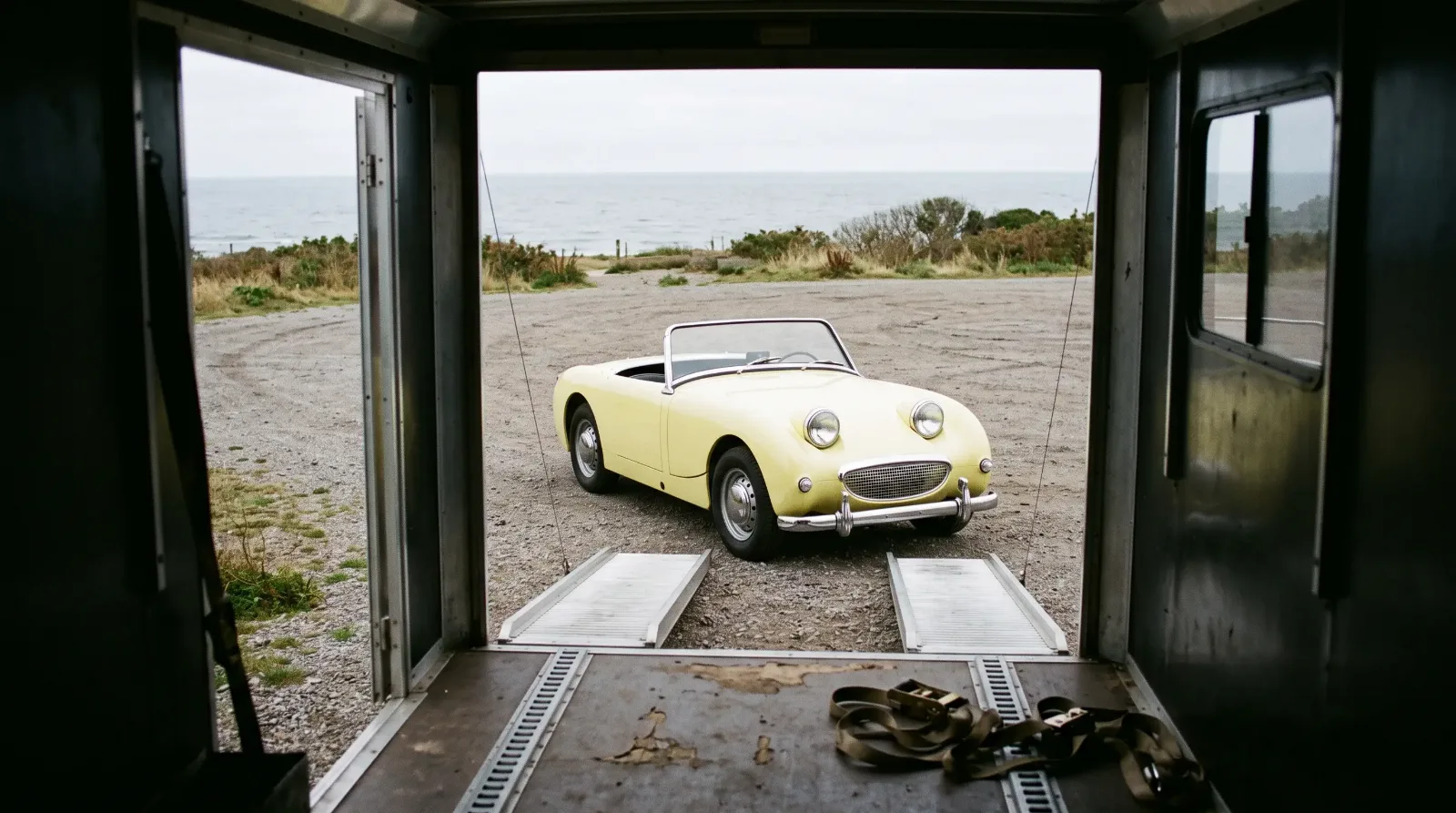
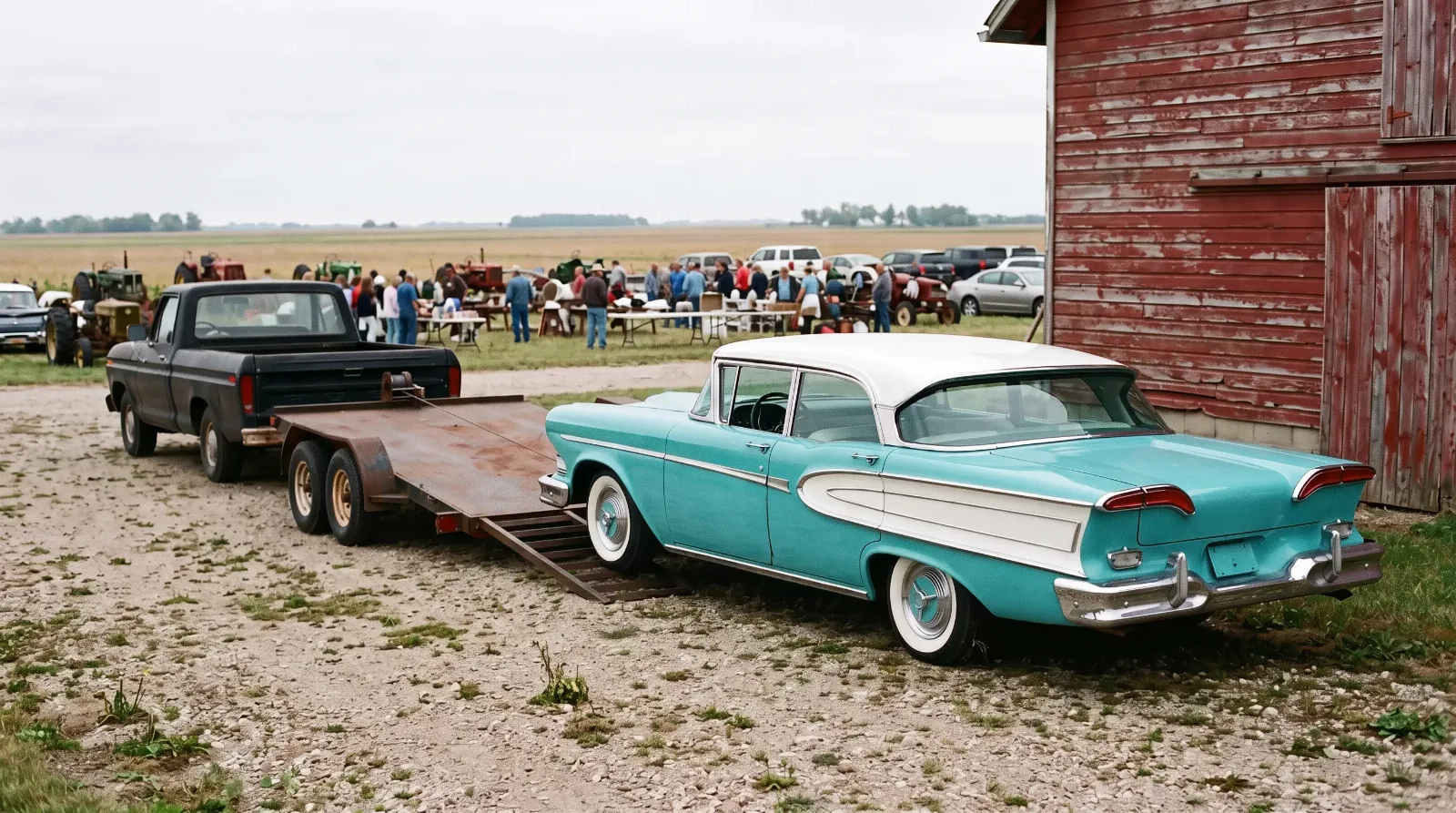
Classics sit low and many have long overhangs. A steep ramp will drag the front valance or the exhaust before the front wheels are even on the deck. Measure the car's lowest point and its overhang, then set up the loading angle to suit: longer ramps, ramp extensions or a beavertail. Some trailers use hydraulic or electric lifts to ease loading, which the dealer guidance lists as an option. Load slowly with a spotter outside watching the clearances, never by feel from the driver's seat.
A winch is not optional for a hauler who takes non-running cars. Mount it on the trailer's centerline at the front wall, backed by structure, so the cable pulls straight. For sizing, WARN's general rule for vehicle winches is the gross vehicle weight rating multiplied by 1.5; apply it to the heaviest car you expect to move, allow more for a steep ramp or a car with dragging brakes, and use a snatch block when the pull angle cannot be straight. Never winch a car up the ramp with someone standing in line with the cable.
Then fit the box out for work, not looks:
Check every strap after the first few miles and at each stop. Webbing settles and tires shift on the deck, and a strap that was tight in the yard can go slack on the highway. Photograph the car and its securement before you close the doors; it is your record of how the car left your hands.
How the setup pays for itself depends on what you charge for enclosed work. The basis for that is covered in pricing a classic haul. If you are still deciding whether one truck and one trailer is the right start, the longer answer walks through the startup side. The trailer is the shop you take on the road. Set it up like one.
Sources and notes
- 49 CFR 393.128: securement of automobiles, light trucks and vans
- 49 CFR 393.102: general performance criteria for cargo securement
- 49 CFR 393.108: working load limits of tiedowns and anchor points
- 49 CFR 383.91: commercial motor vehicle groups and CDL classes
- Kate's Trailer Sales: choosing a car hauler trailer (2023)
- WARN: how to choose the right winch
Related Reading

Have a
Classic Car
for Sale?
Reach thousands of serious classic car collectors across the US.
Sell It Here →
Selling a classic? Here's how: compare the places to sell classic cars
Are You a Classic Car Dealer?
List your full inventory and connect with targeted classic car buyers.
Join as a Dealer →

About the author
Ray Delgado
Metal fabricator and chassis builder who has spent 25 years turning flat sheet and mild steel into hot rods, gassers and restomod underpinnings.
More in Ownership & Lifestyle
Comments
Be the first to comment on this article.