
Search "when to lower price on car" and most answers hand you a calendar: wait two weeks, cut five percent, repeat. The calendar is the least useful part. An asking price is a claim about where your car sits among comparable sales, and a listing is the test of that claim. The response the listing gets is data. Lowering the price is a decision you make from that data, not from the date.
Market & Values
8 min read
When to Drop Your Asking Price, and by How Much
When to lower the price on a classic: read views, messages and visits first, then make one decisive cut instead of many small ones.
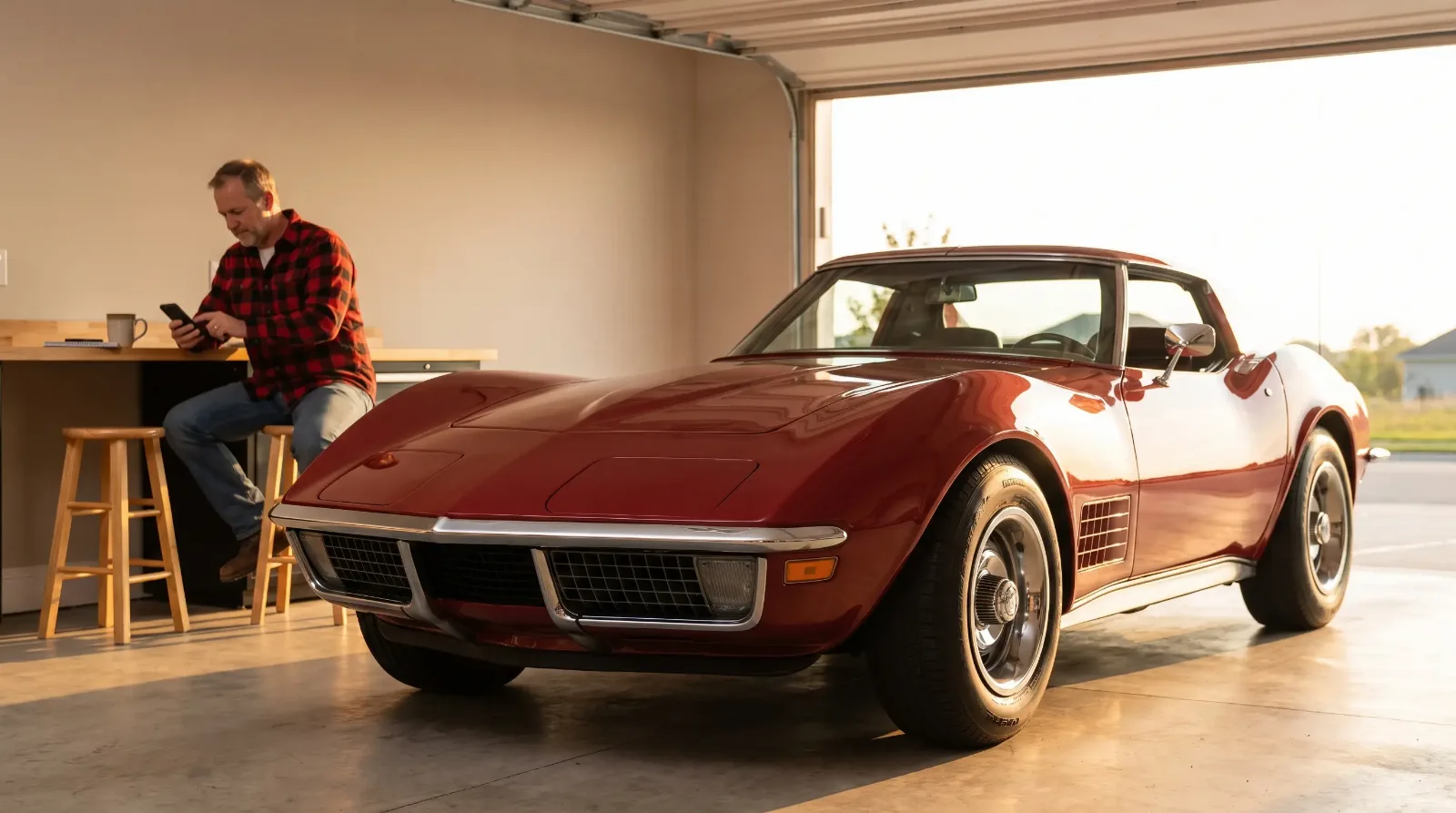
This page covers one narrow question: once a classic is listed and the phone is quiet, how do you know the price is the problem, and how far do you move it? The rest of the selling process, from photos to replies, is laid out in the bigger picture. Here the subject is the number.
Read the response before you touch the number
Every listing produces three kinds of evidence: views, messages and visits. Each one fails for a different reason, and only one of those failures points reliably at price.
Views measure the headline, the lead photo and the price as they appear in search results. Messages measure the full listing. Visits and inspections measure the car against the listing. When views are healthy and messages are thin, buyers are opening the ad and deciding it is not worth a question. That pattern points at price more than anything else. When views themselves are low, the car may not be appearing where its buyers search, or the lead photo is not earning the click. A cheaper car behind the same weak photo is ignored at a lower number.
Messages that never turn into visits are usually a conversation problem: slow answers, vague answers, or a buyer who learned something in the exchange the listing should have said up front. Visits that never turn into offers mean the car in person did not match the car in the ad. Neither is cured by a price cut. A cheaper car that still disappoints at inspection is still a car that disappoints.
| What you see | Most likely cause | First move |
|---|---|---|
| Few views | Weak lead photo, headline or exposure | Fix presentation and placement before price |
| Many views, few messages | Price above where comps support it | One meaningful price adjustment |
| Only lowball offers, no questions | Price reads as out of range | Recheck comps, then adjust once |
| Messages, no visits | Slow or incomplete replies, missing facts | Rewrite the ad, answer faster |
| Visits, no offers | Car does not match the listing | Correct the description and photos |
| Offers a little below asking | Price is about right | Negotiate privately, do not cut publicly |
Note the last row. Offers close to your number are not a signal to drop. They are the market agreeing with you.
How long a fair price should be given
The first days of a listing carry the most weight. Saved searches and new-arrival sorting put a fresh car in front of the buyers who have been waiting for one, and that audience does not refresh itself. If the price is right, the evidence usually shows up early, in specific questions from people who have done their homework.
A reasonable working rule is two to three weeks of full exposure before a price change, provided the listing is complete and every message has been answered promptly. That is a working estimate, not a statistic, and it stretches for rare cars. A model that changes hands a few times a year nationally has a thin pool of buyers, and the right one may not have looked yet. A common driver-grade car with dozens of competing listings should hear from someone inside that window. If it hasn't, the comps are telling you something.
Before the first cut, rule out the cheap fixes: the lead photo, the first paragraph, the questions you keep receiving. There is more on common listing mistakes in a separate piece, and several of them produce exactly the silence an overpriced car does. Cutting the price on a listing with a dark lead photo spends real money to solve a free problem.
How much to cut, and why small cuts cost more
The instinct is to trim a few hundred dollars and see what happens. The cost of that instinct is hidden but real. Buyers who saved the listing see every change. A string of small reductions tells them the seller is losing patience and the price has further to fall, so the rational move is to wait. Each small cut trains the audience to hold off.
A single adjustment should do two things. It should move the car to where the comps say it belongs, and it should be large enough that a buyer who passed on the old number notices. As a working estimate, that usually means somewhere around 5 to 10 percent on a typical driver-grade classic, and more if the original price was set against the wrong condition tier. Treat that range as a starting point for your own comp work, not as a rule.
Search filters matter here. Many listing sites let shoppers set a maximum price, and buyers type round numbers. A car asking $31,500 is invisible to anyone who capped the search at $30,000. Dropping to $29,900 puts the car in front of buyers who never saw it.
Run the numbers on a hypothetical. Say a driver-quality coupe is listed at $34,000 and three weeks pass with views but no serious questions. Trimming $500 a week for six weeks costs $3,000 and leaves the car at $31,000, still above the $30,000 filter, with six more weeks of storage and insurance added. One move to $29,900 costs $4,100 on paper, but it lands inside the search band at once and resets attention while buyers are still watching. The larger cut is often the cheaper one.
"A price cut is not a concession. It is a correction. The expensive version is the one made in installments, because the market prices the seller's patience along with the car."
Marcus Feld
When a price drop is the wrong fix
Some stalls have nothing to do with money. A car listed where its buyers do not look will not move at any sensible price. A rare European sports car sitting on a general marketplace full of commuter cars may need a different venue more than a lower number, and the overview of where each option fits shows which audience each route reaches.
Response time is another. Interest cools quickly once a buyer writes, and a seller who answers on the third day has often lost that buyer to a car whose owner answered on the first. If messages arrive and the conversations die, learning how to respond to car buyers quickly and completely will do more than a discount.
Undisclosed problems are the third. If buyers keep walking away after inspection, the market is not rejecting your price. It is rejecting a surprise. Put the flaw in the listing, with a photo, and price the car honestly with the flaw included. Then the cut, if one is still needed, is made once and made against the truth.
Set your floor before the first cut
Decide the lowest price you will accept before the listing goes live, and write it down. A floor set calmly on day one beats one set in week seven, when every lowball offer starts to look reasonable. The floor should reflect your comps, any money owed on the car, and what keeping it costs each month in storage and insurance.
Then plan the sequence. A complete listing at a researched price. One meaningful correction if the evidence calls for it, ideally paired with a refreshed lead photo so the listing feels new rather than discounted. A second read of the response after another two to three weeks. If the car still has not sold near your floor, the next question is no longer price but method, and that is a different decision with different math.
Fees belong in the calculation as well. A commission or a buyer's premium takes a share of whatever price you settle on, which pushes sellers to ask more to cover it. A flat fee does not move with the price, so a correction comes out of the asking number and nowhere else. On this site the fee is a one-time charge from $49, there is no commission, the buyer pays you directly, and the listing stays up until the car sells. When the number is right, create your listing and let the response tell you whether it should stay there.
Sources and notes
- Hagerty: What does a car's condition really look like? (condition scale #1 to #6; the vast majority of collector cars are #3)
- ClassicCars.com listings search (price-range filtering on a major classic marketplace)
- Bumper: Negotiating when you're selling (set a walk-away number before buyers call)
- PrivateAuto: Managing price requests (compare similar listings and time on market before adjusting)
- Harvard Business Review: The short life of online sales leads (2011) (research on business leads; response speed matters)
Related Reading

Have a
Classic Car
for Sale?
Reach thousands of serious classic car collectors across the US.
Sell It Here →
Selling a classic? Here's how: compare the places to sell classic cars
Are You a Classic Car Dealer?
List your full inventory and connect with targeted classic car buyers.
Join as a Dealer →
#selling tips
#sell a classic car
#asking price
#classic car listing tips
#pricing a classic car
#price drop

About the author
Marcus Feld
Accredited collector-car appraiser who reads the market through hammer prices, condition tiers and risk.



Comments
Be the first to comment on this article.