
A record price is not a valuation. It is a moment, a single room, two determined bidders, and a car that happened to carry the right combination of rarity, history, and coachwork on that particular afternoon. The most valuable classic luxury cars sold at auction are worth studying not because the numbers are large, though they are, but because the reasons behind them are consistent. Almost every eight-figure result rests on the same foundation: a named coachbuilder, provenance you can trace by hand, and a body style that was rare when the car was new and rarer now.
Market & Values
6 min read
The Most Valuable Classic Luxury Cars Ever Sold at Auction
The record-setting classic luxury cars sold at auction, from the $22M Duesenberg SSJ to the Mercedes 300 SLR, and why these numbers happen.
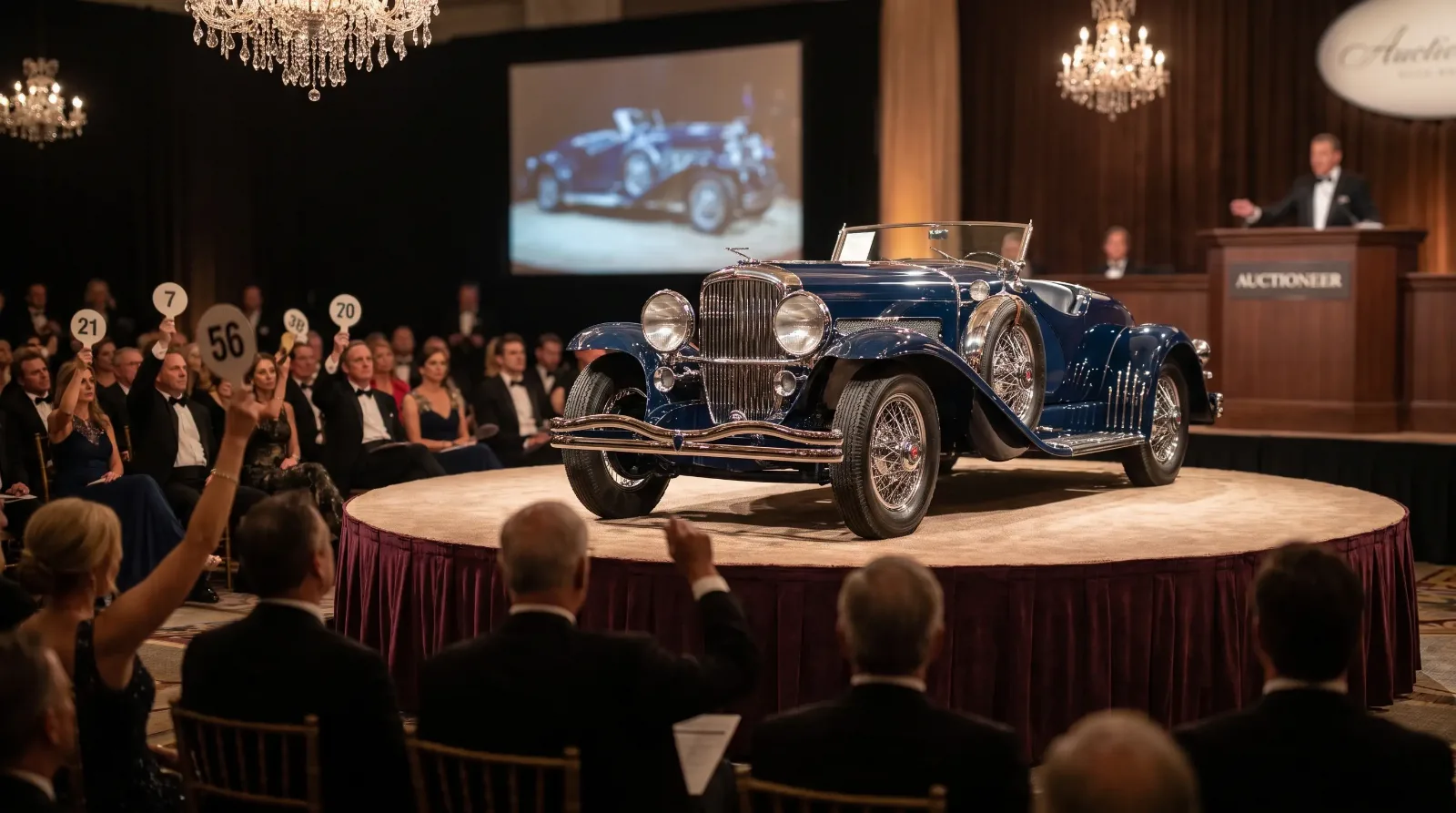
What follows is a walk through the results that define the ceiling of this market. I have flagged the figures that need a source check before you quote them, because auction totals get repeated carelessly, and the difference between a hammer price and a price including premium is often several million dollars.
The American record: the Duesenberg SSJ
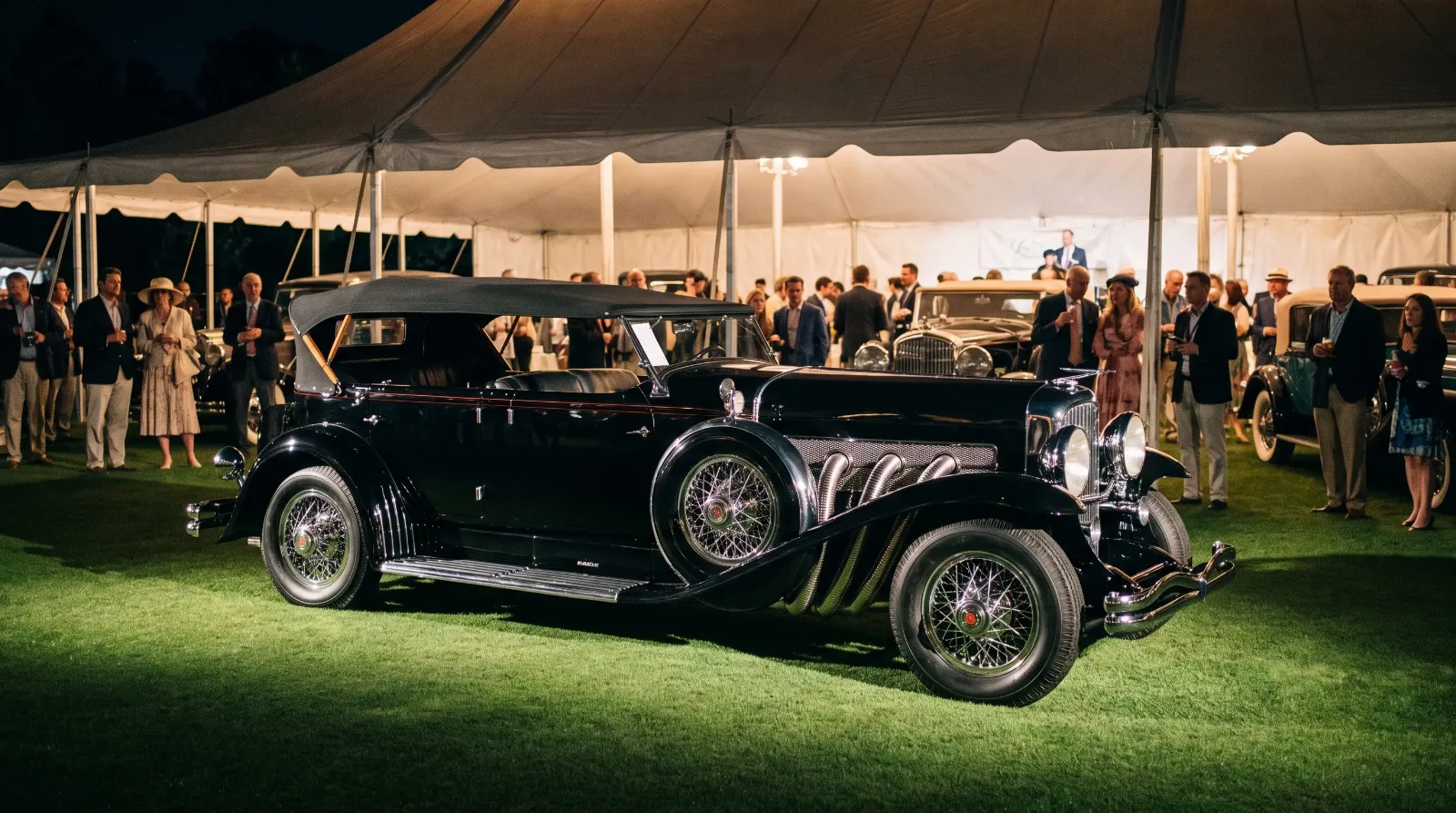
The highest price ever paid at auction for an American automobile belongs to a 1935 Duesenberg SSJ, sold by Gooding & Company at Pebble Beach in 2018 for $22 million. Only two SSJ roadsters were built, on a shortened chassis with a supercharged engine, and this one had been Gary Cooper's. The number makes sense once you understand the object. Two examples. Documented Hollywood ownership. A body by the LaGrande shop with a shape found on no other Duesenberg. Every lever that moves a price was pulled at once.
That result did not appear from nowhere. Duesenberg Model J values have climbed steadily for years, and the standard cars now trade well into seven figures. The SSJ simply sits at the apex of a marque that collectors already treat as the high-water mark of American coachbuilt engineering. If you want to understand why these cars are restored the way they are, and what originality means at this level, the restoration story covers the ground in detail.
The European ceiling: Mercedes-Benz and Bugatti
The overall auction record for any motor car sits far above the Duesenberg. In May 2022, RM Sotheby's sold a 1955 Mercedes-Benz 300 SLR Uhlenhaut Coupe in a private auction for a reported €135 million, roughly $143 million at the time. That car is a competition coupe rather than a salon carriage, but it belongs in any honest discussion of the ceiling because it reset every expectation the market held.
Within the pure luxury class, the pre-war Mercedes-Benz 540K Special Roadster is the model to watch. Fewer than thirty of the long-tail Special Roadsters were built, and the best have brought roughly $10 million to $12 million at Gooding and RM sales over the past decade. The Bugatti Type 57SC Atlantic sits higher still, though the celebrated examples have changed hands privately rather than under the hammer, one reportedly around $30 to $40 million. Only a handful of Atlantics were ever made, and their value reflects it.
The coachbuilders behind these cars are half the reason the numbers climb. A 540K Special Roadster was bodied by Sindelfingen to a standard almost no other maker matched, and the shape of the tail and the sweep of the fenders are what collectors are really bidding on. The same holds for American cars carrying work by Murphy, LeBaron, or Rollston. When two examples of the same chassis reach the block, the one with the more admired coachwork wins, sometimes by a wide margin, even when the mechanical specification is identical. Buyers at this level read the body first and the badge second.
Rolls-Royce and Bentley sit a rung below the very top, but their coachbuilt drophead and open-tourer examples still reach strong seven-figure results when the history is complete. A pre-war Phantom with original coachwork and a traceable file behaves like the cars above it in miniature: the rarer the body and the cleaner the paper, the higher the ceiling. The pattern repeats at every level of the market, which is what makes it worth learning.
| Car | Sale (house / year) | Price |
|---|---|---|
| 1955 Mercedes-Benz 300 SLR Uhlenhaut Coupe | RM Sotheby's, 2022 (private) | ~$143M |
| 1935 Duesenberg SSJ (Gary Cooper) | Gooding & Co., 2018 | ~$22M |
| 1937 Mercedes-Benz 540K Special Roadster | Various, 2012–2016 | ~$10M–$12M |
| 1931 Bugatti Royale (Kellner) | Christie's, 1987 | ~£5.5M |
Why these cars reach these numbers
Strip away the individual stories and the same three factors explain every result. Coachwork by a documented carrossier or in-house special shop is the first. A one-off body cannot be replaced or compared, so the market prices it as art. Provenance is the second. A chain of ownership that can be verified, ideally with a famous name or a competition history, removes the buyer's largest fear, which is that the car is not what it claims to be. Rarity is the third, and it is the one collectors most often misread. Rarity only pays when it is paired with desire. A car that is rare because nobody wanted it stays cheap.
"When a car crosses eight figures, you are no longer buying transportation or even a machine. You are buying an object that a small number of people have agreed is irreplaceable. The bidding settles what they will pay for that agreement, and the coachwork is usually what they are really fighting over."
Sarah Whitfield
Reading a record sale honestly
A record does not lift every car of the same model. When an SSJ brings $22 million, a standard Model J sedan does not suddenly follow. The headline attaches to the specific object, its body, its history, its condition on that day, and nothing else. Treat these figures as the outer boundary of the market, not as a multiplier you can apply to your own car.
The other lesson is quieter. Every one of these results rewarded originality and paper over polish. Over-restored cars with thin history do not reach these rooms, and when they do, they no-sale. The value lives in the object being what it says it is. That principle scales all the way down from a $22 million Duesenberg to a well-kept sedan, and it explains why the same cars keep setting records while the broader luxury market moves in fits and starts.
If the ceiling interests you, the floor is worth understanding too, because the gap between them is where opportunity hides. That is the subject of the next: Why Some Luxury Classics Are Undervalued Compared to Muscle Cars piece, which looks at the cars the record rooms ignore.
Related Reading
Have a
Classic Car
for Sale?
Reach thousands of serious classic car collectors across the US.
Sell It Here →
Are You a Classic Car Dealer?
List your full inventory and connect with targeted classic car buyers.
Join as a Dealer →

About the author
Sarah Whitfield
Third-generation classic car collector specializing in pre-war American and European coachbuilt automobiles. Researcher and concours enthusiast.
Comments (1)
M
Mike Ferrano
1 month ago
Took three years to find the right one. Patience is a genuine skill in this hobby and it pays off.