A man pulled onto a new-truck lot a while back in a 1972 Chevrolet C10 he'd owned since the Carter administration. Long bed, 350, three-on-the-tree, original paint gone soft in the sun. He wanted a new half-ton and figured the old truck would cover a good chunk of it. The salesman walked around it twice, kicked nothing, and came back with a number that would not have bought the tires off the new one. The man drove the C10 home. He was right to.
That's how most attempts to trade in a classic car go at a regular new-car store. Not always, though. There are times when handing the keys across a desk is the sensible move, and times when it is just about the worst money you'll ever leave on the table. This piece sorts one from the other, and it gets into the numbers, because a trade is a math problem before it is anything else.
What a dealer sees when your old car rolls onto the lot
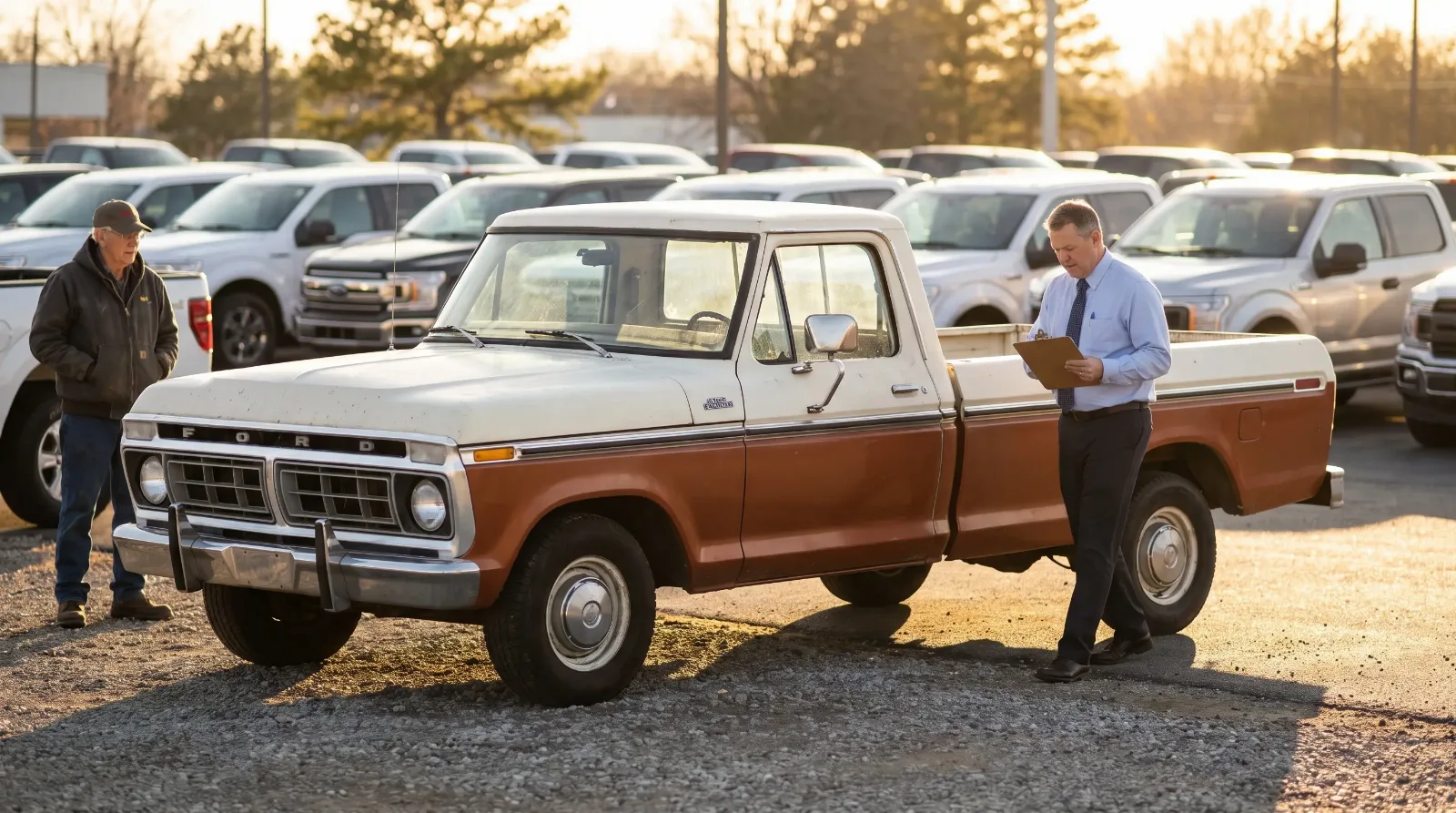
Start with how the appraisal works. When a mainstream dealer takes a trade, the used-car manager looks up a book value, figures what it costs to recondition the vehicle, decides how long it'll sit, and backs into a number that leaves room for profit. That system works fine on a five-year-old crossover. It falls apart on a fifty-year-old pickup.
For one thing, there usually is no book. The guides those managers lean on every day are built for late-model used cars, and they don't publish values for collector vehicles. For another, the store has no buyer for it. A new-car dealer doesn't want a column-shift truck with no air conditioning parked on the front row. If they take it, most likely it goes straight to a wholesale auction, and the appraiser prices it to that outcome, with plenty of cushion for the risk that it brings less than hoped. You are not being offered what the truck is worth. You are being offered what it is worth to someone who doesn't want it.
The math: trade-in value against a private sale
A trade comes with one real benefit in a lot of states: you pay sales tax only on the difference between the new vehicle's price and your trade allowance. That's worth something. It is not worth as much as the gap between a lowball trade number and a fair private price.
The table below runs one hypothetical. Take a driver-quality classic that would bring about $30,000 sold privately, traded against a $55,000 new truck in a state with a 6% sales tax that gives trade-in credit. The tax rate and the trade offers are illustrations, not quotes, and states handle trade-in credit differently. A few, California among them, tax the full price of the new vehicle and give no credit for the trade at all. Michigan caps the credit at $12,000 for 2026, a limit that rises $1,000 a year.
| Scenario (illustrative) | Value you get for the classic | Sales tax saved on the new truck (6%) | Effective value of the classic | Gap versus private sale |
|---|---|---|---|---|
| Private sale, then buy new | $30,000 | $0 | $30,000 | Baseline |
| Trade at a classic specialist dealer (about 25% under private, our estimate) | $22,500 | $1,350 | $23,850 | About $6,150 less |
| Trade at a mainstream new-car store (wholesale-style offer, our estimate) | $15,000 | $900 | $15,900 | About $14,100 less |
The tax savings are real, and they shrink right along with the trade number. The general rule we use across this site is that a dealer offer often lands about 20% to 30% under a fair private price once you account for reconditioning, holding cost and margin. That is our estimate, not a published statistic, and a new-car store with no classic buyers lined up can easily go lower. Run your own numbers with your own state's tax rate before you sign anything.
When trading actually makes sense
All that said, there are honest reasons to trade, and I won't pretend otherwise.
The first is when the car is worth very little to begin with. A tired project with a stuck engine and rusted floors might bring a couple thousand dollars privately after a month of phone calls and three no-shows. If a dealer will give you close to that and save you the hassle, the difference may be smaller than the value of your weekends.
The second is when you're trading into another classic at a dealer who actually sells classics. A specialist store with a showroom of collector cars knows what your car is, has buyers for it, and can give you a fair allowance because they plan to retail it, not wholesale it.
The third is circumstance. An estate sale from out of state. A move with a hard date. A health situation where showings to strangers just aren't going to happen. In those cases the speed and certainty of a trade carry a real dollar value, and it's fair to pay for them.
If none of those apply and you've just got a decent driver and time to sell it, the private route nearly always pays better. Before you settle on anything, read our guide on best way to sell classic car, which compares private sale, auction and consignment side by side. Selling to fellow members of a marque club is another route worth knowing about, but that's covered separately.
Trading classic for classic, and swapping with a private party
Some of the best trades I've heard about never involved a dealer at all. Two owners meet at a swap meet or through a club, one has a Ford and wants a Chevy, the other the reverse, and they swap straight across or with some cash to even it up. It can be a clean deal. It can also go sideways if nobody writes anything down.
Treat a swap like two sales happening at once. Each side signs a bill of sale with the agreed value written on it, each side signs over a title, and each side does the paperwork their own state wants. The tax side matters too. For tax purposes a swap is a sale. Since 2018, like-kind exchange treatment covers only real property, and the IRS says vehicles and collectibles no longer qualify, so each side is treated as selling its car for the fair market value of what it got in return. If your classic has gone up a lot since you bought it, that gain can be taxable as a collectible, at a long-term rate that tops out at 28% for property held more than a year, plus the 3.8% net investment income tax for higher earners. A loss on a personal-use vehicle isn't deductible. That's general information, not tax advice, so talk to someone who does this for a living.
"A trade is a sale with the price hidden inside a bigger number. Pull it out and look at it by itself. If you wouldn't take that figure from a stranger with cash, don't take it from a salesman with a clipboard."
— Robert Halloran
When to walk away from the trade desk
The worst trades happen when people negotiate the monthly payment instead of the vehicle. Keep the two deals apart. Settle the price of whatever you're buying first, then talk about the trade, and know before you walk in what your car would bring on its own.
And think about the other exits. If your car has a strong following and good paperwork, putting it in front of bidders at a no reserve auction can draw more interest than any dealer offer, though you accept whatever the last bid is. If you'd rather keep control of the price, a plain classified ad still works for most driver-grade cars, and our rundown of where to sell your classic car covers the sites and what each one costs.
The fellow with the C10, by the way, sold it a few months later to a young couple who wanted a weekend truck. Got roughly double what the dealer had offered. The money covered his down payment on the new one. Not every trade-in story ends that way. But most of the good ones start with somebody driving home and doing the math.
Sources and notes
- IRS: like-kind exchanges now limited to real property
- IRS Topic 409: capital gains and losses (28% collectibles rate, personal-use losses)
- California CDTFA annotation 140.0100: trade-in allowance included in the measure of tax
- Michigan Department of State: trade-in sales tax credit FAQ
- Classic.com: auction fees and prices