
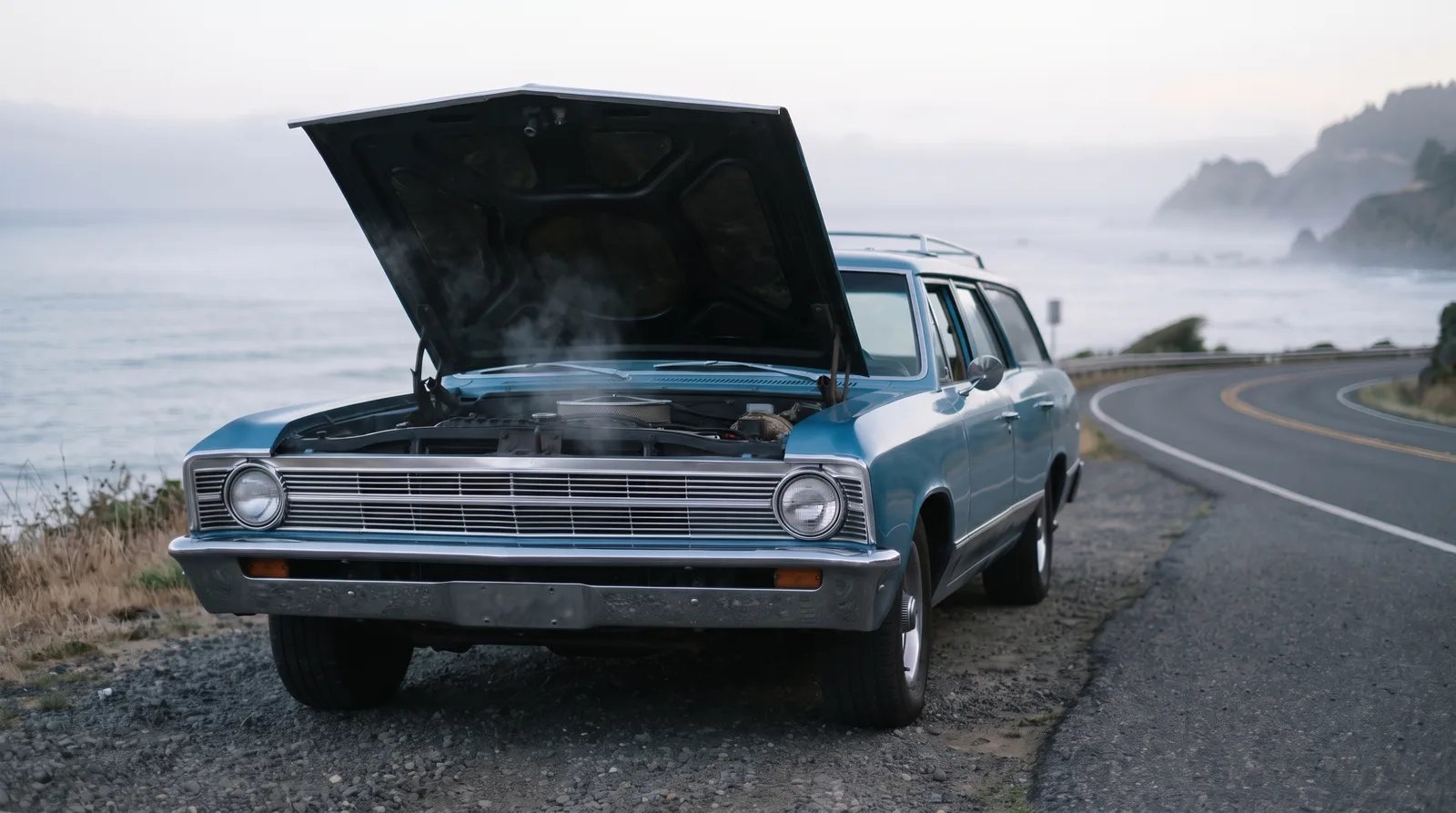
Classic car overheating is rarely one big failure. It is usually four small ones stacked on top of each other: a radiator core that is half clogged, a water pump with a worn seal, a fan that moves less air than it did in 1970, and coolant that has been doing the job for a decade longer than it should have. You can freshen the engine, and the rebuild itself will be wasted if the cooling system cannot carry away the heat a healthy engine makes. Do the cooling system as part of the same job, not as an afterthought.
Restoration & Tech
6 min read
Cooling System Restoration: Radiator, Water Pump, Fan
Classic car overheating usually has several small causes. Here is how to restore the radiator, water pump, fan, hoses and coolant so a rebuilt engine stays cool.
Start with the radiator, not the thermostat
Most people reach for a new thermostat first because it costs ten dollars. That fixes a stuck thermostat and nothing else. The radiator is the part that ages. Brass and copper cores from the 1950s through the early 1970s clog with scale and solder bloom from the inside, and the fins corrode and crumble from the outside. A core that looks fine from the front can still be badly restricted inside.
You have three honest choices. A local radiator shop can boil out and rod the tubes, pressure test the core, and re-tank it for for a few hundred dollars in many shops. A recore, where the shop builds a new core into your original tanks, usually costs somewhat more than a clean-and-repair, and keeps the original look. A modern aluminum replacement in the right fitment is often priced in the same few-hundred-dollar range for common applications and can cool better, but it changes the look of the engine bay and may not suit a numbers-correct car.
Ask for a core with the same number of rows as stock or one more, and match the shroud. A three-row core that will not fit the shroud is worse than the two-row that did.
Water pump, hoses, and the small parts that fail
Replace the water pump during any engine rebuild. Reproduction pumps for common V8s and sixes are inexpensive, usually a small part of the bill, and labor to change one later with the radiator and accessories in place costs far more than the part. Check the impeller design against the original. A pump with a weaker impeller costs you flow at idle, which is exactly when a classic runs hot.
Hoses are the next place to spend carefully. Do not reuse old hoses on a rebuilt engine. Rubber that is soft on the outside can be collapsing inside, and a lower hose without its internal spring will suck flat at high rpm and make the engine overheat on the highway only. Fit a new thermostat, a new cap rated for the pressure the system was designed for, and fresh heater hoses while you are there. Radiator caps matter more than people think. A cap that vents at 7 psi on a system designed for 13 psi drops the boiling point and gives you the same symptom as a bad pump.
Fans, shrouds, and airflow
A lot of classic car overheating comes down to air, not water. Original clutch fans lose their silicone and stop locking up. Plastic flex fans crack. A missing fan shroud is the single most common thing I see on trucks and muscle cars alike, and without it the fan pulls air from around the radiator edges instead of through the core. The shroud is not decoration. If the car came with one, put it back.
For electric fans, size the cfm to the core and wire them to a relay, not through the original switch. An electric fan helps a lot in traffic and does little at highway speed, where ram air does the work. A pusher fan mounted in front of the core can also block airflow at speed on a car that was never designed for it. If you want to understand how these failures show up on the road, read our piece on diagnosing overheating in stop and go traffic.
Flush the block before you trust the new parts
New parts will not help if the block is full of rust and scale. Pull the freeze plugs during a rebuild and have the block hot tanked. On a running car, a reverse flush of the block and a chemical cleaner can help, but it will not clear heavy deposits. Replace freeze plugs with brass or quality steel plugs, and use a sealer sparingly.
Use a proper 50/50 coolant mix with distilled water. Older cars with brass and copper radiators and iron blocks do best on conventional green ethylene glycol coolant, or a compatible formula the radiator shop recommends. Newer long-life coolants use different inhibitor chemistry, and mixing coolant types reduces their service life, so ask your radiator shop which coolant they recommend before you buy.
🔧 Inspection Priorities
- Radiator core flow. Pressure test and flow test. A restricted core will beat every other fix and is usually cheaper to fix than the engine damage it causes.
- Water pump and shaft play. Wiggle the pulley. Any play means a pump replacement and the part is cheap next to the labor.
- Lower hose spring and condition. Collapse at speed mimics a failed pump.
- Fan, clutch, and shroud. Missing or cracked parts quietly cost cooling capacity, especially at idle.
- Cap rating and thermostat. Cheap fixes, but wrong parts defeat the whole system.
Checking your work and moving on
After the install, fill slowly, bleed the air out, and run the engine to temperature with the heater on. Use an infrared thermometer on the radiator top and bottom tanks. A clear, healthy drop from the top tank to the bottom tank under load means the core is shedding heat. A very small drop suggests the core is still restricted.
"Nobody brags about a new radiator. They brag about the engine. But the radiator is the part that keeps the engine alive on a hot July afternoon."
Robert Halloran
Once the engine stays at temperature, the rest of the drivetrain is next. A cool engine bolted to a tired gearbox is half a job, and the transmission rebuild deserves the same planning you gave the cooling system.
Sources and notes
- Summit Racing: radiator cap pressure and boiling point, about 3 degrees Fahrenheit of boiling point per psi of cap pressure
- OnAllCylinders: 9 cooling system myths and mistakes, cap ratings on older cars, shrouds, electric fan relays, 50/50 mix with distilled water, anti-collapse hose springs
- OnAllCylinders: engine cooling system tech 101, factory two-row radiators, aluminum cores with fewer, wider tubes, fan shroud placement, fans at speed
- Wikipedia: Radiator (engine cooling), brass and copper versus aluminum construction, pressurized systems, fan clutches
- Wikipedia: Antifreeze, ethylene glycol 50/50 mixes, inhibitor types, distilled water, mixing coolants
Related Reading

About the author
Robert Halloran
Texas-based classic truck enthusiast with decades of experience buying, restoring, and writing about American pickups from the 1940s through the 1980s.
More in Restoration & Tech

Comments
Be the first to comment on this article.