
Points ignition works. It also needs periodic checking, with some guides suggesting every few thousand miles, and it drifts out of adjustment the whole time. Electronic ignition removes that drift. That is the entire argument for converting, and for most driven cars it is a strong one.
Restoration & Tech
6 min read
Points vs Electronic Ignition: Restoring or Converting
Points to electronic ignition: what points do, why they wear, what a conversion costs, and when to keep the original system for a correct restoration.
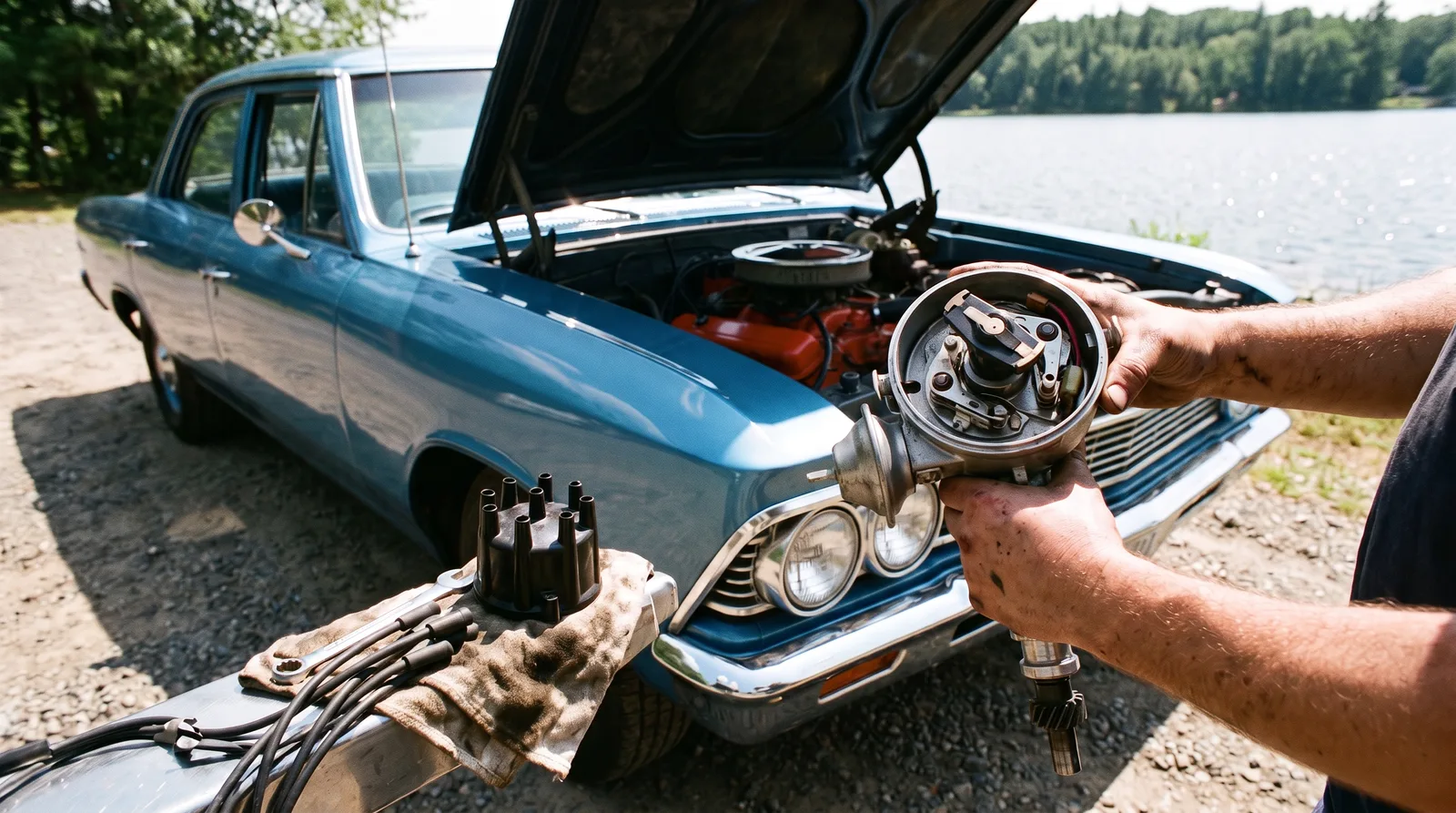
The counter argument is originality, and it is also valid. This article lays out how each system works, what a conversion costs, and how to decide. It sits inside the broader engine and drivetrain rebuild process, where ignition is often the last thing anyone budgets for.
How points ignition works
A set of contact points sits inside the distributor. A cam on the distributor shaft opens and closes the points. When they close, current builds in the coil. When they open, the field collapses and the coil fires the spark through the cap and rotor. A condenser absorbs the arc across the contacts so they last longer.
The points are a mechanical switch, and they wear. The rubbing block that rides the cam wears down, which closes the gap. The contacts pit and burn. The gap drifts, and with it the dwell angle, which is how long the coil charges. Many American V8 specifications sit near a gap of 0.016 inch and a dwell near 30 degrees, but you need the exact figure for your engine.
When the gap closes, timing retards and the spark weakens. That makes a car hard to start, rough at idle, and hesitant at high rpm. Some problems blamed on carburetors turn out to be tired points.
What electronic ignition changes
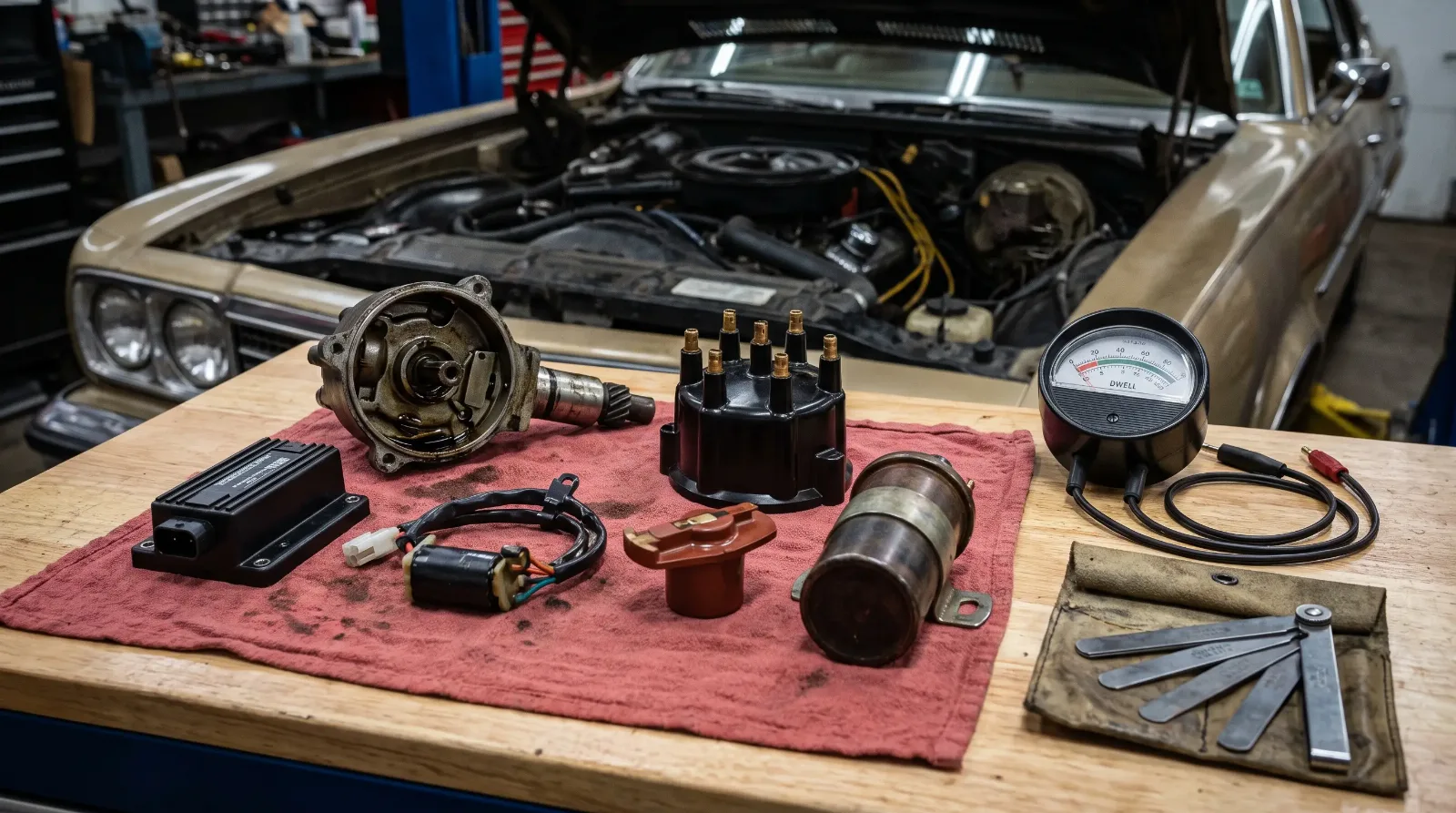
An electronic system replaces the mechanical switch with a solid state module, triggered by a magnetic pickup, a Hall effect sensor, or an optical sensor. Nothing rubs and nothing pits, so dwell stays constant and the spark stays strong for far longer. Cold starts improve, high rpm misfire fades, and plug life lengthens.
There are four common routes, each with different cost and complexity.
| Option | What it is | Relative cost | Notes |
|---|---|---|---|
| Original points and condenser | Stock system, restored | Lowest | Needs regular adjustment |
| Drop in module kit | Replaces points inside the stock distributor | Modest | Looks stock, may call for a matching coil |
| Factory style electronic distributor | Swap to a later OEM design, such as GM HEI | Moderate | Visibly different, strong spark |
| Aftermarket CDI or full kit | Capacitor discharge box, new distributor and coil | Highest | Best for modified engines |
The drop in kits are the easy choice for most restorations, because the stock distributor stays in place and the engine bay looks correct. If you want the stronger spark of a later factory design, the swap to a larger cap distributor is common on General Motors small blocks and big blocks, and there is a detailed example in our walkthrough on wiring an HEI upgrade on a C10.
Installing a conversion correctly
Most failures come from wiring, not from the module. Read the instructions for your exact kit, because the coil requirements vary. Some modules need a coil with a specific resistance. Others tolerate the stock coil if it is in good condition. HEI style conversions want a full 12 volts at the coil at all times, which means bypassing or removing the ballast resistor or resistance wire that older points cars use to drop the voltage while running.
Check the ground on the distributor body, and check the connection at the coil. A bad ground will make the module run hot or fail early. Set the base timing with a light after the install, since the pickup position may shift it a few degrees. Then check the advance curve if the car has a worn distributor.
A worn distributor makes any ignition look bad. Test the shaft for side play and the vacuum canister for leaks, and rebuild or replace the distributor if it is loose. A clean module on a worn shaft still misfires.
When to keep points
Judged cars are the main reason to stay with points. A correct original distributor with a restored points set scores better on authenticity, and it also keeps the engine matching the build documents. If you want both reliability and a correct bay, some owners install a drop in module and keep the original points and condenser in the glove box. That way the car can be returned to stock in ten minutes.
The other case for points is a low mileage car that sees a few hundred miles a year. Points drift with time as well as with mileage, but a car that is checked before each season may be perfectly happy. For anything driven regularly, the module is the practical choice.
"Points do not fail on the dyno sheet. They fail on a cold morning, three hundred miles from home. If you drive the car, convert it. If you show it, keep the parts."
Dan Reeves
Reliability is the practical measure. A module based system has no contacts to wear and needs no routine adjustment, while points need a feeler gauge and a dwell meter on a regular schedule. If you travel in the car or drive it in all weather, that difference is worth more than any cosmetic argument. If the car lives in a garage and comes out on sunny Sundays, points are perfectly respectable and cost almost nothing to maintain.
What else to check while you are in there
A conversion is a good moment to replace the plug wires, cap and rotor, and to inspect the coil. Old resistance wires in a stock harness can age out and add resistance. Fit a quality set, check the plug gap against the engine spec, and look at the heat range of the plugs while you are at it.
Ignition also affects heat, because badly retarded timing can make an engine run hot. If you are chasing high temperatures, look at the cooling system as well, because overheating is rarely only an ignition problem.
Sources and notes
- High energy ignition, Wikipedia, GM HEI history, module and pickup replacing points and condenser, no scheduled maintenance
- Ignition system, Wikipedia, Kettering points, capacitor and distributor layout, history of electronic ignition
- Upgrade to HEI, Out in the Shop, 12 volt supply, ballast resistor and resistance wire handling
- Electronic ignition conversion for classic cars, Classic Car Hub, points service interval, gap and dwell relationship, drop-in kits, originality at concours
- Points vs electronic ignition, Restore an Old Car, points running 10,000 miles or more once set, low-mileage cars, reliability trade-offs
Related Reading


About the author
Dan Reeves
Performance engine builder from North Carolina's motorsports corridor, focused on swaps, forced induction and making real, repeatable power.
More in Restoration & Tech

Comments
Be the first to comment on this article.