
A rear end rebuild is not glamorous, and the results are measured in noise. A tired differential whines on decel, clunks when you get on the throttle, and howls at 55. The fix is a known list of parts and a known set of measurements. Get the measurements right and the axle runs quiet for many years of driving. Get them wrong and you will pull it apart twice. This is part of the rest of the drivetrain, and it is usually a modest slice of the total budget.
Restoration & Tech
6 min read
Rear Axle and Differential Rebuild
A rear end rebuild comes down to correct parts and correct measurements. Learn gear identification, kit costs, pinion depth, backlash and break-in.
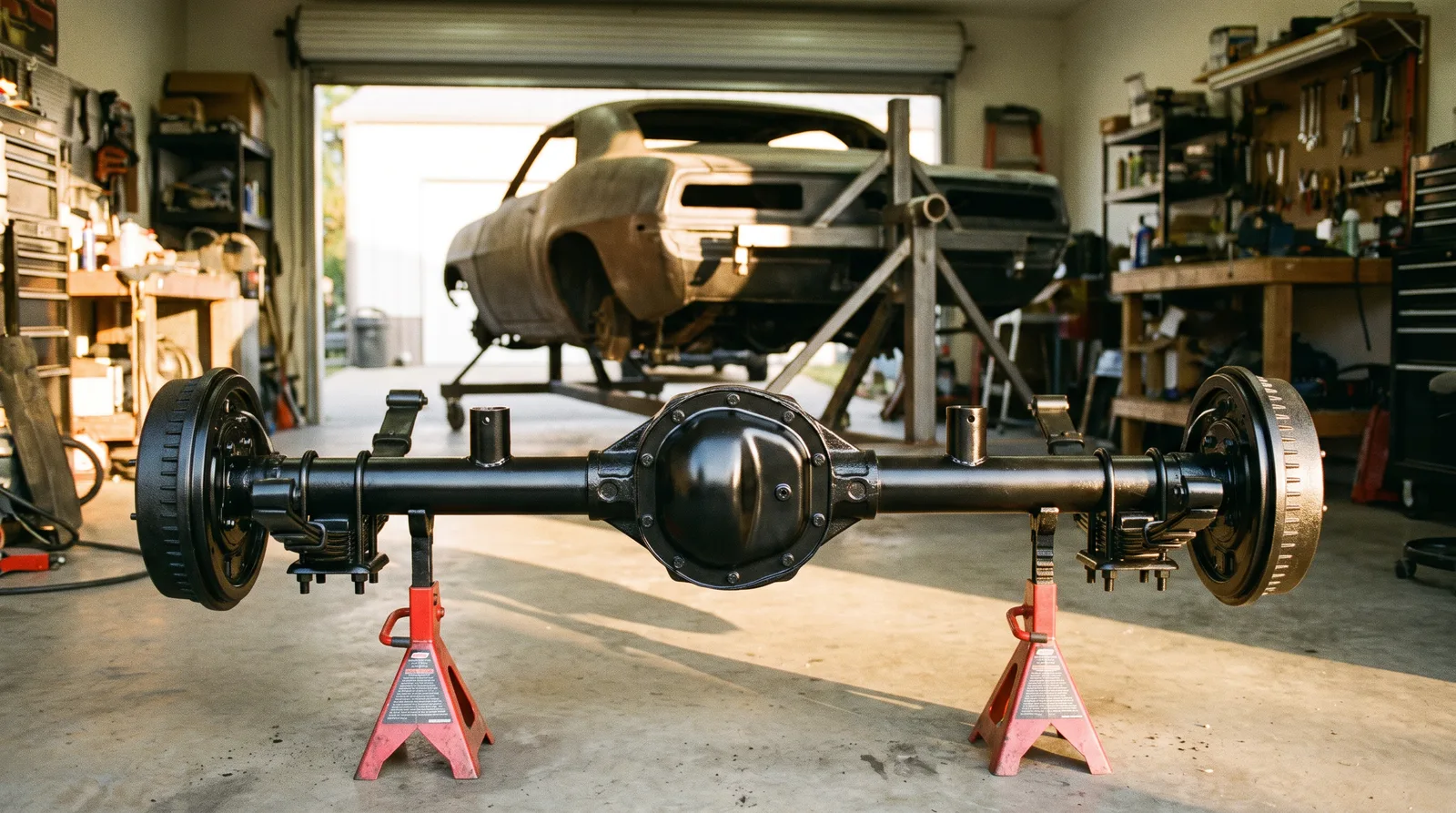
Know what you have before you order parts
Start with the axle tag, the casting numbers, and the ratio. Pull the cover and count the ring and pinion teeth. A ratio you do not recognize may mean a previous owner swapped gears. Identify whether it is a 10-bolt, 12-bolt, Dana 44, Ford 9-inch, or something else, because kits, bearings, and shim sets differ. A limited-slip or locker unit adds clutch packs or cones to the budget.
Bring the original housing back to straight. Check for a bent axle tube or a cracked housing from drag racing or a tow hook. Also inspect for a bent axle shaft with a dial indicator. A bent shaft will chew a new bearing.
The rebuild kit and the real cost
A master install kit commonly includes carrier bearings, pinion bearings, seals, shims, crush sleeve or collapsible spacer, and bolts. A kit is a modest parts expense, and a new ring and pinion set adds to it. Shop labor for a full setup is a larger share, because the work is slow and precise. On a full restoration, restorers often budget the transmission and rear axle together at about $3,000 to $6,000 for a driver-quality car and $5,000 to $12,000 for a show car, and a ring-and-pinion job alone is typically a four-figure item at a shop. A used gearset that has a worn pattern on the teeth should not be reused with new bearings. Replace gears as a matched set.
Axle bearings and seals at the wheel ends are a separate item. Semi-floating axles with a leaking seal contaminate the brake shoes, which is why rear end work and brakes should be planned together.
Setting backlash and pinion depth
This is the step that decides whether the axle is quiet. Pinion depth sets how deep the pinion sits relative to the ring gear. Backlash is the gap between the teeth. Both are set with shims, and both are checked with gear marking compound and a dial indicator. The pattern on the ring teeth should sit as a centered oval, away from the top and bottom edges of the tooth.
Backlash specs commonly fall somewhere between 0.003 and 0.010 inch, with many reproduction gear sets set around 0.007 to 0.009 inch, but the exact spec depends on the axle, and the manual is the authority. Preload on the pinion bearing is set by the crush sleeve or by shim, and it needs a torque-to-rotate reading, not a guess. If you do not have the tools, this is the one job to send out.
Here is a quick look at what each adjustment affects.
| Adjustment | What it sets | Symptom if wrong |
|---|---|---|
| Pinion depth | Contact pattern height on tooth | Whine on drive or coast |
| Backlash | Gap between ring and pinion teeth | Clunk or howl |
| Pinion preload | Bearing tension on the pinion | Early bearing failure |
| Carrier preload | Side bearing tension | Shifting backlash, noise |
Limited-slip units and fluid
Clutch-type limited-slip units need friction modifier in the gear oil, and they chatter on turns without it. Cone-type and gear-type units have different needs. Check which you have. Replace worn clutch plates and springs, and measure the preload so the unit locks when it should.
Use the gear oil the manufacturer called for, commonly 80W-90 or 75W-90 in a classic, and check the manual for your axle. Fill to the bottom of the fill hole and let a few minutes pass for it to settle.
🔧 Inspection Priorities
- Housing and axle tubes. Cracks and bends mean the housing is scrap or needs repair.
- Axle shafts and bearings. Runout and pitting show up fast.
- Ring and pinion teeth. Chips, pitting, or a worn pattern mean new gears.
- Carrier and spider gears. Scored or loose parts cause clunks.
Wheel ends, bearings, and brakes at the axle
The axle shafts are part of the same job. On a C-clip axle, a failed bearing can let the shaft slide out with the wheel attached, which is why many restorers convert to a bearing retainer plate style. Measure shaft runout, check the splines, and look at the bearing surface for wear before you pass the shafts back into service. Replace the axle seals every time, and clean the backing plates and the brake hardware while the axle is out. A dry bearing in a rear axle gives the same sound as a bad ring and pinion, which sends people down the wrong path and costs them money.
Budget the job honestly. A DIY rebuild with a good manual, a dial indicator, and patience costs far less in labor than a shop job, though tools and parts add up. A shop will charge more, but they usually warranty the work. Either way, buy the parts from a supplier that sells complete kits matched to your axle, and do not mix brands of bearings and races, since a mismatched set can fail early. Keep the old shims, because they give you a starting point for the new setup.
Test drive and break-in
Many builders suggest driving gently for roughly the first 500 miles, with no hard launches and no long highway runs. Change the gear oil after break-in to remove the wear-in metal. Listen on both drive and coast, at several speeds. A rhythmic howl that changes with throttle points to the gear set, while a hum that does not change points to bearings.
"Gear noise is the dyno of a rear end. If the pattern is right, you can feel it in a clean mile."
Dan Reeves
With the axle sorted, move on to the brakes, since you will have the drums and backing plates in your hands anyway.
Sources and notes
- How to set differential backlash (Moss Motoring), backlash range for reproduction gear sets, pinion preload, marking compound pattern check
- Red Line Limited Slip Friction Modifier (BimmerWorld), friction modifier to stop chatter in clutch-type limited-slip units
- Differential (mechanical device), Wikipedia, axle ratio and fewer pinion teeth than ring gear teeth
- Axle, Wikipedia, semi-floating circlip retention versus full-floating axles
- Hypoid gear, Wikipedia, hypoid gears in rear-drive automobile drivetrains
Related Reading
Have a
Classic Car
for Sale?
Reach thousands of serious classic car collectors across the US.
Sell It Here →
Selling a classic? Here's how: the best sites to sell a classic car
Are You a Classic Car Dealer?
List your full inventory and connect with targeted classic car buyers.
Join as a Dealer →

About the author
Dan Reeves
Performance engine builder from North Carolina's motorsports corridor, focused on swaps, forced induction and making real, repeatable power.
More in Restoration & Tech
Comments
Be the first to comment on this article.