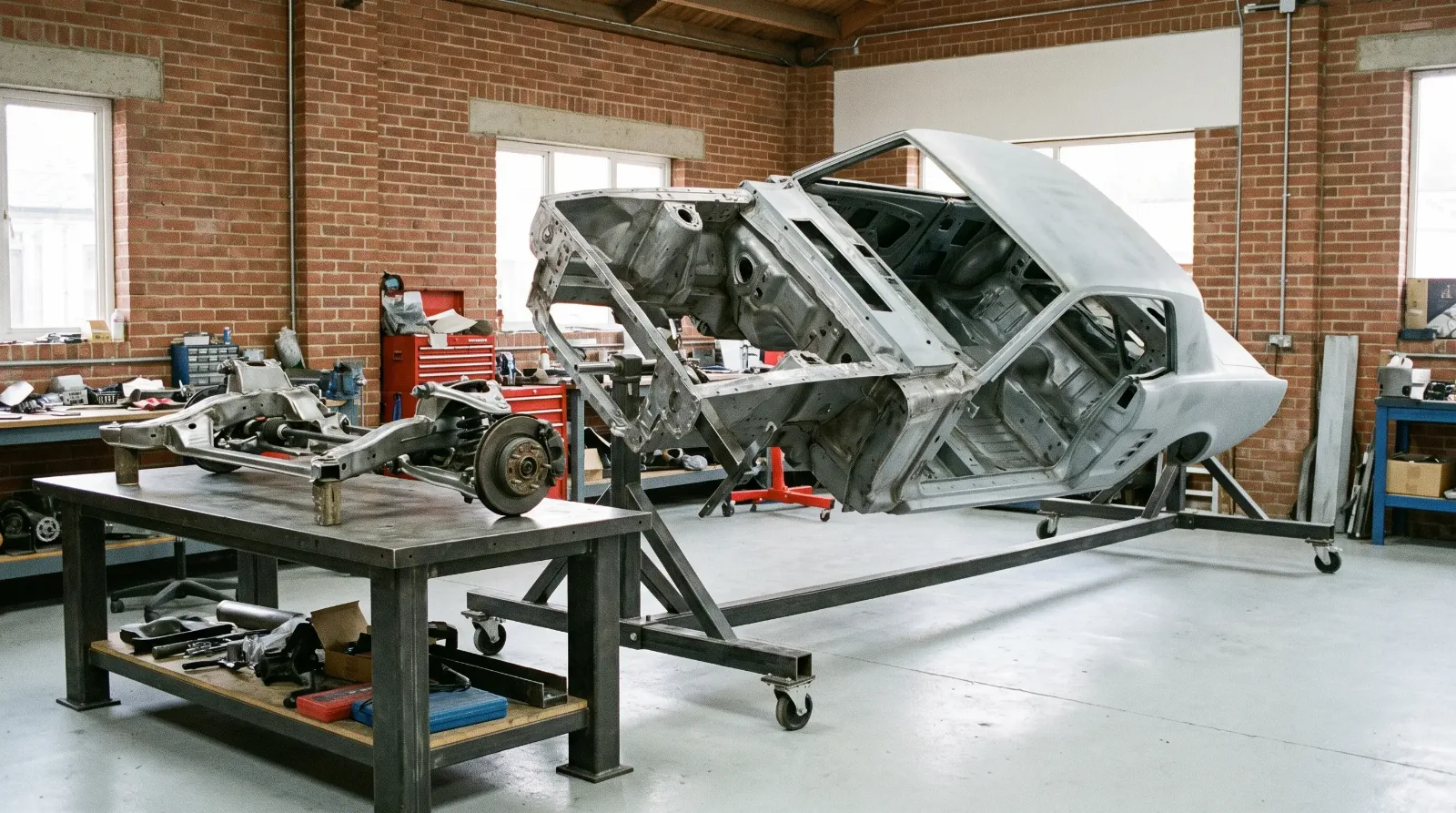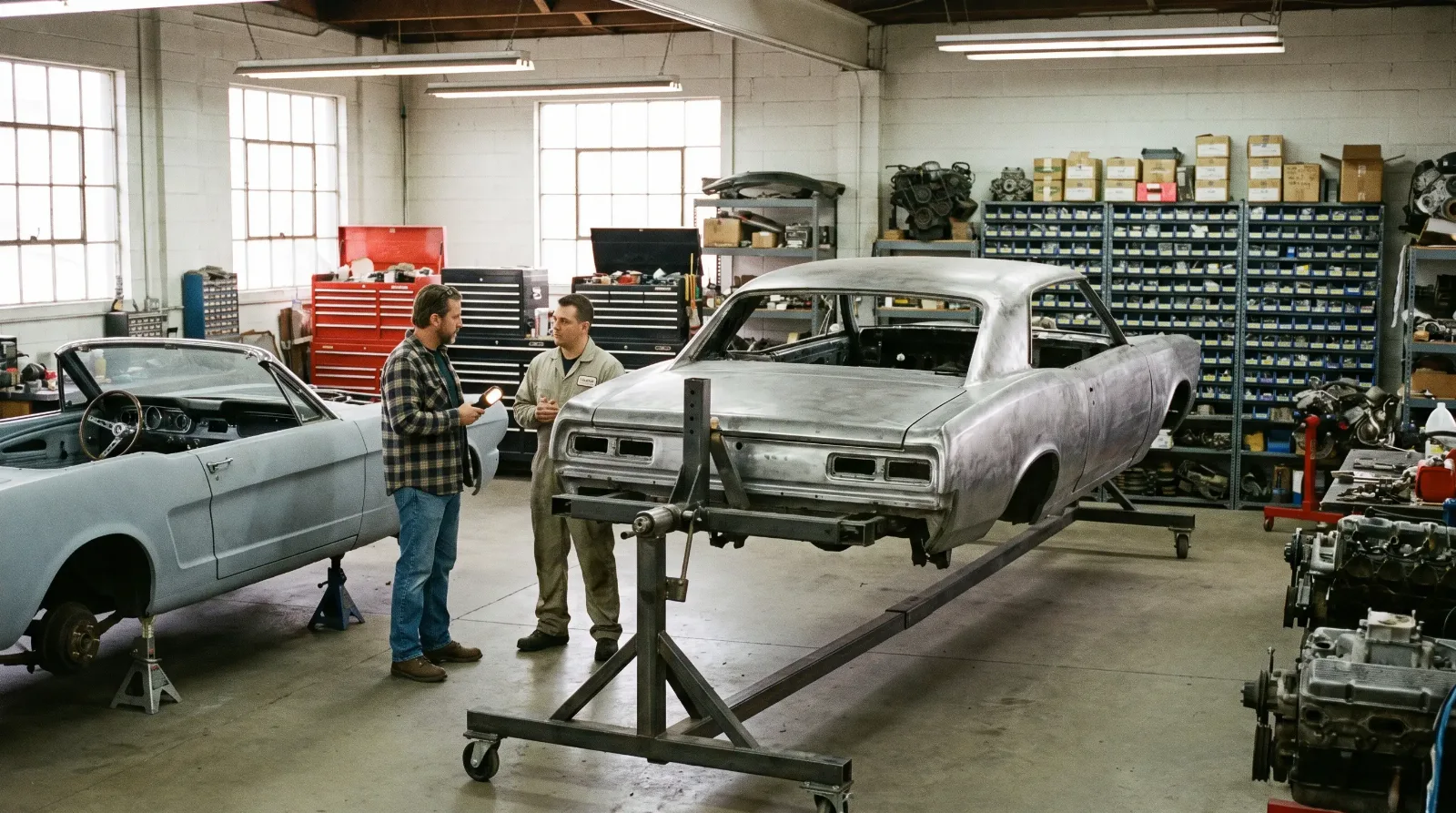
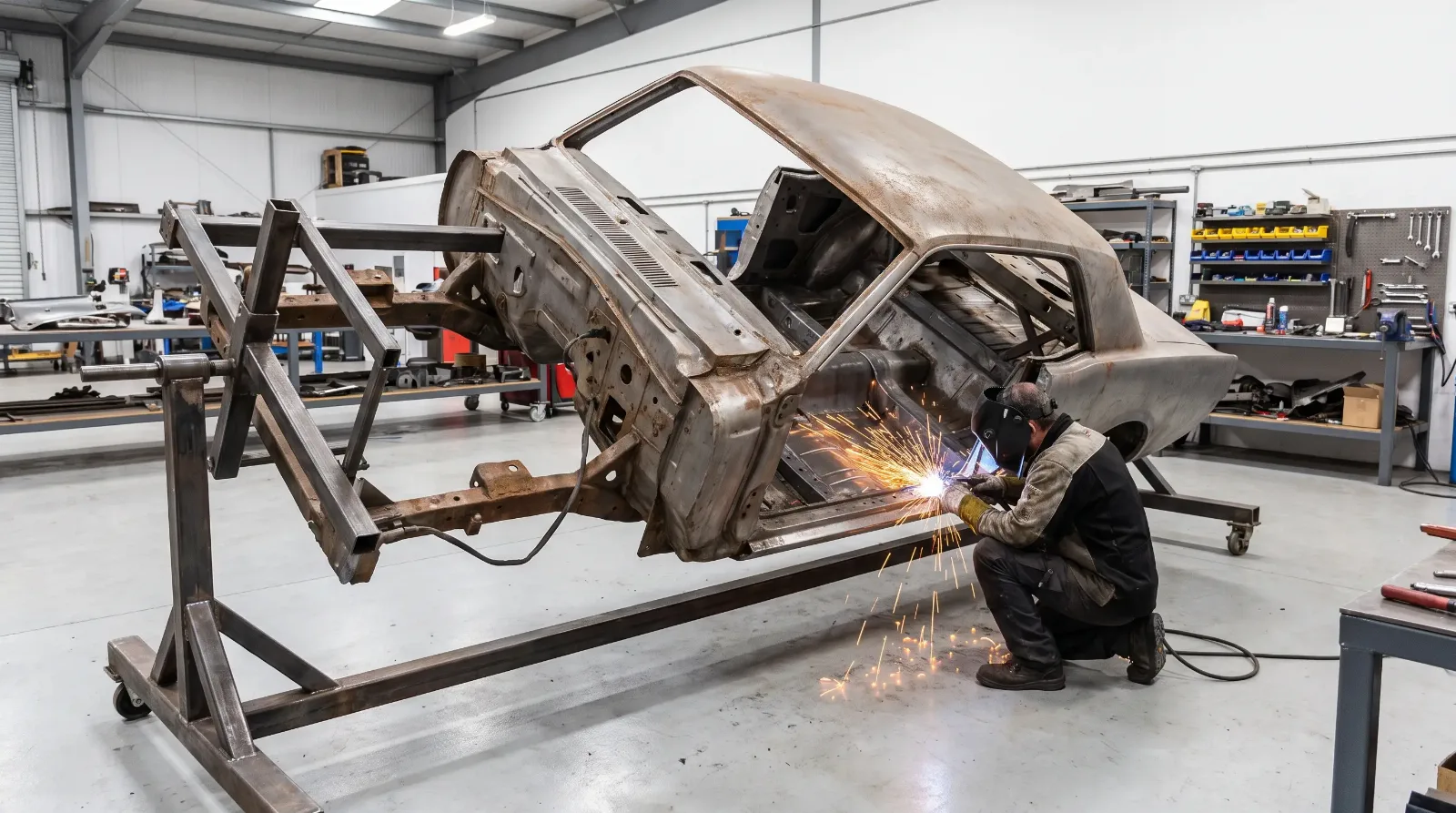
A rotisserie is a rotating stand that holds a car body by its ends so you can turn it like a spit. Mount the shell at the front and rear, lock it, and it can roll to any angle, floor up, roof down, sideways. That is the whole idea, and it solves a real problem: the places that rust and fail on an old car are the ones you cannot see from a standing position.
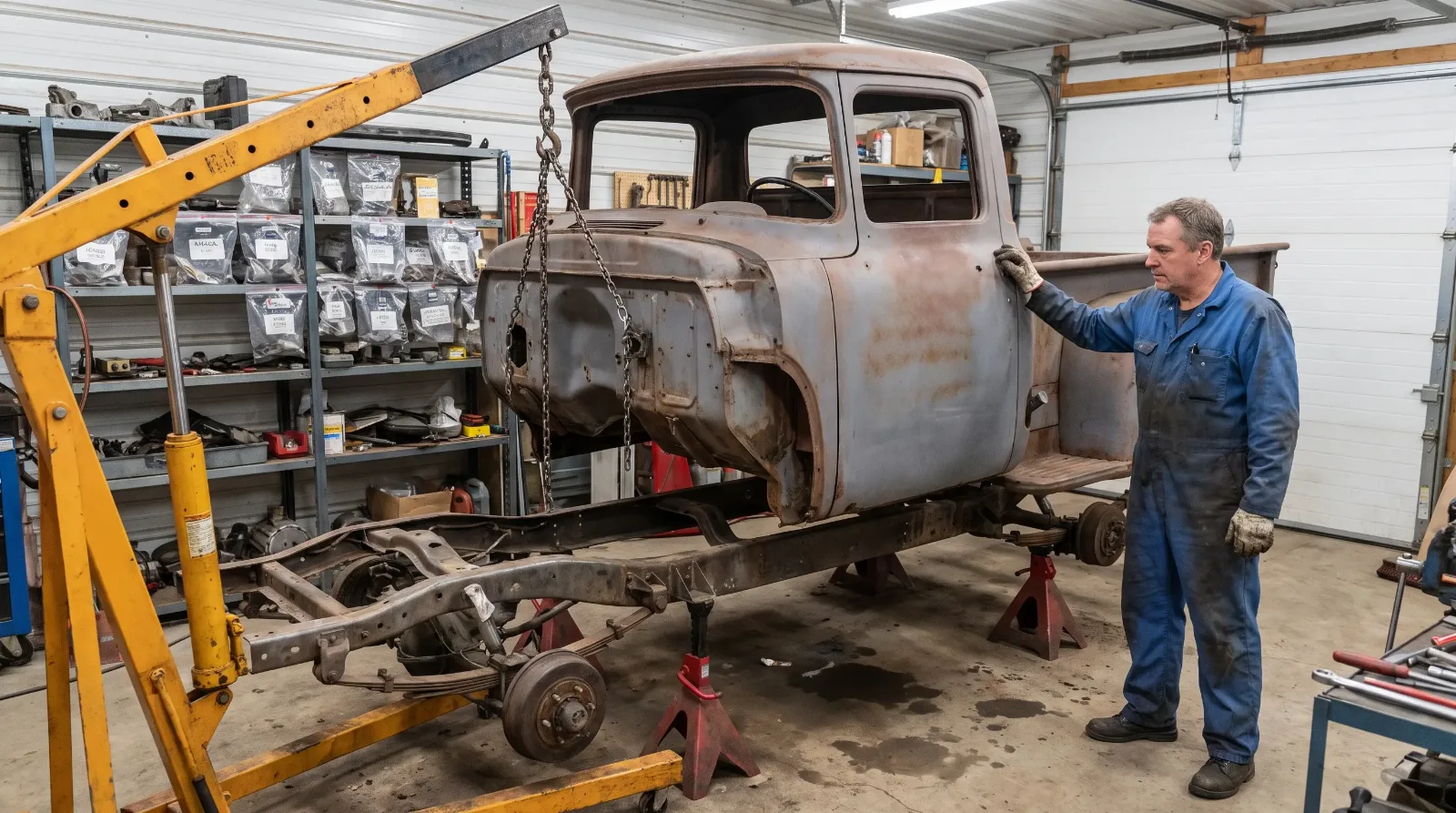
When people say rotisserie restoration, they mean a restoration where the body comes off the chassis, goes on the stand, and is stripped, repaired and often painted while rotating. It is one tool inside a larger frame off restoration, not a restoration level by itself. This guide covers how it works, what it buys you, and what it costs you.
How a rotisserie works
The stand has two end frames on wheels, each with an arm that bolts to the body. The usual attachment points are the bumper mounting holes or the bolt locations at the front and rear structure. Those points have to be strong and square, and often need reinforcement, because the whole shell hangs from them. Once mounted, a crank or a geared head lets one person rotate the body with a surprising amount of ease.
The sequence goes like this, and the order matters.
- Strip the car. Remove glass, trim, wiring, interior, drivetrain and suspension.
- Brace the body. On open cars and unibody shells, tack in temporary braces across door openings so the shell does not flex when the floor is cut out.
- Mount the body on the stand and measure it before anyone cuts anything.
- Blast or strip the paint. Media blasting or chemical stripping shows every repair a previous owner made.
- Repair the metal, working floor-up and underside first while gravity helps.
- Seal and coat the underside, then rotate and prime the rest.
- Paint, then roll the shell back to the chassis for assembly.
Step three is the one beginners skip. Measure diagonals and key points before you start cutting, and measure again as you go. Once the floor is gone, the body only holds its shape if you made it hold its shape.
What the rotisserie actually buys you
The benefit is access and working position. A welder can lay a clean bead on a floor pan from above instead of lying under the car with slag falling on his face. Seam sealer, undercoating and rust-inhibiting coatings can be applied evenly across the underside and inside the rocker panels, areas that a car on a lift does not allow you to work well. Paint reaches the inner edges and jambs without awkward angles.
The result is better metal, more consistent coverage and, if the crew is good, less time lost on awkward positions. It also makes the true condition of the shell impossible to hide. When a body is upside down on a stand, previous repair work and hidden corrosion are in plain sight.
Where it does not help
A rotisserie does not make a bad shell good. It exposes problems, and exposed problems have to be fixed. If a car arrives with a collapsed rear structure, the stand gives access to repair it, but it does not reduce the labor involved.
It also adds work at the beginning and end. Stripping a car to a bare shell, installing bracing, mounting it and later dismounting it takes hours. On a clean, solid car, those hours may not pay back. This is a reason some shops reserve the rotisserie for cars with significant underside rust or for restorations aimed at show level, where the underside is judged.
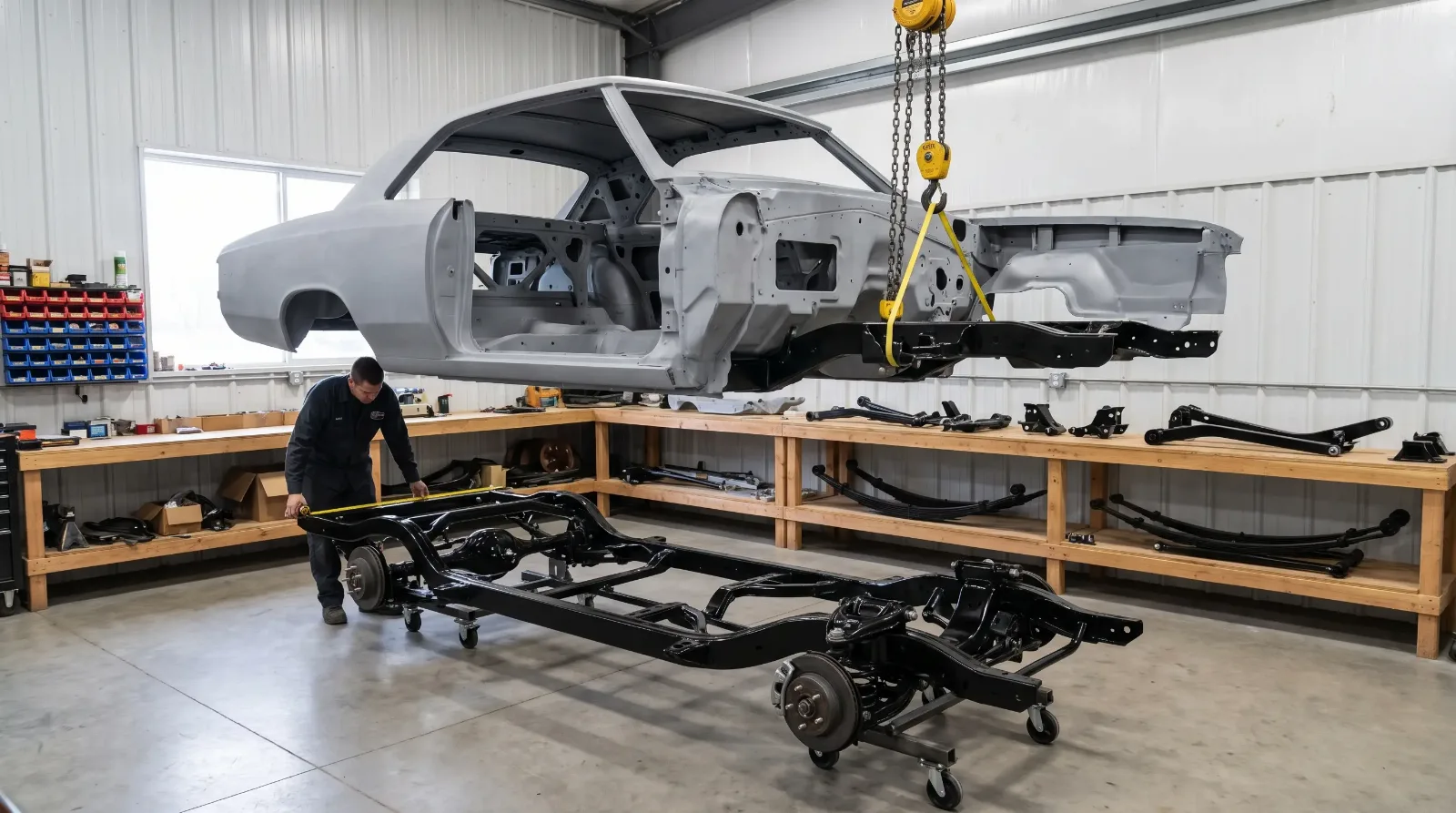
And it matters what type of car you have. A body-on-frame car is a separate shell that is lifted off the chassis. A unibody has no separate frame, so the whole structure is the body, and the terminology gets muddy. If your car is a unibody, see body-off vs frame-off for why the words do not line up neatly.
One more caution on mounting. Whatever the stand, the body should come off the chassis with every door, hood and deck lid fitted or removed in a planned way. Doors left on a shell that is rotating can sag and shift. Shops that do this well label the shims, mark the hinge positions and photograph the gaps before disassembly, so reassembly is a matter of following the record, not guessing.
Cost and when it makes sense
Expect the rotisserie stage to add labor on top of a standard disassembly. Shop rates for restoration commonly run from roughly $85 to $150 per hour in 2026, about $125 being typical, and marque or concours specialists charge $175 or more. A rotisserie-based body job adds many hours of work over a basic repair. For a common American classic at a professional shop, a complete rotisserie restoration is often quoted at about 1,200 to 2,500 hours and roughly $90,000 to $225,000, depending on the car, the rust and the finish you want.
It makes sense when you plan to do a full body-off job anyway, when the underside has real rust, or when you intend to compete in judged events. It makes less sense for a solid driver that needs paint, a mechanical refresh and some trim. In those cases, a car on a lift may do just as well for far less money.
"The stand does not do the work. It gets the work in front of you where you can do it right the first time."
Ray Delgado
Choosing between approaches
Whether to go this route is usually part of a larger question: lift the body, or work on the frame in place. Our comparison frame-off versus frame-on walks through how that decision usually shakes out, and a longer explainer on the same split goes deeper on cost and results.
When you talk to a shop, ask three things. Will the body go on a rotisserie, and for which operations? Who will brace it, and how will it be measured? And what happens if the shell turns out to need major structural repair? A shop that has run a rotisserie job before will answer quickly and in order. A shop that has not will tell you the stand is optional. Sometimes it is. Just make sure you know what you are skipping.
Sources and notes
- Tuxedo CR-3000 car rotator product page, 3,000 lb rating, jacks rated above the load for eccentric loading, 360-degree rotation with locking
- eBay Motors: What is a rotisserie restoration?, definition, removing engine, glass and loose parts before mounting, access benefits, a rotisserie is a tool and not a guarantee of quality
- Homebuilt car body rotisserie write-up, mounting brackets, gusseting and why build quality and safe use matter
- Wikipedia: Car restoration, full restoration involves complete disassembly, and often costs more than the finished car is worth
- Wikipedia: Unibody, body-on-frame versus unit construction, and unibody becoming common in passenger cars by the 1960s