
A work truck cab was never meant to be pretty. It was meant to hold a driver, a thermos and a pair of gloves, and then get hosed out on Saturday. That is exactly why a classic truck interior is the easiest part of a truck restoration to get right, and the easiest to overdo. Owners who bring car habits to a pickup cab end up spending sedan money on a room with one bench and a rubber floor.
Restoration & Tech
7 min read
Truck Interiors: Bench Seats, Rubber Mats and Simple Cabs
A classic truck interior is simpler than a car's. Bench seats, rubber mats and painted dashes: what to restore, what it costs in 2026, and where to stop.
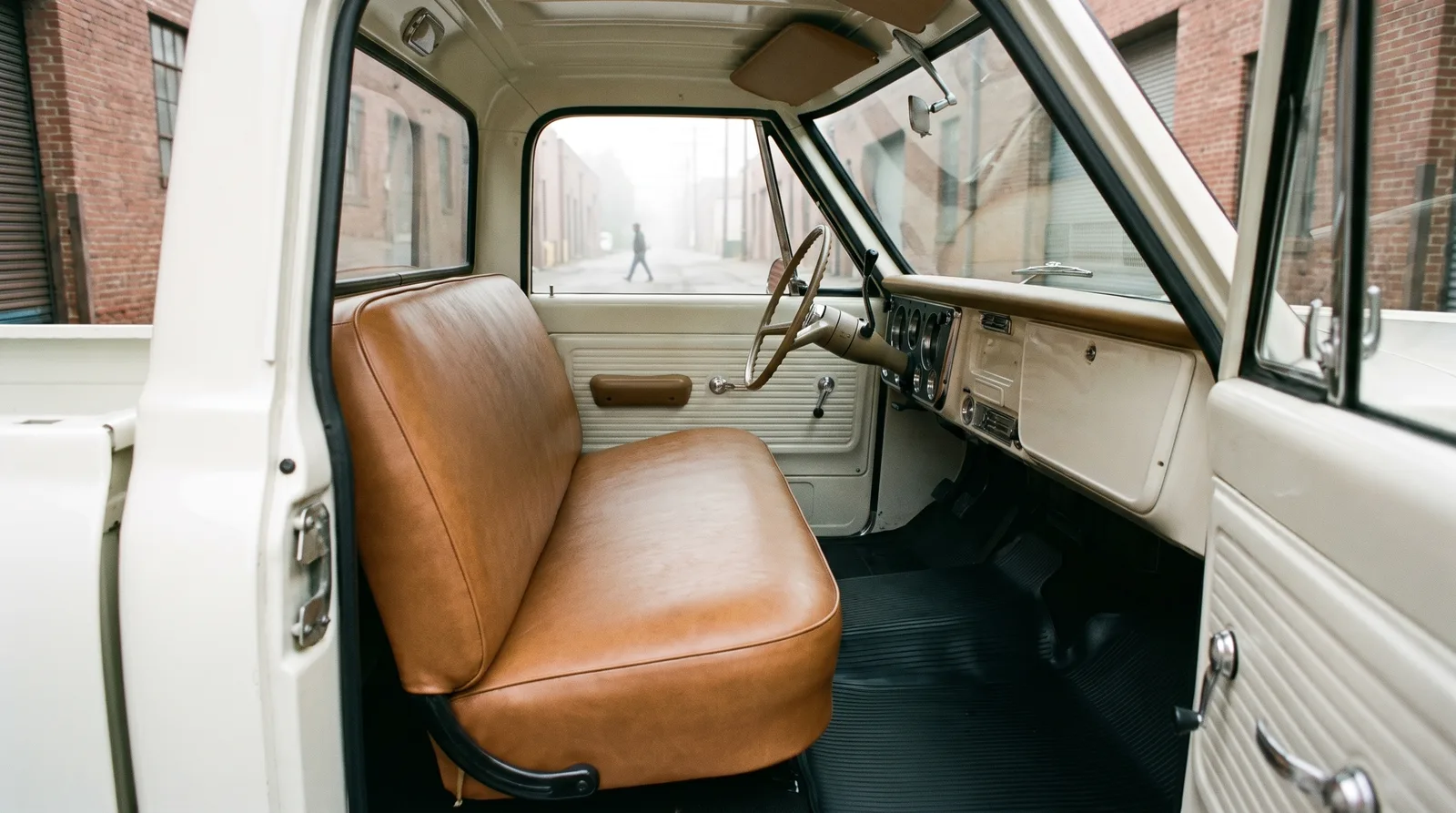
This is a practical walk through what a simple cab needs, what it costs in 2026 US dollars, and where to stop.
Decide what the truck actually was
Before you buy a single yard of vinyl, work out what your truck left the factory with. A base half-ton from the 1950s through the 1970s often came with a painted dash, a plain bench, a rubber floor mat and almost nothing on the doors. The upper trims added a headliner, carpet, door panels with trim and a nicer bench pattern. Restoring a base truck to a trim level it never had is the most common mistake I see, and it costs real money to build something that is wrong.
Look at what survived. Peel back the floor mat edge, lift the seat, check under the dash and behind the door cards for original color and material. The cab tells you more than any catalog does. If you want a broader grounding in how sequencing and budgeting work on a full car, our classic car interior restoration guide covers the process that trucks simplify.
Bench seats: frame, springs, foam, cover
A bench seat is four jobs stacked up. The frame, the springs, the padding and the cover. Most failures are in the last two, but the first two decide how long the work lasts.
Strip the old cover and look at the frame. Surface rust is fine. Cracked welds at the mounting points are not, and they are cheap to fix now and miserable later. Check the spring support, because a sagging bench on a truck is usually a broken or stretched spring and not tired foam. Replace foam with new, firm padding, and rebuild with correct burlap or webbing where the original had it.
For covers you have a choice. Ready-made upholstery kits are the right call on common trucks, because the pattern, grain and stitch spacing are already worked out. A reproduction bench cover for a popular truck lists at roughly $375 for a 1969 to 1970 Chevy or GMC pickup at a large parts house, with foam and labor extra. A custom job from a trimmer for a full bench costs noticeably more, often a four-figure job, and makes sense only when the pattern is rare or you want a modern material.
Rubber mats, not carpet
The rubber floor mat is the signature of a simple cab. It is also the single best reason to keep a truck interior honest, because the mat is cheap, correct and reproduced for most popular models. A new molded rubber mat for a 1967 to 1972 Chevy or GMC pickup lists at about $200 to $220 from the big reproduction suppliers. Lay it over the factory sound deadener or a thin jute layer if the truck had one, and never over bare wet steel.
Do the metal first. Floor pans are where cabs rot, because the mat held water against the steel for decades. Pull the old mat, scrape the floor to bare metal, treat rust, prime and paint before anything goes back. If you find holes, patch panels or full floor sections are the answer, and that is body work that belongs ahead of every interior purchase. A shop that handles this kind of job is worth a call; we keep a list of restoration shops for trucks and other body work.
| Interior item | Reproduction part (2026 listings) | Shop installed | Notes |
|---|---|---|---|
| Bench seat cover | About $375 for a 1969 to 1970 Chevy or GMC pickup bench, foam extra | Often a four-figure job with foam and labor | Kit for common trucks, custom for rare patterns |
| Rubber floor mat | About $200 to $220 for a 1967 to 1972 Chevy or GMC pickup | A few hundred dollars with floor prep | Fit over treated, painted floor |
| Headliner | Roughly a couple hundred dollars for a reproduction hardboard liner | A few hundred dollars | Trim levels only, base cabs had none |
| Door panels | Varies by truck and trim | Varies widely | Check whether your truck had them |
| Dash paint and gauges | Varies by truck | Varies widely | Paint match matters more than parts |
Dash, gauges and the small parts
A painted dash is the center of a simple cab, and most of them have been touched up in the wrong color at some point. Test with a hidden spot, such as under a lip, to find the original shade. Gauges on these trucks are straightforward. Clean lenses, check the sender wiring, and replace a failed fuel gauge sender before you replace the gauge. Many "dead" gauges on old trucks turn out to be a bad ground or a corroded connector.
Door handles, window cranks, the shifter boot and the pedal pads are the parts that make a cab feel original. Reproductions exist for most of them. Buy them last, after the paint is done and nothing is going to scratch them.
"A truck cab should look like somebody worked in it and kept it clean. If yours looks like a showroom, you went one step too far."
Robert Halloran
Where to stop
This is the part nobody wants to hear. Interior money does not come back on a truck the way paint and drivetrain money does. A fresh bench and a new mat on a solid, honest truck lifts the value. A custom leather interior in a base half-ton usually does not, and it can make a buyer wary. Keep the build period correct, keep it simple, and spend what you save on brakes, wiring and the frame.
If you are still deciding whether to build or buy, look at what the market offers. Browse classic trucks for sale to see how original cabs are priced against restored ones, and check how other builders handled theirs. The first-gen Camaro interior restoration shows a much more complex trim job, which makes it a useful contrast to a bare cab. For a very different philosophy, see how rat rod interiors get built from scraps.
Sources and notes
- Classic Industries, 1967-72 Chevrolet and GMC pickup rubber floor mat, reproduction rubber mat listed at $219.99, described as real rubber rather than vinyl
- OER, 1967-72 Chevrolet and GMC pickup rubber floor mat, same mat on the manufacturer's own site
- OPGI, 1969-70 Chevy and GMC truck bench seat upholstery, factory-style vinyl bench cover listed at $376.99
- Best practices for classic auto interior restoration, Legendary Auto Interiors, vinyl, leather and cloth options, original versus reproduction parts, and budgeting the interior with room for surprises
- Wikipedia, Ford F-Series (fifth generation), base Custom, Sport Custom and Ranger trim levels
- Wikipedia, Chevrolet C/K, carpet and other sedan-style options added to pickups in later generations
Related Reading
Have a
Classic Car
for Sale?
Reach thousands of serious classic car collectors across the US.
Sell It Here →
Selling a classic? Here's how: compare the places to sell classic cars
Are You a Classic Car Dealer?
List your full inventory and connect with targeted classic car buyers.
Join as a Dealer →

About the author
Robert Halloran
Texas-based classic truck enthusiast with decades of experience buying, restoring, and writing about American pickups from the 1940s through the 1980s.
More in Restoration & Tech
Comments
Be the first to comment on this article.