
A part is worth what the next person will pay for it, and nothing else. That sentence explains most of the confusion around NOS pricing. A new old stock part for a car that was cheap when new can cost far more than the same part cost in its day, and a rare trim piece can cost a surprising amount. Buyers are often shocked. The shock is understandable and mostly misplaced, because the price reflects supply, not the original sticker.
Restoration & Tech
7 min read
NOS Prices: Why a Part Can Cost More Than the Car Did
New old stock prices follow supply, condition, packaging and demand, not the original sticker. Learn what drives NOS value and when paying the premium makes sense.
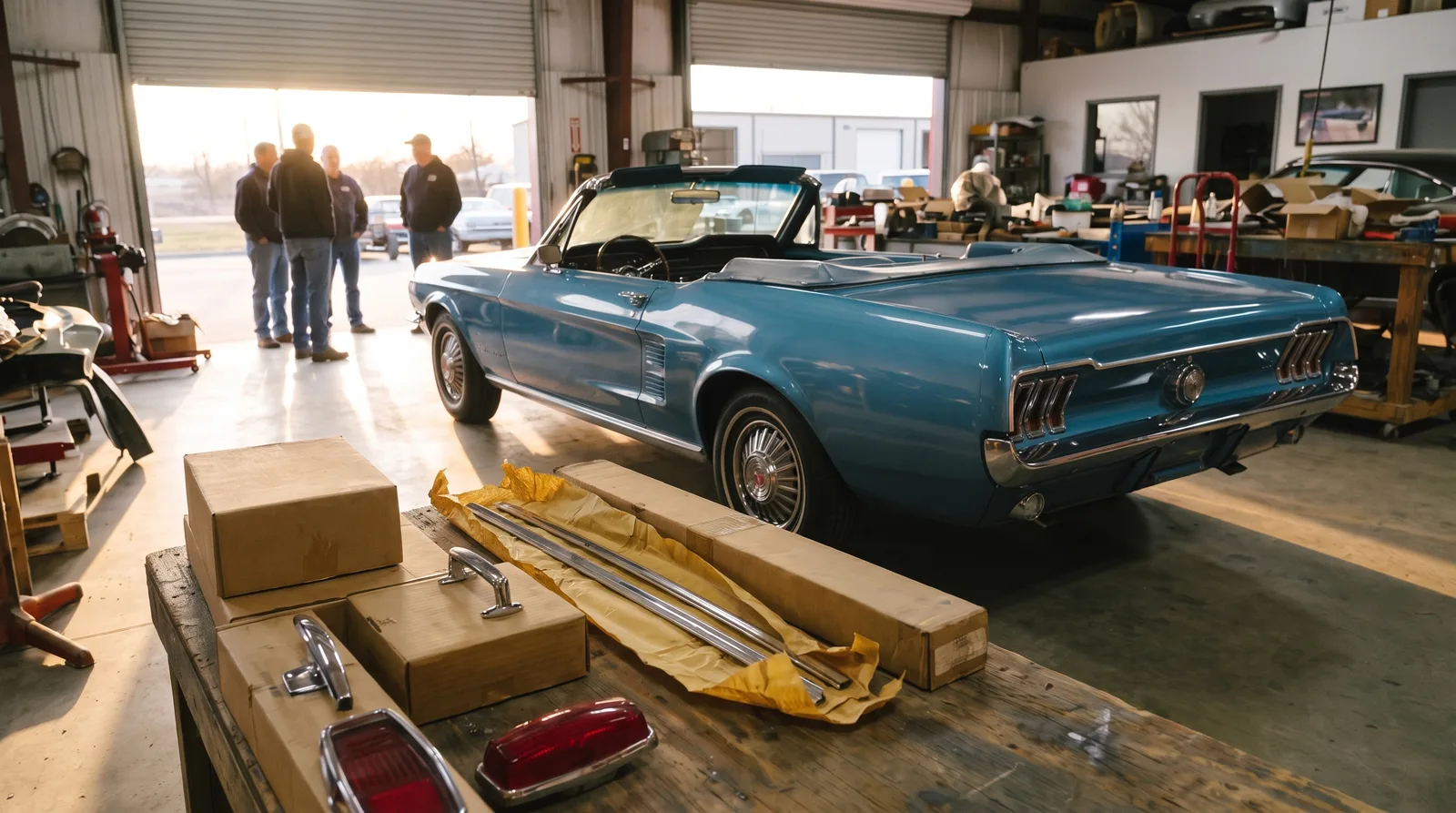
If you are budgeting a restoration with classic restoration parts, it helps to understand what is driving those numbers and when paying them is sensible. First, a short definition. If you are not sure what NOS means, our explainer covers the term. In short, it refers to an original part, made in the period, that was never installed on a vehicle.
Why supply is the whole story
Production of any part ended when the model did, or soon after. Dealers and warehouses held stock for a number of years, then cleared it, scrapped it or sold it off. Whatever survived in a box on a shelf is what the market has now, and that pool shrinks every year as parts are bought and installed. Nobody is making more of it, which is the opposite of the situation with a reproduction. Reproductions keep coming: Ford, for example, has licensed a catalog of more than 9,000 restoration items, and OER is licensed by GM and Chrysler Group for its parts. That is why an NOS part often costs several times what a reproduction of the same part does.
Demand moves the other way. A model with a strong following, such as a popular muscle car, pulls many buyers toward a small number of parts. A model with few fans has little demand, so NOS parts can be oddly cheap. The same part number can cost very different amounts depending on which car it fits.
What buyers actually pay for
A buyer of an NOS part pays for four things: authenticity, condition, documentation and scarcity. Authenticity means the part is original and correct for the year and trim. Condition covers the box, the finish and the absence of corrosion or storage damage. Documentation means original packaging, part number labels and, sometimes, a story that holds up. Scarcity is simply how many exist.
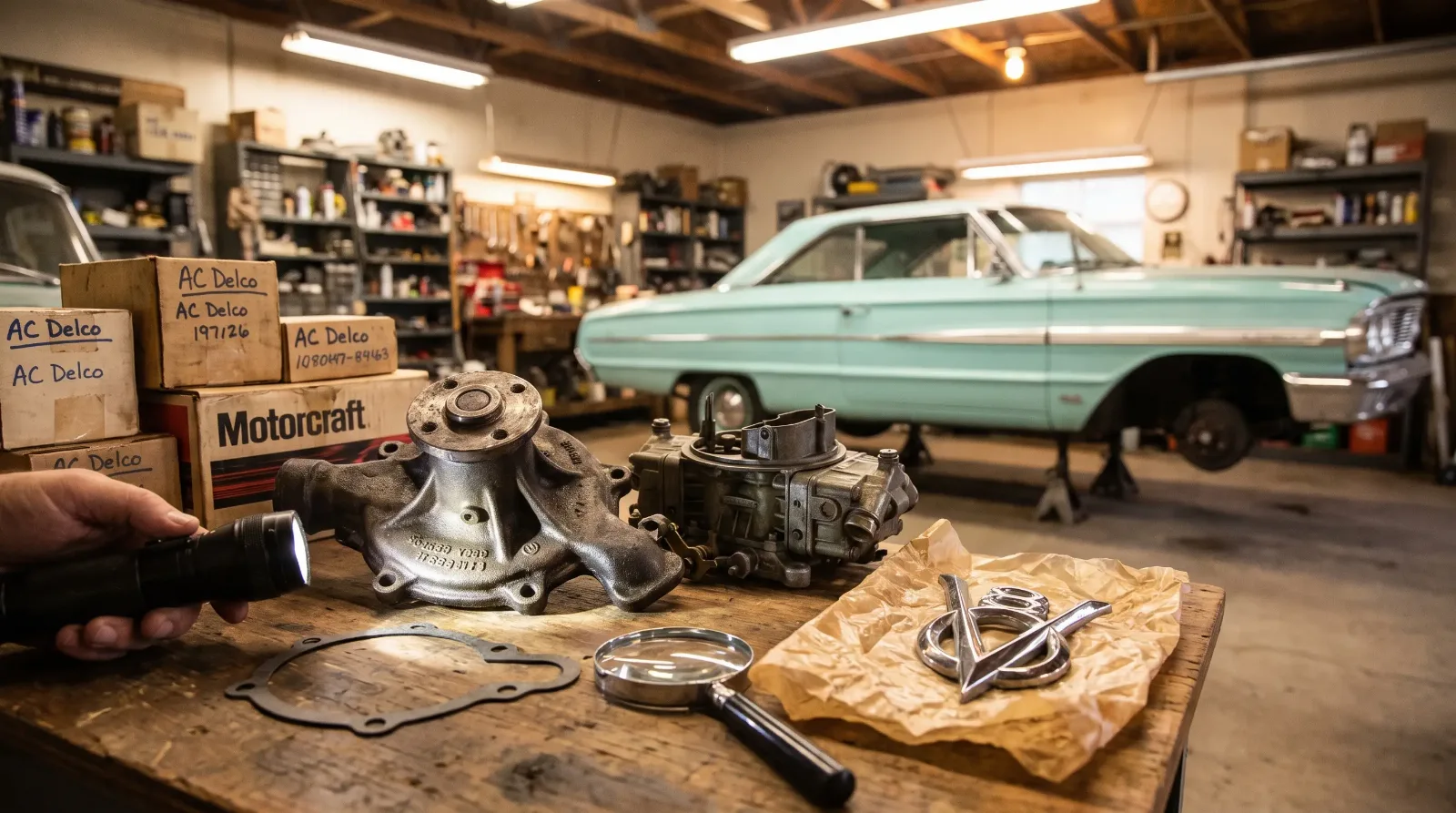
An original box with the correct part number label can add a meaningful premium, since it supports the claim that the item is what it says. A part without its box may sell for much less, even if it is the same piece. A part in rough or rusted condition, though technically new old stock, is often called NOS in a listing, and the label can mislead. Look at the item itself.
| Part type | Typical price level | What moves the price |
|---|---|---|
| Common gaskets and small hardware | Lowest of the four | Brand, packaging, quantity |
| Mechanical parts such as pumps | Moderate | Model popularity, box |
| Chrome trim and lenses | High | Rarity, condition of finish |
| Rare body or interior pieces | Highest, and often well beyond a reproduction | Only a few known, high demand |
The fake and the misdescribed
High prices attract bad actors, and the market has plenty of items sold as NOS that are not. Common problems include reproductions placed in old boxes, used parts cleaned up and repackaged, and parts with the wrong part number for the year. Some sellers are honest and simply mistaken. Others are not.
The best protection is to learn your part. Compare it against an original in hand, against the factory parts catalog, and against photographs from a reliable owner organization. Ask the seller for clear photographs of date codes, stamps, part numbers and the underside of the piece. If a seller refuses, treat that as an answer. Pay with a method that provides recourse, and confirm the return policy before you buy.
When paying the premium makes sense
The question to ask is whether an NOS part solves a problem that nothing else solves. Consider paying up in three situations. First, the part is highly visible and judged, and the car is a concours candidate. Second, no good reproduction exists, so the choice is NOS, a used piece or nothing. Third, fit and function matter more than cost, as with a part where reproductions are known to be poor.
In other cases, a quality reproduction or a restored original will do the job for a fraction of the price. If the car is a driver, an NOS water pump is a luxury, not a necessity, and the money is better used elsewhere. That is the line that separates a smart buy from a vanity purchase.
Fitting it into the budget
NOS parts can swallow a budget fast, and the usual mistake is to buy them early, in a burst of enthusiasm, before you know what the whole job costs. Rank the parts you need by importance and visibility, set a ceiling for each, and keep a separate line in the budget for hard to find items. For a broader view of how parts costs fit into the whole job, read what parts add to a restoration, which breaks down where the money goes.
Your plans also change what you can afford to chase. A show car justifies more spending on originality than a weekend cruiser does. Be honest about which one you are building, because the answer shapes every purchase.
"A part has a value when somebody pays it, and a price when somebody asks it. Know which one you are looking at."
Marcus Feld
Protecting your purchase
Once you have bought an NOS part, record what you paid, where it came from and what documentation came with it, and store it carefully. Keep it in its original box when possible, dry, and away from heat. Do not open sealed packaging unless you need to inspect, and photograph it first. If you decide to install it, that is a one way step, because installation ends its status as unused.
Finally, get quotes before the work begins. Labor can matter as much as parts, and it helps to price a job with a local shop so that a pricey part does not get paired with a surprise bill for installation. Some shops will advise whether a given piece is worth the premium, and a shop with experience on your model can often point you to a better source.
The conclusion is a cool one. NOS prices are high because the supply is finite and the buyers are motivated. Pay when the part earns it, skip it when it does not, and verify everything before the money moves.
- Verify part numbers against the factory catalog before purchase.
- Ask for photographs of stamps, date codes and the box.
- Set a ceiling for each part before you start shopping.
Sources and notes
- New old stock (Wikipedia), definition of NOS, no fixed age standard, premium over reproductions
- AutoGuide: Ford boosts restoration parts inventory for older models, Ford's licensed catalog of more than 9,000 items and retained master samples
- OER: history of OER, licensing by GM and Chrysler Group for reproduction parts
- Dynacorn Classic Bodies, new licensed replacement body shells (a maker's own statement)
- MGOC Spares: extending the life of rubber parts on your classic, rubber degrades with age, so age is the main guide
Related Reading

Have a
Classic Car
for Sale?
Reach thousands of serious classic car collectors across the US.
Sell It Here →
Selling a classic? Here's how: the best sites to sell a classic car
Are You a Classic Car Dealer?
List your full inventory and connect with targeted classic car buyers.
Join as a Dealer →

About the author
Marcus Feld
Accredited collector-car appraiser who reads the market through hammer prices, condition tiers and risk.
More in Restoration & Tech
Comments
Be the first to comment on this article.