Ask three shops for a frame-off restoration on a unibody car and you may get three different jobs. The trouble is the words. Body-off and frame-off came from the era of separate frames, and they stop meaning the same thing when the car has no separate frame to take the body off of.
This guide sorts out the terms so you can read a quote correctly. It sits alongside our overview of the levels of restoration, which describes where each approach fits on the larger scale.
Where the terms came from
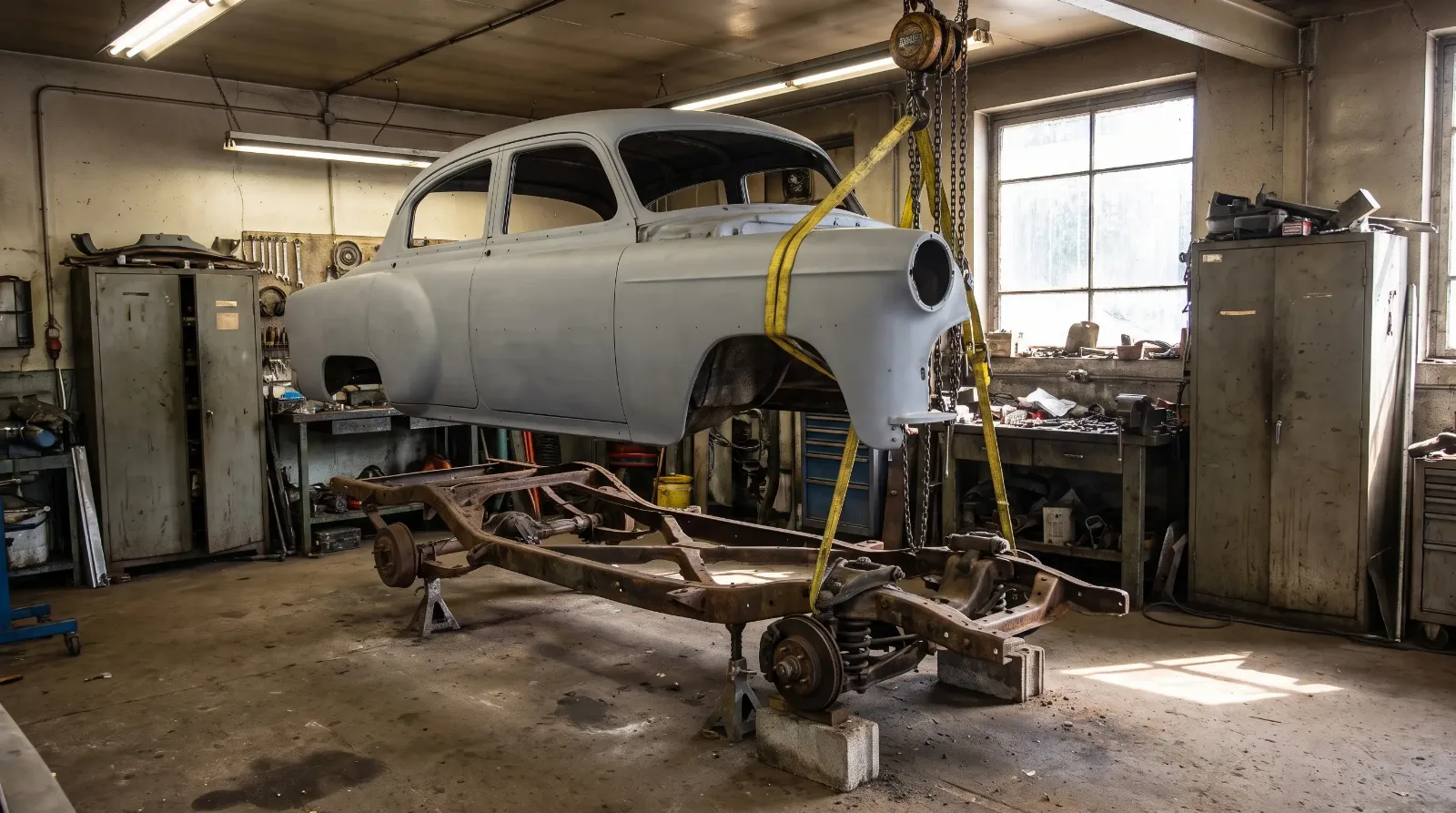
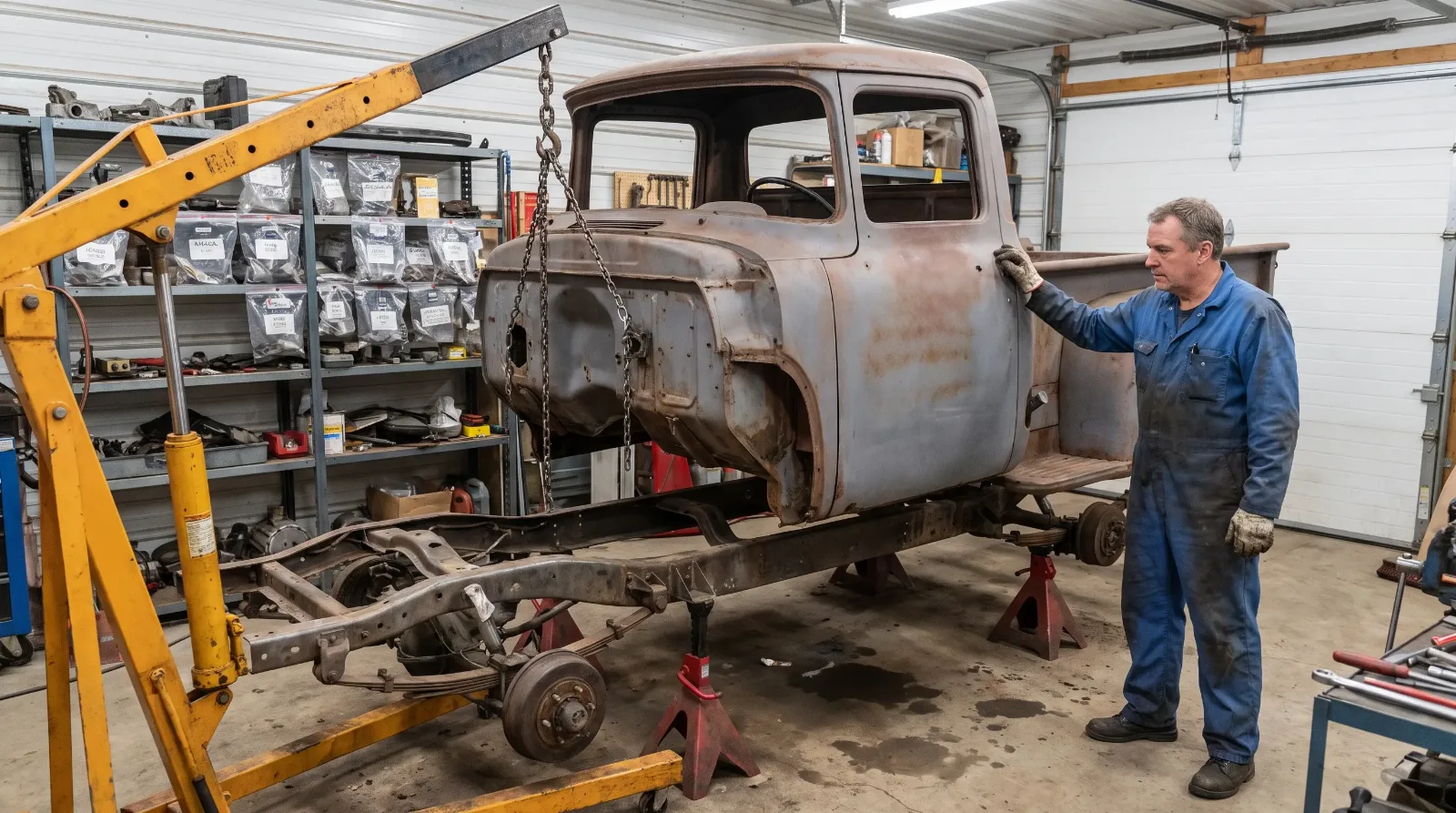
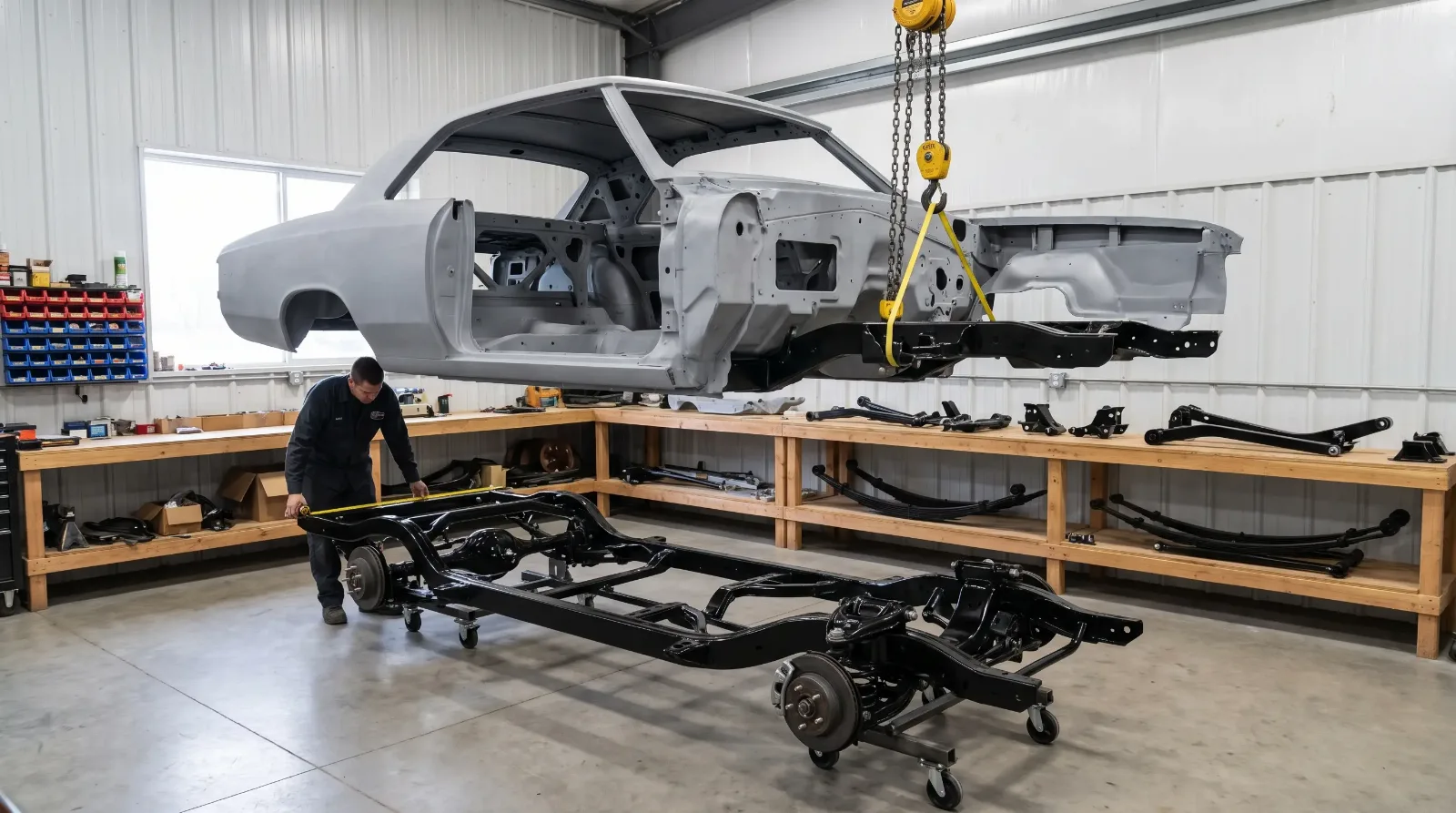
On a traditional body-on-frame car, the chassis is a ladder-style steel frame with the engine, suspension and driveline bolted to it. The body is a separate shell bolted on top, usually with body mounts and rubber or fiber pads. To take the body off, you unbolt it at the mounts, disconnect wiring, fuel, brake and steering links, and lift the shell clear. What is left is a rolling chassis. Both terms describe this same event from two angles. Body-off means the body is lifted from the frame. Frame-off means the frame is separated from the body so each can be restored independently.
On a body-on-frame car, the two phrases are close to interchangeable, and a shop that says either one means the same job. Most American cars before the 1960s were built this way, and many full-size cars and trucks kept a separate frame for decades after, with the last Ford Panther sedans (Crown Victoria) built until 2011 and pickups still using frames today.
Why unibody breaks the vocabulary
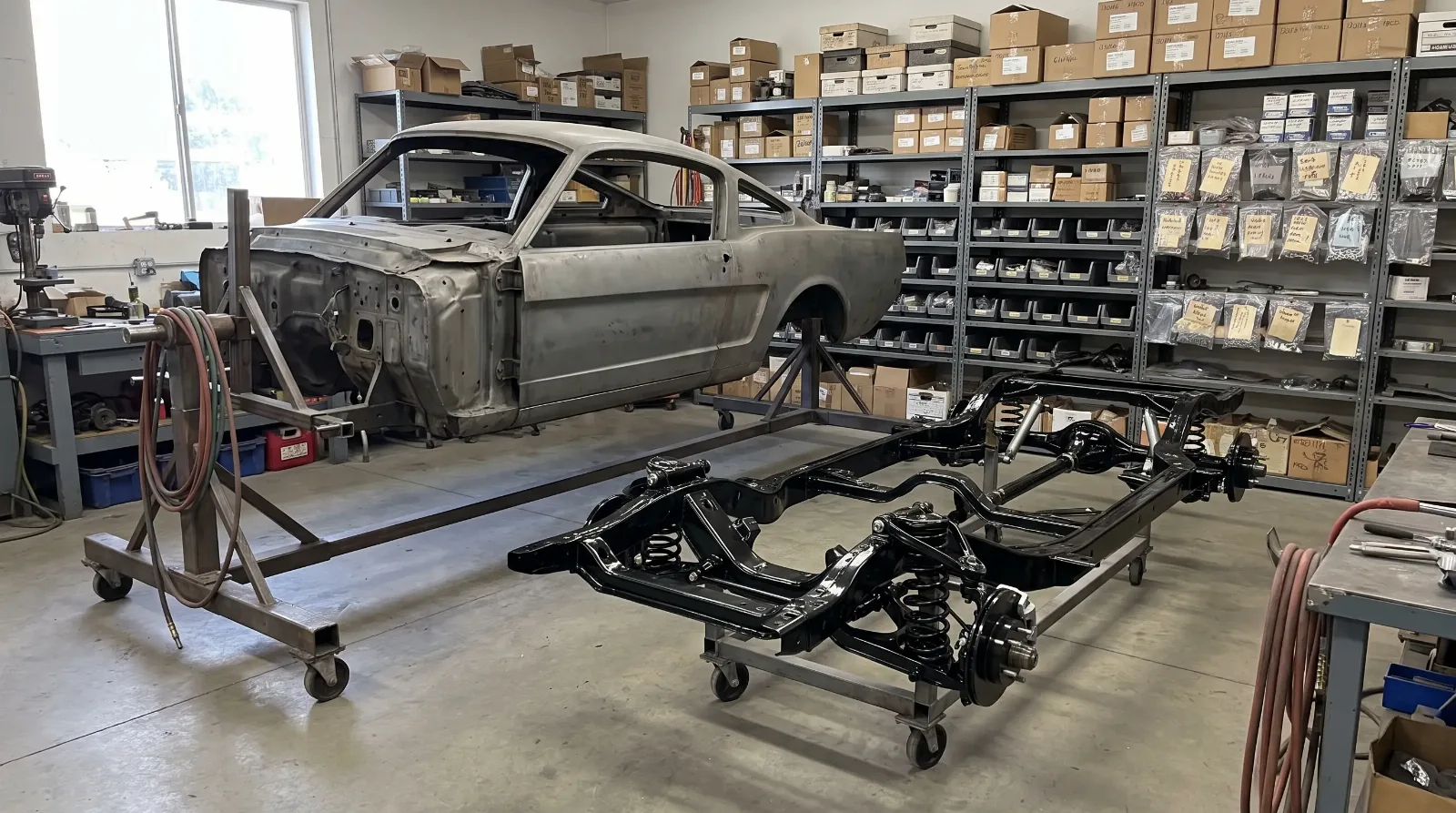
A unibody car, short for unitized body, combines the body and the structure into one welded shell. There are rails and crossmembers, but they are part of the body, not a separate frame. Detroit's compacts adopted the construction by 1960 (Falcon, Valiant, Corvair), and many classic cars use it, from small imports to a wide range of later domestic models. A first-generation Mustang, for example, is unibody, built on a unitized platform derived from the Falcon.
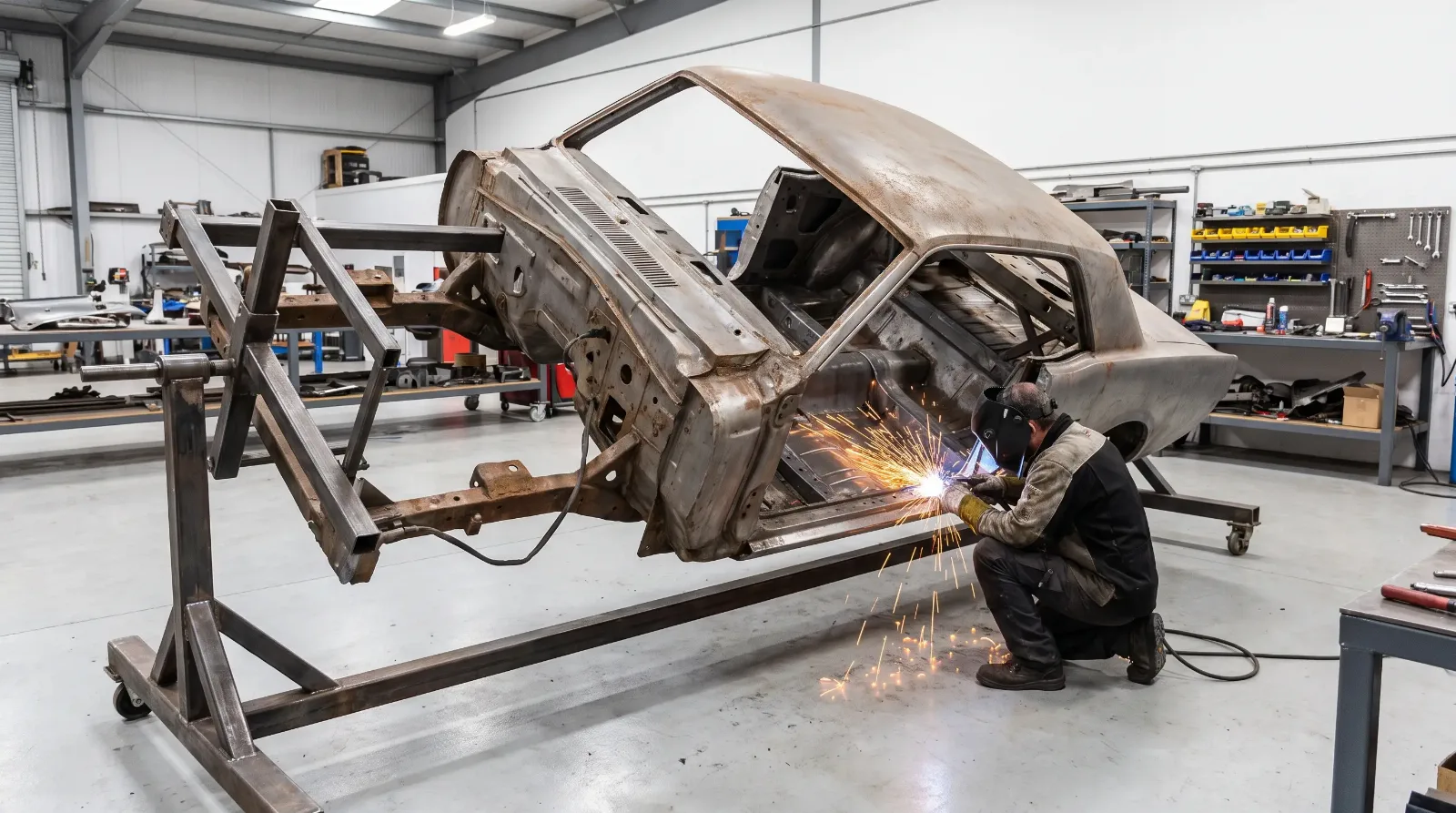
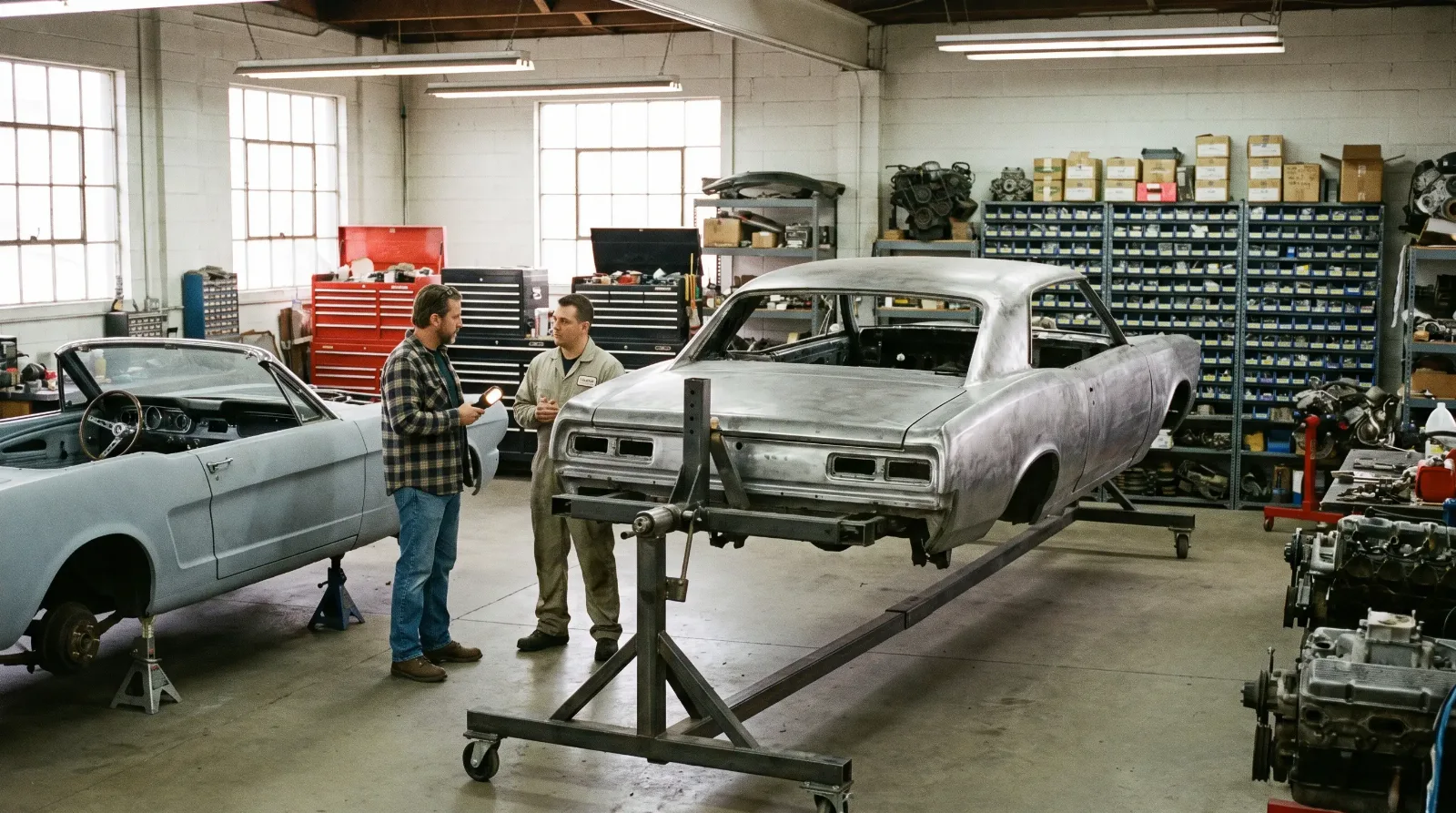
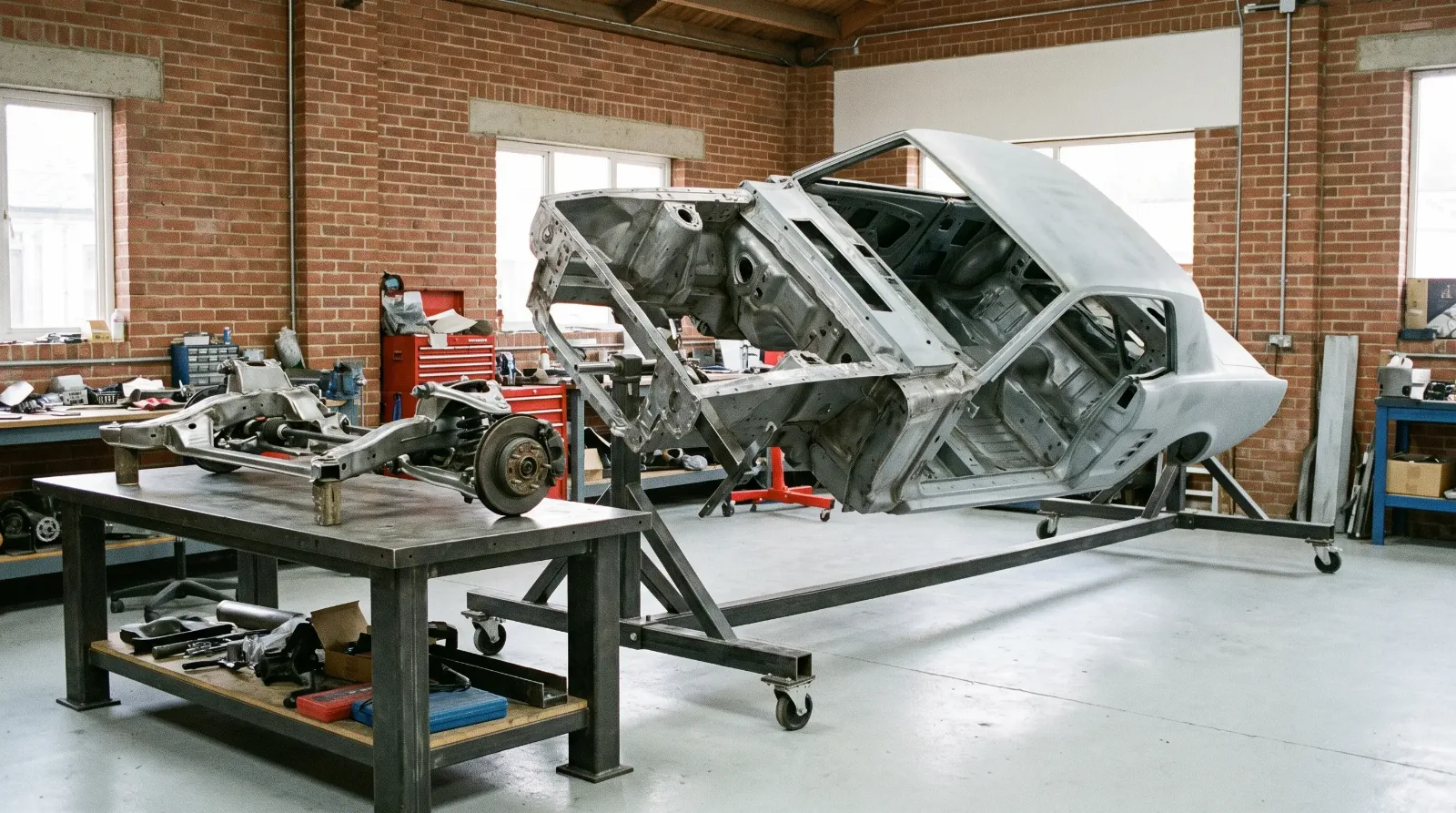
So what does frame-off mean when there is no frame? Strictly, nothing. What shops usually mean is that the car is taken down to a bare shell, with the drivetrain, suspension, subframes and every component removed, so the shell itself can be stripped, repaired and painted. Some people call this a body-off restoration, though there is no body to take off. Others call it a rotisserie restoration, after the stand that holds the shell. Still others say frame-off for the sake of familiarity.
| Term | On a body-on-frame car | On a unibody car |
|---|---|---|
| Body-off | Shell lifted from the chassis | No true meaning; loosely, a full strip to a bare shell |
| Frame-off | Frame separated, restored on its own | Loose shorthand for the same full strip |
| Subframe-off | Rare | Front or rear subframe unbolted and restored separately |
| Rotisserie | Body mounted on a rotating stand | Shell mounted on a rotating stand |
The pieces that do come off a unibody
Unibody cars are not all one piece. Many have bolt-on front subframes that carry the engine and front suspension, and some have a rear subframe or a separate rear suspension cradle. These can be unbolted and restored independently, which gives you a partial equivalent of a frame-off. When a shop says it will pull the subframe, that is a concrete, checkable task.
So the useful question is not whether a job is body-off or frame-off. It is what comes off and what stays on. Does the glass come out? Is the wiring harness removed? Is the shell stripped of paint and seam sealer to bare metal? Is the underside coated afterward? Those are the details that decide the price.
Terminology also drifts by region and by shop. A builder who works mostly on trucks and full-frame cars may use body-off for every job out of habit, while a muscle car shop may say frame-off about a Camaro, which is built with a front subframe and a semi-unibody structure. Neither is lying. They are using a word that stopped fitting the car decades ago, and nobody updated it. Your job is to translate it into a work list.
Here is a quick way to do that. Ask the shop to name the last unibody car it did under that label, and what was removed. Then ask whether the job includes pulling the front subframe, stripping the shell to bare metal, and refinishing the inside of the rockers and the cowl. Each yes is a labor block, and each no is a place where the final car will differ from what you pictured.
How to read a quote
Because the terms are slippery, make the shop spell the work out in writing. Look for a line that says what is removed, how the paint is stripped, whether the shell is mounted on a stand, and what happens to the underside and inner panels. A quote that says only frame-off restoration, with no breakdown, leaves too much room for different assumptions.
Compare quotes line by line, not by label. One shop may be pricing a full strip and rotisserie job. Another may be pricing a standard repaint with the suspension dropped. They can both call the work frame-off and be separated by tens of thousands of dollars, since frame-off work on a common American classic runs roughly 1,000 to 2,000 shop hours against a few hundred for a driver-level repaint.
It also helps to know the next step on the ladder. A restoration where every fastener is removed, cleaned or replaced and every part is individually restored goes by another name, and the details are in our guide to nut-and-bolt restoration.
"If the quote says frame-off on a unibody, ask what that means in parts on the bench. The answer tells you what you are buying."
Ray Delgado
Where to go from here
If you are still deciding between lifting the body or working with it in place on a car that has a frame, our article frame-off versus frame-on covers the tradeoffs, and this plain-language explainer goes through typical costs and results.
The short version is simple. On a body-on-frame car, body-off and frame-off mean the same event. On a unibody, treat them as loose shorthand, and make everyone commit to a list of what comes apart. Words are cheap. A parts list is not. Get it in writing, with photos at each stage, and the term on the cover page will matter a lot less than the work behind it.
Sources and notes
- Unibody, Wikipedia, definition of unitized construction and the 1960 Falcon, Valiant and Corvair
- Body-on-frame, Wikipedia, separate-frame construction and its later use in trucks and full-size cars
- Chevrolet Camaro (first generation), Wikipedia, subframe and semi-unibody design
- The Ford Falcon flew high for a while, Classic Industries, the Falcon as a unibody car launched in 1959 and its chassis shared with the early Mustang
- Are any cars still made with body-on-frame? SlashGear, the Crown Victoria as the last body-on-frame passenger car, ended in 2011, and body-on-frame surviving in pickups and SUVs
- What is frame-off restoration? Wilson Auto, the body lifted off the frame and the car taken down to the bare frame