
Two cars carry almost the entire weight of Ford's early history. The first is the Model T Henry Ford introduced on October 1, 1908, a light, high, plain machine that stayed in production in the United States until late May 1927 (Highland Park stopped on May 26; branch plants finished days later), and passed 15 million built. The second is the Model A, a 1928 to 1931 car designed in a hurry to replace it, which sold nearly 5 million more in about four years. Read together, the two cars describe one company learning what mass production could do, and then learning what it could not.
Car Features
16 min read
Ford Model T and Model A: The Complete Story of Henry Ford's Cars, 1908 to 1931
From the 1908 Model T to the last Model A: how Henry Ford's two great four-cylinder cars were designed, built, sold and replaced.
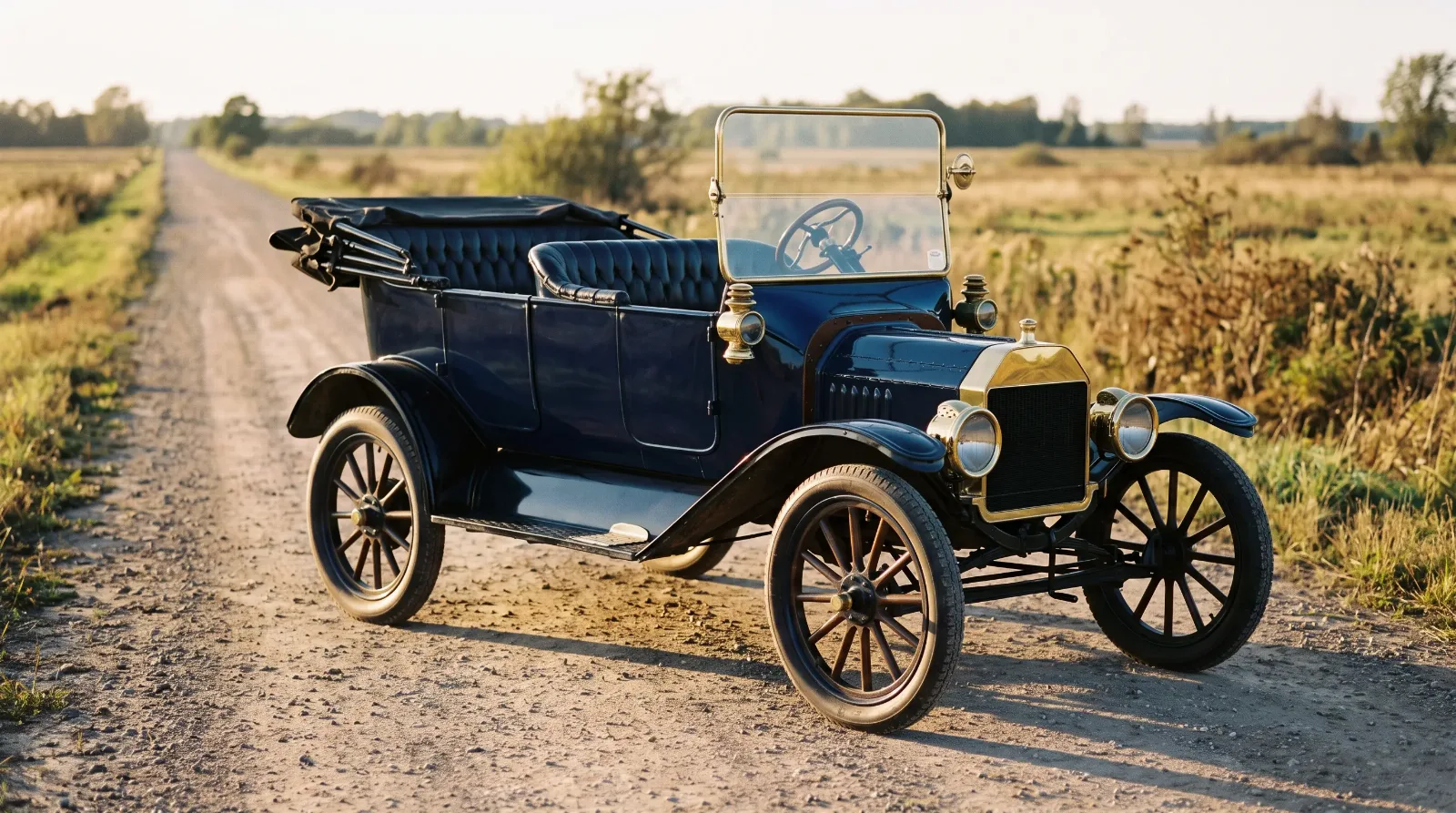
This is the long version of that story, written the way a researcher reads a car: by its dates, its parts and the evidence it leaves behind. The aim is to give every later article on these two Fords a fixed frame to hang from, so the numbers here come from production records and period documents, and the places where the sources disagree are said out loud.
Before 1908: the road to the Model T
Henry Ford was born on July 30, 1863, on a farm in Greenfield Township, Michigan. His first car, the Quadricycle, was finished and test-driven on June 4, 1896. Ford Motor Company followed seven years later, incorporated on June 16, 1903, reformed out of Ford & Malcomson with $28,000 in capital.
The company's first production car was also called the Model A, and that is the first source of confusion for anyone cataloguing Fords. The 1903 to 1904 Model A was a small runabout with a flat-twin engine of about 8 hp and a base price of $750; roughly 1,750 were built, and the first was sold in mid-July 1903 to a Chicago dentist named Ernst Pfennig. It has nothing in common with the 1928 Model A beyond the letter. Ford reused letters freely in those years, working through models lettered from A through S before the T appeared, which made the Model T the company's ninth production model and the first one built for a mass market.
Two of those earlier cars matter to the T's story. Ford's interest in vanadium steel began in July 1906, when he visited the United Steel Company in Canton, Ohio, with the consultant metallurgist J. Kent Smith. The alloy was lighter and stronger than ordinary carbon steel, and Ford first used it on the 1907 Model N. By the time the T was on the drawing board, the company already knew how to buy, specify and machine the material.
Why the Model T Henry Ford built in 1908 was different
The Model T was designed by a small group. Joseph Galamb, a Hungarian engineer who had joined Ford in December 1905, was the main engineer; Childe Harold Wills, Ford's chief designer and metallurgist, is credited with the planetary transmission and the detachable cylinder head; Eugene Farkas worked alongside them. Several other names appear in the company's records, among them Peter E. Martin, who later ran production. The car they produced was built around four ideas, and each can still be seen on a surviving example.
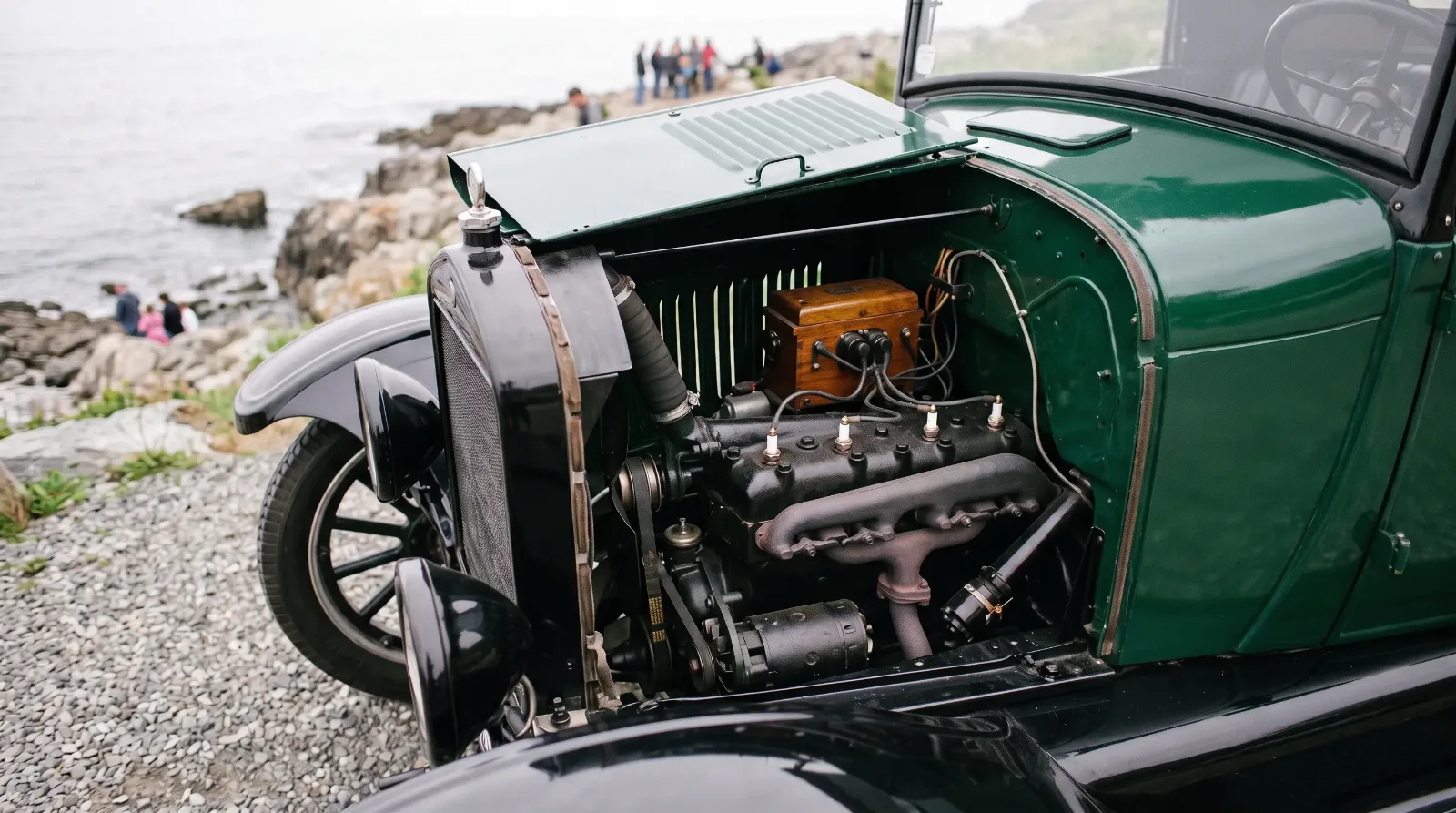
The first was the engine: a 177 cubic inch (2.9 liter) side-valve four, rated at 20 hp, with a top speed of about 40 to 45 mph depending on body and gearing. The second was the transmission, a planetary unit with two forward speeds and reverse, worked by foot pedals and called a "three speed" at the time. The third was ignition by a low-voltage flywheel magneto, which meant a car without an electric starter needed no battery at all. The fourth was the chassis: a 100 inch wheelbase, a curb weight of roughly 1,200 to 1,650 lb, a drop-forged vanadium front axle and a single transverse leaf spring at each end, a layout meant for the unpaved dirt roads that made up most of rural America.
The price did the rest. At launch, the touring car cost $850 and the runabout $825, when most cars of the day cost $2,000 or more. Five body styles were offered for the 1909 model year: touring, runabout, coupe, town car and landaulet. They were not black. Early cars came in gray (mostly runabouts), red (mostly touring cars) and green (town cars and landaulets), and red was dropped after June 1909.
The first production car was completed at the Piquette Avenue plant in Detroit on September 27, 1908, and sold as a 1909 model. Output was slow at first: only 11 cars were built in the first full month. Roughly 12,000 Model Ts were made at Piquette before Ford moved production to the new Highland Park plant, where most work had shifted by January 1910.
Highland Park, the moving line and the five-dollar day
The Model T's early price cuts came from volume. The large ones came from the moving assembly line, which Ford introduced at Highland Park in stages. The first moving line, around April 1, 1913, built flywheel magnetos: a worker who had needed about 20 minutes to assemble one at a bench took about 13 minutes on the first line and about 5 minutes once it was tuned. The method then moved to the chassis. A trial in August 1913 cut chassis assembly from 12.5 hours to just under 6; by October it was about 3 hours, and by early 1914 the labor per chassis was 93 minutes.
The date of the moving chassis line is one of the small arguments of Ford history. Many sources give October 7, 1913. The museum curator's account records the August 1913 trial, and another source places full implementation on December 1, 1913. All three are true in their way: the line was rolled out over months, not switched on in a day.
The line made the work faster and also made it harder to keep people doing it. Labor turnover at Highland Park was around 370 percent in 1913. Ford's answer, announced on January 5, 1914, was the five-dollar day: qualifying production workers went from $2.34 for a nine-hour day to $5 for an eight-hour day. It was structured as profit-sharing, not a simple raise; a worker kept his base wage and earned the balance as a bonus if he met the company's conditions.
Output and prices moved in opposite directions. Using the Nevins and Hill figures for Ford cars built in the United States, production rose from 10,202 in Ford's 1908 to 1909 fiscal year to 308,162 in 1914 to 1915 and 734,811 in 1916 to 1917, while the runabout fell from $825 to $440 in 1914 and $345 in 1916. In 1914 Ford built more cars than all other automakers combined.
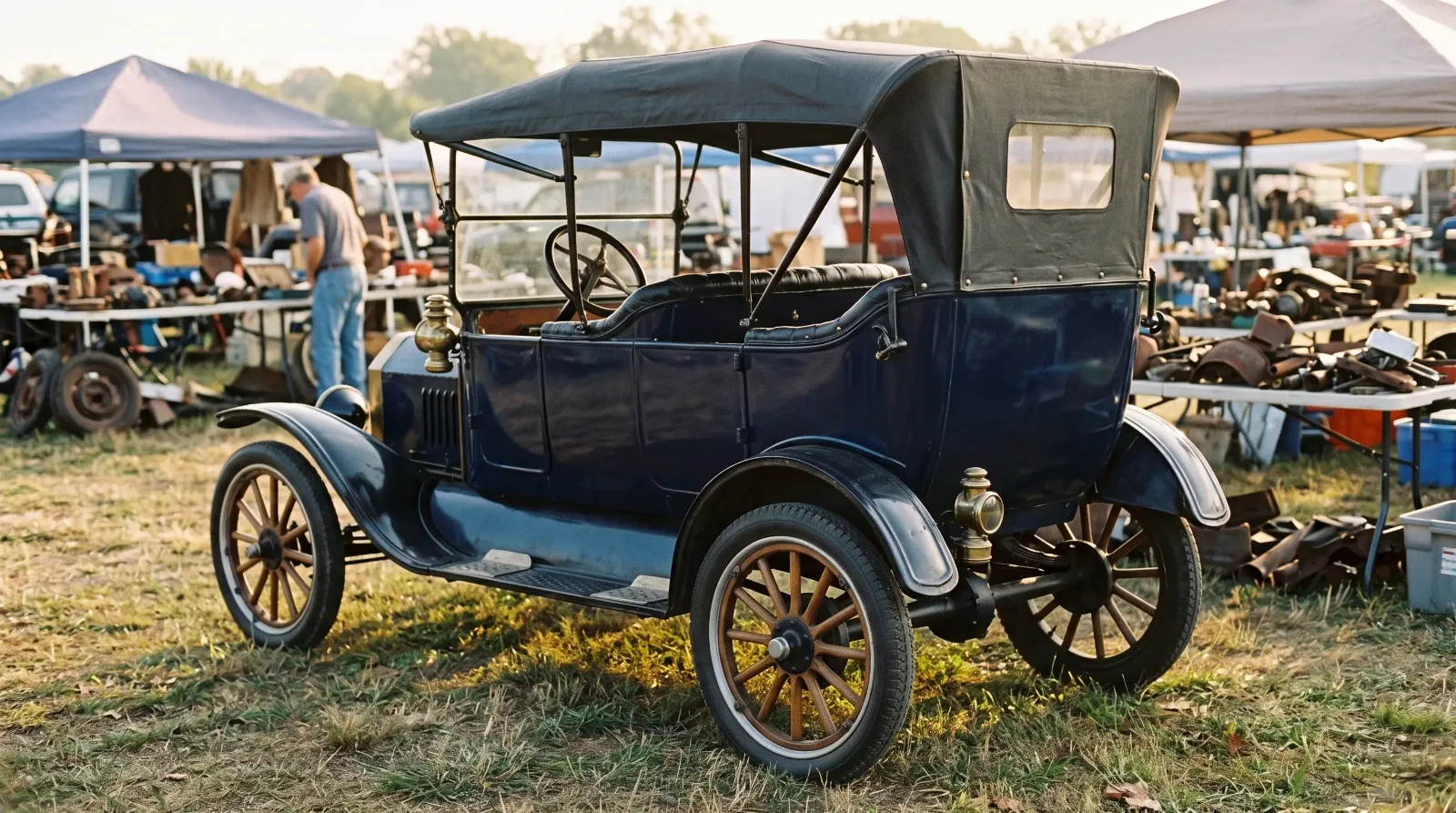
Paint followed the logic of the line. By 1912 every car was midnight blue with black fenders, and from about 1914 to 1925 the Model T was offered only in black. More than 30 types of black paint were used on different parts. The popular explanation is that black dried fastest; the better-documented reasons are its low cost and the durability of gilsonite-based black enamel, and the drying-time story should be treated as tradition rather than fact.
"The moving line is usually told as a story about speed. The cars tell it as a story about sameness. A 1915 Model T is valuable to a researcher precisely because thousands of others were made to the same pattern, so every departure from it, a part, a finish, a fastener, means something."
Sarah Whitfield
How the Model T changed the country
The United States had about 8,000 motor vehicles in 1900 and about 2.5 million cars on the road by 1915. The Model T was the largest single reason for the jump, and the effects reached well past the garage. The Lincoln Highway Association formed on July 1, 1913, to plan a coast-to-coast road, and on July 11, 1916, Woodrow Wilson signed the Federal Aid Road Act, which put $75 million in matching funds over five years into rural post roads. Roads were being built for cars that farmers could afford, and the most affordable car was a Ford.
The car was also adapted for work it was never designed to do. Kits such as the Smith Form-a-Tractor, advertised in 1917 with the line "$255 and a Ford", and the Pullford kit from Quincy, Illinois, turned a Model T into a light farm tractor. In 1917 Ford added the Model TT, a one-ton truck on a heavier, longer Model T chassis, priced at $600 as a bare chassis.
The war in Europe put the car in uniform. The first 10 ambulances of the American Hospital at Neuilly were Model Ts built and donated by Ford's French plant in 1914, and Ford later built 5,745 military ambulances for the Allied powers and 107 for the Red Cross. In Britain, the Trafford Park plant in Manchester began building Model Ts in 1911; by 1913 the T was Britain's best-selling car, with 30 percent of the market, and about 150,000 were built there in total.
The car kept changing in small ways. The 1917 model year, built from August 1916, brought the black-painted radiator shell, crowned and curved fenders and the end of most brass trim, the line collectors use to divide "Brass T" from "Black T" cars. Electric lighting arrived in 1915, and the electric starter came for the 1919 model year, first on the sedans along with demountable rims; on open cars it was a $75 option. The magneto stayed, so a T without a starter still needed no battery. The 10 millionth Ford, a Model T, was photographed on June 4, 1924, and by the early 1920s more than half the registered cars in the world were Fords.
| Item | Model T (1908 to 1927) | Model A (1928 to 1931) |
|---|---|---|
| Engine | 177 cu in side-valve four | 200.5 cu in (rounded to 201) L-head four |
| Rated power | 20 hp | 40 bhp at 2,200 rpm |
| Transmission | Two-speed planetary, pedal-operated | Three-speed sliding-gear manual |
| Ignition | Low-voltage flywheel magneto | 6-volt battery, generator, coil and distributor |
| Brakes | Transmission band on the right pedal; hand lever on rear drums | Four-wheel mechanical drums, rod-operated |
| Wheelbase | 100 in | 103.5 in |
| Weight | About 1,200 to 1,650 lb | About 2,265 to 2,465 lb |
| Top speed | About 40 to 45 mph | About 65 mph |
| Price range | $850 (1909 touring) down to $260 (1925 runabout) | $385 roadster up to about $1,400 town car |
| Total built | More than 15 million | Nearly 5 million (4,858,644 in one count) |
The long decline, 1923 to 1927
The peak came in 1923, with 1,817,891 Ford cars built in the United States by the Nevins and Hill count. Ford's own production department, counting trucks as well, put the 1923 Model T figure at over two million. Either way, it was the high point. In 1925 the company was building 9,000 to 10,000 cars a day, and the runabout reached its all-time low price of $260.
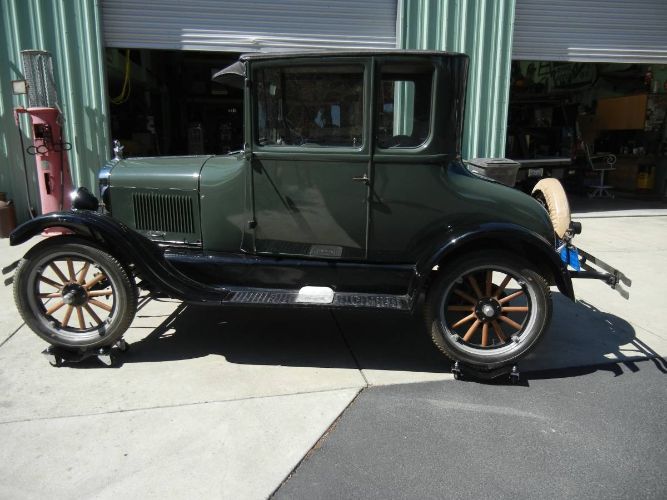
The problem was not price. General Motors, under Alfred P. Sloan, bet that Model T owners would trade up for comfort, features and style, and Chevrolet gave them somewhere to go. Ford's response was the "Improved" Model T, introduced in summer 1925 for the 1926 model year. It had a wider, straighter cowl with more legroom, new fenders, larger brakes and pedals, a body about an inch lower and, on most models, a fuel tank moved from under the seat into the cowl. Closed cars got colors again, among them Fawn Gray, Royal Maroon and Highland Green, still with black fenders, and the Coupe, Tudor and Fordor came with a nickel radiator shell.
It did not change the trend. Ford car production fell from 1,643,295 in 1925 to 1,368,383 in 1926 and 356,188 in 1927. Chevrolet passed half a million cars in 1926 and over a million in 1927, taking first place. On May 25, 1927, Ford announced the end of the Model T. The next day, May 26, the 15 millionth Ford, a touring car, left the line at Highland Park, with Henry and Edsel Ford at the ceremony. Car production at Highland Park stopped that day and US branch plants finished within days, but the Cork plant in Ireland kept building Model Ts until December 1927, which makes a Cork car the last Model T built anywhere. The engine lasted longer still: Ford kept making Model T engines until August 4, 1941, roughly 170,000 of them after the car itself ended. The TT truck continued until the Model AA replaced it in 1928.
The Model A arrives, 1927 to 1928
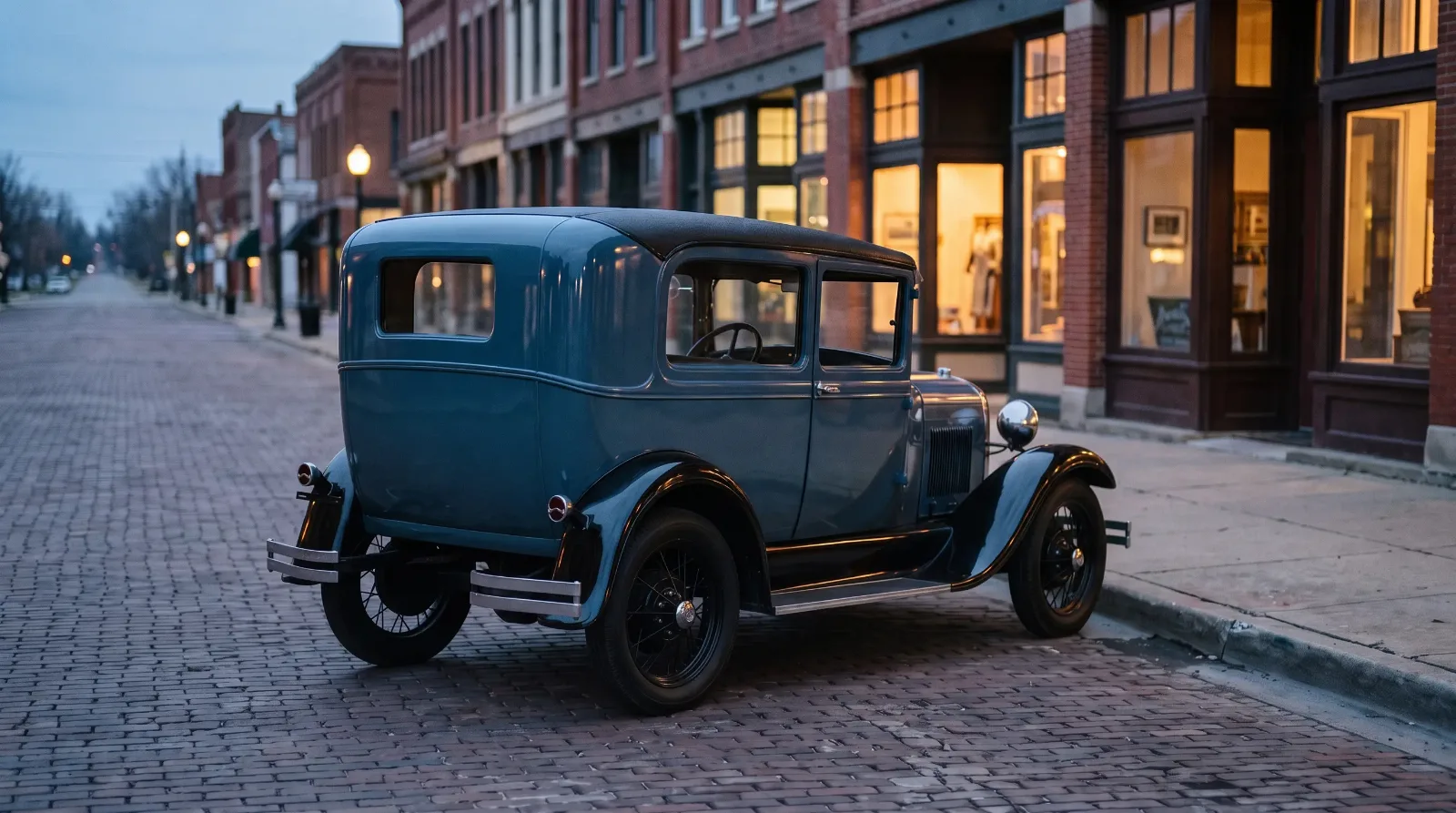
Ford had no replacement ready when the T ended. Production stopped for about six months while the new car was finished and tooling moved from Highland Park to the River Rouge complex. The development team was led by Eugene Farkas, with Laurence Sheldrick and Frank Johnson; Sheldrick and Harold Hicks did most of the engine work, Charles Sorensen and Peter Martin handled production, and Edsel Ford, company president since 1919, directed the styling. On October 20, 1927, Henry Ford stamped the first engine "A-1", and production began at the Rouge that month.
The public introduction came on December 2, 1927, with the car sold as a 1928 model. It followed a five-day advertising campaign that began on November 28 and placed $2 million of ads in 2,000 newspapers; more than 9 million Americans reportedly visited Ford dealers that week. They found a car that shared almost nothing with the T beyond the company name.
The Model A's engine was a 200.5 cubic inch L-head four making 40 bhp at 2,200 rpm, about twice the T's output, with a water pump, a battery and generator in place of the magneto, and a distributor ignition. A three-speed sliding-gear manual transmission replaced the planetary, and with it the Model A brought in the pedal layout drivers still use. It had four-wheel mechanical drum brakes, Houdaille hydraulic shock absorbers (the T had none from the factory), a 103.5 inch wheelbase and a fuel tank in the cowl. It could reach about 65 mph.
The 1928 factory list ran from $385 for the roadster to $570 for the Fordor, f.o.b. Detroit; later the Town Car stretched the top of the range past $1,000, a figure the sources themselves do not agree on. The A was a larger, heavier and more finished car than the T, and it still sold at prices a Model T buyer could recognize.
"Edsel's influence is easiest to see from three feet away. The Model T was drawn by engineers who wanted a car to last; the Model A was drawn by someone who expected people to look at it, and the proportions, the trim and the color choices show that intention everywhere."
Sarah Whitfield
Four years of the Model A, 1928 to 1931
The Model A was an immediate production success. The millionth was built by February 4, 1929, the two millionth by July 24, 1929, and the three millionth by March 1930. Chevrolet stayed ahead through 1928 while the new car was still ramping up, but in 1929 the Model A put Ford back in first place in US sales. The Model AA truck, using the same 201 cubic inch, 40 hp engine, replaced the TT and was built from 1927 to 1932.
Then the economy turned. The Model A's whole life ran across the start of the Great Depression, and by 1931 Chevrolet was back on top. Production records differ slightly on the ending: the most cited count has the last Model As built in March 1932. The engine count settles part of the question, with 4,830,806 production engines built from October 1927 to November 1931. The total for the cars is usually given as 4,858,644 across all body styles, and nearly 5 million worldwide is a fair round figure.
The design lived on abroad. Ford's new Dagenham plant in England built a Model AA as its first vehicle in October 1931; Ford UK also built a smaller 2,043 cc, 28 hp version of the car. In the Soviet Union, the GAZ-A was built under license from 1932 to 1936, and GAZ built more than 985,000 GAZ-AA trucks between 1932 and 1950.
In 1932 the Model A gave way to the four-cylinder Model B and the Model 18, which introduced Ford's flathead V8, and with it a different chapter of the company's history began.
Reading a Model T or Model A today
Both cars survive in large numbers, which is exactly why detail matters. When so many were built to one pattern, the evidence of when and where a particular car was made sits in small things. For a Model T, the first questions are era and body. A brass radiator and brass lamp trim place a car before the 1917 model year; a black shell and curved, crowned fenders place it after. The enlarged "high hood" and longer cowl mark the 1926 to 1927 Improved cars, a third visual era, and colors other than black on a closed body belong to those years too. Very early cars carry their own markers, including the reverse lever on the first 800 and the water pump on the first 2,447 engines.
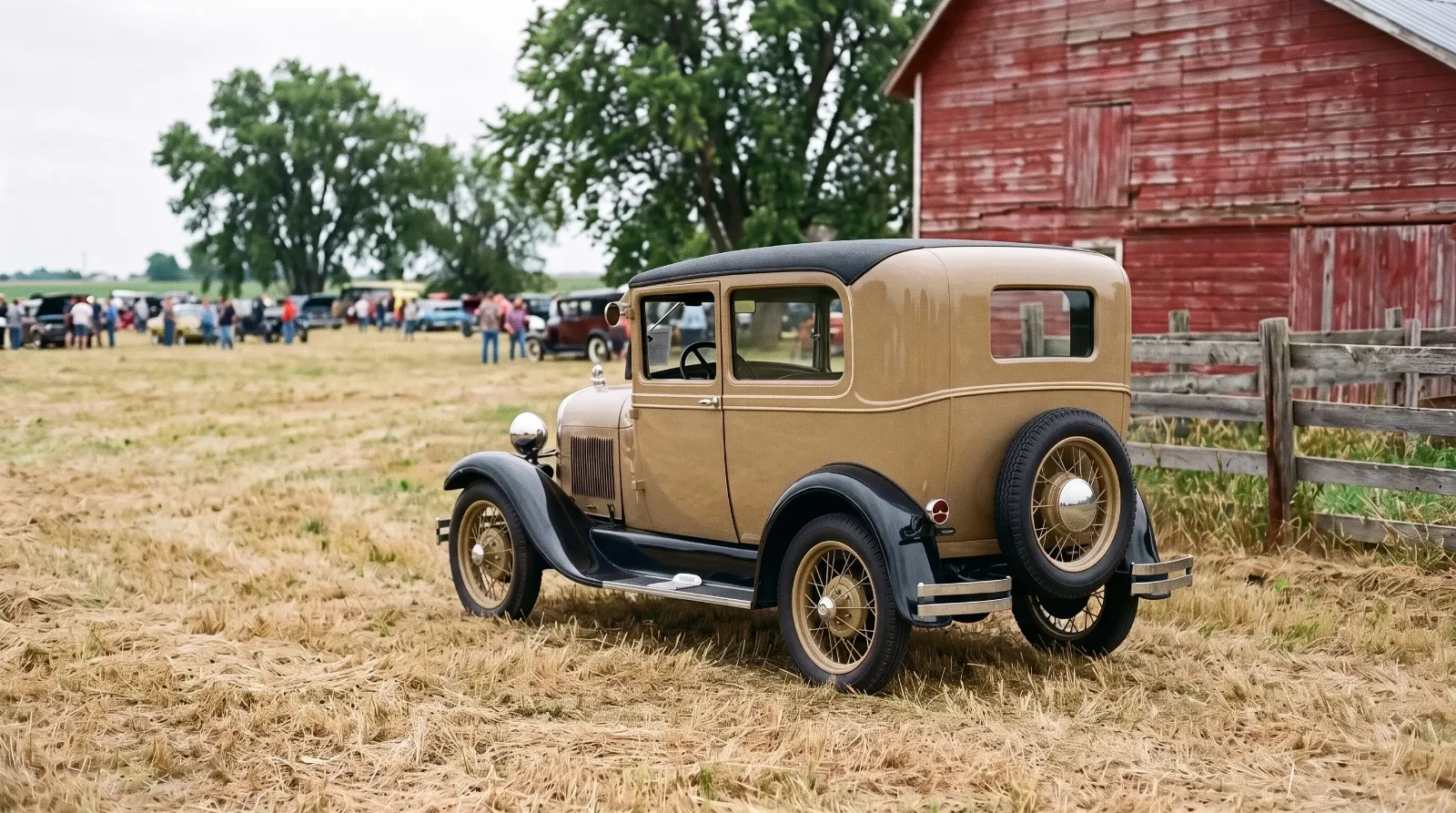
For a Model A, the questions shift to year-specific parts. The fuel tank grew from 10 gallons in 1928 and 1929 to 11 gallons in 1930 and 1931. The steering ratio changed from 11.25:1 to 13:1 for 1930. Brake drums were stamped steel through 1930 and cast iron from 1931. Early 1928 "AR" cars had features later removed, including a left-side, cowl-mounted hand brake lever that Ford dropped in the late spring of 1928, and a car that claims to be early should show them. Carburetors are a good example of why a single part proves little: Zenith reportedly supplied about 3.5 million of the roughly 4.8 million engines, Holley built many more under licence, and Ford made its own from 1931.
The market reflects the numbers. Because millions were built and parts are still made, both cars remain some of the most approachable ways into prewar motoring, and condition and documentation matter more than rarity for most body styles. Anyone shopping should compare several cars side by side; browsing Ford Model A cars for sale is a quick way to see how much originality and records change the price of otherwise similar examples.
The Model T was named Car of the Century on December 18, 1999, in Las Vegas, with 742 points. The award recognized what the T did for the world. The Model A deserves its own credit for what it did for Ford: it proved the company could stop, redesign everything and start again, and it carried the four-cylinder Ford through the first years of the Depression. Between them, the two cars span 1908 to 1931 and nearly 20 million vehicles, and each surviving one is a small, readable record of how they were made.
Sources and notes
Related Reading
Article
Ford Model T History: When It Was Made and How It Put America on Wheels
Article
Tin Lizzie: The Ford Model T's Nickname, Its Disputed Origins and the Legend
Article
Henry Ford's Assembly Line: How the Model T Was Built
Article
How the Model T and Model A Engines Worked: From 20 to 40 Horsepower
External
/ford/model-a
Have a
Ford Model T
for Sale?
Reach thousands of serious classic car collectors across the US.
Sell It Here →
Selling a classic? Here's how: compare the places to sell classic cars
Are You a Classic Car Dealer?
List your full inventory and connect with targeted classic car buyers.
Join as a Dealer →
#ford model a
#Edsel Ford
#brass era
#ford model t
#henry ford
#Highland Park
#River Rouge
#Prewar Fords

About the author
Sarah Whitfield
Third-generation classic car collector specializing in pre-war American and European coachbuilt automobiles. Researcher and concours enthusiast.
Related Listings - Ford Model T
Comments
Be the first to comment on this article.