
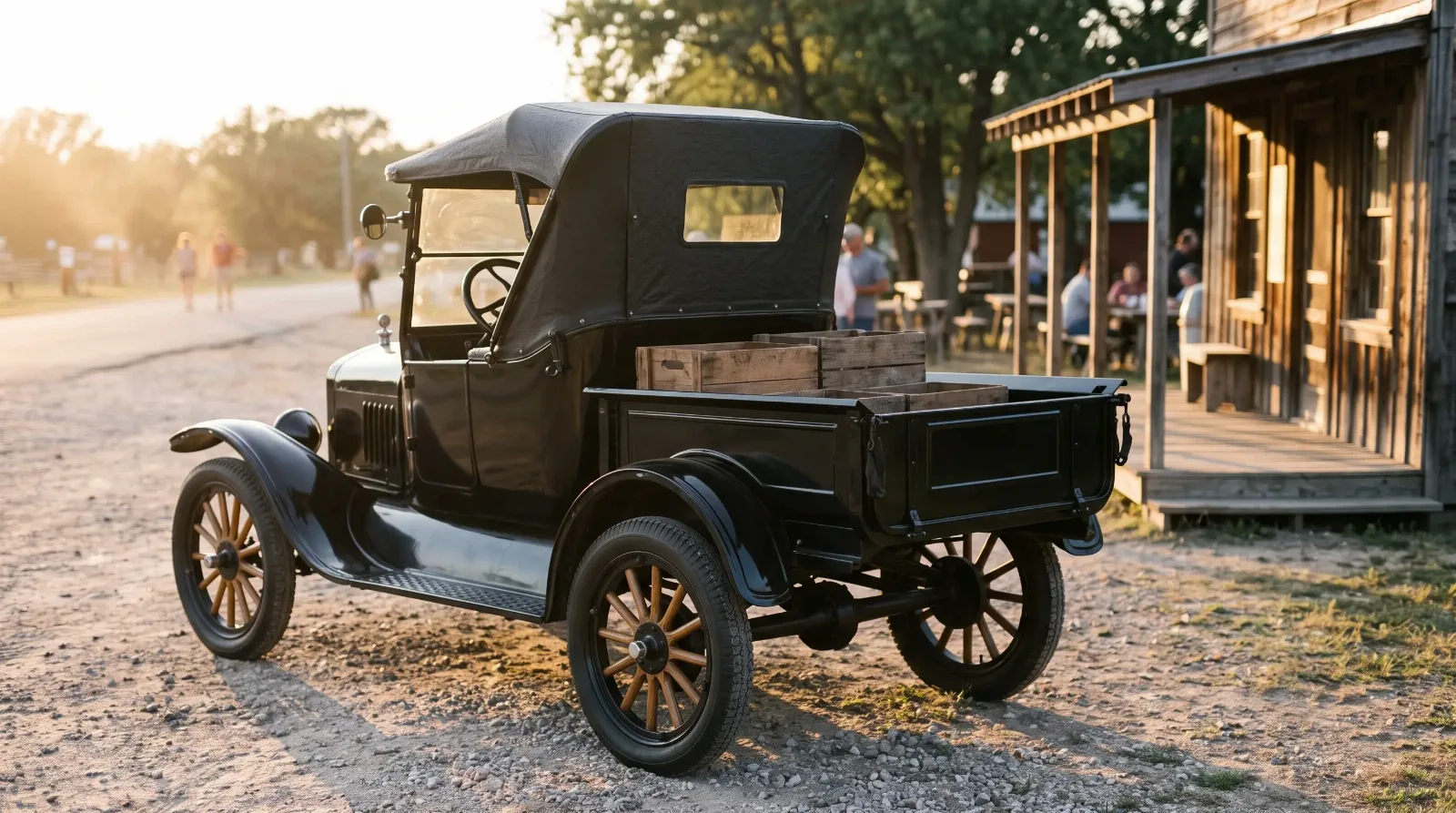
For years the farmer who wanted a light truck from Ford had two choices: buy a one-ton TT chassis and have a local shop build a body, or improvise something on a car. In April 1925 Ford gave him a third. The 1925 Model T pickup, sold under the plain name "Ford Model T Runabout with Pickup Body," put a factory steel bed on the back of the ordinary two-seat runabout and sold the package for $281. It was Ford's first factory pickup, and it is the truck most people picture when they hear the words "old Ford pickup."
Car Features
6 min read
1925: The Model T Runabout With Pickup Body
In April 1925 Ford put a steel bed on the Model T runabout and sold it for $281. Here is what the first factory Ford pickup was and how to buy one.
Why Ford built a pickup on the runabout
By 1925 the runabout was the cheapest car Ford sold. It listed at $260 that year, the lowest price any Model T ever carried. The chassis was already being built by the hundreds of thousands, so adding a bed was cheap work: same engine, same frame, same planetary transmission, with a steel box where the rear deck used to be. The $281 price meant the factory bed added about $21 over the plain runabout.
That was the whole idea. The TT was a real truck, with a longer frame and a worm-drive rear axle geared for a full ton and about 15 mph. Plenty of buyers didn't need that. They needed to carry feed, tools, milk cans or a few crates to town, and they wanted to do it at car speed on a car's running costs. The runabout pickup filled that gap with parts Ford already had on the shelf. For the place this truck holds in the larger family of Ford commercial vehicles, see the full story.
"The clever part wasn't the box. It was putting a working truck on the price list for twenty-one dollars more than the cheapest car Ford made."
Robert Halloran
The bed, the chassis and what came standard
The factory bed was steel, 56 inches long and 40-3/4 inches wide, with an adjustable tailgate and four stake pockets. Some dealer literature gives the width as an even 40 inches and the height as 13 inches. The stake pockets mattered: drop in a set of boards and you had sides tall enough for a load of hay or a few calves.
Everything forward of the bed was runabout. That meant the 177 cubic inch four rated at 20 hp, the two-speed planetary transmission with its three pedals, and the standard Model T frame. Balloon tires in 4.40 x 21 size came into the Model T range from 1925, so check which tires a given truck should be wearing for its build date.
| Item | 1925 Model T runabout pickup |
|---|---|
| Official name | Ford Model T Runabout with Pickup Body |
| Introduced | April 1925 |
| Price | $281 FOB Detroit |
| Plain runabout, same year | $260 |
| Bed | Steel, 56 in long x 40-3/4 in wide, adjustable tailgate, four stake pockets |
| Chassis | Standard Model T runabout |
| Engine | 177 cu in four, 20 hp |
| Transmission | 2-speed planetary |
| First-year sales | Nearly 33,800 |
How many were sold
The Henry Ford's figure is "nearly 33,800" in the first year. That is the number to use, with one caution: it appears to be a calendar-year count of pickup bodies, so the year boundaries are loose. You will see other figures, much lower ones, quoted in club discussions and museum notes. They seem to count different things over different periods, and none of them is better documented than the museum's.
What nobody has nailed down is a clean model-year breakdown for 1925, 1926 and 1927, or how many runabouts had their bed fitted by a dealer rather than at the factory. Closed cab Model T trucks were a separate body, and most closed cab Model T pickups you see today began life as something else. If a seller tells you exactly how many were built in a given year, ask where the number came from.
1926 and 1927: the improved runabout underneath
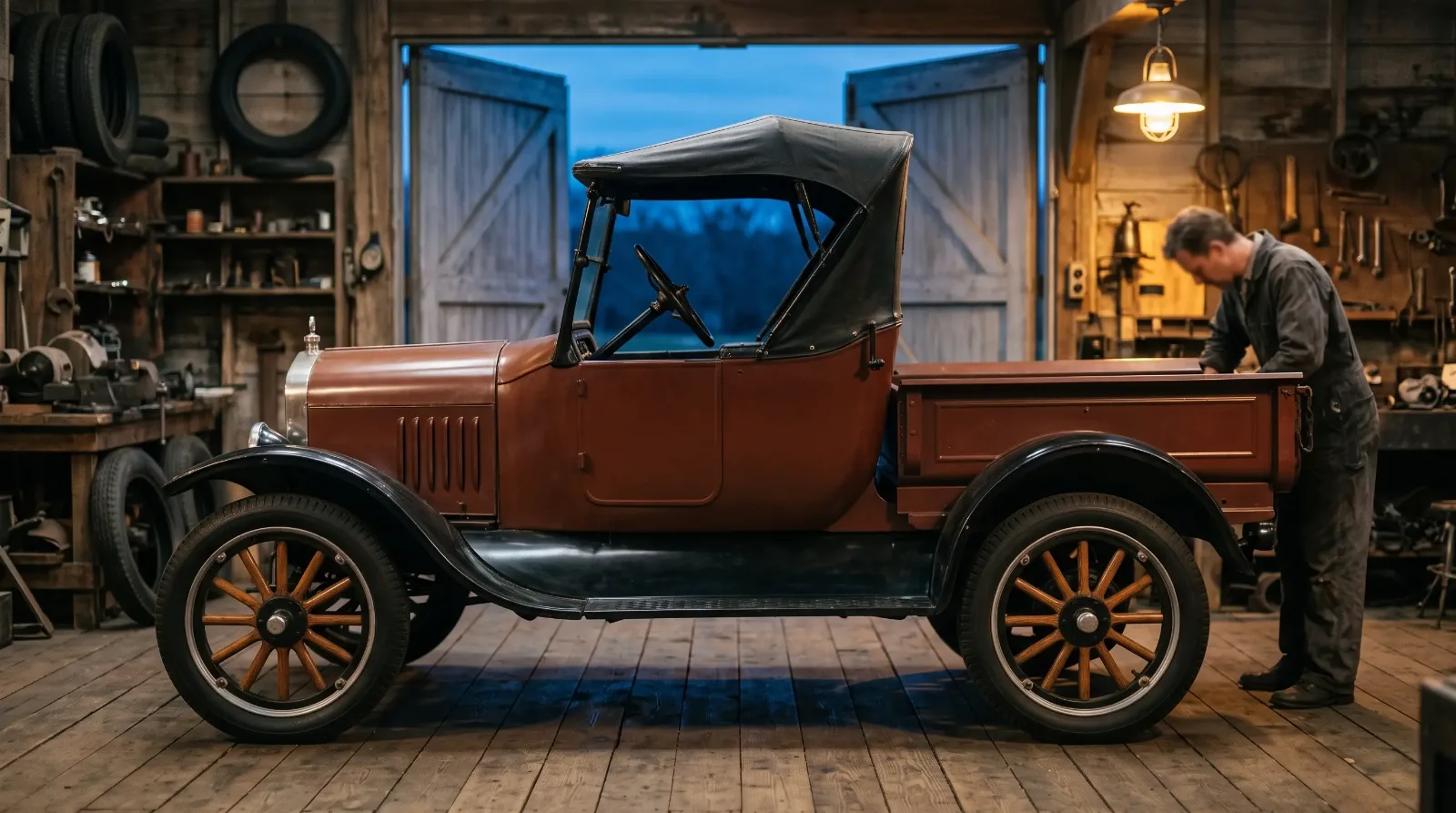
The runabout pickup ran from 1925 through the end of Model T production in 1927. For 1926 the car underneath changed. Ford's "improved" Model T got larger brakes and pedals, and a revised frame, axles and spindles that sat the car about an inch lower. The electric starter, optional since 1919, was standard on all Model Ts by 1926. Steel welded-spoke wheels became available in 1926 and 1927.
The runabout's own price rose to $360 for both of those years. Ford's dealers had a harder time with the whole Model T line by then, and the pickup was no exception. When Model T production ended in 1927, the pickup role went to the Model A, and the heavy work went to the Model AA, the 1-1/2 ton truck that replaced the TT.
Some writers trace a line straight from this truck to every Ford pickup that followed. That is a reasonable way to tell the story, as long as it is understood as a lineage argument, not a fact about any particular part or design. What is plain is that Ford sold a factory pickup from 1925 and never stopped.
Buying and keeping a 1925 Model T pickup in 2026
This is about as practical a pre-war truck as you can own. It's a Model T underneath, and Model T parts are plentiful: engine, transmission bands, ignition, steering and brakes are all supported by suppliers and clubs. A competent owner can keep one running with hand tools and a manual.
The trap with these trucks is conversions. Because a runabout is easy to convert, some "1925 pickups" are runabouts with a box added at some point. That's not a crime, and many are honest, useful trucks. But a factory-bodied pickup with a correct bed is a different thing from a converted runabout, and the price should reflect which one you're buying.
Restoration costs track the Model T car closely, because that's what most of it is. The bed is simple steel and can be repaired or reproduced without much drama. Upholstery, a correct top and the side curtains are where the bills climb. If you're shopping, start with listings of Model T pickups for sale, then bring a tape measure and a copy of the factory bed dimensions.
Sources and notes
- The Henry Ford: Model T runabout with pickup body, April 1925 (price, bed size, first-year sales)
- Classic Promenade: 1925 Ford Model T Runabout with Pickup Body
- Mac's Motor City Garage: Tin Lizzie's last stand, the 1926-27 Model T
- Mac's Motor City Garage: the 1917-27 Ford Model TT
- Wikipedia: Ford Model T (prices by year, wheels and tires)
- Wikipedia: Ford Model TT (truck gearing and speeds)
Related Reading

Have a
Ford Model T
for Sale?
Reach thousands of serious classic car collectors across the US.
Sell It Here →
Selling a classic? Here's how: sell my classic car
Are You a Classic Car Dealer?
List your full inventory and connect with targeted classic car buyers.
Join as a Dealer →
#ford model t
#vintage trucks
#Model T runabout
#1925 Model T pickup
#Ford pickup history
#first Ford pickup

About the author
Robert Halloran
Texas-based classic truck enthusiast with decades of experience buying, restoring, and writing about American pickups from the 1940s through the 1980s.
Related Listings - Ford Model T
Comments
Be the first to comment on this article.