
Ford didn't build a truck in 1917 so much as it sold you the bones of one. The Ford Model TT truck left the factory as a bare chassis with a cowl, a hood and a radiator, and the buyer found somebody local to build whatever went on the back. It was sold as the "Model T One-Ton Truck," and it was rated for one short ton. That rating, a longer frame and a very low gear in the rear axle were most of what separated it from the car. The rest was plain Model T, which is exactly why it worked and exactly why it was slow.
Car Features
8 min read
The Ford Model TT: Ford's One-Ton Truck
A $600 bare chassis, a worm-drive axle and a 15 mph recommended top speed: what the Ford Model TT one-ton truck was and how to keep one working.
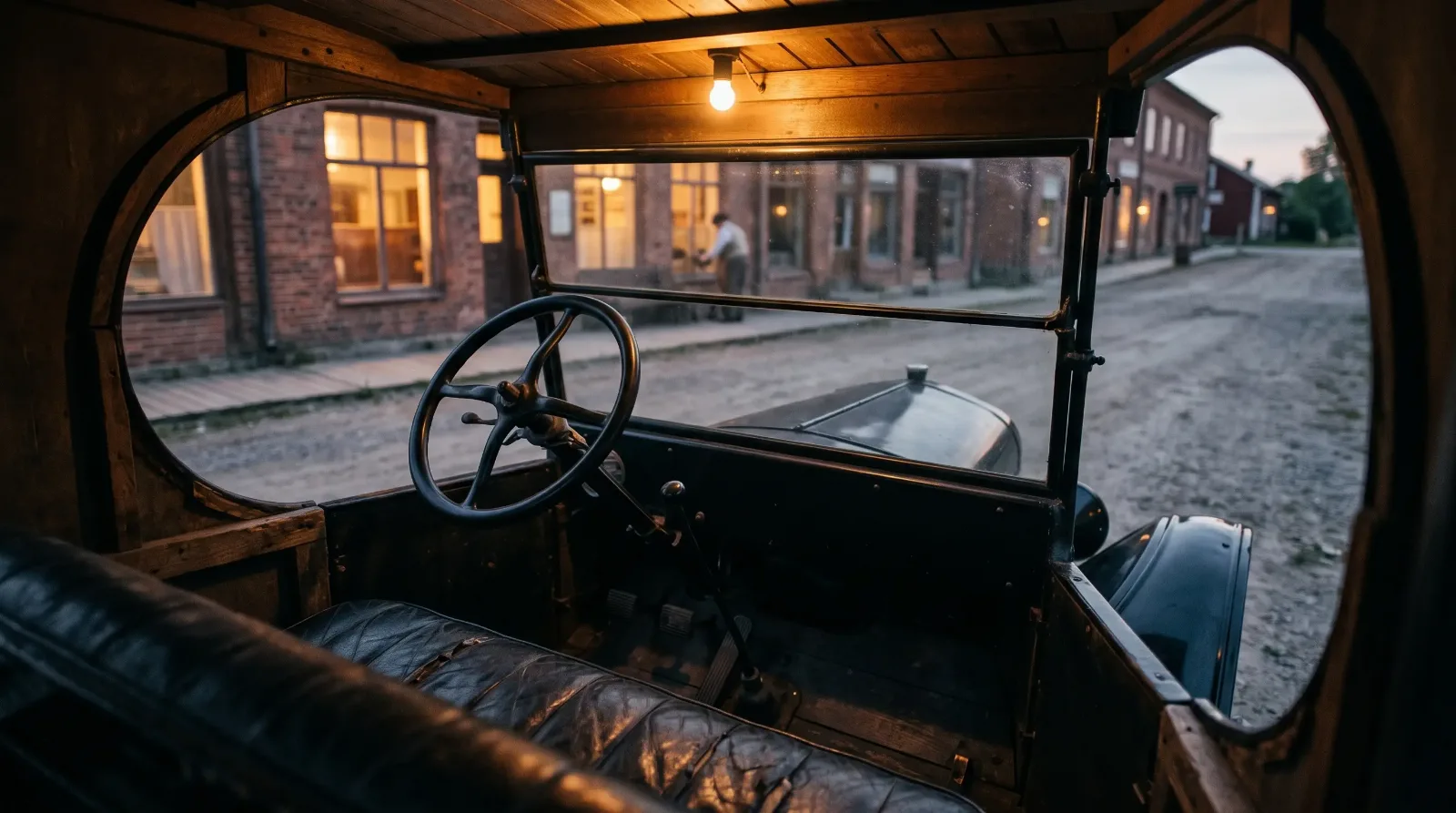
What Ford actually sold in 1917
Ford introduced the truck on July 27, 1917, and the launch price was $600 for the chassis alone. No bed, no cab, no body of any kind. That was normal for commercial vehicles of the time, and it suited Ford, which could build one chassis in volume and leave the hundred different jobs to wagon makers and body shops in every town. Before 1924 nearly every TT you see in a period photograph is wearing an outside body: a stake bed on one, a panel box on the next, a canopy express on a third.
The price came down hard as Ford's volume went up. By 1926 the TT chassis listed at $325, with the electric starter $50 extra. Ford also sold trucks through its Weekly Purchase Plan, with payments as low as $5, which put a working truck within reach of a man who would pay for it out of what the truck earned. That is the real reason so many of them ended up hauling milk, coal and feed in the 1920s.
Ford's own 1923 advertising claimed that more than half of all trucks then in service were Fords. Treat that as a company boast, not a census, but nobody at the time thought it was far off. If you want the TT set beside the pickups and the AA that followed, the early Ford trucks covers the whole line in one place.
Same engine, longer frame, very low gearing
Under the hood the TT ran the same 177 cubic inch four as the car, rated at 20 hp, and the same two-speed planetary transmission with its foot pedals. Ford did not give the truck more power. It gave it leverage. The rear axle used a worm drive in place of the car's bevel gear, and the standard final drive was 7.25:1, against 3.63:1 on the car. An optional special gearing of 5.17:1 was offered for lighter loads and better roads.
The frame was stretched too. The TT wheelbase was about 124 to 125 inches, against the car's 100 inches, and you will see both figures quoted. Some references give 131 inches for the TT, but that number belongs to the Model AA that came later and got copied over.
| Item | Model TT truck | Model T car |
|---|---|---|
| Engine | 177 cu in four, 20 hp | 177 cu in four, 20 hp |
| Transmission | 2-speed planetary | 2-speed planetary |
| Rear axle | Worm drive | Bevel gear |
| Final drive | 7.25:1 standard, 5.17:1 optional | 3.63:1 |
| Wheelbase | About 124 to 125 in | 100 in |
| Rating | 1 short ton | n/a |
| Price | $600 chassis (1917), $325 (1926) | n/a |
Living with 15 miles an hour
Here is the part the brochure didn't stress. With the standard gearing, a loaded TT topped out just under 20 mph, and Ford recommended no more than 15 mph. With the special gearing that recommendation went up to 22 mph. The car could run about 40 to 42 mph on the same engine. On a TT you traded speed for the ability to drag a ton of something up a grade without frying the bands.
"People laugh at the 15 mph number until they put a ton of coal on the back and find a hill. Then they understand why Ford geared it the way they did."
Robert Halloran
Owners didn't accept that gap quietly. The aftermarket answered with auxiliary transmissions such as the Warford and the Jumbo, and with the Ruckstell axle, all meant to add ratios beyond the planetary's two speeds. The Ruckstell was a two-speed planetary unit built into the rear axle, giving direct drive or an underdrive. It was common on trucks and available for cars too. A TT with a working Ruckstell is a far more usable truck today, and a far more expensive one to set up correctly.
Factory bodies arrive, and the numbers peak
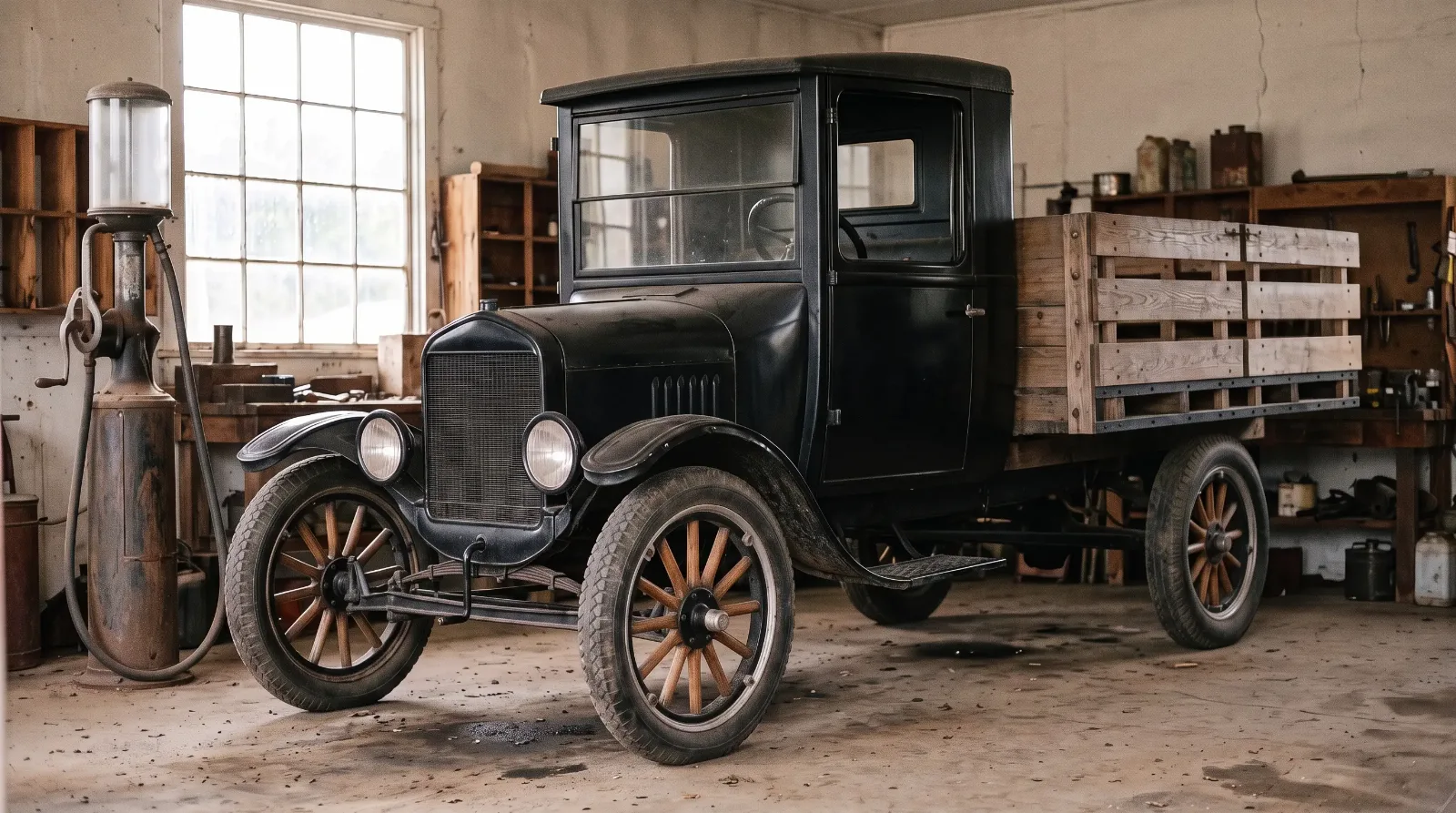
Ford started offering its own factory body for the TT in 1924. A closed cab followed in 1925, the same year a hand-operated windshield wiper was added. Before that, the outside builders had the business to themselves, and many C-cab and express bodies on surviving TTs came from them rather than from Ford. That same 1925 season Ford also put a pickup box on the runabout chassis for lighter work; the 1925 pickup is a separate machine from the TT and gets its own write-up.
Production figures for Model T trucks, excluding Canada, ran from just 3 in 1917 to 41,105 in 1918 and climbed to a peak of 306,434 in 1925. The total over 1917 to 1927 comes to about 1.5 million. One caution: the table those figures come from is labelled "Model T trucks" and may count more than the TT alone, so treat the total as the size of the family rather than a TT-only count. The TT was built into 1928 and then replaced by the Model AA, which in turn gave way to the Model BB.
The chassis carried just about everything. Pickup, panel, canopy express, box and stake bodies were all common, and so were bus bodies. The best known survivor is probably Blue Bird No. 1, built in 1927 on a TT chassis by a Georgia Ford dealer and now in the Henry Ford Museum as the oldest surviving school bus in America.
Buying and restoring a Ford Model TT truck today
The good news first. Mechanically, a TT is a Model T, and Model T engine, transmission and ignition parts are about as easy to find as any parts for a car this old. Rebuilders know the 177 four, and the planetary transmission is a known quantity. If the drivetrain is tired, it can be fixed without heroics.
The worm-drive rear axle is where the money goes. Worm gears wear, and a worn set will howl, run hot and eventually fail under load. Replacement worm gears and the right bearings are harder to find than car parts, and the work takes someone who has done it before. Price that into any TT that hasn't had the axle opened up in living memory.
The body question is the one buyers get wrong. A TT with a nicely finished C-cab or express body may be wearing a modern reproduction, and that's fine as long as it's sold that way. Original wooden bodies from the 1920s are rare, and a truck that still has one is worth documenting carefully. Restoration economics on these trucks are simple: the chassis is cheap to keep alive, the axle is the risk, and the wood is the bill.
A TT is not a fast truck and was never meant to be. It was Ford's first purpose-built truck chassis, and it tells you a lot about how Henry Ford thought: take the car that already sold by the million, give it a longer frame and a lower gear, and let the country build the rest. For the bigger picture of how that thinking carried from the T into the A, see the Model T to Model A story.
Sources and notes
- Mac's Motor City Garage: The truck that put American business on wheels, the 1917 to 1927 Ford Model TT
- Wikipedia: Ford Model TT
- Automotive Fleet: Ford celebrates 100 years of work trucks
- The Henry Ford: Blue Bird No. 1 school bus on a 1927 Model TT chassis
- Wikipedia: Glover Ruckstell and the two-speed axle
- Auto Restorer: the 1930 Model AA Ford truck, with TT comparison
Related Reading
Have a
Ford Model T
for Sale?
Reach thousands of serious classic car collectors across the US.
Sell It Here →
Selling a classic? Here's how: sell my classic car
Are You a Classic Car Dealer?
List your full inventory and connect with targeted classic car buyers.
Join as a Dealer →

About the author
Robert Halloran
Texas-based classic truck enthusiast with decades of experience buying, restoring, and writing about American pickups from the 1940s through the 1980s.
Related Listings - Ford Model T
Comments
Be the first to comment on this article.