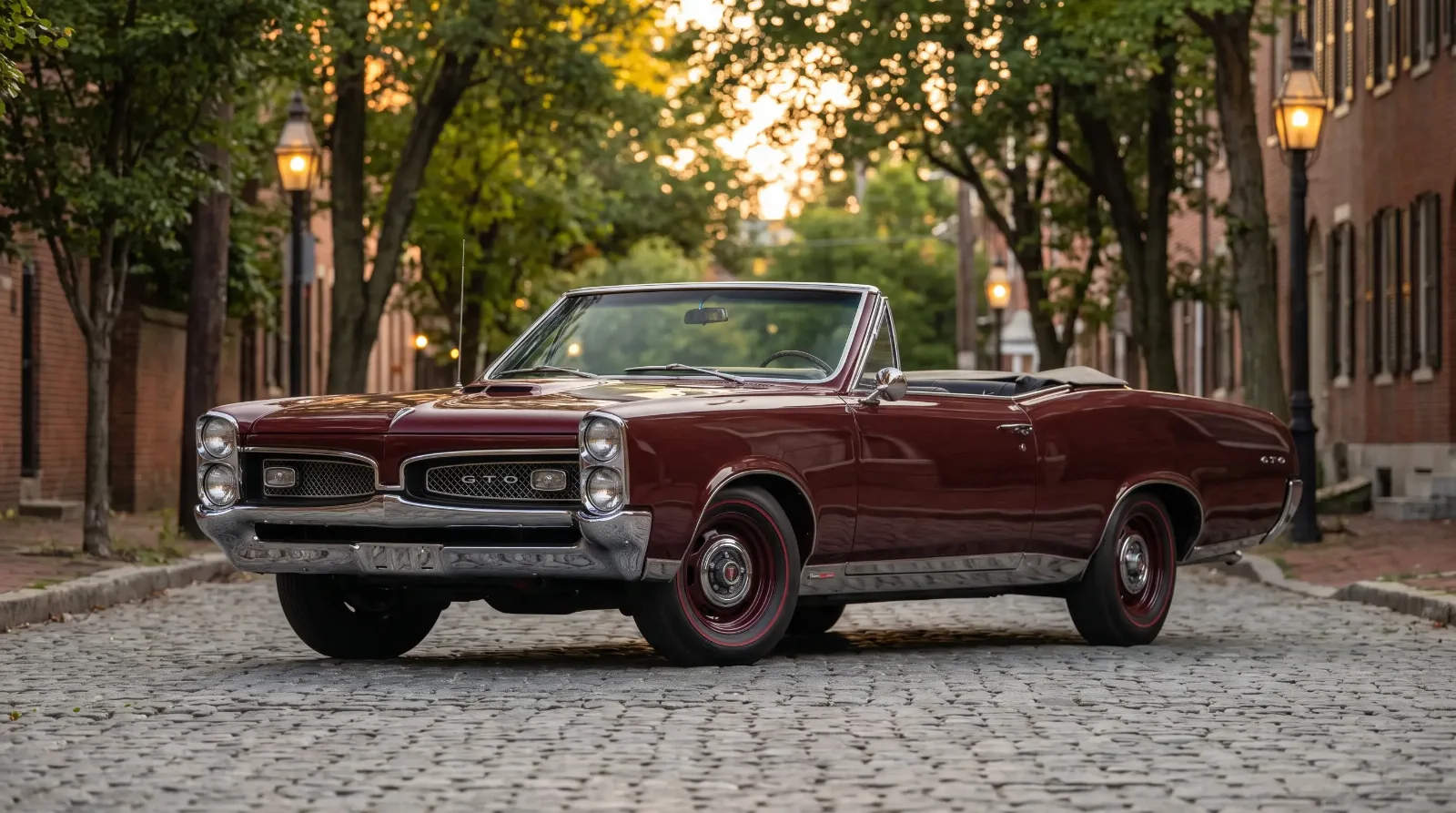
There is a particular kind of summer evening photograph that keeps showing up in GTO owner scrapbooks from the late 1960s: top down, a line of chrome catching the last light, someone's arm resting on the door. More often than not, that car is a 1967 GTO convertible. It is the version of the Coke-bottle GTO that was built to be seen as much as driven, and it arrived at the exact moment the whole muscle car era was hitting its stride.
The last year of a shape people still argue is the best one
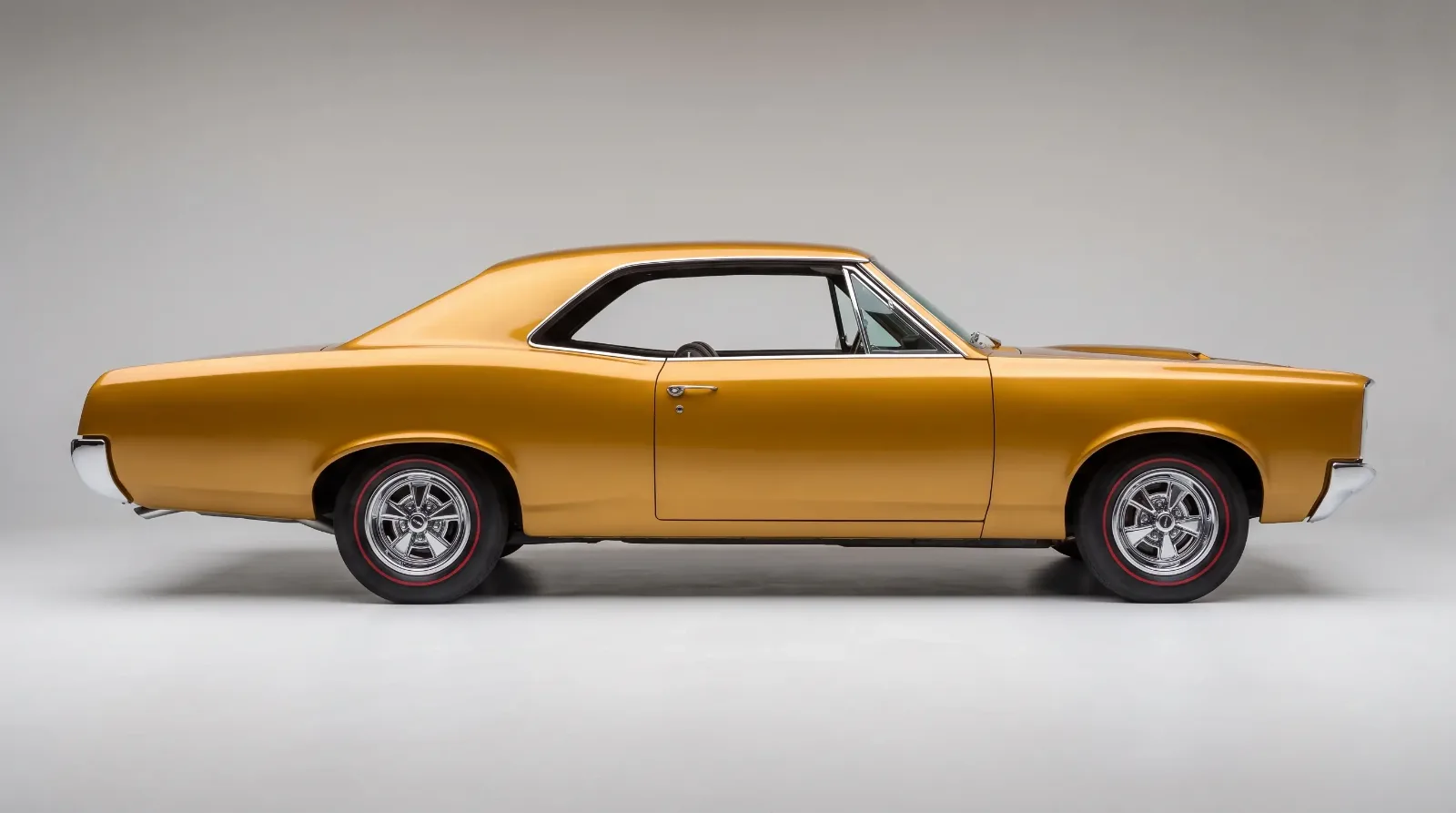
The 1967 GTO carried over the Coke-bottle body Pontiac introduced the year before, the pinched-waist, flared-fender shape that defined the classic Coke-bottle era of the car. With the top down, that body reads differently than it does as a hardtop. The beltline curve and the flared rear quarters, details that can look busy under a fixed roofline, become the whole story once there is no roof competing for attention. A lot of collectors will tell you the convertible is the purest expression of that body style, because it strips away everything except the sheet metal Pontiac's designers actually drew.
There is something almost architectural about looking at a convertible this way, the way removing a roof from a building can suddenly reveal the bones underneath. A 1967 GTO hardtop is a handsome car. The convertible version of the same body, with nothing but a windshield frame and two doors interrupting the line from hood to trunk, is the one that makes strangers stop in a parking lot and ask what year it is before they ask what's under the hood.
What made 1967 different under the skin
Mechanically, the 1967 GTO picked up a genuinely important change: the three-carburetor Tri-Power setup that had defined the car's top-performance option since 1964 was dropped, replaced by a single four-barrel carburetor across the board, now paired with a larger 400-cubic-inch V8 in place of the 389. Pontiac also introduced a three-speed Turbo Hydra-Matic automatic that year, a meaningfully more modern transmission than the two-speed unit it replaced. None of that shows up in a photograph, but it shaped how the car actually drove, and it is part of why serious buyers treat 1967 as its own distinct model year rather than a footnote to 1966.
| Spec | 1967 GTO Convertible |
|---|---|
| Body style | 2-door convertible, Coke-bottle body |
| Standard engine | 400 cu in V8, 4-bbl |
| Top performance option | Ram Air 400, 360 hp (widely considered underrated) |
| New for 1967 | Turbo Hydra-Matic 3-speed automatic |
| Dropped for 1967 | Tri-Power 3x2-bbl carburetion |
Why the numbers favor the convertible today
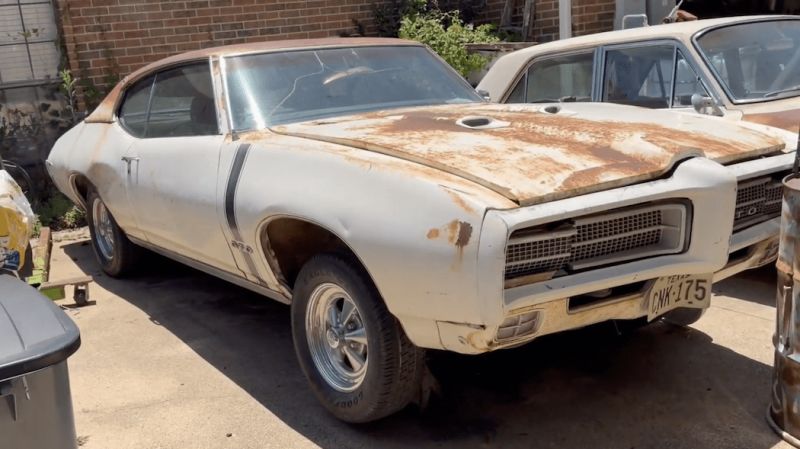
Every open car built in this era faced the same attrition story: soft tops wear out, water finds its way into places it should not, and a convertible that spent decades outdoors or half-restored tends to rust in spots a hardtop never sees. Fewer 1967 GTO convertibles were built to begin with compared to the coupe and hardtop, and a smaller share of those survived in condition worth restoring. That scarcity is the single biggest reason convertible values have pulled ahead of closed-roof 1967 GTOs, sometimes by a wide margin, particularly for cars with documented Ram Air options or desirable color and interior combinations.
"A GTO convertible in good original color with the top mechanism working properly is not a common thing to find anymore. Most of what is left has been through at least one serious restoration."
— Nora Beckett
Living with the top down
Open cars from this era ask more of an owner than their hardtop counterparts. The top mechanism itself, the frame, the pump if power-assisted, the fabric or vinyl covering, all of it needs attention that a coupe simply does not require. Body flex is a real consideration too; a convertible loses the structural rigidity a steel roof provides, so owners tend to notice cowl shake and door alignment issues sooner than they would in a hardtop. None of that has stopped people from chasing these cars for sixty years. If anything, the extra care they demand seems to be part of what keeps owners attached to them.
There is a particular ritual to owning one of these that hardtop owners never quite experience the same way. Deciding whether to put the top down becomes a small daily negotiation with the weather, with time, with whatever errand you were actually running. People who have owned both will tell you the hardtop is the more sensible car and the convertible is the one they think about when they are not driving it. That is not a small distinction for a machine that spends most of its life parked in a garage.
A road that still asks something of you
Drive one of these with the top folded down on a two-lane road at dusk and the car asks a little more of you than the coupe does. Wind noise changes how you hear the 400 under the hood. The cowl moves, just slightly, over rough pavement in a way a fixed roof would never let you feel. None of that is a flaw so much as a kind of honesty the closed cars don't offer, a reminder that you are driving a machine built before anyone worried much about isolating a driver from the road they were on.
What to look for beyond the obvious rust spots
Anyone shopping a 1967 convertible eventually has to move past the emotional pull of top-down photos and look at the car with a colder eye. The top well behind the rear seat is worth real attention, since that's where water collects when a folded top or a worn seal lets it through, and it's a slower, quieter kind of damage than the rust you can spot on a fender. Frame rails deserve a look too, given the extra flex an open body puts through the structure over decades of driving. None of this makes the convertible a riskier buy than any other fifty-plus-year-old car, it just means the inspection has to account for problems a hardtop simply doesn't have.
Documentation carries even more weight on a convertible than it does elsewhere in the GTO lineup, because the premium these cars command makes them a more tempting target for cars built up from a coupe or dressed with a non-original top mechanism. A build sheet, a broadcast sheet, or period paperwork tying the car to its original convertible configuration is worth chasing down before money changes hands, not after.
Where the convertible fits in the bigger sales story
The convertible was always a smaller slice of GTO production than the hardtop, and understanding exactly how the numbers broke down across the mid-60s run says a lot about how Pontiac positioned the car and who was actually buying it. That sales picture, and the record-setting year that came right before the Coke-bottle body arrived, is worth its own look, so read on. And if you are less interested in the history and more interested in finding one, current inventory is the fastest way to see what a real 1967 example looks like and costs today: browse GTO listings.
A car that still does what it was built to do
Strip away the option codes and production numbers, and the 1967 GTO convertible is still doing the same job it did the day it left the dealership: turning a normal drive into something worth remembering. That is not nostalgia talking. It is the reason people keep restoring these cars long after the practical arguments for doing so have stopped making sense.