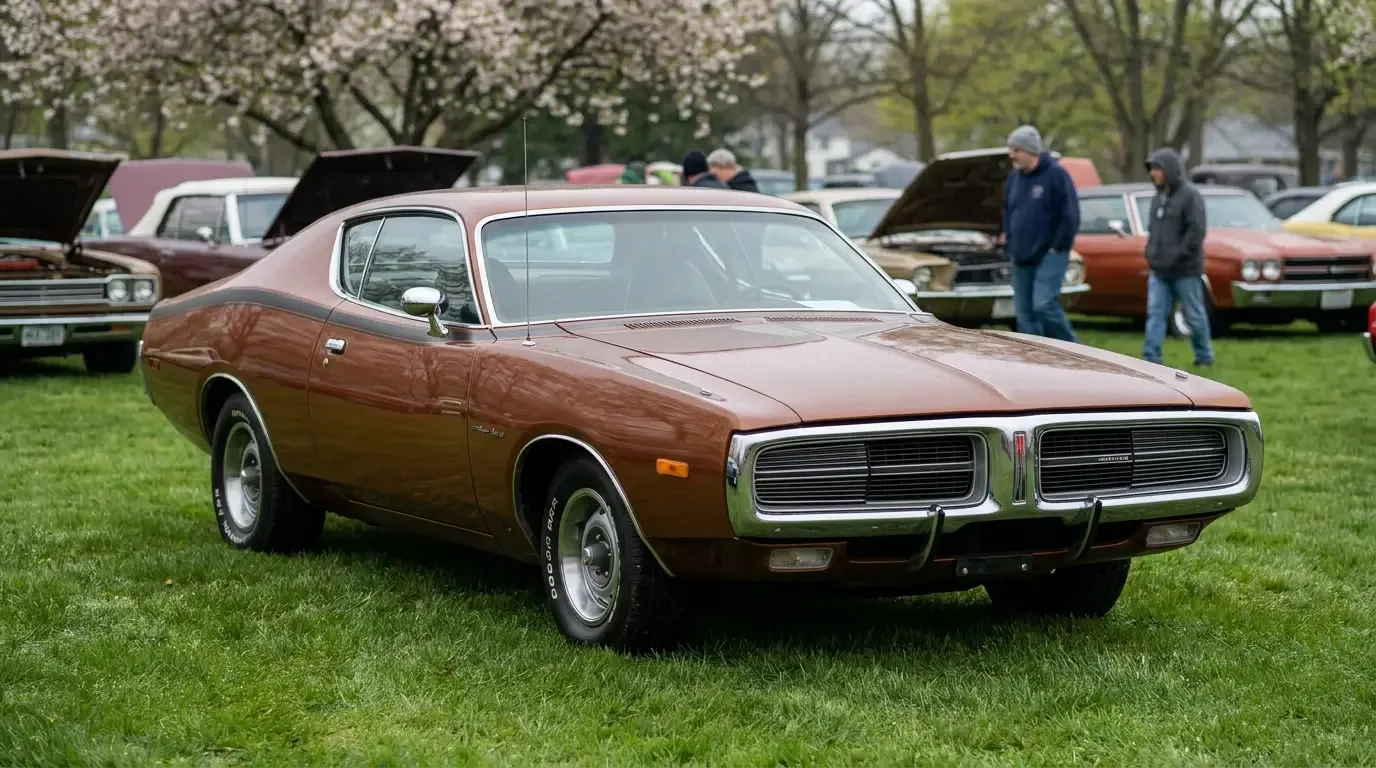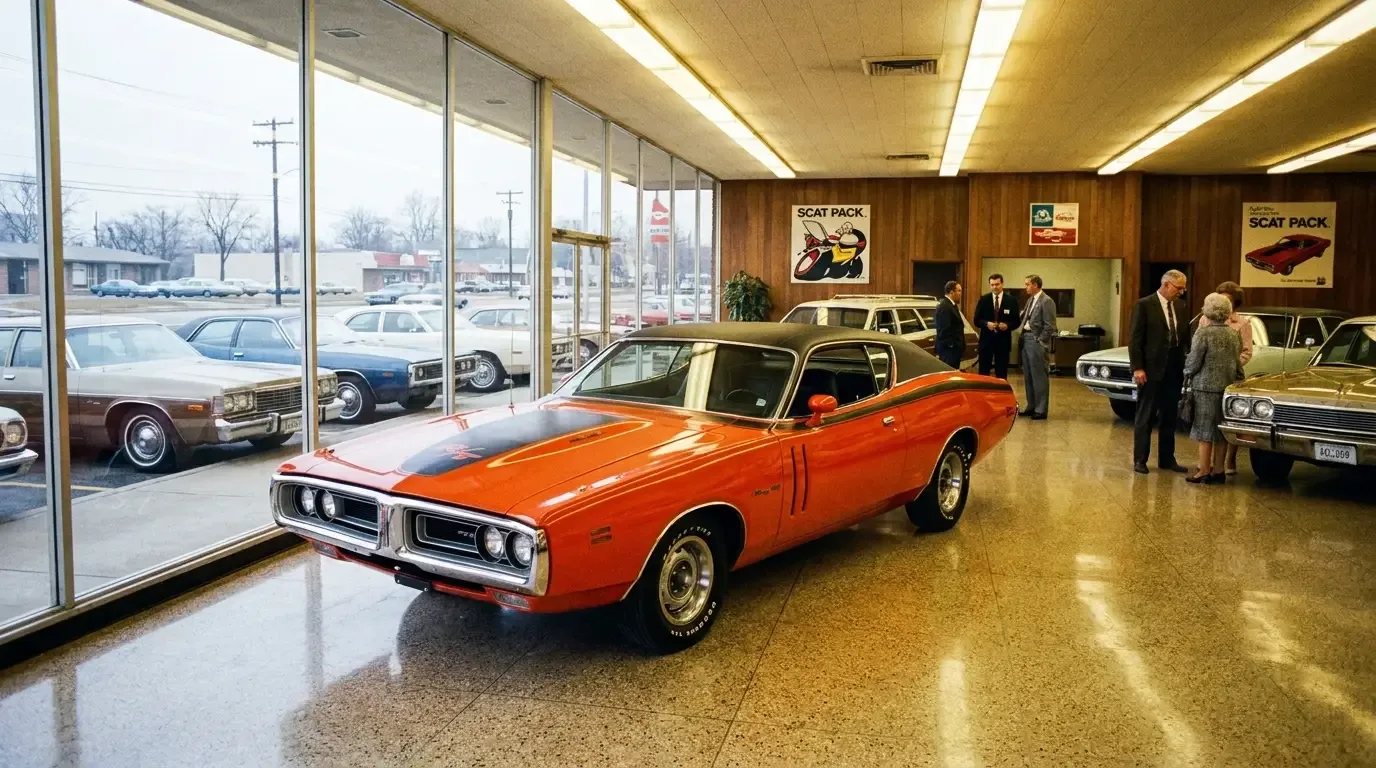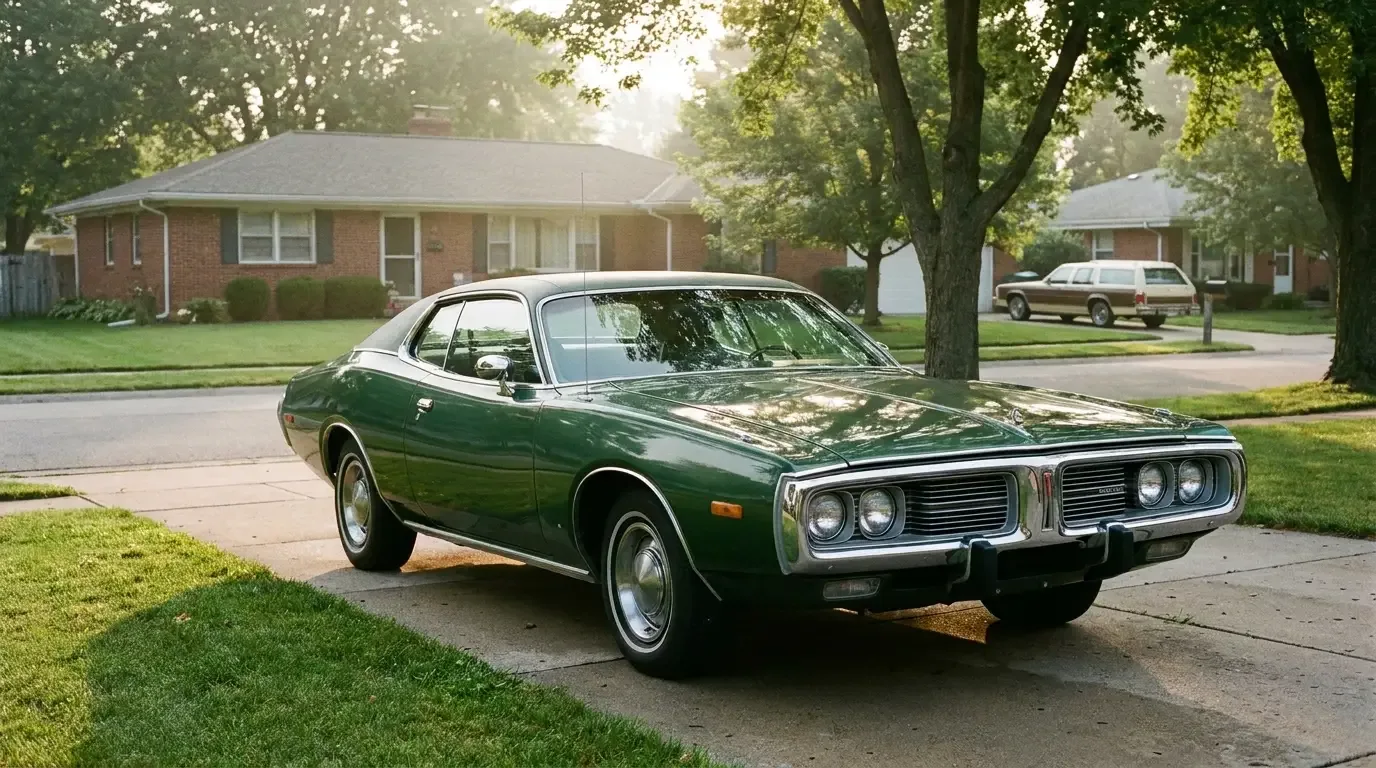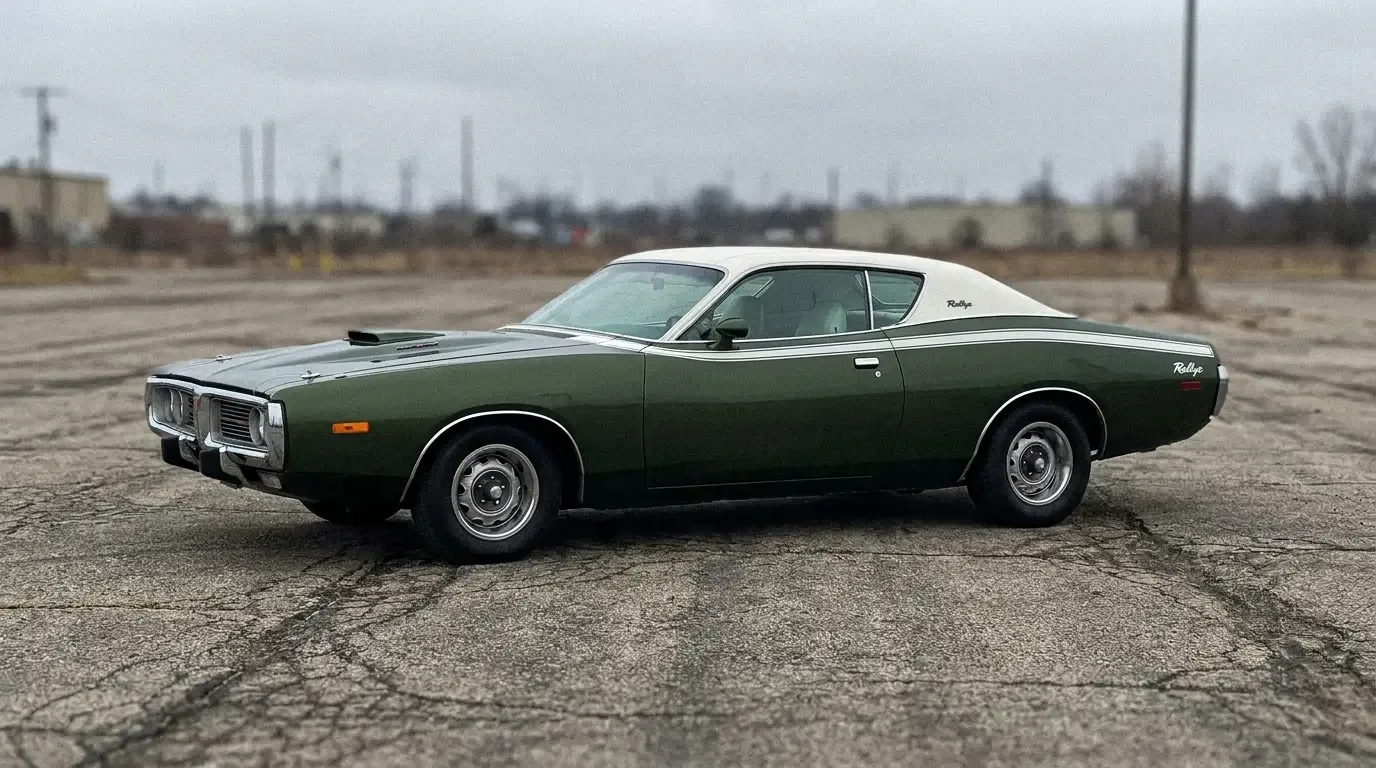
The build record matters here more than most people expect. Not because it tells you everything about a car, but because it's the factory's own account of what actually left the assembly line, and the 1972 Charger is a car where that account gets misread often. This is the year the R/T name disappeared from the Charger lineup, replaced by a new trim called Rallye, and the change gets described in shorthand that doesn't quite match what Dodge's own paperwork shows.
What Rallye actually replaced
The Rallye package for 1972 took over as the top-line handling and appearance option on the Charger, but it wasn't a direct swap for the R/T in every sense people assume. The R/T had been built around a specific big-block engine commitment, the 440 Magnum as standard with the Six Pack and previously the Hemi as options. The Rallye package, by contrast, was available across a wider range of engine choices, including smaller V8s, and leaned more on suspension and trim upgrades than on a guaranteed big-block underneath.
That's an important distinction for anyone researching a specific car. A Rallye-optioned 1972 Charger with a 318 or 400 under the hood is a documented, correct combination, not a mismatch, even though it reads unusual to someone expecting every Rallye to carry a 440. The factory build sheet, when one survives with the car, settles the question far better than assumption.
Engine lineup and what changed from 1971
The big shift for 1972 across the whole industry was the move to SAE net horsepower ratings, replacing the gross figures used in prior years. This makes side-by-side comparisons with 1971 cars misleading if you're not accounting for the measurement change. A 440 rated in the mid 200s net for 1972 isn't necessarily a weaker physical engine than a 440 rated higher under the old gross standard for 1971, though the printed number certainly looks that way at a glance.
The 440 Magnum remained available, now rated at 280 hp net, down on paper from the prior year's gross figure, and the 440 Six Pack option was dropped from the Charger lineup for 1972 entirely, a genuine reduction in top-end performance rather than just a rating change. Buyers looking for the strongest available combination that year were working with fewer options than they'd had in 1971.
| Engine | Net Horsepower (approx.) | Notes |
|---|---|---|
| 318 V8 | 150 hp | Base V8 option |
| 400 V8 (2bbl) | 190 hp | Mid-range option |
| 440 Magnum | 280 hp | Top engine, Six Pack dropped |
"The build record matters. Not because it tells you everything, but because it's the factory's own account of what left the line."
— Tom Ramirez
How to verify a Rallye correctly
The fender tag on a 1972 Charger will carry a sales code specific to the Rallye package, distinct from the base trim codes. Cross-referencing that code against the broadcast sheet, when available, and the VIN's engine designation gives you the clearest picture of what the car left the factory with. I'd caution against relying on badges alone. Trim pieces get swapped during restorations more often than owners disclose, sometimes without any intent to misrepresent the car, just because a part was available and close enough.
Where records don't survive, and plenty don't after fifty-plus years, a knowledgeable inspection of casting numbers on the block and other date-coded components can at least confirm the engine is period-correct for the car, even without proving it was the exact factory-installed unit. I don't think it's dishonest to say "I don't know" when the paper trail runs out. It's more honest than filling the gap with a confident guess.
Where the Rallye fits in the bigger picture
The Rallye trim continued through the rest of the third-generation Charger's run, and understanding its introduction in 1972 helps explain the direction Dodge took with the nameplate through 1973 and 1974, covered in more detail in the Charger feature on Classic Cars Arena. The broader fuselage-era design story, including the styling changes that came with the 1971 redesign, is laid out in this story if you want the full context before this model year.
For those researching a specific car to buy, 1972 Dodge Chargers for sale is a reasonable starting point, though I'd always recommend requesting whatever documentation the seller has before assuming a Rallye badge tells the whole story.
The suspension and handling side of the package
Rallye wasn't purely a badge and stripe package. It included heavy-duty torsion bars, a larger front sway bar, and firmer shock valving compared to a base Charger, along with the Rallye instrument cluster featuring a tachometer and additional gauges not standard on lesser trims. For buyers who cared more about how the car handled a corner than how quickly it left a stoplight, the Rallye suspension upgrades were arguably a more meaningful improvement than any single engine option.
That handling emphasis fits the broader direction Dodge was taking the Charger by 1972. Straight-line performance was getting harder to sell given insurance costs and emissions restrictions, but a car that handled well and looked sporty without necessarily being the fastest thing on the block still had a market. The Rallye package was Dodge's answer to that shifting demand, and it's worth judging on those terms rather than purely against R/T-era benchmarks.
A transitional car worth understanding on its own terms
The 1972 Charger Rallye gets treated as a lesser stand-in for the R/T it replaced, and in some respects the comparison is fair. Fewer big-block options, lower net ratings, no Hemi at all. But it's also a genuinely different car with its own documented history, and buyers who approach it as a diminished R/T rather than its own thing tend to misjudge both its value and what to actually look for when shopping one.
Sources and notes
- automobile-catalog - 1972 Charger 440 V8 - confirmed the 1972 440 Magnum at 280 hp net.
- Muscle Car Facts - 1972 Charger - confirmed the Rallye replaced the R/T and net-rating engine lineup.
- autoevolution - 1972 Charger Rallye - confirmed the Rallye package's suspension focus and broad engine availability.
- Wikipedia - Dodge Charger (B-body) - confirmed 1972 as first year with no Hemi and the gross-to-net switch.
- Conceptcarz - 1972 Dodge Charger - confirmed 318 (150 hp) and 400 (190 hp net) figures.
I'd encourage anyone researching a specific 1972 Rallye to focus less on how it compares to a car it never tried to be and more on whether the example in front of them is correctly documented for what it actually is. That's the more useful question, and it's the one the fender tag and broadcast sheet can actually answer.