
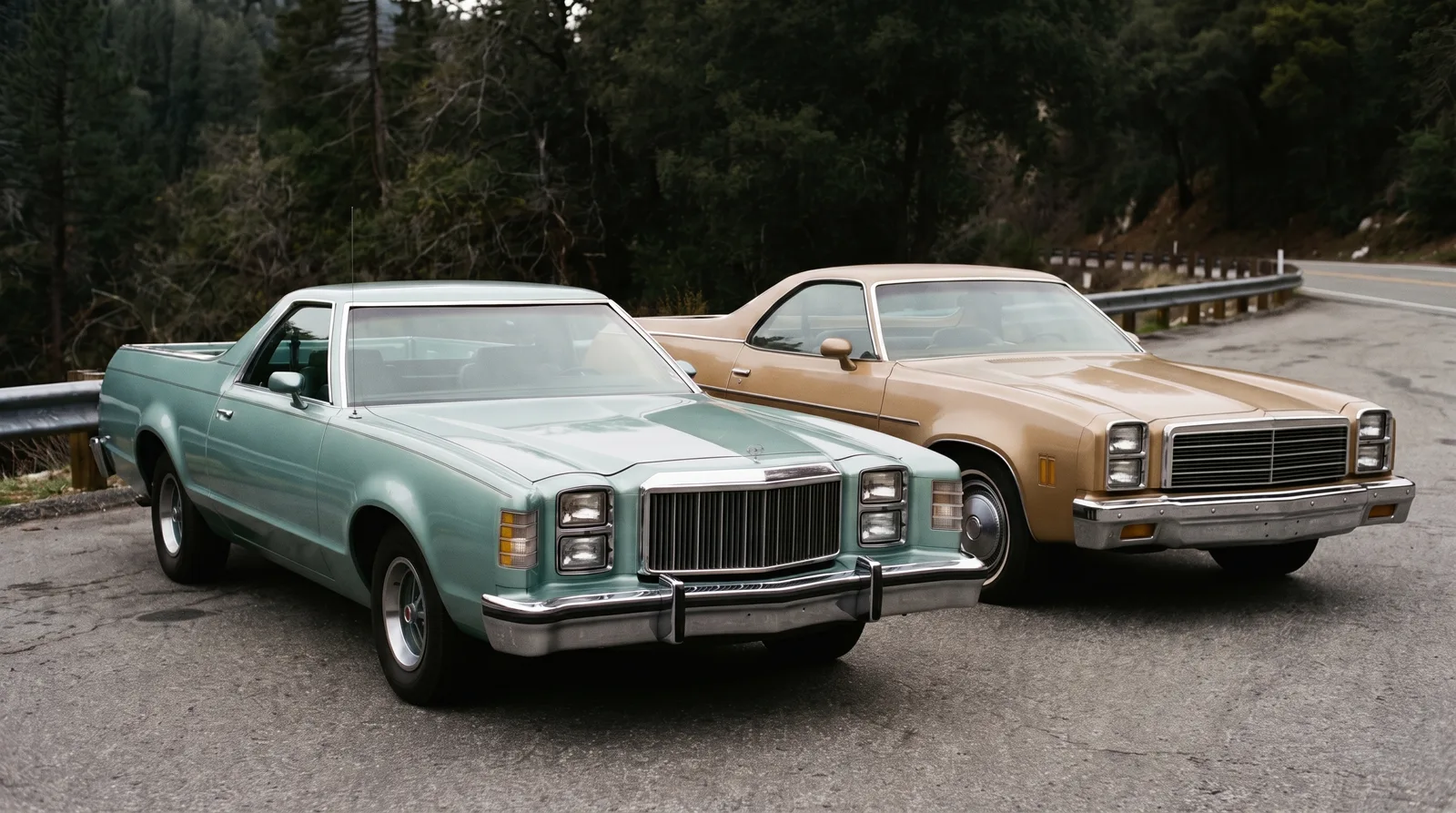
The el camino vs ranchero 1977 torino era marks the point where the two nameplates finally stopped sharing a comparable platform story. Ford had retired the Torino name after 1976, folding the Ranchero into the new LTD II line for 1977, a mid-size platform with formal, personal-luxury styling that traded whatever remained of the truck's sporting pretense for a smoother ride and a more formal, brougham-adjacent presence. Chevrolet, meanwhile, kept the El Camino on the Chevelle-derived Colonnade body it had introduced back in 1973, a mid-size platform that by 1977 was itself approaching the end of its run but had never chased the same personal-luxury direction Ford was now pursuing with the Ranchero.
Car Features
7 min read
1977: The Torino-Based Ranchero Meets the El Camino
In 1977 the Ranchero moved to Ford's LTD II personal-luxury platform while the El Camino stayed on its Colonnade Chevelle bones, a split that foreshadowed very different futures for each nameplate.
Two different bets on what buyers wanted
That divergence is worth sitting with, because it is not a minor trim update, it is two different visions of what a car-truck buyer wanted in the second half of the 1970s. Ford's LTD II-based Ranchero leaned into comfort features, softer suspension tuning, and styling cues borrowed directly from the LTD II coupe and sedan, including a more formal grille and available brougham-style interior trim. The El Camino, still riding the Colonnade Chevelle body, kept a leaner, more angular profile that had more in common with its 1973 origins than with anything Chevrolet was doing on its full-size cars. Neither approach was wrong. They simply reflected each company's read on where the mid-size and personal-luxury markets were heading as the decade wound down.
| Spec | 1977 El Camino | 1977 Ranchero |
|---|---|---|
| Platform | Colonnade Chevelle (since 1973) | LTD II (new for 1977) |
| Design direction | Mid-size, leaner profile | Personal-luxury, formal styling |
| Interior positioning | Chevelle-based trim levels | Brougham-influenced options |
| Engine range | Inline-six through V8, emissions-tuned | V8 lineup, emissions-tuned |
Sales patterns and dealer literature made the split obvious
Sales data from this period reflects the split clearly. Ford's LTD II-based Ranchero found an audience among buyers who wanted the visual comfort of a personal-luxury coupe without giving up cargo capability, a niche that had genuine appeal in the mid-1970s but that also positioned the Ranchero further from its own working-truck origins than at any point since the model's 1957 debut. The El Camino, by staying closer to its Chevelle roots, kept a slightly more utilitarian identity even as Chevrolet layered on the same brougham-adjacent trim options, like the Conquista package, that were fashionable across the entire industry at the time.
Documentation from this era, dealer brochures especially, makes the contrast obvious even to a casual reader. Ford's Ranchero literature for 1977 photographs the truck against suburban driveways and formal-wear occasions, emphasizing comfort and status. Chevrolet's El Camino brochures from the same year still lean on cargo capacity and versatility messaging alongside the Conquista trim options, a more balanced pitch that hedges between utility and style rather than committing fully to either. That hedge turned out to be the more durable strategy, even if it was not obviously the more exciting one at the time.
Diverging lifespans after the 1977 split
Historically, this is also the moment the two nameplates' remaining lifespans start to diverge sharply. The Ranchero had only two model years left after 1977, with Ford discontinuing it entirely after the 1979 model year. Ranchero sales had slid from a peak of more than 45,000 units in 1973 to barely 14,000 by 1979, and Ford's broader strategy was shifting toward dedicated light trucks, the compact Ranger that would arrive for 1983 and the full-size F-Series, that could be engineered and regulated as trucks rather than as passenger-car derivatives, a distinction that mattered increasingly under tightening fuel economy and emissions rules. The El Camino, by contrast, was about to enter a major downsizing transition of its own onto the G-body platform, but that transition kept the nameplate alive and, in fact, extended its life by another decade. Two companies facing the same market pressures in 1977 made very different bets about how to answer them, and only one of those bets kept its car-truck in production past the early 1980s.
"By 1977 the Ranchero had drifted toward LTD II formality while the El Camino stayed closer to its Chevelle identity. That single choice explains most of what happened to each nameplate over the following decade."
- Sarah Whitfield
Engines, regions, and a genuinely different research task today
Powertrain choices in 1977 reflected the same identity split visible in the sheet metal. Chevrolet kept a broad engine range on the Colonnade-based El Camino spanning from an economical inline-six through several V8 displacements, letting a buyer configure the truck anywhere from a fuel-conscious work vehicle to a genuinely capable V8-powered cruiser. Ford's LTD II-based Ranchero leaned more heavily toward V8 power across its lineup, consistent with the personal-luxury positioning the redesign was chasing, since a buyer paying for brougham-style trim and a formal grille was less likely to also want the truck's most austere engine option.
Regional buying patterns from 1977 also hint at how differently each truck was perceived around the country. The El Camino continued to sell strongly in markets with genuine working-truck use cases, ranches, small contractors, and rural buyers who valued its lighter, more agile Chevelle-based footprint alongside its passenger-car comfort. The Ranchero's LTD II-based redesign found more of its audience in suburban and semi-urban markets where the personal-luxury framing resonated more directly, a pattern that dealer inventory data from the period tends to support even without a single comprehensive nationwide sales breakdown to confirm the exact regional split.
Collectors evaluating either nameplate from this specific year today face a genuinely different research task depending on which truck they are chasing. LTD II-based Rancheros are a comparatively narrow slice of the model's overall production run, since the platform only lasted from 1977 through the model's final model year, which makes surviving well-documented examples from this exact window scarcer than the broader Torino-based Ranchero population from earlier years. Colonnade-based El Caminos from 1977, by contrast, sit in the middle of a much longer production span running from 1973 through 1977, giving buyers a wider pool of comparable cars to research condition and pricing against, even though the specific 1977 model year still carries its own distinct trim and engine details worth understanding on their own terms.
A hinge point neither company could see clearly yet
1977 is a hinge point precisely because neither company knew yet how the decade would end for their car-truck. Ford was betting on personal-luxury appeal outliving the fuel crisis pressures already reshaping the industry. Chevrolet was betting on staying flexible. Only one of those bets paid off in the long run, and understanding why requires looking closely at what each company actually built in this specific year rather than judging the decision with the benefit of decades of hindsight. For readers who want the complete arc of this rivalry from its 1960s mid-size beginnings through this late-1970s platform split, the el camino vs ranchero story covers every model year in sequence, and the full story of the El Camino nameplate on its own fills in what came both before and after 1977 specifically. Anyone drawn to this particular window of car-truck history should also take a look at classic El Caminos on the market to see how well-preserved Colonnade-era examples are currently trading.
Sources and notes
Related Reading

About the author
Sarah Whitfield
Third-generation classic car collector specializing in pre-war American and European coachbuilt automobiles. Researcher and concours enthusiast.
Related Listings - Chevrolet El Camino




Comments (1)
M
Mike Ferrano
1 week ago
Which holds money better today, '77 Ranchero or '77 El Camino? Asking for a REAL buyer.
Mike, on a dollar basis the El Camino usually trades more easily, simply because the pool of comparable cars from 1973 to 1977 is deep and buyers know how to price them. The LTD II Ranchero has the opposite problem: only three model years, fewer documented survivors, and a smaller audience for that formal look. Scarcity does not automatically produce a premium. If you are buying to resell, the El Camino is the safer choice. If you want the rarer object, find a Ranchero with its original paperwork and trim intact.