
The second-generation Camaro ran for twelve model years, and its engine list changed almost every year. Any 2nd gen Camaro engine discussion has to start with that fact, because a 1970 car and a 1981 car can both wear a 350 badge and share very little else. Between the two came lower compression, a new way of rating horsepower, catalytic converters, two V6 engines and computer engine control. This article goes through the record year by year, with the factory ratings and the codes that let you check what a car left the plant with.
Car Features
7 min read
Second-Gen Camaro Engines, 1970 to 1981
Every 2nd gen Camaro engine from 1970 to 1981: RPO codes, gross and net ratings, the 402 that wore a 396 badge, and the VIN codes that prove them.
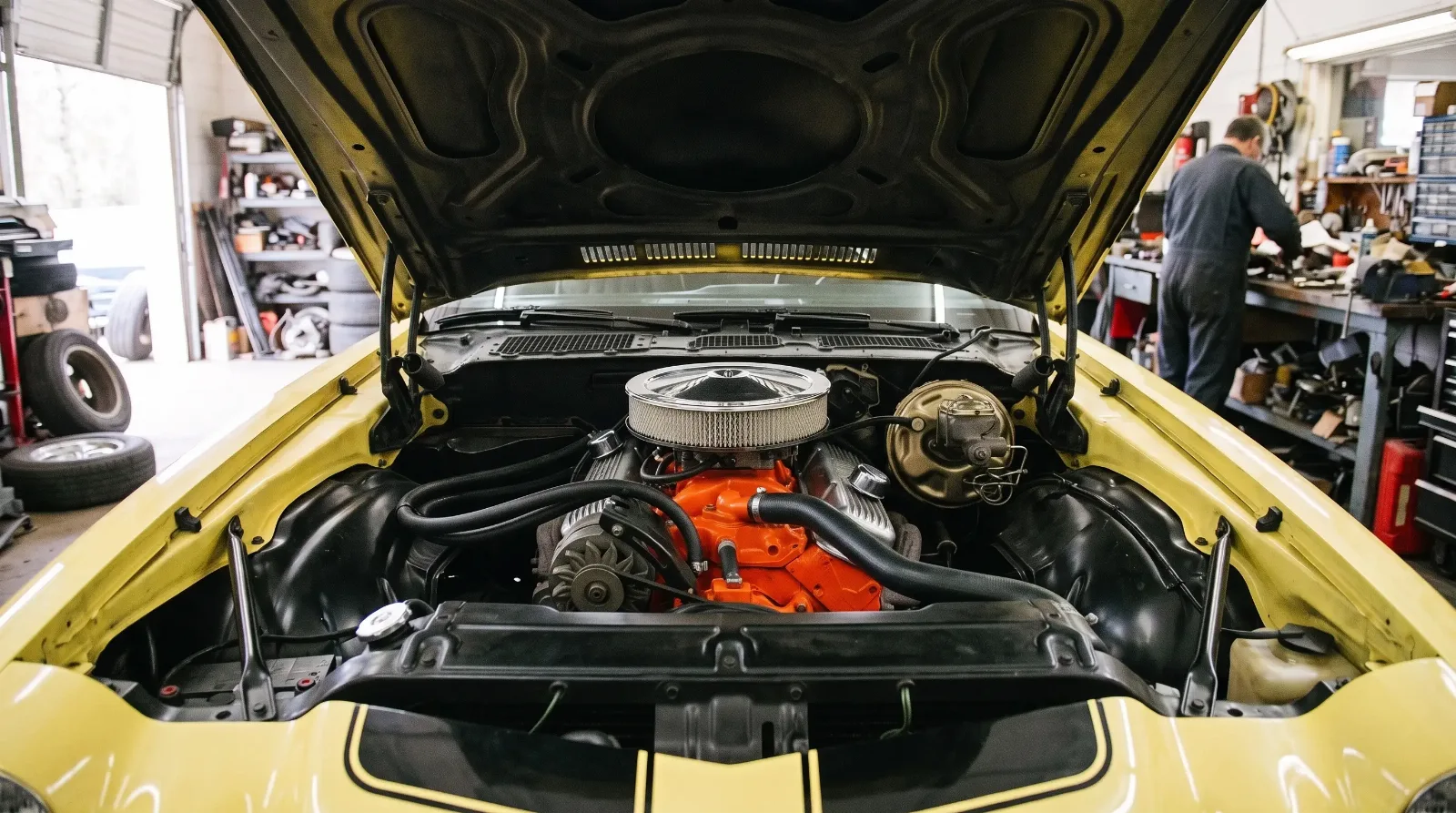
For the body, the plants and the sales history, see the second-gen chapter. Here the subject is only what sat between the front fenders.
The 1970 2nd gen Camaro engine lineup
The car arrived in February 1970, after the late 1970½ launch, with seven engines, all rated in SAE gross horsepower. That rating method measured an engine on a stand without the accessories and exhaust it would carry in the car, so the numbers ran high. They are still the numbers on the factory paperwork, and they are the only fair way to compare one 1970 engine with another.
| RPO | Engine | 1970 rating (gross) |
|---|---|---|
| L22 | 250 inline six | 155 hp |
| L14 | 307 V8 | 200 hp |
| L65 | 350 V8, two-barrel | 250 hp |
| L48 | 350 V8, four-barrel | 300 hp |
| LT-1 | 350 V8 (Z/28) | 360 hp, 380 lb-ft |
| L34 | "396" V8 | 350 hp, 415 lb-ft |
| L78 | "396" V8 | 375 hp, 415 lb-ft |
Two points in that table need a gentle correction, because they are repeated wrongly at shows. First, the "396" engines in the second-gen Camaro actually displaced 402 cubic inches, bored .030 inch over. Chevrolet kept the 396 name on the SS, and from 1971 it marketed the engine as a 402. Second, the L78 at 375 hp and 415 lb-ft was the most powerful engine of the whole 1970 to 1981 run. Nothing that came later matched it on paper.
The LT-1 was the specialist. It had 11.0:1 compression, four-bolt mains, solid lifters, aluminum pistons and a Holley 780 cfm four-barrel. The same engine was rated 370 hp in the Corvette. At the other end, 12,578 of the 124,901 Camaros built for 1970 had the 250 six.
1971 to 1973: lower compression and net ratings
The decline started with a decision, not a regulation. In early 1970, GM president Ed Cole announced lower compression for 1971 so the engines could run on lower-octane unleaded fuel. The 1971 gross ratings show the cut: L65 245 hp, L48 270 hp, LT-1 330 hp and the 402 at 300 hp. Chevrolet also printed net figures that year, and the LT-1's 330 gross became 275 net.
For 1972 the industry went over to SAE net ratings, measured with accessories and exhaust fitted. This is where the record most often gets misread. The 1972 numbers (six 110 hp, 307 130 hp, L65 165 hp, L48 200 hp, Z28 255 hp, 402 240 hp) look like a collapse, but much of the drop is the change in method, not the engine. A 1971 LT-1 at 275 net and a 1972 LT-1 at 255 net are a fair comparison. A 1971 at 330 gross and a 1972 at 255 net are not.
The year 1972 also closed a chapter. It was the last year for the SS 350, the SS 396 and a factory big-block in the classic Camaro; only 970 SS 396 cars were built that year. For 1973 the Z28 changed to the L82 350 with hydraulic lifters, and air conditioning became available on the Z28 for the first time. The 1973 net ratings ran six 100 hp, 307 115 hp, L65 145 hp, L48 175 hp and Z28 245 hp.
"People tell me the 1972 cars lost a hundred horsepower overnight. They did not. The engines lost some compression in 1971, and the rating method changed in 1972. Read the two changes separately and the record makes sense."
Tom Ramirez
1974 to 1976: catalytic converters and the low point
For 1974 the 307 was dropped in favor of a two-barrel 350, and the Z28 got HEI ignition with its L82 350 at 245 hp net. That was the Z28's last year before a break, dropped "due to tight emission regulations" despite more than 13,000 sales.
Then came 1975. Every US GM passenger car got a catalytic converter that year, and HEI became standard on every Camaro engine. The lineup shrank to three: the 250 six at 105 hp and two 350 V8s at 145 hp and 155 hp. That 155 hp figure is the low point of the generation for V8 output. Buyers still chose the V8 by a wide margin; of 145,770 Camaros built for 1975, 116,021 had one.
The 305 V8 arrived for 1976 at 140 hp, standard on the Type LT. One reference says the 305 came in 1975, but its own text contradicts itself, and the other sources agree on 1976. The 350 four-barrel made 165 hp that year and the six held at 105 hp.
1977 to 1981: the LM1 Z28, V6 engines and a computer
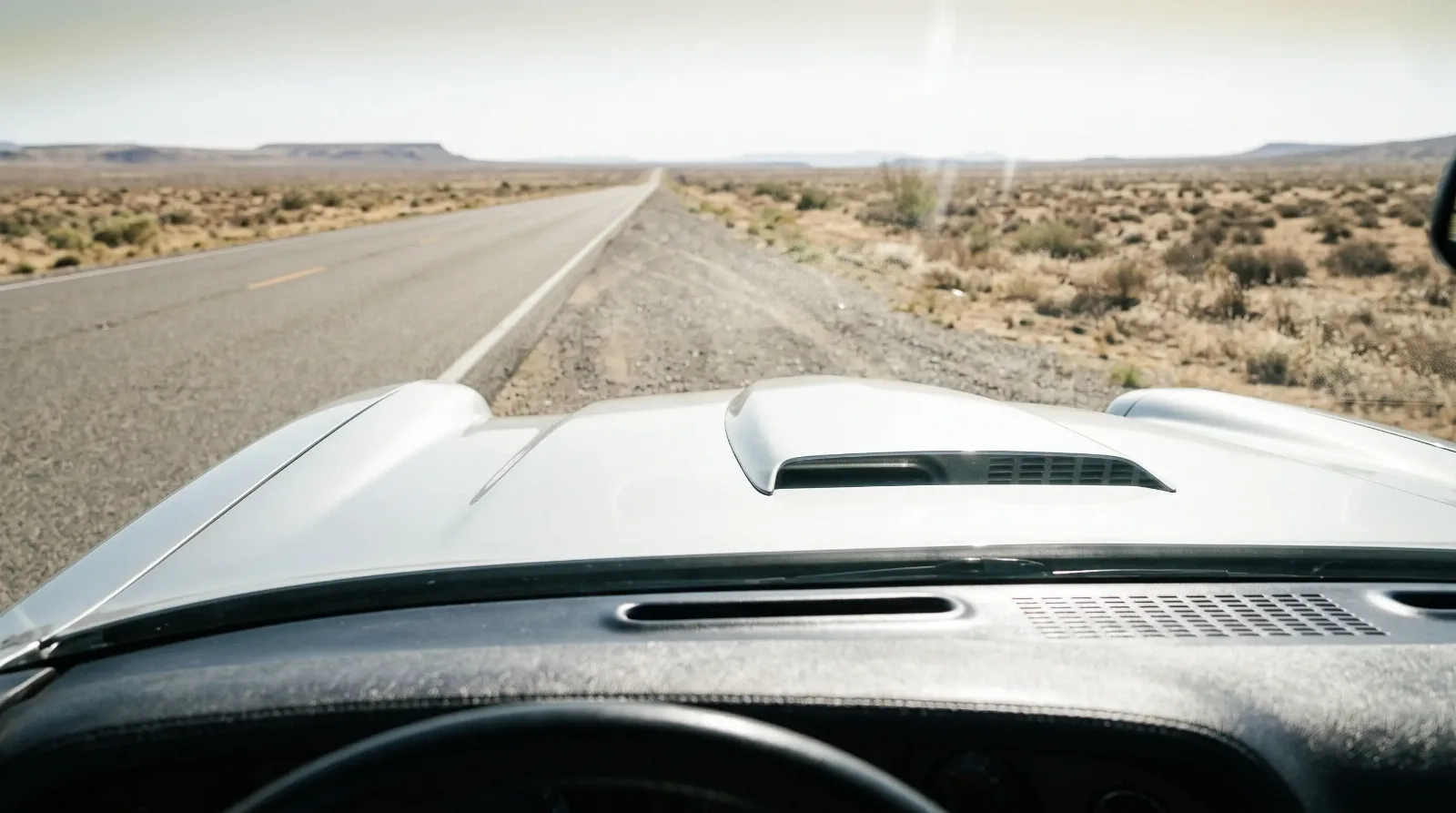
The Z28 came back in spring 1977 as the "1977½" with the LM1 350 four-barrel: 185 hp at 4,000 rpm and 280 lb-ft at 2,400 rpm, 8.5:1 compression, and 175 hp in California. The rest of the 1977 range ran the 250 six (now standard on both the Sport Coupe and the LT), a 305 at 145 hp and a 350 at 170 hp. The LM1 kept 185 hp for 1978 and was listed at 175 hp for 1979.
The 1979 lineup was the 250 six at 115 hp, a two-barrel 305 at 130 hp and the four-barrel 350 at 175 hp. That was the engine range of the generation's biggest sales year, which is covered here. By then the V8 dominated; of 272,631 Camaros built for 1978, 235,649 were V8 cars.
For 1980 the inline six went away. In its place came a 229 V6 (LC3) in 49 states and a 231 V6 (LD5) in California, plus a small L39 267 V8 at 120 hp and 215 lb-ft. The Z28 got a 350 four-barrel at 190 hp, its highest rating since 1974, while California Z28s used a 305 with the TH350 automatic.
The last year, 1981, brought GM's Computer Command Control system, with its check-engine light, and the 17-digit VIN. The Z28's 350 was rated 175 hp and came only with the automatic; four-speed and California buyers got a 305 at 165 hp. Of 126,139 Camaros built for 1981, 52,004 had a V6.
Reading the engine codes
The paperwork improves as the generation goes on. For 1970 and 1971 the VIN gives only the cylinder count, so a V8 car's original engine has to be confirmed from other documents and the stamped engine pad. From 1972 the fifth VIN digit carries an engine letter: D for the 250, F for the 307, H for the 350, K for the SS 350, L for the Z28 and U for the 396. In 1973 and 1974 the Z28 engine was coded T.
The 2nd gen Camaro engine record is not a simple fall from 375 hp to 175 hp. It is a set of separate changes, each with a date: compression in 1971, net ratings in 1972, the big-block's end after 1972, catalytic converters in 1975 and computer control in 1981. Keep them apart and almost every argument about these cars can be settled with the codes.
Sources and notes
- Hagerty: Your handy 1970-81 Chevrolet Camaro buyer's guide (ratings, production and VIN engine codes)
- Chevy Hardcore: Camaro engines through the years, second generation (RPO codes)
- Muscle Car Facts: 1970 Camaro engines and ratings
- Collector Car Market: 1970-74 Chevrolet Camaro profile (1972 SS 396 count)
- Wikipedia: Chevrolet Camaro (second generation)
- Wikipedia: Chevrolet Camaro, model-year production table
Related Reading
Have a
Chevrolet Camaro
for Sale?
Reach thousands of serious classic car collectors across the US.
Sell It Here →
Selling a classic? Here's how: compare the places to sell classic cars
Are You a Classic Car Dealer?
List your full inventory and connect with targeted classic car buyers.
Join as a Dealer →
#camaro z28
#chevrolet camaro
#ss-396
#LT-1 350
#second generation Camaro
#Camaro engines
#VIN engine codes

About the author
Tom Ramirez
Corvette researcher and historian based in Bowling Green, Kentucky. Two decades documenting Corvette production history from original factory records.
Related Listings - Chevrolet Camaro


Comments
Be the first to comment on this article.