
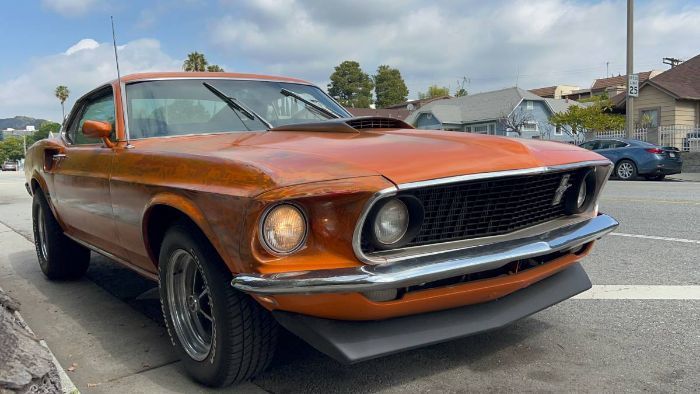
The 1979 Mustang turbo made 131 to 132 hp from 2.3 liters. The 302 V8 in the same showroom made 139 to 140 hp from more than twice the displacement. On a spec sheet that is close to a tie, and the spec sheet is where the first turbocharged Mustang looked its best. The turbo lasted about two and a half model years, and the reasons it arrived and the reasons it left both come down to a handful of numbers.
Car Features
8 min read
The 1979–1981 Turbo Mustang: The First Turbocharged Mustang
Ford's 2.3 turbo four made 131 to 132 hp on 5 psi with no intercooler, out-rated the 1980 V8, then faded on reliability. The numbers behind it.
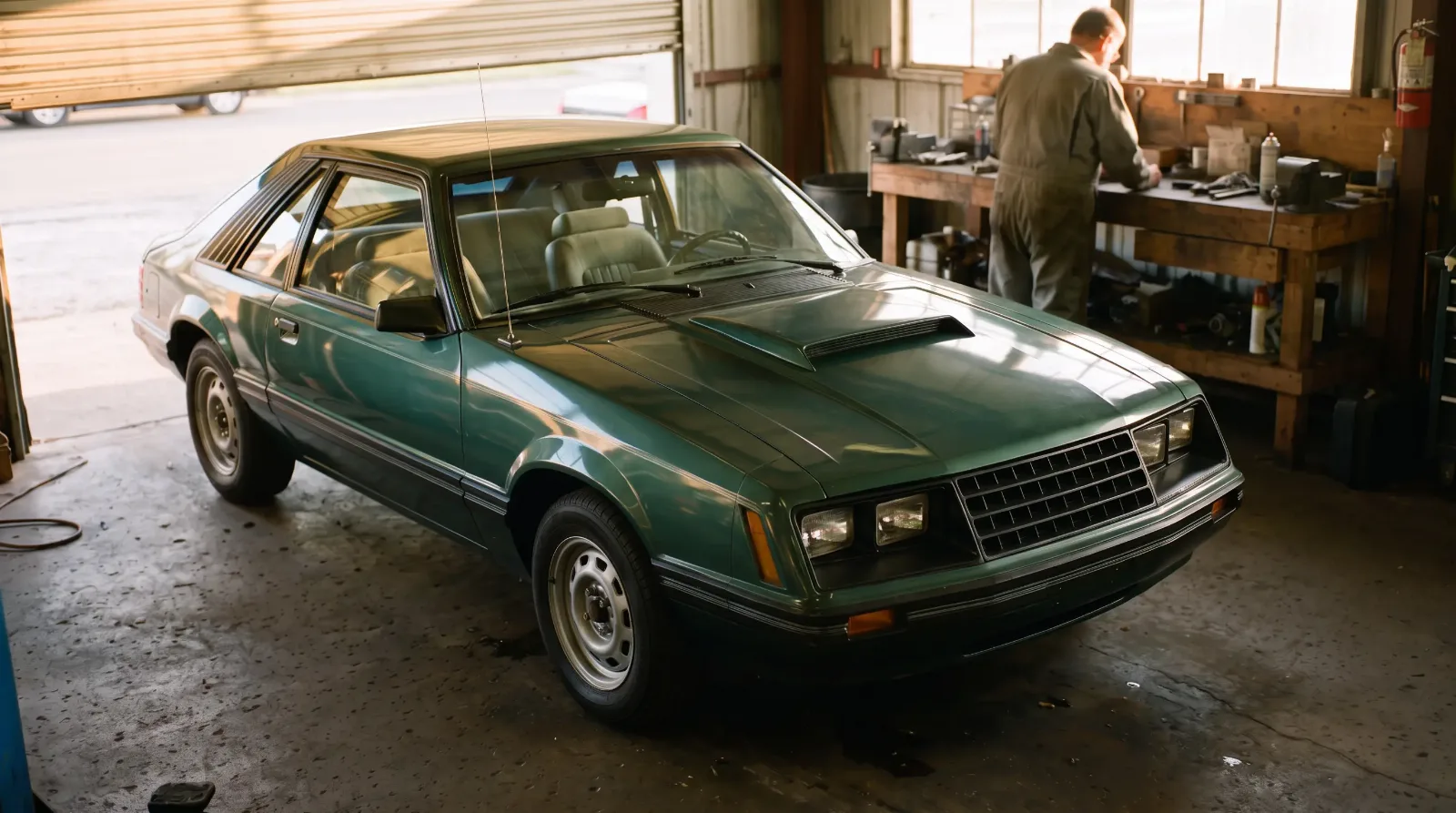
The new Fox-body car around it is its own story, and a big one (more on that here). This piece stays under the hood. What Ford bolted onto its four-cylinder, what it got for the trouble, how the turbo compared with the V8s it shared a price list with, and why it was gone before the 1982 cars arrived.
What Ford bolted onto the 2.3 Lima four
The starting point was the 2.3 liter (140 cubic inch) single-overhead-cam four that Ford built in Lima, Ohio. It had been in the Mustang since 1974, and in base 1979 form it made 88 hp. Nobody bought it for speed.
Ford's fix was a turbocharger in a draw-through layout with no intercooler, and boost limited to 5 psi. Draw-through means the carburetor sits ahead of the turbo. The engine mixes fuel and air first, and the compressor then pulls that wet mixture through and pushes it into the intake. Draw-through is simpler and cheaper to package. It also means the compressor handles fuel, and with no intercooler the charge goes into the cylinders as hot as the turbo leaves it.
Five psi is a mild number. Mild was the point. Without an intercooler and with a carburetor, there was not much room to push harder before detonation became the problem. The gain was still real: from 88 hp to 131 or 132 hp is roughly a 49 percent jump from the same 140 cubic inches. The same hardware went into the Mercury Capri, its Fox-body twin.
| Engine | Mustang years | Rated output | Note |
|---|---|---|---|
| 2.3 four | 1979 | 88 hp | Base engine |
| 2.3 turbo four | 1979 to 1980 rating | 131 to 132 hp | Draw-through, no intercooler, 5 psi |
| 2.8 V6 | 1979 | 109 hp | Dropped late in 1979 for supply reasons |
| 3.3 six | 1979 | 89 hp | Added early in the model year |
| 302 V8 | 1979 | 139 to 140 hp | Gone after 1979 |
| 4.2 (255) V8 | 1980 to 1981 | 118 to 120 hp | Automatic only |
| 2.3 Turbo GT | 1983 | 145 hp | Fuel injection; 483 sold |
| SVO 2.3 turbo | 1984 to 1985 | 175 hp, 210 lb-ft | Intercooled, about 14 psi |
The 1979 Mustang turbo against the 302
Put the 1979 Mustang turbo next to the 302 and the numbers look friendly. The V8 had about 8 more horsepower. Per cubic inch the four was making about 0.94 hp against the V8's 0.46, which is the kind of ratio that sells turbochargers to engineers. It is also the kind of ratio that tells you nothing about torque, and torque is what a driver feels at a light.
The acceleration figures that still circulate on spec sites say the same thing: about 9.1 seconds to 60 mph for the turbo and 8.3 for the 302. Nobody has tied those to a named magazine test, so treat them as rough. The one period road test I could put my hands on was less kind. When the British magazine Motor Sport drove a Ghia Turbo in November 1979, the brochure figure it quoted was 10.4 seconds to 60, and the writer called the performance mediocre. The direction is believable. A low-boost turbo four without much low-end torque gives up most of its deficit before the turbo is doing any work.
Ford still put the turbo at the front of its sporty packages. The 1979 Cobra was a $1,200 option, hatchback only, and the 2.3 turbo was its standard engine, with the 302 as the upgrade. Ford built 17,579 Cobras that year. The Indy pace car replicas told the same story from the buyer's side: 5,970 went out with the turbo, every one with a four-speed manual, against 4,508 with the V8. More than half of the people who bought the loudest-looking Mustang of 1979 took the four.
The car around the engine helped. The Fox Mustang was about 200 lb lighter than the Mustang II it replaced, and the $298 Michelin TRX package brought metric forged wheels, 195/60 tires and a specific suspension tune. A turbo car on TRX was a better-handling Mustang than anything Ford had sold in years.
1980 and 1981: when the four out-rated the V8
For 1980 the 302 left the lineup. Its replacement was a 4.2 liter (255 cubic inch) V8 rated at 118 to 120 hp and sold only with an automatic. That is the lowest-rated V8 ever put in a Mustang.
Do the subtraction. The turbo four's 131 to 132 hp beat the only V8 on the order sheet by a good 11 hp or more, and it could be had with a manual gearbox. For the 1980 model year, the most powerful engine you could order in a Mustang had four cylinders. That had never happened before, and it says as much about emissions-era V8s as it says about the turbo.
The market did not reward it. Mustang production fell from 369,936 in 1979 to 271,322 in 1980 and 182,552 in 1981. The Cobra package, the turbo's natural home, went from 17,579 cars to 5,550 and then 1,821, and Ford dropped both the Cobra and the Ghia after 1981.
The fix for a weak Mustang lineup did not come from the turbo. It came from the V8. For 1982 the 302 returned as the 5.0 HO at 157 hp, the GT name came back after 13 years, and Ford's message was that the Boss is back. The turbo was not part of that pitch.
Why the turbo went away
The sources agree on the verdict and disagree on the date. One says the turbo was optional through calendar 1981 in the United States. Another says it was already gone by 1981 because of reliability problems. The safest reading is that it was offered early in 1981 and then dropped. Both records name the same cause: reliability.
Neither record itemizes the failures, and I won't invent a list. The clearest account I found comes from Sports Car Market, which says Ford had to do a good deal of service work on these turbos, most of it on drivability and on balancing the two-barrel carburetor against the turbo. The same piece points to heat soak when the engine was shut off hot. That fits what any engine builder checks first on a late-1970s draw-through turbo. The turbo's bearings live on engine oil, and a hot turbo shut off with no cool-down can cook that oil in the center section. The period advice was to let the engine idle for a few minutes after a hard run, and not every owner did. Early drivability trouble also hit resale values of the 1979 and 1980 cars hard.
"Five psi with no intercooler and a carburetor ahead of the compressor is a cautious recipe, and it still made more power than Ford's own V8 a year later. The peak number was never the problem. How long the parts lived making it was the problem."
Dan Reeves
What the next turbo Mustangs fixed
Ford's next production turbo Mustang was the 1983 Turbo GT. It used the same 2.3, now with electronic fuel injection in place of the draw-through carburetor, and it was rated at 145 hp. Ford sold 483. By then the 5.0 HO was rated at 175 hp, so the turbo four was once again second best, and buyers knew it.
The real answer came in 1984 with the SVO. It kept the 2.3 Lima block and changed nearly everything that had held the 1979 car back. A Garrett AiResearch T03 turbo ran around 14 psi, nearly three times the old limit, and an air-to-air intercooler cooled the charge on its way in. Output was 175 hp and 210 lb-ft for 1984 and 1985, then 205 hp for the 1985½ cars. Same displacement as 1979, roughly 55 percent more power than the first turbo at its 1985½ peak, and this time the hardware was designed to live with the boost. That car, and the Cobras and Saleens that followed, belong to a different chapter (read more here).
Read the 1979 to 1981 turbo as the first draft. It proved Ford could make V8-class peak numbers from a four. It also proved that peak numbers are the easy part. Durability, low-end torque and charge temperature are where the work is, and Ford needed five more years and a racing division to get them right.
Sources and notes
- Ford Mustang (third generation), Wikipedia
- Ford Pinto engine (2.3 Lima and turbo versions), Wikipedia
- 1979 Ford Mustang engines, production and prices, MustangSpecs
- 1979 Mustang Indy pace car replica engine split, MustangSpecs
- Road Impressions: Mustang Ghia Turbo, Motor Sport, November 1979
- Forced-Induction Foxes, Sports Car Market (2019)
Related Reading

Have a
Ford Mustang
for Sale?
Reach thousands of serious classic car collectors across the US.
Sell It Here →
Selling a classic? Here's how: compare the places to sell classic cars
Are You a Classic Car Dealer?
List your full inventory and connect with targeted classic car buyers.
Join as a Dealer →
#Ford Mustang
#Mustang engines
#Fox-body
#1979 Mustang
#2.3 turbo
#turbocharged Mustang
#Mustang Cobra

About the author
Dan Reeves
Performance engine builder from North Carolina's motorsports corridor, focused on swaps, forced induction and making real, repeatable power.
Related Listings - Ford Mustang
Comments
Be the first to comment on this article.