
Walk the rows at a Mustang swap meet after dark and the 1979 Mustang pace car is one of the easier cars to pick out, even under the streetlights. Pewter over black, orange and red stripes, a deep air dam with fog lamps set into it, and a spoiler across the tail. It looks like nothing else Ford sold that year, and that was the idea. The car paced the 63rd Indianapolis 500 in the first season of a brand-new Mustang, and Ford turned that one afternoon in May into roughly 10,500 replicas that anyone could order from a dealer.
Car Features
8 min read
The 1979 Indy 500 Pace Car Mustang
Jackie Stewart paced the 1979 Indy 500 in a new Fox Mustang. What the track cars had, what the 10,478 replicas got, and the turbo vs V8 split.
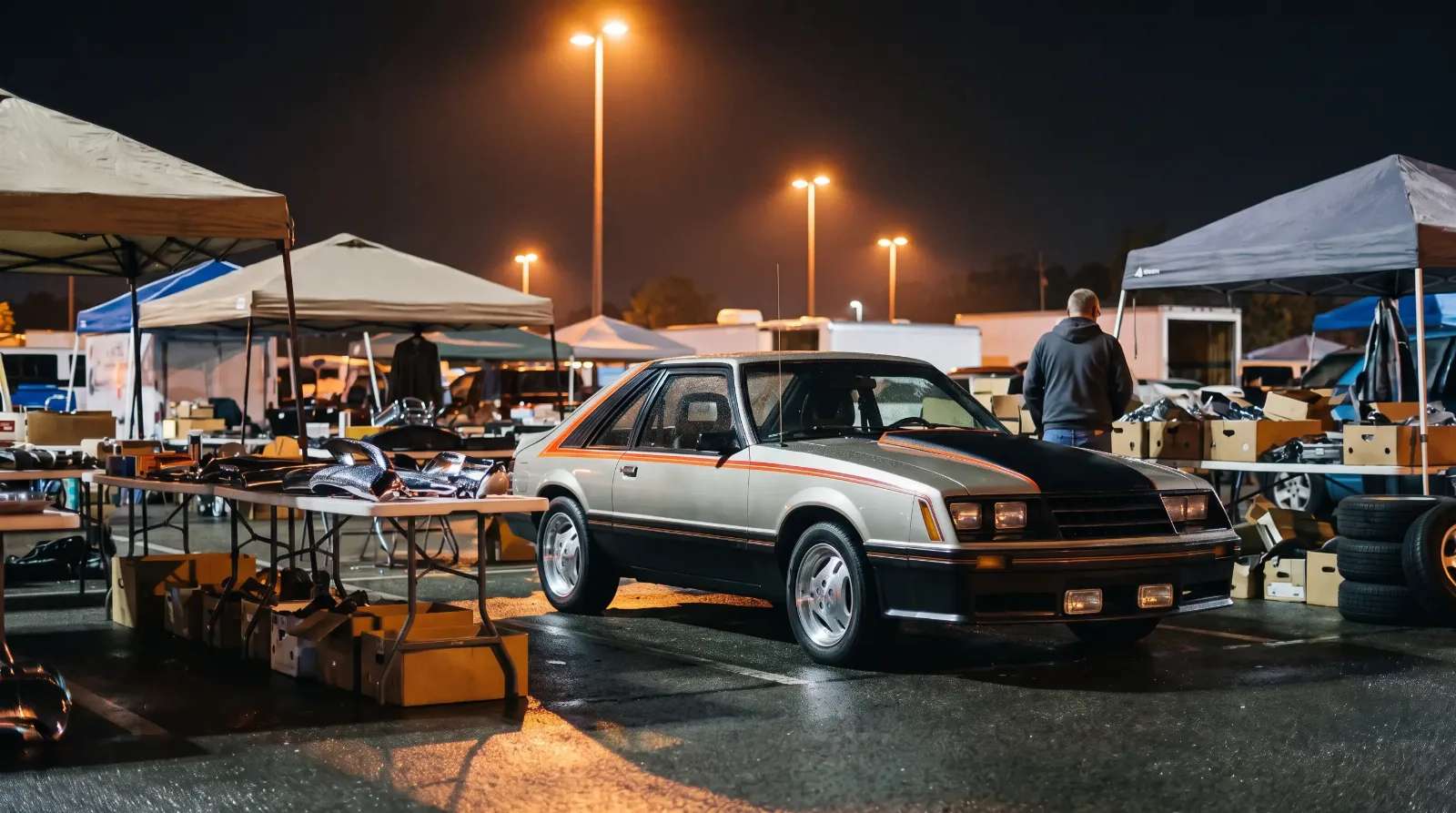
This is the story of that one car. The wider arc of the platform underneath it is covered in our Fox Body history, which runs all fifteen model years. And the reason a Mustang at the Speedway meant something to Ford goes all the way back to 1964, which is a part of the origins of the Mustang that tends to get left out of the retelling.
Why Ford wanted the pace car in 1979
The 1979 Mustang was a clean break. It was the first Mustang on the Fox platform, the rear-drive chassis Ford had introduced a year earlier under the Fairmont and the Mercury Zephyr. It rode on a 100.5-inch wheelbase, about four inches longer than the Mustang II it replaced, and it still came in about 200 lb lighter. Jack Telnack's design team gave it a crisp wedge shape with a drag coefficient of 0.44 in hatchback form. Those are good numbers. They are also numbers, and numbers do not stop people on a showroom floor.
A pace car does. Indianapolis put whatever led the field in front of a huge crowd and into every photograph of the start, and Ford had used that stage before. A Mustang paced the race in 1964, the year the car went on sale, with Benson Ford as pacemaker. Fifteen years later the company had a whole new generation to introduce and the same front row available. The timing worked out. Ford built 369,936 Mustangs for 1979, the best year the Fox car would ever have.
Jackie Stewart and the cars that ran at the Speedway
The 63rd Indianapolis 500 ran on May 27, 1979. Jackie Stewart drove the pace car, and Rick Mears won the race for Penske. For a Mustang that Ford was selling on handling as much as on looks, a driver of Stewart's standing at the wheel said more than a brochure could.
The cars on the track were not quite the cars in the showrooms. The actual pace cars wore T-tops, cut in by Cars & Concepts of Brighton, Michigan. There were three of those track cars, and Jack Roush prepared the 302 V8s inside them with Boss 302 camshafts and reworked heads. None of that Roush hardware reached the showroom cars.
The T-top is the useful part. Ford did not offer a T-top on a production Fox Mustang until 1981. A 1979 replica came with a conventional sunroof instead. So a 1979 pace car with T-tops is either one of the Speedway cars or somebody's later conversion, and that is a difference you can see from across a parking lot. It settles a surprising number of show-field arguments.
What came on a 1979 Mustang pace car replica
The count depends on who did the counting. MustangSpecs gives 10,478, and its engine-by-engine breakdown adds up to exactly that. Wikipedia gives 10,479. A one-car gap like that is the sort of thing registry people lose sleep over, and nobody has closed it yet, so "about 10,500" is the honest way to say it out loud.
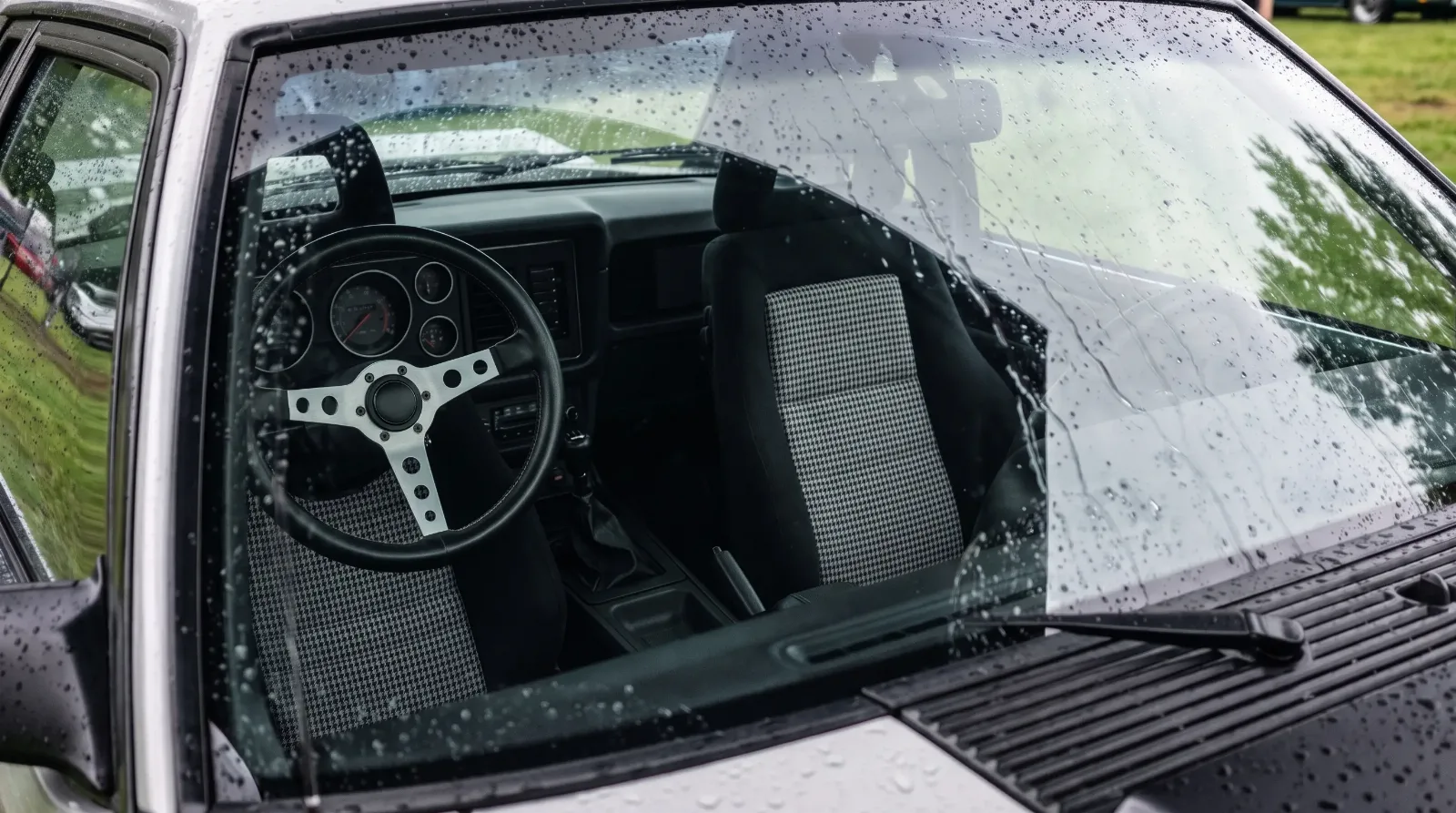
The package was more than paint. The pewter and black two-tone carried orange and red striping. The air dam up front held Marchal fog lamps, and a three-piece spoiler sat across the rear of the hatchback. Underneath, the car rode on Ford's TRX suspension with Michelin TRX tires: the metric 195/60HR390 tire on forged 390 mm wheels, a package that cost $298 as an option on any other 1979 Mustang. Inside were Recaro seats, a European touch in an American pony car of that era.
| Item | 1979 pace car replica |
|---|---|
| Production | 10,478 (10,479 in some references) |
| Engines | 2.3 turbo four or 302 V8 |
| Turbo cars | 5,970, four-speed manual only |
| V8 cars | 4,508 (2,402 manual, 2,106 automatic) |
| Paint | Pewter and black, orange and red stripes |
| Front end | Air dam with Marchal fog lamps |
| Rear | Three-piece spoiler |
| Wheels and tires | TRX suspension, Michelin TRX 195/60HR390 on 390 mm wheels |
| Seats | Recaro |
| Roof | Sunroof (no T-top) |
| Lettering | "Official Pace Car" decals, optional and dealer-applied |
The detail people argue about most is the lettering, and it turns out to matter least. The "Official Pace Car" decals were optional, and the dealer put them on. Some buyers wanted them. Some did not care to drive to work advertising a race. A replica without the decals is not automatically a fake, and a car wearing them is not automatically real. The paint, the Recaros, the TRX wheels and the sunroof tell you far more than the stickers do.
It also helps to keep the pace car apart from the other dressed-up hatchback Ford sold that year. The Cobra package was a $1,200 option, hatchback only, and Ford built 17,579 of them in 1979. Both cars leaned on the turbo four and both looked fast parked. The pace car was the rarer of the two by a wide margin.
Turbo or V8: how the buyers split
Buyers had two engines to choose from, and they split more evenly than most people would guess. The turbocharged 2.3 four went into 5,970 replicas, every one with a four-speed manual. The 302 V8 went into 4,508, with 2,402 manuals and 2,106 automatics.
The turbo was the new idea for 1979. It was a draw-through setup with no intercooler, held to 5 psi of boost, and it made 131 to 132 hp. The longer story of the 2.3 Turbo is not a happy one. Reliability trouble followed it, Ford pulled it from the United States lineup by 1981, and only an improved version came back, in the 1983 Turbo GT. The 302 was the familiar choice, rated at 139 to 140 hp, which was modest for a V8 but honest about what it was.
Acceleration times for the replica are harder to pin down than you would expect, and I have not found a period road test of the pace car itself that I would quote. The general verdict holds up, though. With 250 lb-ft of torque on tap, the V8 was the stronger, more relaxed car and the easier one to live with.
What makes the V8 replicas interesting now is what came after them. For 1980 and 1981 the 302 left the Mustang, and the only V8 on the order sheet was a 4.2 rated at 118 to 120 hp, automatic only. A buyer who wanted a V8 Mustang with a clutch pedal had to wait for the 1982 GT and its 157 hp 5.0. So a 1979 pace car with the 302 and a manual gearbox marks the end of something, even if nobody at the dealership saw it that way at the time.
"The pace car is the best argument the 1979 Mustang ever made for itself. Take away the stripes and you still have a car that told people Ford was done apologizing for the Mustang II."
Patrick Walsh
Where the 1979 Mustang pace car sits in the story
Ford brought the Mustang back to Indianapolis in 1994, when a Cobra convertible paced the 78th race and 1,000 replicas followed it into showrooms. Line the three Mustang pace car years up, 1964, 1979 and 1994, and each lands at the start of a new chapter for the car. I doubt anyone planned that pattern thirty years ahead. It still reads well on paper, and it gives the 1979 car a clear place in the full history of the Ford Mustang, start to finish.
Of the three, the 1979 car is the one people forget to take seriously, partly because it was built in the largest numbers and partly because the Fox body was everywhere for fifteen years. That is a shame. It was the car Ford chose to introduce a whole new Mustang to the public, it carried equipment the regular car did not, and its V8 version was among the last 302 Mustangs before a two-year gap. Of all the 1979 Mustangs still on the road, it is the one with the best story attached, and the pewter paint makes it easy to find, even at a swap meet after dark.
Sources and notes
- MustangSpecs: 1979 Ford Mustang Indy pace car, equipment and engine split
- MustangSpecs: 1979 Ford Mustang specifications and production
- Jalopnik: why the 1979 Mustang Indy 500 pace car was such a big deal
- Wikipedia: Ford Mustang (third generation)
- Wikipedia: 1979 Indianapolis 500
- Wikipedia: Indianapolis 500 pace cars
Related Reading
Have a
Ford Mustang
for Sale?
Reach thousands of serious classic car collectors across the US.
Sell It Here →
Selling a classic? Here's how: sell my classic car
Are You a Classic Car Dealer?
List your full inventory and connect with targeted classic car buyers.
Join as a Dealer →

About the author
Patrick Walsh
Automotive journalist covering classic car shows, events, and the enthusiast community across North America.
Related Listings - Ford Mustang
Comments
Be the first to comment on this article.