
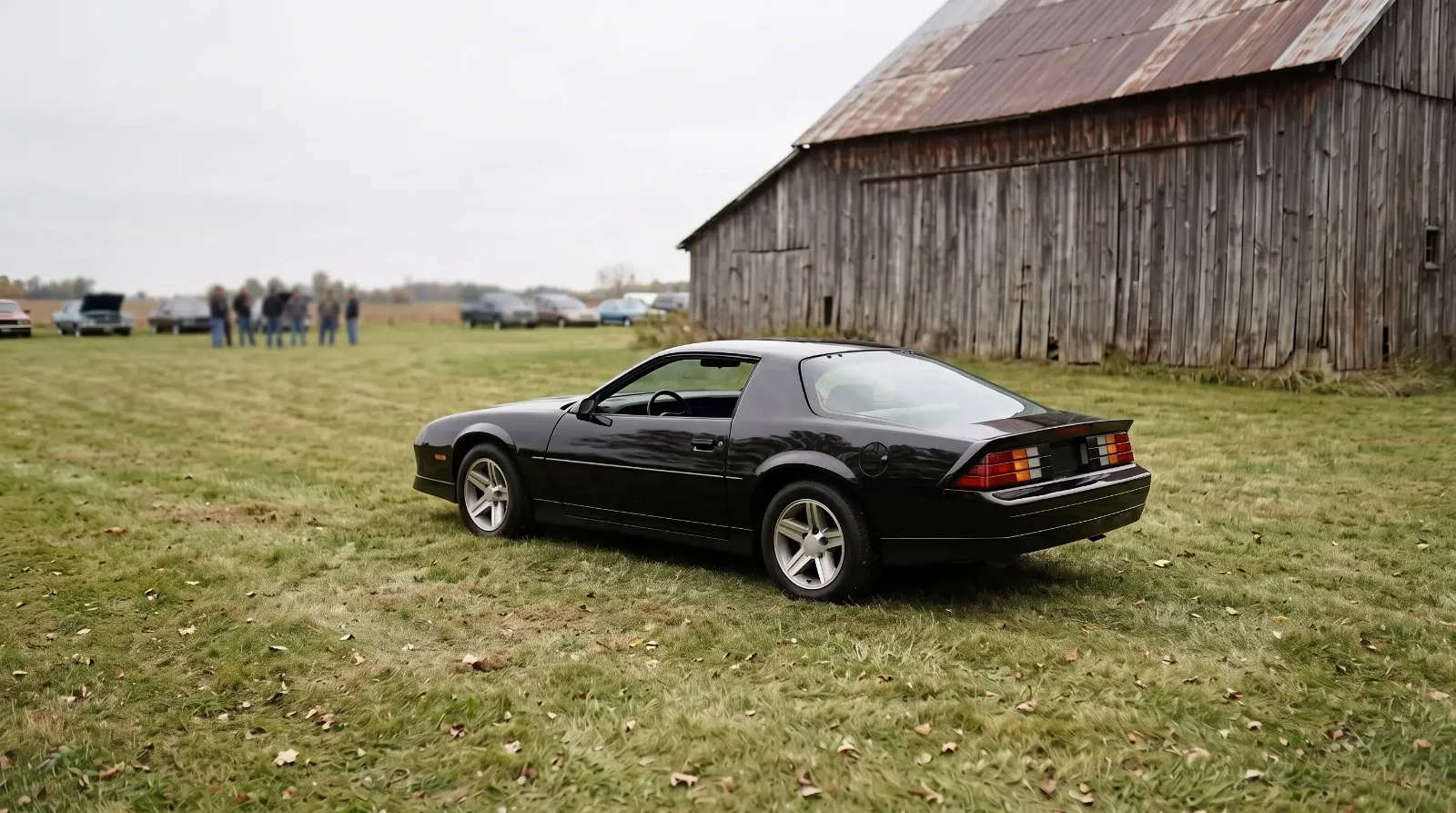
The headline number for the 1987 IROC-Z 350 is 330 lb-ft of torque. That figure, not the horsepower, is what changed the car. For 1987 Chevrolet dropped its 5.7-liter Tuned Port Injection V8, the L98 family engine, into the Camaro for the first time, and it went into one car only: the IROC-Z, with an automatic, and nothing else. The rating was 225 hp at 4,400 rpm and 330 lb-ft at 2,800 rpm. Put that next to the 305 TPI and the reason buyers paid extra is plain. This piece sticks to that one model year and that one engine. If you want the whole run from 1985 to 1990, the full story covers it.
Car Features
7 min read
The 1987 IROC-Z 350: When the L98 Arrived
In 1987 the 5.7 TPI V8 reached the Camaro: 225 hp, 330 lb-ft, IROC-Z coupe only, automatic only. What it delivered and why the first year matters.
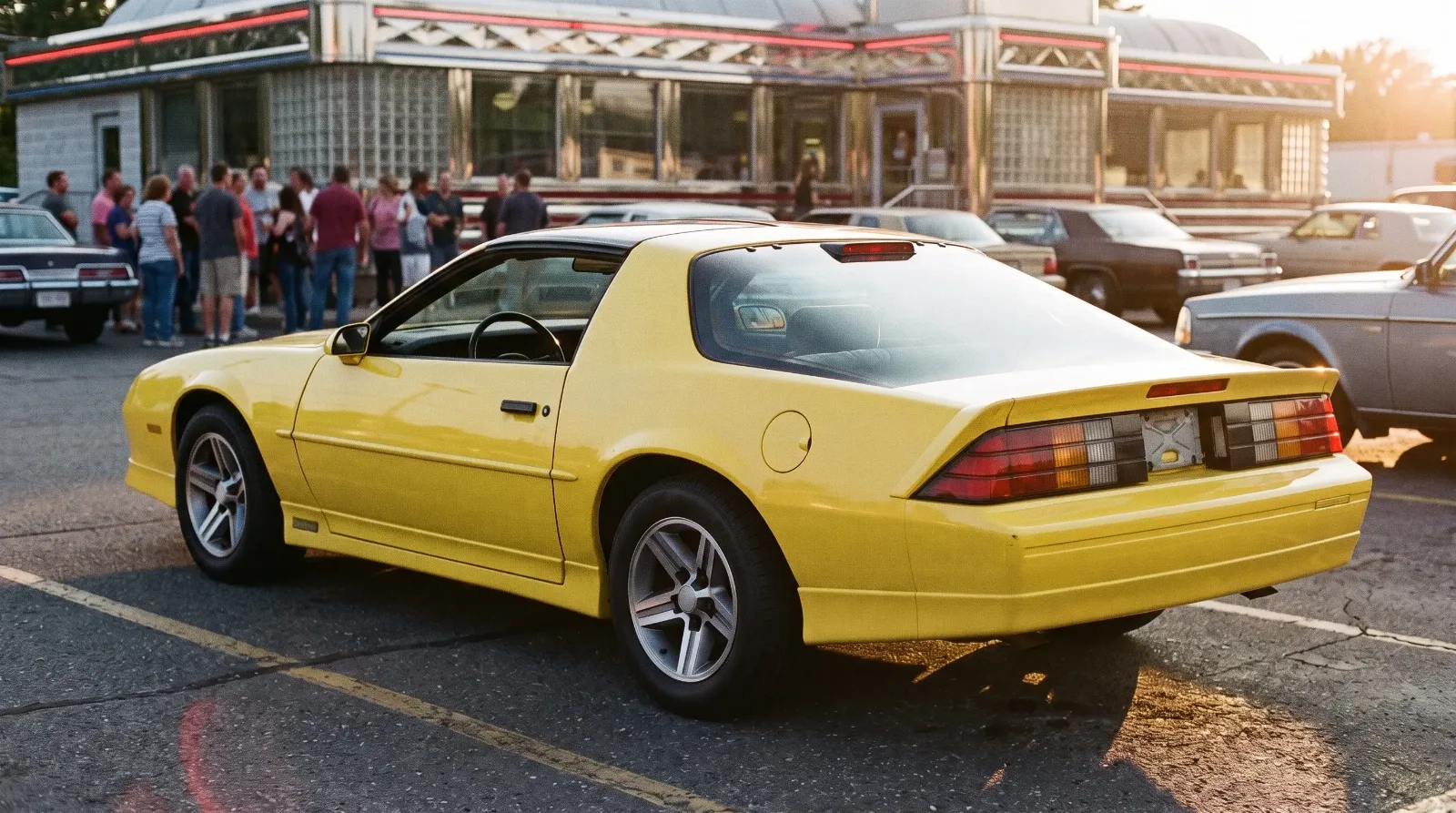
What the L98 actually delivered in 1987
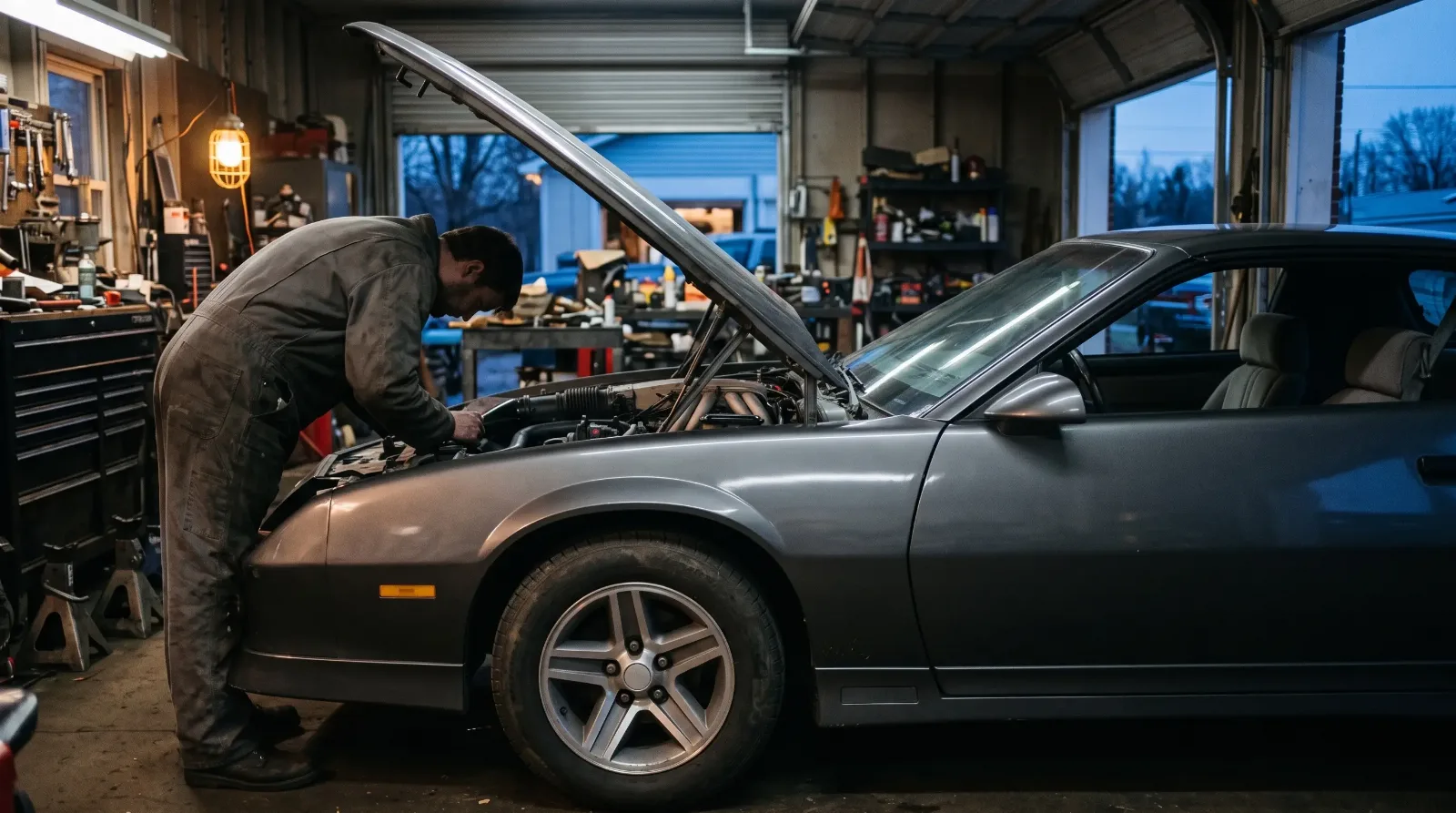
Start with the 305. In 1987 the LB9 5.0 TPI was rated at 190 hp with the automatic and 215 hp with the five-speed. The 350 added 35 hp over the automatic 305 and 10 hp over the manual one. On paper that is a modest gain. Horsepower was never the story with this engine, though. The long tuned runners on the TPI manifold are built to fill the cylinders at low and middle revs, and the extra cubic inches put the torque peak at 2,800 rpm, right where a street car spends its life.
The power peak at 4,400 rpm tells you the other half. This is not an engine that wants to be wound out. The runners that help it at 2,800 choke it near the top, so the 350 pulls hard off a light and then flattens. Drivers who expect a big-block rush at 5,500 rpm come away disappointed. Drivers who measure a car by how it leaves a stoplight in traffic come away grinning.
| 1987 IROC-Z V8 | Order code | Transmission | Rated output (SAE net) |
|---|---|---|---|
| 5.0 TPI (LB9) | LB9 | 4-speed automatic | 190 hp |
| 5.0 TPI (LB9) | LB9 | 5-speed manual | 215 hp |
| 5.7 TPI (L98 family) | B2L | TH700-R4 4-speed automatic only | 225 hp @ 4,400 rpm, 330 lb-ft @ 2,800 rpm |
One more number worth knowing if you are shopping: the eighth character of the VIN. On these cars an 8 means the 350 TPI, and an F means the 305 TPI. A 1987 IROC-Z badged as a 350 with an F in that slot is a 305 car that somebody upgraded, or a car somebody wants you to think was upgraded at the factory.
Why the IROC-Z 350 rated below the Corvette
The Corvette got the L98 in 1985, two model years ahead of the Camaro, and in 1987 it was rated at 240 hp. The Camaro version came in 15 hp lower. Some owners still read that as Chevrolet holding the F-body back to protect the Corvette. The hardware tells a simpler story. The Camaro engine ran 9.5:1 compression with cast-iron cylinder heads. The Corvette used aluminum heads. Different heads, different rating.
Iron heads are heavier and they shed heat differently, which limits how much compression and spark advance a factory engineer will sign off on for pump gas. So the 225 hp figure is not a marketing number pulled down to keep the peace inside GM. It reflects a cheaper, heavier, more conservative engine. That gap also explains why later F-body ratings crept up: by 1990 the Camaro's L98 was rated at 245 hp and 345 lb-ft, still on iron heads, with refinements along the way.
"Forget the 15 hp gap to the Corvette. The real gap that matters is between 2,000 and 3,500 rpm, where the 350 has the 305 beaten in every gear. That is the part of the tach you actually use."
Dan Reeves
The price of entry: B2L, an automatic and a 3.27
The 350 was a line item, order code B2L, listed at $1,045. You could not get it on a Z28. You could not get it in the returning convertible, which was offered without the 350 that year. You could not get it with a clutch pedal. Every 1987 IROC-Z 350 left the plant with the TH700-R4 four-speed automatic with overdrive.
The automatic-only rule is the one that still irritates people, and the explanation that made it into print is mostly about the rear axle. The 7.625-inch ring gear in the Camaro's 10-bolt was judged not up to 330 lb-ft behind a manual gearbox, where a hard clutch drop shocks the driveline in a way a torque converter does not. That argument gets its own treatment in the automatic-only 350, so I will leave it there.
What the 1987 buyer did get was gearing. The 350 came with a 3.27 rear axle as standard that year. From 1988 the standard ratio with the L98 dropped to a tall 2.77, and the 3.27 moved into the G92 performance axle package. That one change is a large part of why the first-year car is the one collectors chase, and I will come back to it below.
How fast it really was
Here the record gets thin, and I would rather say so than fill the gap. I do not have a period magazine test of a 1987 model-year IROC-Z 350 with an issue number I can stand behind. What I do have is close neighbors.
On the 305 side for 1987, Road & Track (April 1987) ran a five-speed 215 hp IROC-Z to 60 mph in 6.6 seconds and through the quarter mile in 14.9 seconds at 95.0 mph. Motor Trend (November 1986) tested a 190 hp automatic 305 car at 8.1 seconds and 16.5 seconds at 85.1 mph. That spread is wide, and it shows how much the transmission and the test day mattered.
For the 350, the nearest published numbers are from later cars. Motor Trend (September 1988) recorded 7.2 seconds to 60 and a 15.7 second quarter at 91.6 mph. Motor Trend (November 1989) did better: 6.6 seconds and 15.2 seconds at 91.2 mph. Those are 1988 to 1990 cars, mostly on the 2.77 or a G92 axle, so treat them as a guide to the 1987 car, not a measurement of it. My read: a healthy 1987 IROC-Z 350 on its standard 3.27 should sit right with those later cars, and it feels quicker than its numbers in daily driving because of where the torque lives.
Being blunt about it, the automatic 350 does not humiliate a well-driven five-speed 305 at the drag strip. It wins the everyday contest, the one from 20 to 60 mph with no downshift, and that is the contest most owners were actually entering.
Why the 1987 car is the one to find
Chevrolet built 38,889 IROC-Zs in the 1987 model year, within 52,863 Z28s and 137,760 Camaros in total. How many of those 38,889 carried the 350 is a number I have not seen confirmed, so I will not guess at it here.
The collector logic is cleaner. 1987 is the only year you can get the 350, the 3.27 rear gear and T-tops in the same IROC-Z. From 1988 the 3.27 required the G92 package, and G92 was not offered with T-tops. If you want an IROC-Z 350 that both pulls and opens to the sky, the first year is the only year.
The market has noticed. Hagerty's condition #1 value for a 1987 IROC-Z stood at $44,300 in mid-2022, and that same year a 729-mile 1987 car sold for $64,575 including fees, a record for any third-generation Camaro at the time. The previous record holder was also a 1987 IROC-Z, with 1,700 miles. Those are outliers, and the price of a driver with 90,000 miles is a different conversation. But they point the same way as the specification sheet. If you are hunting, the 1987 listings are where to start, and you can browse 1987 Camaros for sale to see what the 350 cars are bringing now.
Sources and notes
- Hagerty: the 1987 IROC-Z record sale, the 3.27 axle and condition #1 value (June 2022)
- Muscle Car Facts: 1987 Camaro production, engines and period road tests
- In The Garage Media, Steve Magnante: the IROC-Z 350 and the 10-bolt ring gear
- Camarotech: 1987 Camaro VIN and RPO codes (B2L, engine code 8)
- Wikipedia: Chevrolet Camaro (third generation)
- Wikipedia: Chevrolet small-block engine, L98 ratings for Corvette and F-body
Related Reading
Have a
Chevrolet Camaro
for Sale?
Reach thousands of serious classic car collectors across the US.
Sell It Here →
Selling a classic? Here's how: where to sell your classic car online
Are You a Classic Car Dealer?
List your full inventory and connect with targeted classic car buyers.
Join as a Dealer →

About the author
Dan Reeves
Performance engine builder from North Carolina's motorsports corridor, focused on swaps, forced induction and making real, repeatable power.
Related Listings - Chevrolet Camaro
Comments
Be the first to comment on this article.