
The 1987 Mustang GT is the car most people picture when they hear "Fox body." Flush headlamps, skirts down both sides, louvered taillamps and a 5.0 rated at 225 hp. It looks like a car Ford planned as a high point. It was not planned that way at all. Ford gave the Fox its biggest update at a moment when the company fully expected to replace it with something very different, and that explains a lot about what changed for 1987 and what did not.
Car Features
8 min read
The 1987 Facelift and the 225-hp 5.0
The 1987 Mustang GT: aero nose, cheese-grater taillamps, turbine wheels and E7TE heads that took the 5.0 to 225 hp.
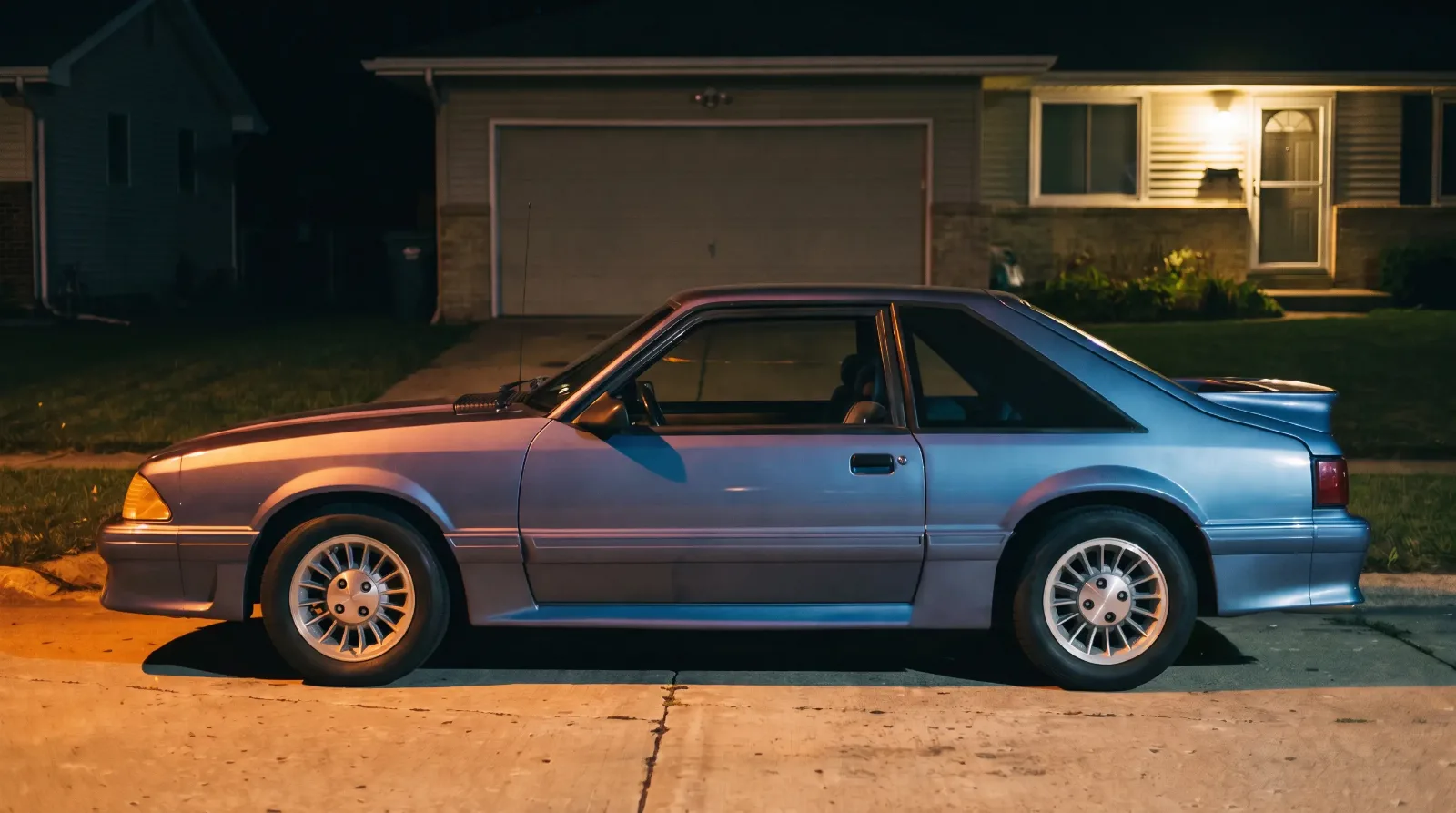
This piece stays on the one model year: the nose, the GT package and where the extra 25 hp came from. The wider run, from the 1979 launch to the last cars of 1993, is covered in our history of the Fox era.
A facelift for a car with an end date
Ford announced the 1987 Mustang in August 1986. By then the Fox had been the Mustang since 1979, and the company already had a successor in development. That car, coded ST-16, was a front-drive coupe built on Mazda hardware, and Ford had it scheduled as the 1989 Mustang. On the product plan, the 1987 update was a bridge to a very different car.
You can see that in where the money went. The nose, the tail and the dashboard are what a shopper sees and touches, and all three were new. The Fox platform underneath carried on as it was, and the engine got new cylinder heads rather than a new design. Ford spent where the showroom would notice and saved where a car with two years left would not need it. That is my reading of the parts list, not something Ford announced, but the parts list makes the case on its own.
That plan did not hold. Once the front-drive car was public, Mustang Monthly editor Donald Farr used his June 1987 editorial to urge readers to write to Ford chairman Donald Petersen, and a great many enthusiasts wrote in. Also in 1987, Alex Trotman ruled that ST-16 was not a Mustang. It went on sale as the Ford Probe, and the Probe that nearly replaced it has its own story. For this one, the result is what matters. A nose meant for two model years ended up on seven.
What the 1987 Mustang GT changed on the outside
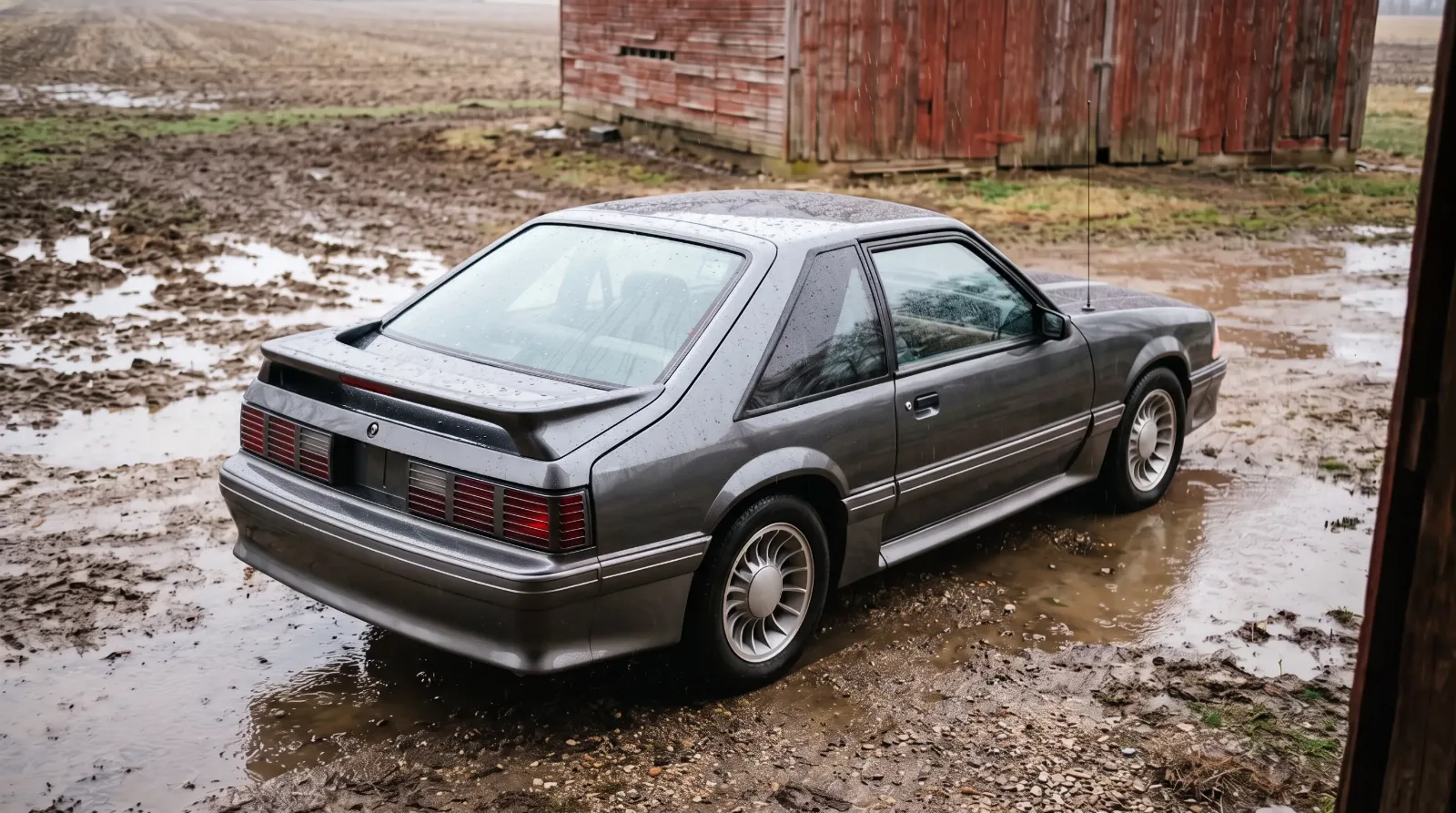
Every 1987 Mustang got the aero nose. The four rectangular sealed-beam headlamps the regular cars had worn since 1979 were gone, replaced by flush composite lamps in a smooth fascia that followed the SVO. The SVO itself, the turbocharged four-cylinder hatchback that had worn aero lamps since 1985½, finished its run with the 1986 model year. Its face outlived it.
The GT got a lot more than a new nose. Ford hung ground-effects skirts along the rockers and gave the tail louvered taillamps, the ones owners have called cheese graters for as long as anybody can remember. The wheels were 15-inch turbine-style alloys on four-lug hubs, a design the GT kept through 1990. The LX 5.0 carried the same engine in the plainer body, and from 1987 on the gap between the two cars was impossible to miss from across a parking lot.
Inside, the dash and console were new. That gets less attention than the nose, but it is the part you actually live with. Fox owners argue about headlamps while sitting behind the dashboard. The next big change in there did not come until 1990, when a driver airbag became standard and the tilt wheel went away.
The update was announced while Don Kopka was still Ford's vice president for design. Jack Telnack, whose team had drawn the original 1979 Fox, took over that job in mid-1987, so the aero cars spent nearly their whole production life under the man who designed the shape they were built on.
Where the 225 hp came from
The 1986 car had already done the hard part. That year the 5.0 got sequential multiport fuel injection, rated at 200 hp, and V8 cars got the 8.8-inch rear axle. For 1987 Ford fitted E7TE cylinder heads and the rating climbed to 225 hp at 4,200 rpm and 300 lb-ft at 3,200 rpm. The heads are what the 1987 number is credited to, and 25 hp from a head change on an otherwise familiar engine is a good year's work.
The fuel system was speed-density, and that matters more to owners than the horsepower figure does. A speed-density computer works out how much air the engine is taking in from engine speed and manifold pressure, using a fixed map. On a stock engine it works fine. Change the cam, the heads or the intake and the map no longer matches the engine, and the car runs badly until somebody sorts it out. Ford made mass-air-flow injection, which measures the air directly, standard across the line for 1989. So the 1987 and 1988 cars are the aero GTs that fight you hardest when you start changing parts, and plenty of them have been converted to mass-air since.
| Item | 1986 Mustang | 1987 Mustang |
|---|---|---|
| Headlamps (non-SVO) | Four rectangular sealed beams | Flush composite aero lamps |
| 5.0 V8 rating (net) | 200 hp | 225 hp at 4,200 rpm, 300 lb-ft at 3,200 rpm, E7TE heads |
| Fuel system | Sequential multiport injection, speed-density | Same |
| Rear axle, V8 cars | 8.8-inch | 8.8-inch |
| Dash and console | Earlier design | New |
| Model-year production | 224,410 | 159,145 (Wikipedia) or 169,772 (MustangSpecs body-style table) |
GT or LX 5.0: one engine, two cars
The 1987 base prices show how cheap the V8 had become. A coupe started at $8,271, a hatchback at $8,690 and a convertible at $13,052. The LX 5.0 package, which put the 225 hp engine in the plainer car, listed at $1,885. The GT brought the skirts, the cheese graters and the turbines, and it brought extra weight to go with them. Published figures for exactly how much extra vary, so I won't pin a number on it.
Same engine, lighter car. You do not need a dyno sheet to see where that goes. The GT was the car with the look, and the LX 5.0, the notchback coupe in particular, became the one that people who only cared about the stopwatch went looking for. Neither choice was wrong. They were different answers to the same question, and Ford was glad to sell both.
"The '87 GT is the better-looking car, and I will argue that with anybody. It is also the one with plastic skirts that hold road grime against the rockers, and four lug nuts a corner holding back 300 lb-ft. Ford spent its money where you could see it in 1987. Owners have been spending theirs where you can't ever since."
Mike Sullivan
How the 1987 car became the template
Once the Probe became a Probe, the 1987 Mustang turned into the pattern for the rest of the Fox run. The 225 hp rating stayed on the books through 1992. Mass-air-flow injection came for 1989, the airbag for 1990, and 16-inch five-spoke wheels replaced the turbines on V8 cars for 1991. For 1993 Ford rerated the 5.0 to 205 hp and 275 lb-ft. The face never changed again.
Outside Ford, the aero car went to work right away. ASC McLaren built just over 1,800 coupes and convertibles on it from 1987 to 1990, all with the stock 5.0 HO. Saleen's Mustangs took the 1987 SCCA drivers', team, manufacturer and tire championships. The car Ford meant to retire was winning titles in the same year it was supposed to be living on borrowed time.
Production tells a less flattering story. Ford built 224,410 Mustangs for 1986. For 1987 the figure is 159,145 or 169,772, depending on whether you go by Wikipedia or the MustangSpecs body-style tables, which add up to 169,772. Nobody has settled the gap. Either way, the facelift year sold fewer cars than the four-eye year before it. A new nose did not bring buyers in by itself. The 225 hp did its selling over the next six years.
A look through the 1987 Mustangs that turn up now shows both kinds of car side by side. Some are GTs kept the way Ford built them, turbines, cheese graters and speed-density intact. More have been through a mass-air conversion, two sets of wheels and a five-lug swap. Both are honest cars. Only one of them is a 1987 the way Ford meant it.
Sources and notes
- Ford Mustang (third generation), Wikipedia
- 1987 Ford Mustang: specs, prices and production, MustangSpecs
- Ford Probe, Wikipedia
- Mustang Club of America Hall of Fame (Donald Farr and the 1987 Mustang Monthly editorial)
- The Henry Ford, Automotive Industry Design Oral Histories (Ford design leadership, Kopka and Telnack)
- American Specialty Cars and the ASC McLaren Mustang, Wikipedia
Related Reading
Have a
Ford Mustang
for Sale?
Reach thousands of serious classic car collectors across the US.
Sell It Here →
Selling a classic? Here's how: compare the places to sell classic cars
Are You a Classic Car Dealer?
List your full inventory and connect with targeted classic car buyers.
Join as a Dealer →

About the author
Mike Sullivan
Detroit-area muscle car enthusiast and restoration specialist with three decades of hands-on experience working on American iron.
Related Listings - Ford Mustang
More in Car Features
Comments
Be the first to comment on this article.